
3 SGX ETFs to diversify dividend income beyond Singapore
ETFs
Powered by

By Gerald Wong, CFA • 18 Jun 2026
Why trust Beansprout? We’ve been awarded Best Investment Website at the SIAS Investors’ Choice Awards 2025
'%3e%3cpath%20fill-rule='evenodd'%20clip-rule='evenodd'%20d='M17.64%209.20455C17.64%208.56637%2017.5827%207.95273%2017.4764%207.36364H9V10.845H13.8436C13.635%2011.97%2013.0009%2012.9232%2012.0477%2013.5614V15.8195H14.9564C16.6582%2014.2527%2017.64%2011.9455%2017.64%209.20455V9.20455Z'%20fill='%234285F4'/%3e%3cpath%20fill-rule='evenodd'%20clip-rule='evenodd'%20d='M9%2018C11.43%2018%2013.4673%2017.1941%2014.9564%2015.8195L12.0477%2013.5614C11.2418%2014.1014%2010.2109%2014.4205%209%2014.4205C6.65591%2014.4205%204.67182%2012.8373%203.96409%2010.71H0.957275V13.0418C2.43818%2015.9832%205.48182%2018%209%2018V18Z'%20fill='%2334A853'/%3e%3cpath%20fill-rule='evenodd'%20clip-rule='evenodd'%20d='M3.96409%2010.71C3.78409%2010.17%203.68182%209.59318%203.68182%209C3.68182%208.40682%203.78409%207.83%203.96409%207.29V4.95818H0.957273C0.347727%206.17318%200%207.54773%200%209C0%2010.4523%200.347727%2011.8268%200.957273%2013.0418L3.96409%2010.71V10.71Z'%20fill='%23FBBC05'/%3e%3cpath%20fill-rule='evenodd'%20clip-rule='evenodd'%20d='M9%203.57955C10.3214%203.57955%2011.5077%204.03364%2012.4405%204.92545L15.0218%202.34409C13.4632%200.891818%2011.4259%200%209%200C5.48182%200%202.43818%202.01682%200.957275%204.95818L3.96409%207.29C4.67182%205.16273%206.65591%203.57955%209%203.57955V3.57955Z'%20fill='%23EA4335'/%3e%3c/g%3e%3cdefs%3e%3cclipPath%20id='clip0_0_2849'%3e%3crect%20width='18'%20height='18'%20fill='white'/%3e%3c/clipPath%3e%3c/defs%3e%3c/svg%3e)
Make Beansprout your preferred source on Google
Add us on Google to see more of our insights in your search results
I look at 3 SGX dividend ETFs that help to diversify income across ASEAN, Asia Pacific financials and China dividend stocks.

This post was created in partnership with SGX. All views and opinions expressed in this article are Beansprout's objective and professional opinions.
What happened?
Singapore dividend stocks have performed strongly.
The STI has reached new highs in recent months, supported by gains in Singapore blue chips.
For investors who already own Singapore banks, REITs and blue-chip stocks, this has helped portfolio returns.
At the same time, stronger share prices can also moderate dividend yields if dividends do not rise at the same pace.
Investors who already own Singapore dividend stocks in their investment portfolio may be looking at ways to further diversify their income stream.
In this article, I look at three SGX-listed dividend ETFs that provide exposure to ASEAN dividend stocks, Asia Pacific financials and China dividend companies.
Why consider diversifying dividend income beyond Singapore?
#1 - Dividend yields in Singapore have moderated after the STI rally
Singapore equities offer higher and more attractive dividend yields compared with the major developed markets such as the United States.
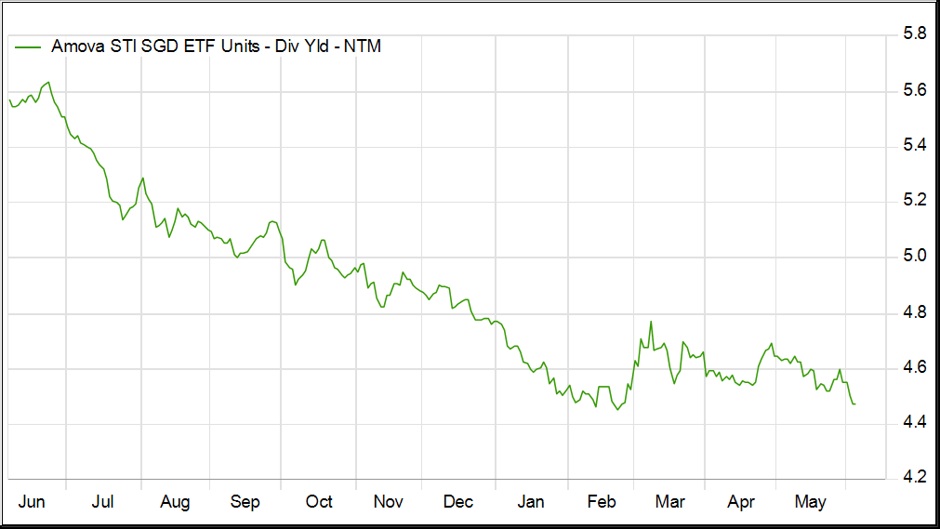
However, the strong rally in the STI has also moderated forward dividend yields.
Based on the chart below, the Amova STI ETF’s forward dividend yield stood at around 4.5% as of 4 June 2026.
This remains a meaningful yield for income investors. However, it is also lower than what investors may have seen when Singapore share prices were weaker.
#2 - Asia remains home to many dividend-paying companies
The dividend opportunity in Asia is not limited to Singapore.
Across ASEAN, China and Asia Pacific, there are established companies in sectors such as banks, insurance, energy, utilities, telecommunications and consumer staples.
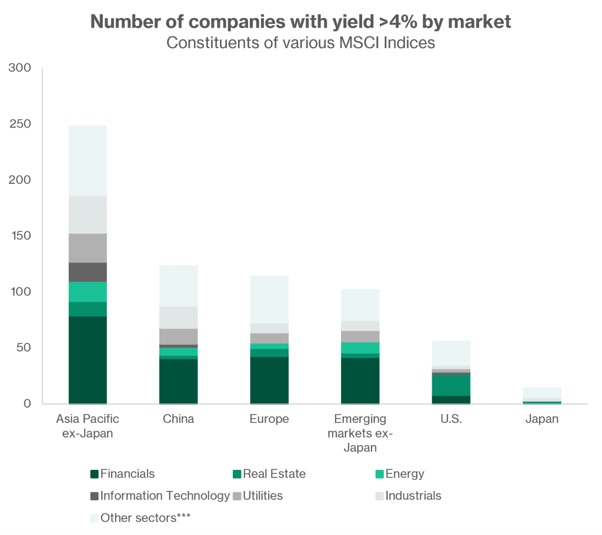
Some of these companies are tied to domestic consumption, infrastructure development, financial deepening and regional growth.
For Singapore investors, the challenge is that researching and buying individual stocks across several regional markets can be difficult.
SGX-listed dividend ETFs help to simplify this access by allowing investors to gain exposure to a basket of companies through a single ETF listed on SGX.
#3 - Dividend ETFs offers a different way to gain regional exposure
When investors think about overseas investing, the conversation often centres on US technology stocks, China internet companies, semiconductor leaders or global AI beneficiaries.
These themes may offer long-term growth, but they can also be more sensitive to valuations, market sentiment and earnings expectations. Dividend ETFs offer a different route.
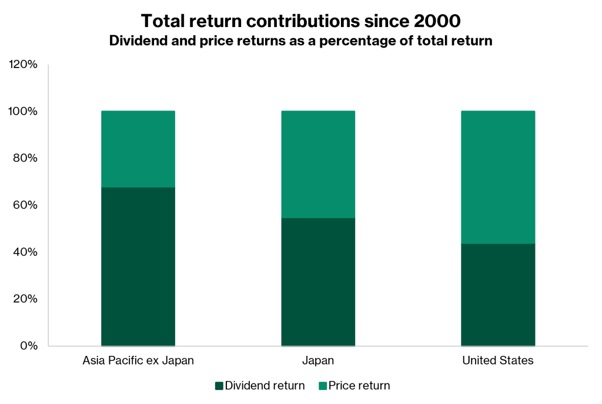
In several markets, dividends have historically contributed a meaningful share of long-term total returns.
This has been particularly evident in Asia Pacific ex-Japan and Japan, where dividend income has often played a larger role in overall equity returns compared with some other regions.
As the chart below shows, dividends accounted for about 69% of total returns in Asia Pacific ex-Japan since 2000, compared with 45% in the US.
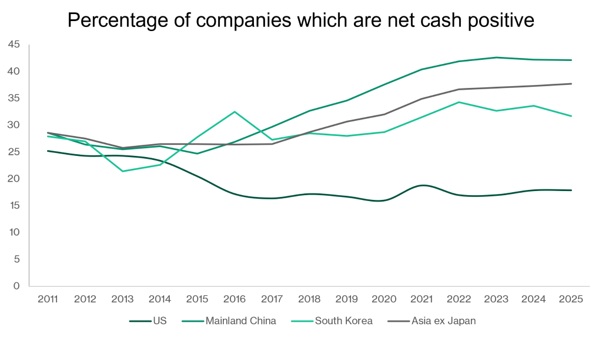
Dividend growth in Asia may also have room to improve, supported by stronger free cash flows among companies in the region.
For Singapore investors, the key point is diversification.
Rather than relying only on Singapore dividend stocks, investors can look at dividend opportunities across ASEAN, Asia Pacific financials and China dividend companies.
SGX-listed dividend ETFs provide one way to access these broader regional income opportunities without having to pick individual overseas stocks.
3 SGX ETFs to gain dividend income exposure beyond Singapore
#1 - UOBAM Ping An FTSE ASEAN Dividend Index ETF (SGX: UPD/UPU)
If I want dividend exposure across Southeast Asia, the UOBAM Ping An FTSE ASEAN Dividend Index ETF would be one of the most direct options on SGX.
The ETF seeks to replicate the performance of the FTSE ASEAN ex REITs Target Dividend Index.
This gives investors exposure to dividend-paying companies across ASEAN markets through a single SGX-listed ETF.
The ETF was listed on 29 January 2026 and has a management fee of 0.45% per annum.
It is traded on SGX under UPD for the SGD counter and UPU for the USD counter.
For the UOBAM Ping An FTSE ASEAN Dividend Index ETF, distributions are made semi-annually.
Its distribution policy aims to pay at least 6.0% per annum in 2026 and 2027, although distributions are not guaranteed and may be made out of income, capital gains and/or capital.
The portfolio includes companies from Singapore, Indonesia, Malaysia, Thailand and the Philippines.
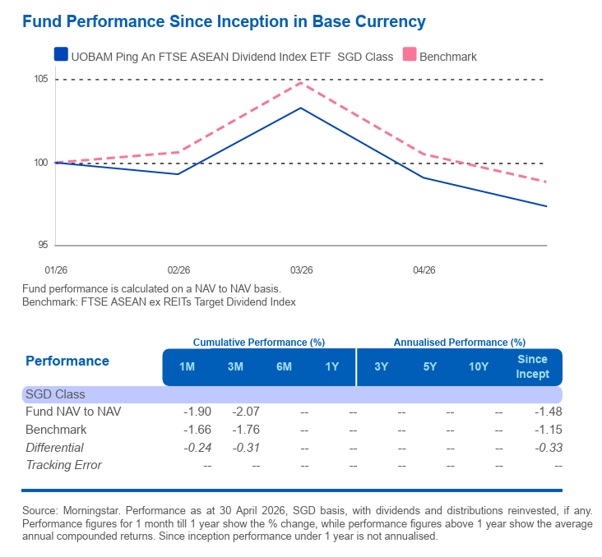
Despite recent volatility in global markets and the sell-off in Indonesia, UPD’s broad-based diversification has helped limit its drawdown, with the ETF returning -1.48% since inception.
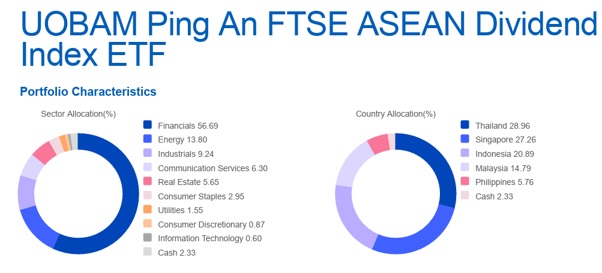
Some of the names highlighted by UOBAM include Singapore banks, Malaysia’s Maybank, Indonesia’s Astra International and Thailand’s PTT.
This means investors are not only getting exposure to Singapore dividend stocks, but also to regional banks, energy companies and other established ASEAN businesses.
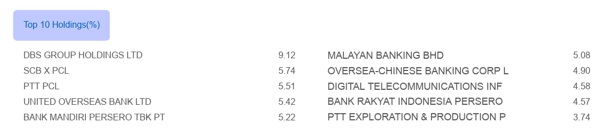
Investors may also want to consider how the ETF fits within their overall portfolio. While it provides exposure across ASEAN markets, it may still include meaningful exposure to financials, including Singapore banks. For investors who already own DBS, OCBC or UOB directly, it may be useful to review whether the ETF increases exposure to these stocks.
Currency exposure is another factor to keep in mind. Although the ETF is traded in SGD, its underlying holdings may generate revenues and pay dividends in different ASEAN currencies, which may influence returns for Singapore investors.
Learn more about the UOBAM Ping An FTSE ASEAN Dividend Index ETF here.
#2 - Lion-OCBC Securities APAC Financials Dividend Plus ETF (SGX: YLD/YLU)
If I want to diversify beyond Singapore banks while staying within the financial sector, the Lion-OCBC Securities APAC Financials Dividend Plus ETF would be worth a closer look.
The ETF seeks to replicate the performance of the iEdge APAC Financials Dividend Plus Index.
The index aims to track 30 of the largest and most tradable companies listed in Asia Pacific, with a focus on financial companies that have stable dividend payout attributes and growth potential.
This means the ETF is more sector-specific. Instead of giving broad exposure across different industries, it focuses on financial institutions such as banks, insurers, investment services companies and specialty finance companies.
The ETF was listed on 13 May 2024. It is listed under YLD for the SGD counter and YLU for the USD counter.
It has a current management fee of 0.50% per annum, with a maximum management fee of 0.99% per annum. It has a total expense ratio of 1.08%.
Its recent performance has also been supported by the strong run in regional financial stocks.
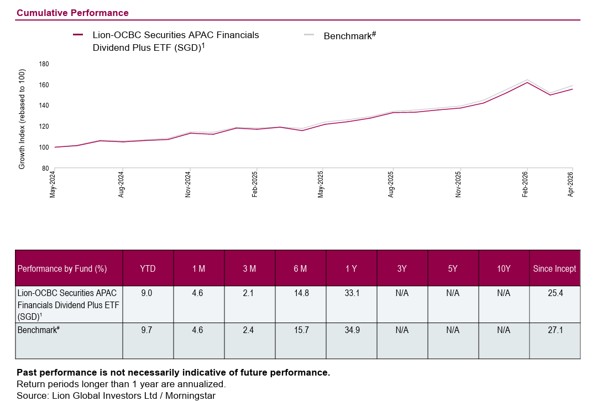
As of 30 April 2026, the fund had returned 9.0% year to date, 14.8% over six months, 33.1% over one year on a NAV-to-NAV basis in SGD, assuming dividends are reinvested net of charges.
For the Lion-OCBC Securities APAC Financials Dividend Plus ETF, distributions are made quarterly, every March, June, September and December.
According to SGX Screener, its historical dividend yield over the 12-month period was 5.80% as of the ex-dividend date, based on data as of 15 June 2026.
This may appeal to investors who like the income profile of financial stocks, but do not want their exposure to be limited to Singapore banks.
For example, a Singapore investor who already owns DBS, OCBC or UOB may use this ETF to gain exposure to financial institutions in other Asia Pacific markets.
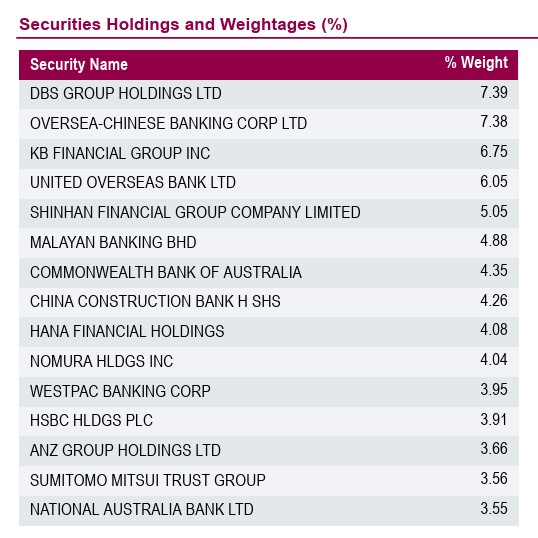
Among the index’s top 10 constituents are large financial institutions across key Asia Pacific financial hubs, including Commonwealth Bank of Australia, Westpac Banking Corporation and ANZ Group Holdings in Australia, as well as Nomura Holdings and Sumitomo Mitsui Trust Group in Japan.
As the ETF is focused on the financial sector, investors may want to consider how it fits within their overall portfolio. Its performance can be influenced by factors such as interest rate cycles, credit conditions, financial regulation and market sentiment toward banks and insurers.
For investors who already have broad dividend exposure, this ETF may serve as a complementary income holding rather than the sole dividend ETF in a portfolio.
#3 - Lion-China Merchants CSI Dividend Index ETF (SGX: INC/ICH)
If I want China exposure through a dividend lens, the Lion-China Merchants CSI Dividend Index ETF is the most targeted option among the three.
The ETF tracks the CSI Dividend Index by investing in units of the China Merchants CSI Dividend ETF.
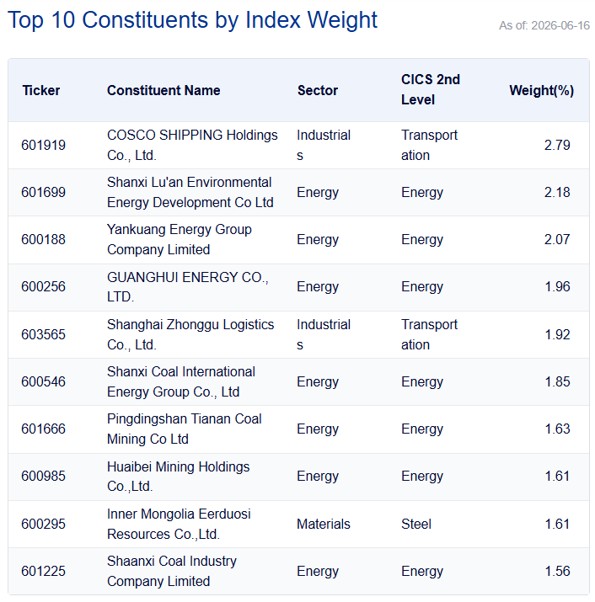
The index comprises 100 Shanghai-listed, Shenzhen-listed or Beijing-listed A shares with high cash dividend yields, stable dividends, scale and liquidity.
This makes the ETF different from many China ETFs that are more focused on internet, technology or broad market exposure. Instead, it focuses on dividend-paying A-share companies.
The CSI Dividend Index is tilted towards more traditional dividend-paying sectors, including energy, financials, industrials and materials.
These sectors may offer higher dividend yields compared with growth sectors such as technology, although they can also be more cyclical and sensitive to commodity prices, interest rates and economic conditions.
The index is rebalanced annually in December.
The ETF was listed on 28 March 2025 and trades on SGX under INC for the SGD counter and ICH for the CNH counter.
It has a current management fee of 0.50% per annum, with a maximum management fee of 0.99% per annum. It has a total expense ratio of 1.32%.
For the Lion-China Merchants CSI Dividend Index ETF, distributions are made annually.
According to SGX Screener, its historical dividend yield over the 12-month period was 3.89% as of the ex-dividend date, based on data as of 15 June 2026.
Its early performance has also been reasonably steady.
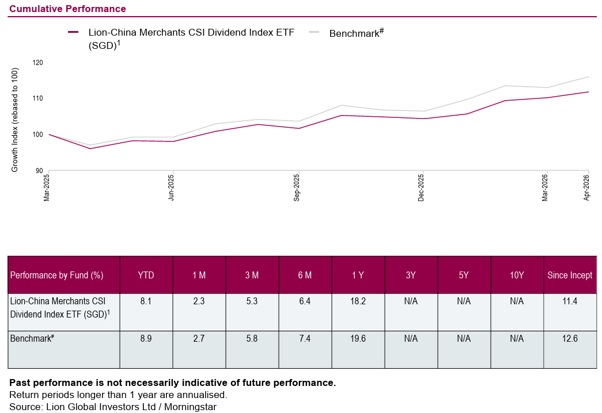
As of 30 April 2026, the fund had returned 8.1% year to date, 6.4% over six months, and 11.4% since inception on a NAV-to-NAV basis in SGD, assuming dividends are reinvested net of charges.
This ETF may appeal to investors who want China exposure through established dividend-paying companies rather than higher-growth technology names.
Investors may want to consider how the ETF fits within their overall portfolio, as China equities can experience periods of volatility. Investor sentiment may also be influenced by policy developments, economic data, property market conditions, currency movements and geopolitical events.
At the same time, the ETF can provide exposure to China dividend stocks, which may offer diversification benefits and help reduce reliance on a Singapore-focused income portfolio.
It may be better used as a complementary holding rather than the only equity exposure for dividend income, especially for investors who prefer more regular distributions.
How do these 3 SGX dividend ETFs compare?
While all three ETFs focus on dividend-paying companies, they are not interchangeable.
The UOBAM Ping An FTSE ASEAN Dividend Index ETF provides regional ASEAN dividend exposure and is likely to be the broadest regional option among the three.
The Lion-OCBC Securities APAC Financials Dividend Plus ETF is more sector-specific, as it focuses on Asia Pacific financial companies.
The Lion-China Merchants CSI Dividend Index ETF is more country-specific, giving investors exposure to dividend-paying China A-share companies.
| ETF | UOBAM Ping An FTSE ASEAN Dividend Index ETF | Lion-OCBC Securities APAC Financials Dividend Plus ETF | Lion-China Merchants CSI Dividend Index ETF |
| SGX tickers | UPD / UPU | YLD / YLU | INC / ICH |
| Main exposure | ASEAN dividend stocks | APAC financial stocks | China A-share dividend stocks |
| Current management fee | 0.45% p.a. | 0.50% p.a. | 0.50% p.a. current, maximum 0.99% p.a. |
| Distribution frequency | Semi-annually | Quarterly | Annually |
| Distribution policy / Yield (%)* | Aims for at least 6.0% per annum* p.a. in 2026 and 2027 | 5.80%* | 3.89%* |
| Portfolio role | Regional dividend diversification | Broader financial-sector income exposure | China companies with strong cash flows |
| Source: Respective fund factsheets and fund manager websites. Figures are based on the latest available factsheets and product pages as at June 2026. *Taken from SGX Screener as of 15 June 2026. Historical Dividend Yield over 12-month period (%) as of ex-dividend date | |||
What are the factors to consider before investing in these 3 SGX dividend ETFs
1. Distributions are not guaranteed
The headline yield or target distribution should not be treated like a fixed deposit rate.
ETF distributions may change over time.
They may also be made out of income, capital gains and/or capital, depending on the ETF’s distribution policy.
This matters because distributions made out of capital may reduce the ETF’s net asset value.
2. Higher yield does not always mean better returns
A higher dividend yield can look attractive, but it may also reflect higher risk.
For example, a company or market may trade at a higher yield because investors are concerned about earnings growth, currency weakness, policy risks or dividend sustainability.
Total return matters too.
3. There may be overlap with Singapore banks
Some regional dividend ETFs may still hold Singapore banks.
This is not necessarily a problem, especially if the banks remain strong dividend payers.
However, investors who already own DBS, OCBC or UOB directly should check whether buying a regional dividend ETF increases their exposure to the same stocks.
4. Concentration risk within the ETF
Some dividend ETFs may have significant exposure to a small number of sectors or countries, even if they appear diversified by name.
For example, a regional dividend ETF may still be heavily weighted towards financial stocks, while an APAC financials ETF is clearly a sector-specific exposure.
5. Currency risk remains
Even when an ETF trades in SGD, its underlying holdings may be exposed to foreign currencies.
ASEAN dividend stocks may be affected by currencies such as the Indonesian rupiah, Malaysian ringgit, Thai baht or Philippine peso.
China dividend stocks may be affected by the renminbi or CNH.
Currency movements can affect the final returns for Singapore investors.
6. Withholding tax on foreign dividends may reduce the effective yield
Singapore investors receiving dividends from overseas holdings within an ETF may be subject to withholding taxes in the source country.
This tax is typically deducted before distributions reach the investor and may not be fully recoverable.
As a result, the effective yield received by investors may be lower than the gross dividend yield of the underlying portfolio.
What would Beansprout do?
In my view, these dividend ETFs may be useful for investors who want to build a broader portfolio beyond Singapore banks, REITs and blue-chip stocks.
Rather than trying to pick individual dividend stocks across unfamiliar markets, the 3 SGX-listed dividend ETFs provide a simpler way to gain regional exposure without having to pick individual overseas stocks.
If I wanted broad regional dividend exposure, I would start by looking at the UOBAM Ping An FTSE ASEAN Dividend Index ETF (SGX: UPD for SGD; UPU for USD). It provides exposure to dividend-paying companies across Southeast Asia, although I would watch for financial-sector concentration and overlap with Singapore banks. Learn more about the UOBAM Ping An FTSE ASEAN Dividend Index ETF here.
If I already like the income profile of banks and insurers but do not want to rely only on DBS, OCBC and UOB, the Lion-OCBC Securities APAC Financials Dividend Plus ETF (SGX: YLD for SGD; YLD for USD) may be worth comparing. It offers exposure to financial companies across Asia Pacific and provides quarterly distributions, although investors should be comfortable with its sector concentration.
If I wanted China exposure through a more income-focused lens, the Lion-China Merchants CSI Dividend Index ETF (SGX: INC for SGD; ICH for CNH) would be the more targeted option. However, I would size it more carefully because China equities can be volatile and policy-sensitive.
Overall, I would view these ETFs as complementary building blocks that can broaden income exposure, rather than as replacements for a diversified core portfolio.
Instead, they can complement Singapore blue chips, STI ETF, REITs ETFs, bond ETFs and broad global ETFs, depending on how much regional dividend exposure I want.
The key is not simply to chase the highest yield. It is to build a more resilient stream of income across different markets, sectors and asset classes.
Would you consider adding dividend ETFs beyond Singapore to your portfolio? Share your thoughts with us in the comments below or in our Telegram group.
You can find out more about these and other SGX-listed ETFs on the SGX ETF screener page.
If you are considering where to buy them, you may also want to check out our review of the best stock trading platforms in Singapore and the latest broker promotions below.
Are there any ongoing broker promotions when I invest in SGX ETFs?
Several brokers and platforms offer promotions to incentivize ETF investments:
| Broker | Promotion Description |
| iFast FSMOne |
|
| Phillip Securities |
|
| *Terms and conditions of participating brokers apply. Please refer to their website for more details. | |
Enjoyed this insight? Follow Beansprout on Telegram, Youtube, Facebook and Instagram, and add Beansprout as your preferred source on Google so you never miss an update.
Disclaimer
This advertisement has not been reviewed by the Monetary Authority of Singapore.
Any information provided in this article is meant purely for informational and investor education purposes and should not be relied upon as financial or investment advice, or advice on corporate finance.
This article is not and does not constitute or form part of any offer, recommendation, invitation or solicitation to purchase any financial product or subscribe or enter any transaction. This article also does not take into account your personal circumstances, e.g. investment objectives, financial situation or particular needs and shall not constitute financial advice. You should consult your own independent financial, accounting, tax, legal or other competent professional advisors.
The information provided in this article are on an “as is” and “as available” basis without warranty of any kind, whether express or implied. Beansprout does not recommend any particular course of action in relation to any investment product or class of investment products. No information is presented with the intention to induce any person to buy, sell, or hold a particular investment product or class of investment products.
Read also
Gain financial insights in minutes
Subscribe to our free weekly newsletter for more insights to grow your wealth
Most Popular

Comments
0 comments