
Silver pulls back. Is there an opportunity to trade?
Trading
Powered by

By Nicole Ng • 27 Mar 2026
Why trust Beansprout? We’ve been awarded Best Investment Website at the SIAS Investors’ Choice Awards 2025
Silver prices have seen huge swings recently. Discover what’s driving silver and how to trade silver opportunities in the market.

What happened?
Silver prices have seen dramatic swings over the past year.
After starting 2025 at around US$29 to 30 per ounce, silver surged strongly through the year, breaking multiple long-term resistance levels.
Prices eventually crossed the US$100 mark for the first time in history, before reaching an all-time high of about US$121 in January 2026.
Shortly after the peak, silver experienced one of its sharpest single-day declines in decades, triggered by a mix of policy developments, margin requirement changes, and profit-taking by traders.
As of early March 2026, silver has settled around US$89 to 90 per ounce, still far higher than levels seen a year ago, but roughly 26% below its recent peak.
Unlike gold, which is primarily viewed as a store of value, silver plays a dual role as both an industrial commodity and a precious metal.
As a result, its price reacts to a wide range of factors, including economic growth, technological demand, interest rates, and geopolitical developments.
For traders who want to position around these price swings, futures contracts offer a way to gain exposure to the silver market.
💡 Want to trade silver futures yourself?
Several brokers available to Singapore investors provide access to CME silver futures, including Moomoo, Tiger Brokers, Webull, Phillip Nova, and Saxo Markets.
What drives silver prices?
Understanding what drives silver prices can help explain why the metal tends to experience larger swings than gold.
#1 – Industrial demand from technology and clean energy
Silver is widely used in modern technologies because it is one of the best electrical conductors.
It is used across many industries, including:
- Electronics and semiconductors
- Solar panels
- Electric vehicles
- 5G infrastructure
- Data centres and advanced computing
Today, industrial applications account for about 60% of global silver demand according to J.P Morgan, highlighting the metal’s importance in manufacturing and technology.
For example, solar panels require silver in conductive paste, while electric vehicles use silver in battery management systems, sensors, and charging infrastructure.
As these industries continue to expand, demand for silver may increase as well.
#2 – Safe-haven demand, similar to gold
At the same time, silver also behaves like a precious metal.
Investors often buy silver during periods of:
- Inflation
- Currency weakness
- Geopolitical uncertainty
Historically, silver has tended to move in the same direction as gold, but with larger price swings.
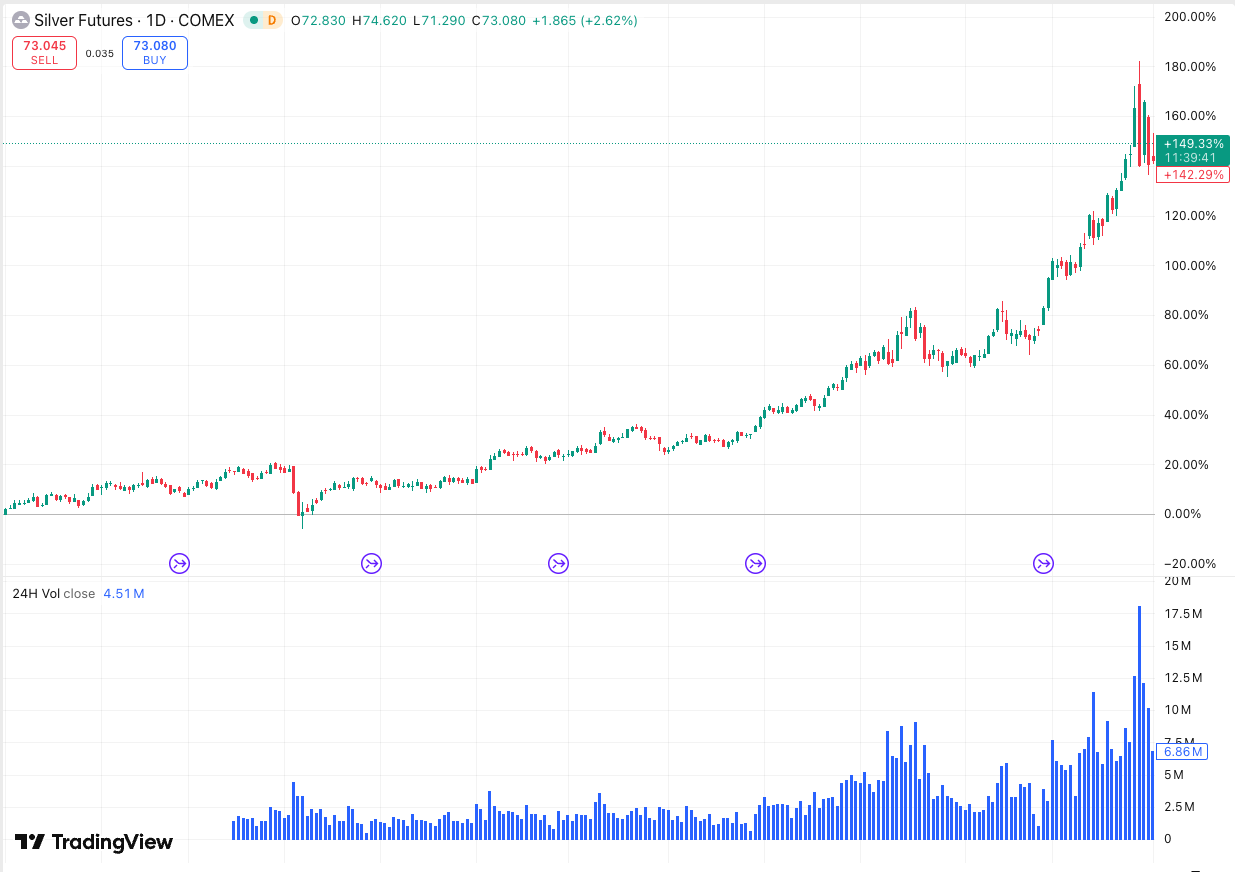
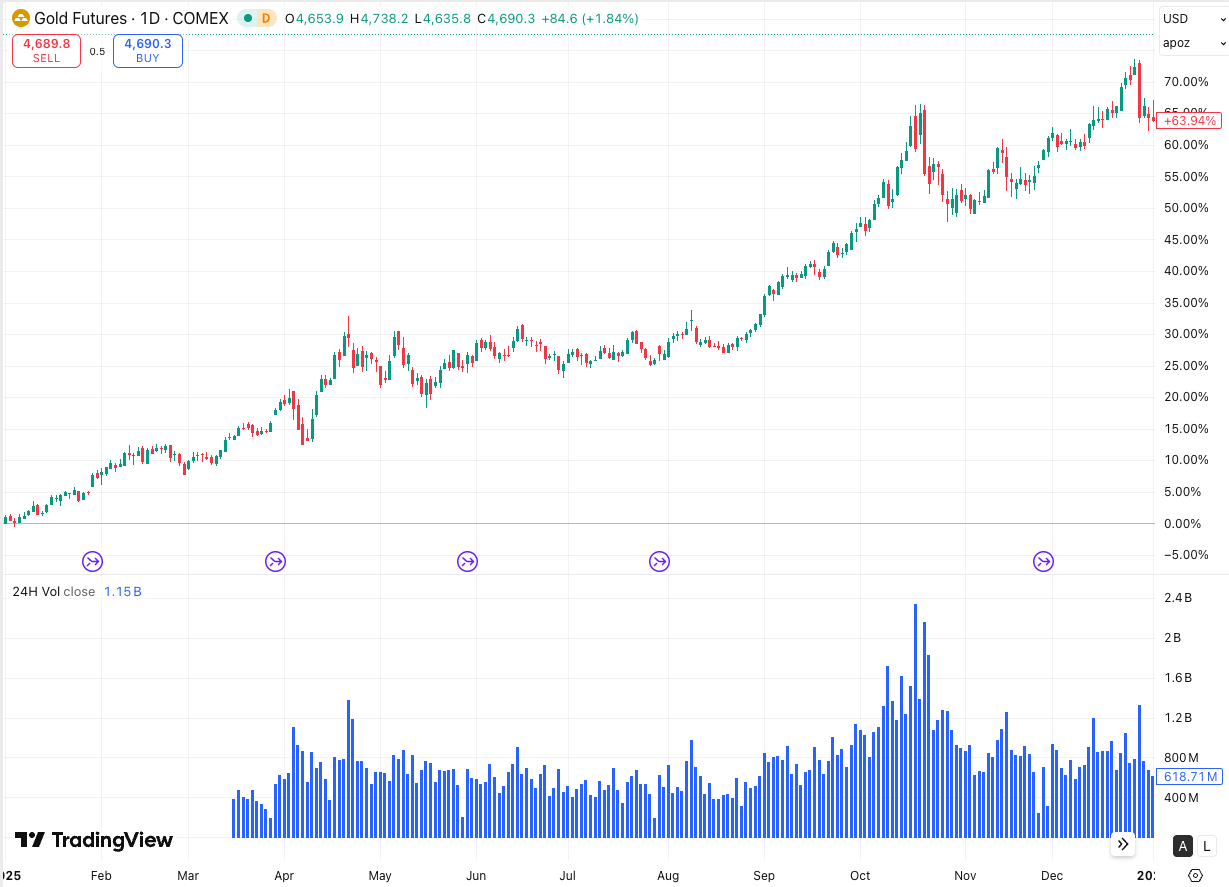
For example, silver surged about 142% in 1 year, around US$71 per ounce on 2 January 2026, significantly outperforming gold, which gained about 63% over the same period.
This combination of industrial demand and investment demand is one reason why silver prices can rise rapidly during commodity cycles.
#3 – Supply dynamics in the silver market
Supply conditions also play an important role in silver prices.
Unlike gold, most silver is not mined directly.
Instead, roughly 70–72% of silver production comes as a by-product of mining other metals such as copper, lead, zinc, and gold.
This makes supply relatively inflexible.
Even if silver prices rise sharply, mining companies cannot easily increase silver production because output depends on the production of other metals.
At the same time, global silver supply has struggled to keep pace with demand.
The market has experienced five consecutive years of supply deficits, meaning that global demand has exceeded mine production.
This structural imbalance has been one of the key factors supporting silver prices in recent years.
Futures contracts that can be used to trade silver
CME Group offers several silver futures contracts with different sizes.
The newest addition is the 100-ounce silver futures contract, launched in February 2026 to make silver futures more accessible to retail traders.
| Contract | Contract size | Approx notional value* | Approx Maintenance Margin |
| Standard Silver Futures | 5,000 oz | ~US$365,000 | ~US$49,000 |
| E-mini Silver Futures | 2,500 oz | ~US$182,500 | ~US$25,000 |
| Micro Silver Futures | 1,000 oz | ~US$73,000 | ~US$10,000 |
| 100-oz Silver Futures | 100 oz | ~US$7,300 | ~US$1,000 |
| *Based on silver price $73 per ounce - Silver price changes daily. Source: CME Group, as of 20 March 2026 | |||
The smaller contract size allows traders to take positions in silver futures with a lower capital requirement, making position sizing easier.
Futures strategies using silver
Because silver prices are influenced by many factors, traders sometimes use futures contracts to express different views on the market.
Here are three commonly used approaches.
#1 – Trading momentum around macro events
Silver prices often react to macroeconomic developments.
Events that often influence silver prices include Federal Reserve interest rate decisions, inflation data, employment data, trade policies, and geopolitical developments.
Example: Trading a macro-driven breakout
To see how this strategy works in practice, let's walk through an example using the Micro Silver Futures contract (SIL), where each US$1/oz move in silver = US$1,000.
Setup — Trading a macro-driven breakout
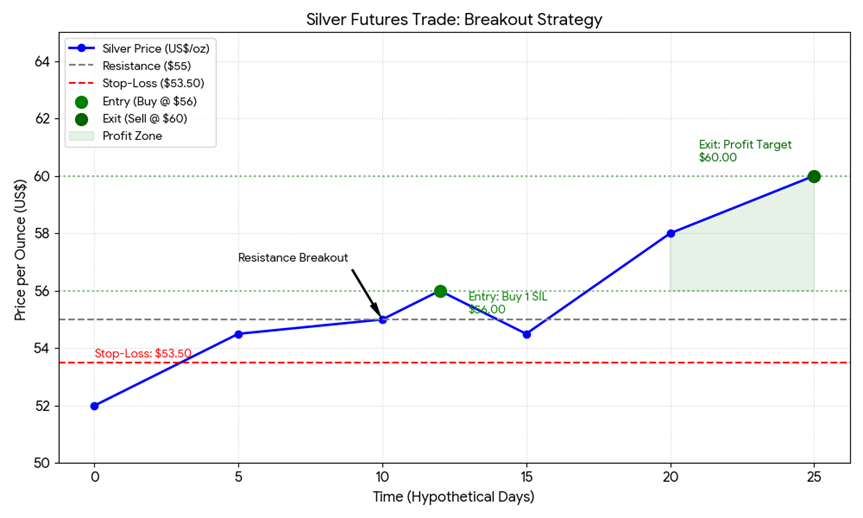
Say that silver has been trading in a sideways range between US$50 and US$55 per ounce for several weeks.
At the same time, the CME FedWatch Tool shows a higher probability of the Fed cutting rates in the coming months due to weaker economic data.
When interest rates fall, precious metals sometimes benefit because the opportunity cost of holding non-yielding assets like silver decreases.
Because of this relationship, traders sometimes look for opportunities when market expectations around monetary policy shift.
Signal — Silver breaks above resistance
As investors begin to buy silver, the price of silver may break above the US$55 resistance.
When a price breaks above resistance, traders sometimes interpret it as a signal that strong buying momentum may continue.
Trade — Buy 1 Micro Silver Futures (SIL) contract
The trader buys 1 Micro Silver Futures (SIL) contract at US$56 per ounce. Here is what the position looks like:
| Trade details | |
| Entry price | US$56 per oz |
| Contract size | 1,000 oz |
| Total value controlled | US$56,000 |
| Margin required (approx.) | US$5,600 |
Even though the contract represents US$56,000 worth of silver, the trader only needs to deposit around 10% of that value as margin to open the position.
This is what creates leverage in futures trading.
Because prices can move in either direction, traders often set a stop-loss order.
In this example, the trader places a stop-loss at US$53.50.
This means that if silver falls to that price, the position will automatically close to limit losses.
Suppose silver continues rising and eventually reaches US$60 per ounce.
The trader decides to close the position.
| Trade result | |
| Exit price | US$60 |
| Profit per ounce | US$4 |
| Profit on 1 SIL contract | US$4,000 |
The profit comes from:
US$4 × 1,000 ounces = US$4,000
Even though silver only rose about 7%, the trader earned a US$4,000 profit because each price movement is magnified by the contract size.
🔎 Want to try trading silver futures yourself?
Platforms like Tiger Brokers, Moomoo and Webull allow Singapore investors to access CME futures markets directly from their trading apps.
#2 – Trading supply and demand developments
Another approach is to trade silver based on underlying supply-demand trends.
Because silver is heavily used in industrial applications, changes in technology demand can influence prices.
For example:
- Growth in solar energy installations
- Expansion in EV production
- Increased demand for semiconductors or AI infrastructure
If news or industry data suggests stronger demand for silver, traders may position for potential price increases.
Example: Buying a pullback in an uptrend
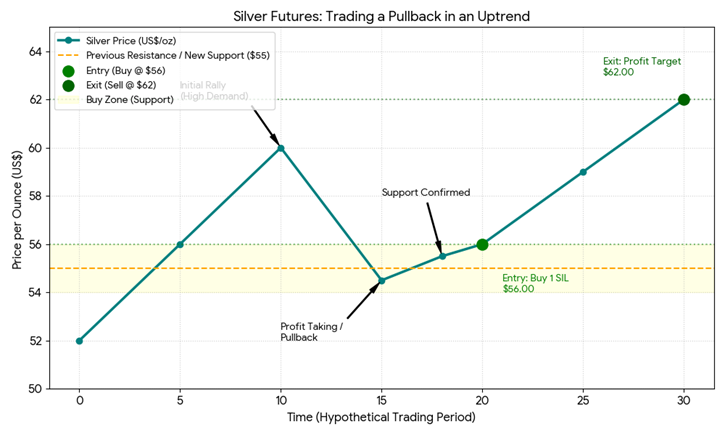
Consider a scenario where silver has been in a strong uptrend and recently reached US$60 per ounce.
After this rally, profit-taking pushes prices lower and silver pulls back to US$54–55, a level that previously acted as resistance.
Traders sometimes view such pullbacks as potential opportunities to enter a trend at a better price.
Setup — Uptrend remains intact
The broader market trend remains upward, but silver has temporarily pulled back.
Signal — Price stabilises at support
Silver begins to stabilise around US$55, suggesting buyers are stepping in.
Trade — Buy 1 SIL contract at US$56
| Trade details | |
| Entry price | US$56.00 |
| Contract size | 1,000 oz |
| Notional value | US$56,000 |
| Estimated margin | ~US$5,600 |
If the uptrend resumes and silver returns to US$62, the trader may exit.
| Trade result | |
| Exit price | US$62 |
| Profit per oz | US$6 |
| Profit on 1 SIL | US$6,000 |
This strategy is less about timing a macro event and more about patience — waiting for silver to pull back to a support level within an uptrend, rather than chasing a rally that has already run.
#3 – Trading the gold-to-silver ratio
A different approach focuses on the relationship between gold and silver prices.
This ratio measures how many ounces of silver are required to buy one ounce of gold.
Historically:
- A high ratio suggests silver may be undervalued relative to gold
- A low ratio suggests silver may be relatively expensive compared to gold
In April 2025, the ratio exceeded 100:1, one of the highest levels in modern history. It later compressed sharply as silver outperformed gold.
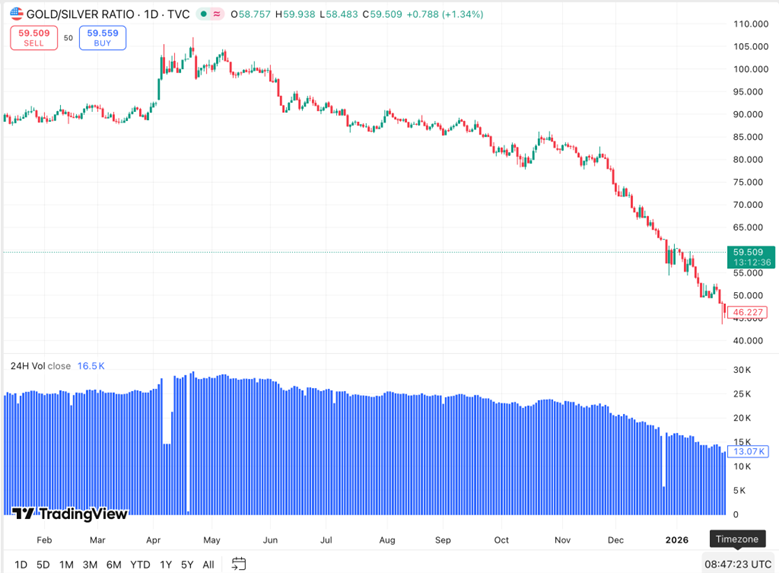
As of early March 2026, the ratio is around 55–62, closer to its historical average.
Example: Trading ratio compression
The gold-to-silver ratio trade is a relative-value strategy where the trader takes a position that silver will outperform gold over the trade's duration.
This makes it useful even in uncertain markets, because even if both metals fall, the trade can still profit if silver falls less than gold.
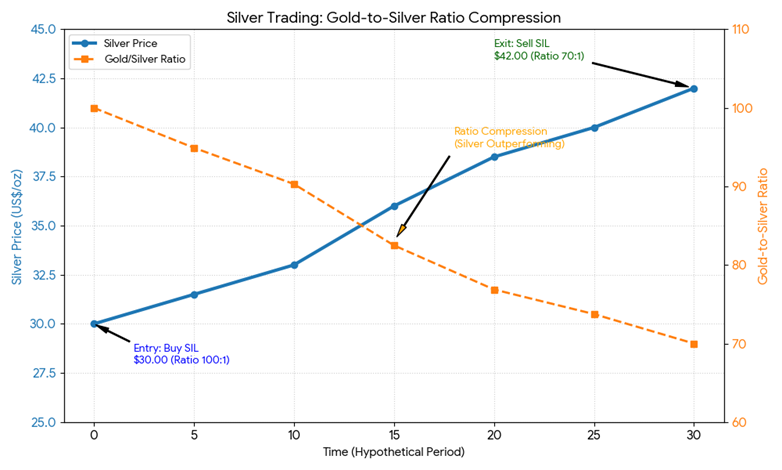
Imagine a scenario where:
| Metal | Price |
| Gold | US$3,000/oz |
| Silver | US$30/oz |
This implies a gold-to-silver ratio of 100:1.
If the ratio later falls toward 70:1, it suggests silver has outperformed gold.
Trade — Buy Micro Silver Futures
A trader expecting the ratio to fall may take a directional position in silver.
| Trade details | |
| Entry price | US$30/oz |
| Contract | 1 SIL |
| Notional value | US$30,000 |
| Estimated margin | ~US$3,000 |
If silver rises to US$42, the trade generates:
| Trade result | |
| Exit price | US$42 |
| Profit per oz | US$12 |
| Profit on 1 SIL | US$12,000 |
This type of trade focuses less on predicting silver prices outright and more on changes in the relative pricing between metals.
More advanced traders sometimes implement this strategy as a spread trade, going long silver futures while shorting gold futures to isolate movements in the ratio itself.
Risk considerations when trading silver futures
While silver can offer trading opportunities, historically, silver has experienced significantly more volatility than gold.
For traders using futures, risk management is essential.
#1 – Position sizing
Futures contracts provide leveraged exposure.
Even though the margin requirement may appear small, traders are exposed to the full notional value of the contract.
#2 – Stop-loss orders
Stop-loss orders can help limit downside risk if prices move against a position.
#3 – Margin awareness
Margin requirements may increase during periods of high volatility, so traders should ensure they have sufficient capital to maintain their positions.
What would Beansprout do?
Silver’s recent price swings show how quickly opportunities and risks can emerge in commodities markets.
The metal’s unique combination of industrial demand and safe-haven appeal means it can react to many different economic developments.
For investors looking to trade silver more actively, futures contracts offer a way to gain exposure to these price movements, including the ability to take both long and short positions.
If you’re newer to the space, you can first read more about how futures work and how investors use them
However, silver’s volatility means that risk management and position sizing remain critical.
Traders may want to understand how futures can be used for hedging, especially when markets become more unpredictable.
For those comparing opportunities across asset classes, it may also be helpful to explore how investors use US index futures to trade broad market views, or how gold futures are traded given the close relationship between gold and silver prices.
More advanced traders who are thinking beyond outright directional trades may also want to learn how futures options can be used to protect profits or manage downside risk.
If you are interested in learning more about futures trading, you may wish to explore the educational resources and trading simulator provided by CME Group.
In Singapore, several brokers provide access to CME futures markets, including:
- Moomoo
- Tiger Brokers
- Webull
- Phillip Nova
- Saxo Markets
- KGI Singapore
- DA Financial Service
- Nanhua Futures
Are there any promotions for brokerage accounts providing access to futures?
If you’re interested in trading silver futures, you’ll need a brokerage account that provides access to CME futures markets.
Here are several platforms available to investors in Singapore currently offering promotions:
Tiger Brokers Exclusive Promotion
Learn more about the Tiger Brokers promotion here.
Moomoo Exclusive Promotion
Learn more about the Moomoo promotion here.
Webull Exclusive Promotion
Learn more about the Webull promotion here.
Disclaimer
Any information provided in this article is meant purely for informational and investor education purposes and should not be relied upon as financial or investment advice, or advice on corporate finance.
This article is not and does not constitute or form part of any offer, recommendation, invitation or solicitation to purchase any financial product or subscribe or enter any transaction. This article also does not take into account your personal circumstances, e.g. investment objectives, financial situation or particular needs and shall not constitute financial advice. You should consult your own independent financial, accounting, tax, legal or other competent professional advisors.
The information provided in this article are on an “as is” and “as available” basis without warranty of any kind, whether express or implied. Beansprout does not recommend any particular course of action in relation to any investment product or class of investment products. No information is presented with the intention to induce any person to buy, sell, or hold a particular investment product or class of investment products.
This advertisement has not been reviewed by the Monetary Authority of Singapore.
Read also
Gain financial insights in minutes
Subscribe to our free weekly newsletter for more insights to grow your wealth
Most Popular

Comments
0 comments