
Singapore EQDP funds compared: How to choose one for your portfolio
Mutual Funds
By Gerald Wong, CFA • 29 Sep 2026
Why trust Beansprout? We’ve been awarded Best Investment Website at the SIAS Investors’ Choice Awards 2025
'%3e%3cpath%20fill-rule='evenodd'%20clip-rule='evenodd'%20d='M17.64%209.20455C17.64%208.56637%2017.5827%207.95273%2017.4764%207.36364H9V10.845H13.8436C13.635%2011.97%2013.0009%2012.9232%2012.0477%2013.5614V15.8195H14.9564C16.6582%2014.2527%2017.64%2011.9455%2017.64%209.20455V9.20455Z'%20fill='%234285F4'/%3e%3cpath%20fill-rule='evenodd'%20clip-rule='evenodd'%20d='M9%2018C11.43%2018%2013.4673%2017.1941%2014.9564%2015.8195L12.0477%2013.5614C11.2418%2014.1014%2010.2109%2014.4205%209%2014.4205C6.65591%2014.4205%204.67182%2012.8373%203.96409%2010.71H0.957275V13.0418C2.43818%2015.9832%205.48182%2018%209%2018V18Z'%20fill='%2334A853'/%3e%3cpath%20fill-rule='evenodd'%20clip-rule='evenodd'%20d='M3.96409%2010.71C3.78409%2010.17%203.68182%209.59318%203.68182%209C3.68182%208.40682%203.78409%207.83%203.96409%207.29V4.95818H0.957273C0.347727%206.17318%200%207.54773%200%209C0%2010.4523%200.347727%2011.8268%200.957273%2013.0418L3.96409%2010.71V10.71Z'%20fill='%23FBBC05'/%3e%3cpath%20fill-rule='evenodd'%20clip-rule='evenodd'%20d='M9%203.57955C10.3214%203.57955%2011.5077%204.03364%2012.4405%204.92545L15.0218%202.34409C13.4632%200.891818%2011.4259%200%209%200C5.48182%200%202.43818%202.01682%200.957275%204.95818L3.96409%207.29C4.67182%205.16273%206.65591%203.57955%209%203.57955V3.57955Z'%20fill='%23EA4335'/%3e%3c/g%3e%3cdefs%3e%3cclipPath%20id='clip0_0_2849'%3e%3crect%20width='18'%20height='18'%20fill='white'/%3e%3c/clipPath%3e%3c/defs%3e%3c/svg%3e)
Make Beansprout your preferred source on Google
Add us on Google to see more of our insights in your search results
We compare seven Singapore EQDP funds by strategy, fees, AUM and small-cap exposure, and share what we would consider before investing.

What happened?
Singapore’s Equity Market Development Programme (EQDP) is expanding.
On 29 September 2026, MAS announced a further S$1.45 billion allocation to five asset managers, bringing total allocations to S$5.4 billion across 14 managers.
While the EQDP has brought fresh capital into Singapore equities and led to several retail fund launches, the latest appointees’ EQDP funds have yet to launch for retail investors.
The existing funds take different approaches, ranging from a focus on Singapore small and mid cap stocks to a mix of company sizes or broader Asia Pacific exposure.
With more EQDP funds now available to retail investors, we have also seen growing interest from the Beansprout community in what the EQDP is, how to invest in these funds, and how the different options compare.
In this article, we look at what the EQDP is, the seven funds available to retail investors, and how they compare across their strategies, AUM, track records and exposure to Singapore small and mid cap stocks.
What is the Equity Market Development Programme (EQDP)?
The Equity Market Development Programme was introduced by MAS in February 2025 as part of efforts to strengthen Singapore’s equities market.
One of its aims is to bring more capital and attention to Singapore small and mid cap companies, which have historically received less research coverage and investor interest than larger companies.
The programme was initially launched with S$5 billion. MAS increased this to S$6.5 billion in February 2026.
With the third batch announced on 29 September 2026, MAS has allocated S$5.4 billion to 14 fund managers under the EQDP.
| EQDP fund manager | Batch |
| Avanda Investment Management | First |
| Fullerton Fund Management | First |
| JPMorgan Asset Management | First |
| Amova Asset Management | Second |
| AR Capital | Second |
| BlackRock | Second |
| Eastspring Investments | Second |
| Lion Global Investors | Second |
| Manulife Investment Management | Second |
| Amundi | Third |
| Franklin Templeton | Third |
| HSBC Asset Management | Third |
| M&G Investments | Third |
| Natixis Investment Managers | Third |
| *Programme appointments updated to 29 September 2026. | |
The first three managers received a combined S$1.1 billion, while another S$2.85 billion was allocated to the six managers in the second batch.
The third batch received a combined allocation of S$1.45 billion. As of 29 September 2026, their EQDP funds have yet to be launched for retail investors. We will update this comparison when details of the funds and their retail availability are announced.
An important point to understand is that the EQDP is a government programme, not an investment strategy.
Two funds selected under the programme can therefore own very different stocks and take very different levels of risk.
MAS has also stated that the appointed fund managers are responsible for their own investment decisions, and MAS funding does not guarantee investment performance.
That is why we would look at the fund rather than the EQDP label.
Which EQDP funds can retail investors buy?
Of the 14 managers appointed so far, six currently offer retail EQDP funds that Singapore investors can access. The funds from the five managers appointed in the third batch have yet to launch for retail investors.
Amova has launched two separate retail funds, bringing the total number of retail EQDP funds we identified to seven:
- Amova Singapore Dividend and Growth Equity Fund
- Amova Singapore Small Mid Cap Equity Fund
- Eastspring Investments Singapore Income and Growth Equity Fund
- Fullerton Singapore Value Up Fund
- LionGlobal Singapore Trust Fund
- JPMorgan Singapore and Asia Equity Income Fund
- Manulife Singapore Opportunities Income Fund
Here is how they compare.
| Fund | Inception date | Fund size | Management fee* | Benchmark | Main focus |
| Amova Singapore Dividend and Growth Equity Fund | 30-Mar-26 | About S$399m as of 31 July 2026 | 1.50% p.a. | FTSE ST All Share Total Return Index | Singapore all cap, income and growth |
| Amova Singapore Small Mid Cap Equity Fund | 30-Mar-26 | About S$172m as of 31 July 2026 | 1.60% p.a. | FTSE ST Mid & Small Cap Total Return Index | Singapore small and mid caps |
| Eastspring Singapore Income and Growth Equity Fund | 22-Jul-26 | Not publicly disclosed | 1.25% p.a. | FTSE Straits Times All Share Index | Singapore all cap, income and growth |
| Fullerton Singapore Value Up Fund | 2-Oct-25 | About S$1.05b as of 31 July 2026 | 1.50% p.a. | FTSE ST All Share Total Return Index | Singapore all cap, value unlocking |
| LionGlobal Singapore Trust Fund | 3-Mar-89 | About S$2.26b as of 31 July 2026 | 1.25% p.a. | FTSE ST All Share Index | Singapore equities across market caps |
| JPMorgan Singapore and Asia Equity Income Fund | 20-Jan-26 | About US$784.9m as of 30 June 2026 | 1.50% p.a. | 50% FTSE ST All Share, 50% MSCI AC Asia Pacific ex Japan | Singapore and Asian equities, income |
| Manulife Singapore Opportunities Income Fund | Mar-26 | S$7.73m as of 30 June 2026 | 1.25% p.a. | FTSE ST All Share Total Return Index | Singapore all cap, income and growth |
*Management fees shown are for a retail SGD share class available to Singapore investors, typically Class A where applicable. LionGlobal uses its SGD Class. Management fees do not represent the total cost of investing, and other fund expenses or sales charges may apply. Source: Latest available fund factsheets from the respective fund managers. Eastspring had not published a conventional monthly fund factsheet with fund size information at the time of writing. Fund sizes are reported in the currencies used by the respective fund managers and are from different reporting dates. Data as of August 2026. | |||||
Let us take a closer look at each fund.
1. Amova Singapore Dividend and Growth Equity Fund
The Amova Singapore Dividend and Growth Equity Fund was launched in March 2026 as one of two new Singapore equity funds from Amova under the EQDP.
The fund aims to balance capital appreciation and income over the medium to long term.
It can invest across companies of different sizes rather than focusing mainly on the largest Singapore companies.
Amova has indicated that approximately 50% of the fund’s NAV may be invested in Singapore small and mid cap companies. That gives the fund more exposure beyond the traditional STI names while retaining exposure to larger dividend-paying companies.
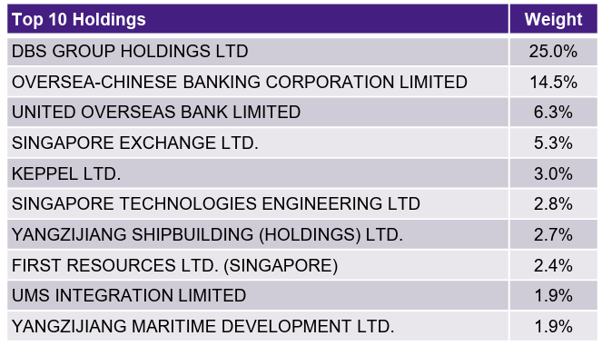
Its benchmark is the FTSE ST All Share Total Return Index.
For the retail Class A SGD share classes, the management fee is 1.5% per year. Investors can invest using cash or SRS funds, with a minimum initial investment of S$1,000.
As of 31 July 2026, the fund had about S$399 million in assets, based on the July 2026 fund factsheet.
The fund combines exposure to larger Singapore companies with a meaningful allocation to small and mid cap companies.
With up to approximately 50% of the portfolio invested in small and mid caps, its exposure to this segment is higher than several of the other all-cap EQDP funds we compared.
2. Amova Singapore Small Mid Cap Equity Fund
The Amova Singapore Small Mid Cap Equity Fund was launched alongside the Dividend and Growth Equity Fund in March 2026.
However, the two funds have very different mandates.
The fund is focused specifically on Singapore small and mid cap companies.
Amova says the strategy is 100% dedicated to this segment, compared with up to approximately 50% for its Dividend and Growth Equity Fund.
The fund looks for smaller companies with growth potential and potentially sustainable income generation.
For more on the investment case for this part of the market, we previously explored where Amova sees opportunities beyond Singapore's blue chips.
Its benchmark is the FTSE ST Mid & Small Cap Total Return Index.
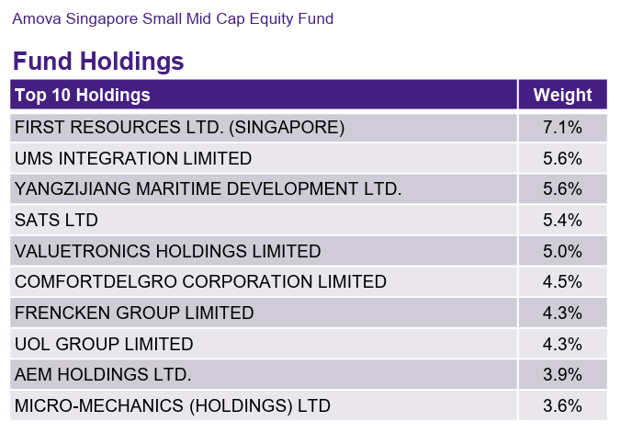
The retail Class A has a management fee of 1.6% per year and a minimum initial investment of S$1,000. It is available using cash and SRS.
As of 31 July 2026, the fund had about S$172 million in assets.
3. Eastspring Investments Singapore Income and Growth Equity Fund
The Eastspring Investments Singapore Income and Growth Equity Fund is the newest of the seven funds. Its retail share class launched on 22 July 2026.
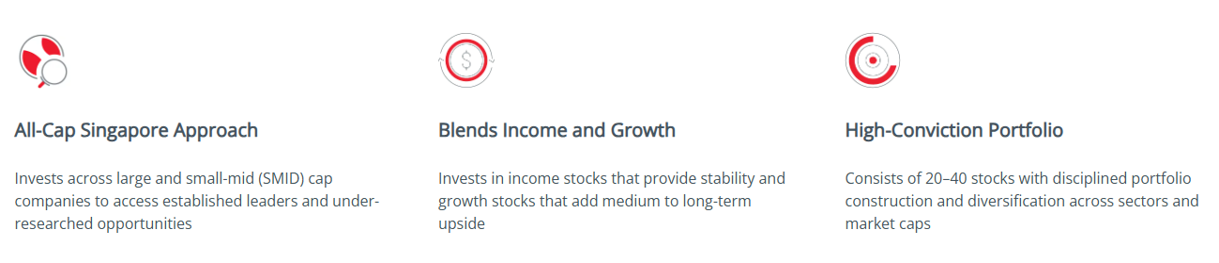
Eastspring takes an all-cap approach to Singapore equities.
It combines established large companies with smaller companies that the manager believes have stronger growth potential.
Eastspring has said the fund will maintain at least 35% of its portfolio in small and mid cap companies, although this allocation can increase over time.
The portfolio is relatively concentrated, typically holding around 20 to 40 stocks.
The strategy combines income stocks with growth stocks. The intention is to have income provide some stability while growth companies contribute to longer-term upside.
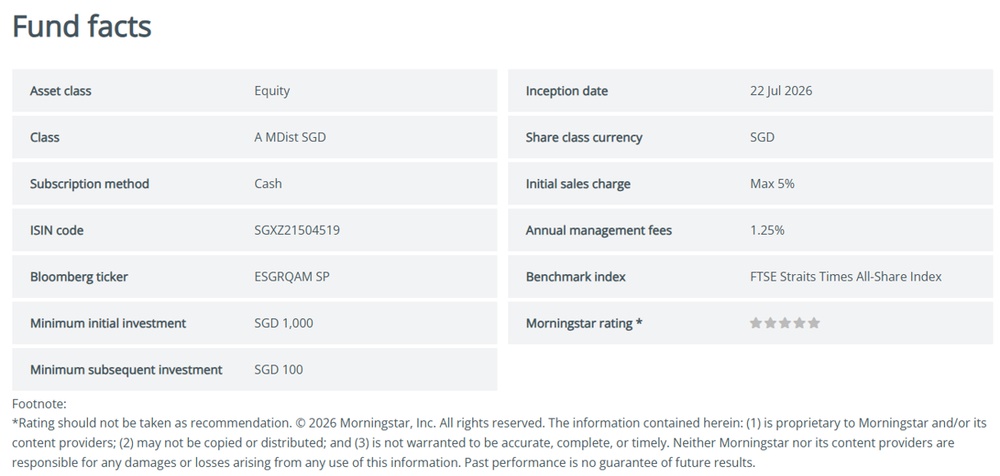
Its benchmark is the FTSE Straits Times All Share Index.
The Class A Acc SGD fund has a management fee of 1.25% per year and a minimum initial investment of S$1,000.
The fund's stated small and mid cap allocation puts it between a broad large-cap portfolio and a dedicated small-cap strategy.
However, the retail share class has only been available since July 2026, so there is not enough history yet to judge how the strategy performs through different market conditions.
4. Fullerton Singapore Value Up Fund
The Fullerton Singapore Value Up Fund was one of the earliest new retail funds launched under the EQDP.
Its Class A SGD accumulation share class was launched in October 2025.
The fund invests primarily in equities and equity related securities listed on the SGX.
Its investment universe can include large, mid and small cap companies, REITs, IPOs and pre IPO opportunities.
Fullerton targets around 30% of its NAV in Singapore small and mid cap equities, although the allocation can vary depending on market conditions and liquidity.
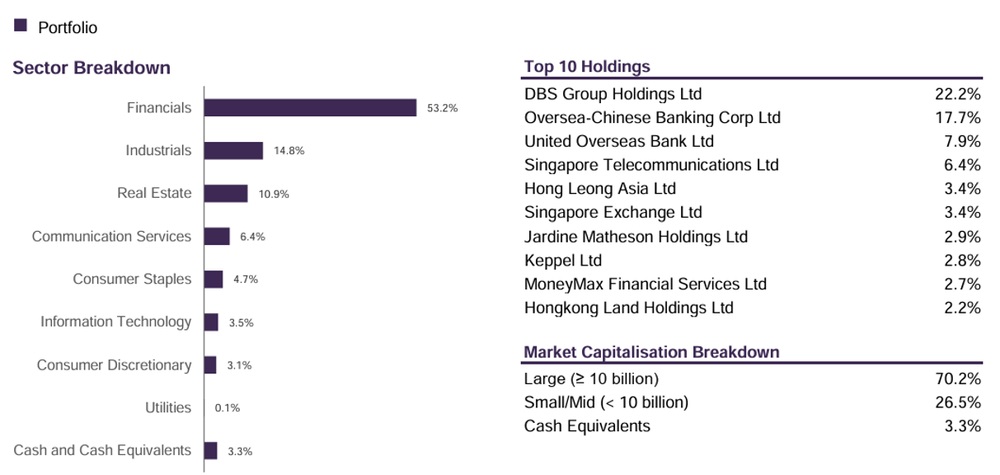
What differentiates Fullerton is not simply its allocation to smaller companies.
The fund focuses on companies where changes could unlock shareholder value, including restructuring, improving profitability, changes in capital allocation or exposure to longer-term structural growth trends.
Its benchmark is the FTSE Straits Times All Share Total Return Index.
The retail Class A has a management fee of 1.5% per year and is available for SRS investment.
The fund has also grown quickly. As of 31 July 2026, it had AUM of about S$1.05 billion.
5. LionGlobal Singapore Trust Fund
The LionGlobal Singapore Trust Fund is very different from the other funds on this list.
It was not newly created for the EQDP.
The fund was launched on 3 March 1989, giving it a track record of more than 37 years.
That gives investors more than three decades of history to examine, while the other six retail funds were launched between October 2025 and July 2026.
Lion Global subsequently deployed its EQDP mandate into the existing fund.
The fund aims to achieve long term capital appreciation by investing primarily in companies with significant exposure to Singapore.
It invests across the Singapore market, rather than simply replicating the STI.
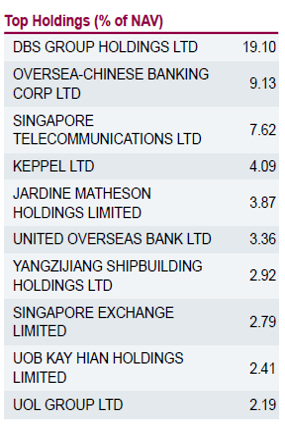
Following Lion Global’s appointment under the EQDP, the fund’s allocation to small and mid cap companies increased to around 30% to 40%, compared with a historical average of around 15% since 2014.
Lion Global has also said that about 70% of the fund’s historical outperformance came from the small and mid cap segment.
From 2 March 2026, its benchmark was changed to the FTSE ST All Share Index.
The fund had AUM of approximately S$2.26 billion as at 31 July 2026, making it the largest of the retail EQDP funds we compared.
The Class SGD management fee is currently 1.25% per year, and investors can use cash, SRS or CPFIS-OA funds.
LionGlobal stands out from the other EQDP funds because investors have a much longer track record to examine, and it is also available for CPFIS-OA investment.
However, its portfolio today has a significantly larger allocation to small and mid cap stocks than it did historically, so its future performance may look different from its longer-term track record.
We recently took a closer look at the LionGlobal Singapore Trust Fund as part of our guide to building a balanced Singapore portfolio, including how its broader market exposure differs from simply investing in the STI.
6. JPMorgan Singapore and Asia Equity Income Fund
The JPMorgan Singapore and Asia Equity Income Fund was launched on 20 January 2026.
Unlike the other funds on this list, it is not a pure Singapore equity strategy.
The fund invests across Asia Pacific excluding Japan, with a significant allocation to Singapore.
At least 67% of its assets are invested in equities and REITs in Asia Pacific excluding Japan. Within the equity portfolio, Singapore companies and REITs must account for between 30% and 70%.
Its benchmark reflects this broader mandate.
It consists of 50% FTSE Straits Times All Share and 50% MSCI AC Asia Pacific ex Japan.
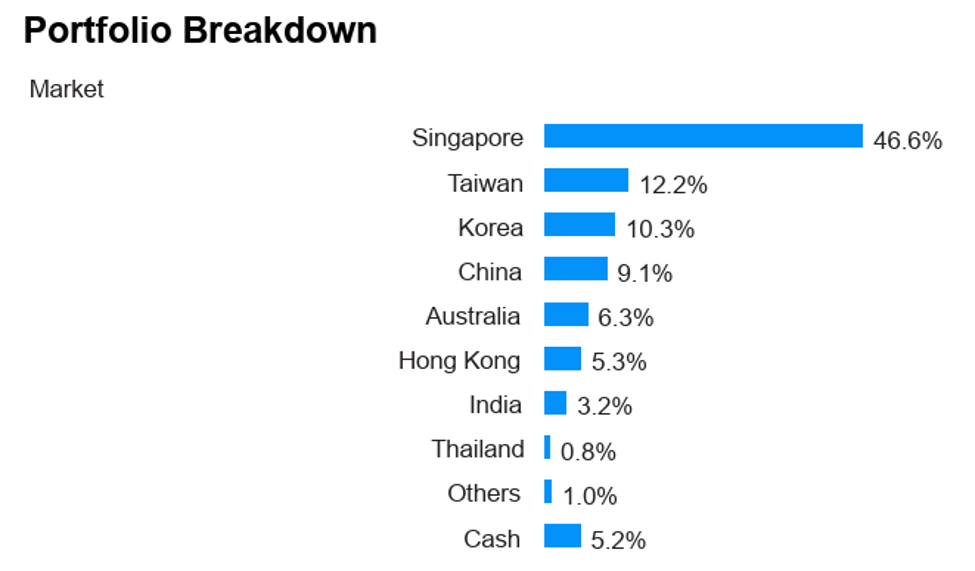
Another major difference is how the fund generates income.
In addition to dividends from its investments, JPMorgan systematically sells call options on equity indices to earn option premiums.
This can provide additional income and may help reduce volatility. The trade-off is that selling call options can limit some upside when markets rise strongly.
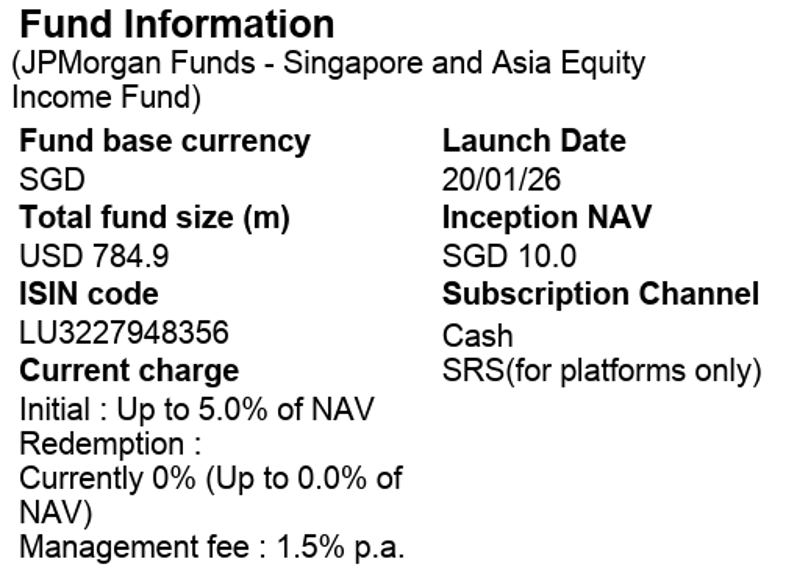
The fund had total assets of US$784.9 million as at 30 June 2026, according to JPMorgan's latest available fund factsheet.
For the Singapore retail Class A, the management fee is 1.5% per year. Cash subscriptions are available, while SRS is available through selected platforms.
7. Manulife Singapore Opportunities Income Fund
The Manulife Singapore Opportunities Income Fund was launched under the EQDP in March 2026, while its retail SGD share classes became available in April 2026.
The fund primarily invests in equities and equity related securities listed or due to be listed on the SGX, including REITs.
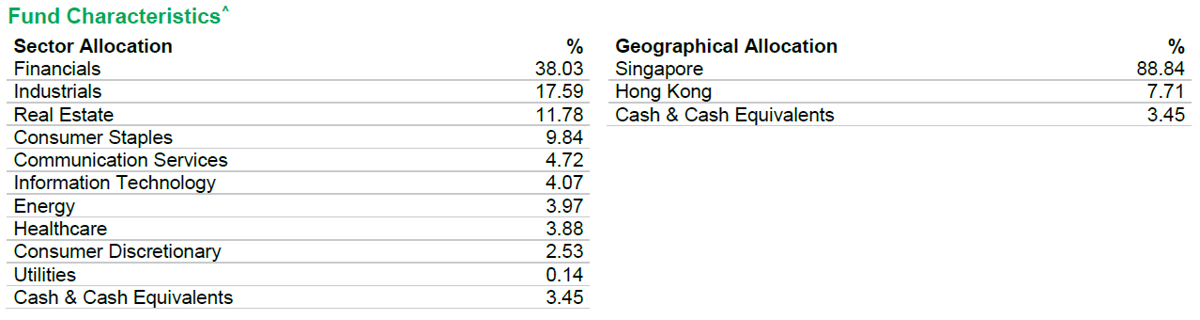
It targets around 40% of NAV in Singapore small and mid cap companies.
The manager uses a bottom up approach to identify companies it believes have strong fundamentals but are underappreciated by the market.
The fund’s benchmark is the FTSE Straits Times All Share Total Return Index.
One feature that differentiates Manulife from most of the other EQDP funds is that it may allocate up to 20% of its portfolio to Singapore dollar denominated fixed income securities when the manager wants to reduce downside risk. These can include Singapore government securities and corporate bonds issued by Singapore companies.
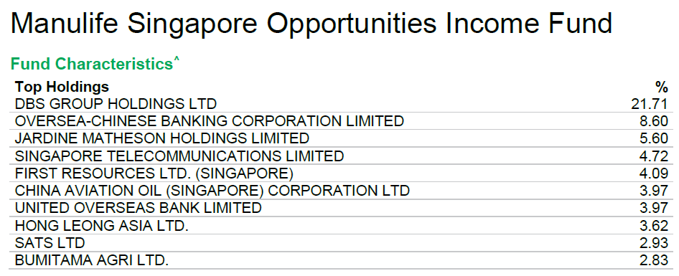
The retail Class A has an annual management fee of 1.25%, and can be purchased using cash or SRS through distributors.
As at 30 June 2026, the fund had AUM of S$7.73 million, based on its latest available fund factsheet.
Manulife combines a meaningful 40% target allocation to Singapore small and mid cap companies with the flexibility to hold fixed income when the manager wants to reduce downside risk.
How do the Singapore EQDP funds compare?
Looking across all seven funds, there are a few differences that we think matter most.
Which EQDP fund has the longest track record?
LionGlobal Singapore Trust Fund clearly stands out here.
It was launched in 1989, while every other retail EQDP fund in this comparison was launched between October 2025 and July 2026.
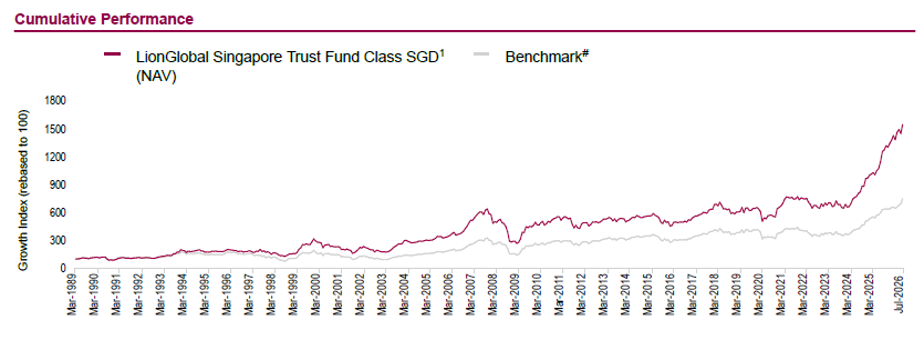
This means LionGlobal is currently the only fund where investors can study how the actual fund has performed through multiple market cycles.
For example, as at the end of 2025, the fund had generated an annualised return of 10.38% over 10 years compared with 7.61% for its benchmark at the time. Its annualised return since inception was 7.58%.
The other funds simply do not have sufficient history for us to draw meaningful conclusions on manager performance yet.
We therefore would not rank the newer funds based on a few months of returns.
Which EQDP fund is the largest?
LionGlobal Singapore Trust Fund is currently the largest of the retail EQDP funds we compared, with AUM of about S$2.26 billion as at 31 July 2026.
Fullerton Singapore Value Up Fund had also grown to about S$1.05 billion as at 31 July 2026.
JPMorgan's Singapore and Asia Equity Income Fund reported total assets of US$784.9 million as at 30 June 2026.
However, we would not automatically choose a fund simply because it has the most assets.
AUM can provide some indication of investor adoption and scale, but the underlying investment strategy and how it fits into our portfolio remains more important.
Which EQDP fund has the most small and mid cap exposure?
This is where the differences become much clearer.
Based on the stated investment approaches:
| Fund | Small and mid cap exposure |
| Amova Singapore Small Mid Cap Equity | 100% focus |
| Amova Singapore Dividend and Growth Equity | Around 50% |
| Manulife Singapore Opportunities Income | Target around 40% |
| Eastspring Singapore Income and Growth Equity | At least 35% |
| LionGlobal Singapore Trust | Around 30% to 40% currently |
| Fullerton Singapore Value Up | Target around 30% |
| JPMorgan Singapore and Asia Equity Income | No directly comparable target |
| Source: Respective fund managers. Actual allocations can change over time. | |
The Amova Singapore Small Mid Cap Equity Fund therefore stands out for investors specifically seeking exposure outside Singapore’s largest companies.
This distinction may be important if you already own an STI ETF or individual Singapore bank stocks.
Adding another portfolio dominated by the same large cap stocks may not provide as much diversification as a strategy that invests further down the market cap spectrum.
Which EQDP funds focus more on income?
Several of the funds have an explicit income component.
The Amova Singapore Dividend and Growth Equity Fund combines dividend paying companies with growth opportunities.
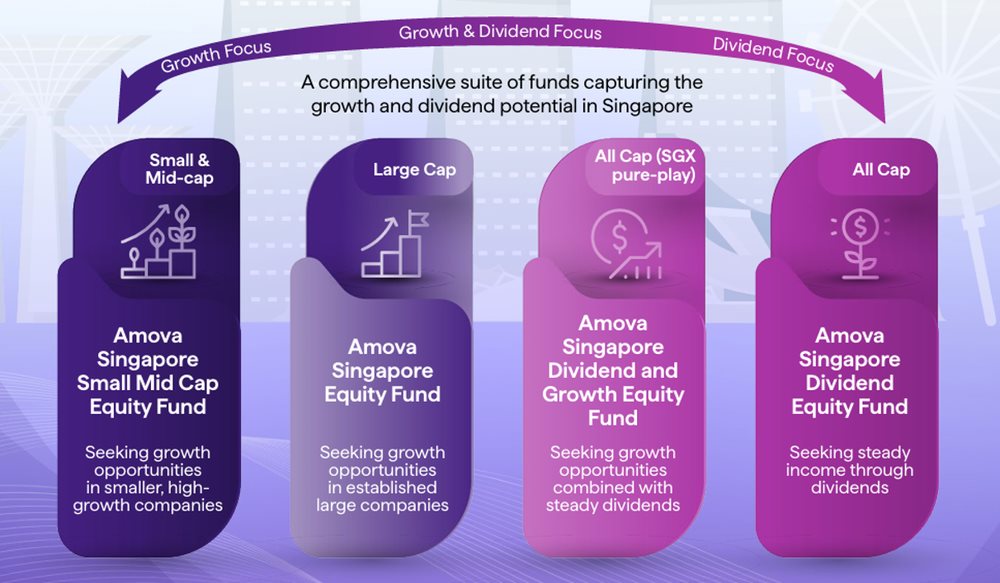
Eastspring similarly targets both income and growth.
Manulife aims for income and capital appreciation, with income coming primarily from dividends.
JPMorgan has perhaps the most differentiated income approach, because it combines share dividends with option premiums generated through selling call options.
Investors should nevertheless remember that distributions from unit trusts are not guaranteed, and a high distribution rate does not necessarily mean that the fund is generating a high investment return.
Which EQDP fund has the lowest management fee?
| Fund | Management fee* |
| Amova Singapore Dividend and Growth Equity Fund | 1.50% p.a. |
| Amova Singapore Small Mid Cap Equity Fund | 1.60% p.a. |
| Eastspring Singapore Income and Growth Equity Fund | 1.25% p.a. |
| Fullerton Singapore Value Up Fund | 1.50% p.a. |
| LionGlobal Singapore Trust Fund | 1.25% p.a. |
| JPMorgan Singapore and Asia Equity Income Fund | 1.50% p.a. |
| Manulife Singapore Opportunities Income Fund | 1.25% p.a. |
*Management fees shown are for a retail SGD share class available to Singapore investors, typically Class A where applicable. LionGlobal uses its SGD Class. Management fees do not represent the total cost of investing, and other fund expenses or sales charges may apply. Source: Latest available fund factsheets from the respective fund managers. Eastspring had not published a conventional monthly fund factsheet with fund size information at the time of writing. Fund sizes are reported in the currencies used by the respective fund managers and are from different reporting dates. Data as of August 2026. | |
For the retail SGD share classes used in our comparison, management fees range from 1.25% to 1.60% per year. These are typically Class A share classes where applicable, while LionGlobal uses its SGD Class.
Eastspring Singapore Income and Growth Equity Fund, LionGlobal Singapore Trust Fund and Manulife Singapore Opportunities Income Fund have the lowest management fee among the seven at 1.25% per year.
The Amova Singapore Dividend and Growth Equity Fund, Fullerton Singapore Value Up Fund and JPMorgan Singapore and Asia Equity Income Fund charge 1.50% per year, while the Amova Singapore Small Mid Cap Equity Fund has the highest management fee at 1.60% per year.
However, we would not choose a fund based on its management fee alone. The funds have different mandates and exposures, so a lower fee does not necessarily make one fund more suitable for our portfolio.
The management fee also does not represent the full cost of investing. Other fund expenses and sales charges may apply depending on the fund and the platform used.
If you want to understand the other costs that may apply, read our guide to mutual fund and unit trust fees in Singapore, where we explain management fees, sales charges and other expenses to look out for.
EQDP fund or STI ETF, which is better?
Another question investors may have is whether they should invest in an EQDP fund or simply buy an STI ETF.
The answer comes down to what exposure you want.
If we simply want exposure to Singapore's largest listed companies, an STI ETF remains a straightforward and generally lower-cost way to do so.
The STI, however, is heavily concentrated in larger companies, particularly Singapore’s three banks.
An actively managed EQDP fund can provide greater exposure to companies outside the STI, particularly Singapore small and mid cap stocks.
This is also where active fund managers may potentially add value, as smaller companies generally receive less analyst coverage.
The trade-off is cost.
The retail EQDP funds we reviewed generally charge annual management fees of about 1.25% to 1.6%, before considering other fund expenses.
There is therefore a higher hurdle for these active managers to overcome compared with a low cost index ETF.
If you prefer a simpler and lower-cost way to invest in Singapore’s largest companies, read our guide to STI ETFs in Singapore to compare the available options and understand how they work.
For us, the question is not whether active management or an STI ETF is always better.
It is whether the active fund provides enough differentiated exposure and investment value to justify the additional fees.
Where can you buy the EQDP funds?
Unlike an STI ETF, the EQDP funds in this comparison are not traded on the Singapore Exchange (SGX).
Instead, they are unit trusts that investors can buy through fund platforms, banks, financial advisers and other appointed distributors. The exact platforms and funding methods available differ by fund.
| Fund | Cash | SRS | CPFIS |
|---|---|---|---|
| Amova Singapore Dividend and Growth Equity Fund | Yes | Yes | No |
| Amova Singapore Small Mid Cap Equity Fund | Yes | Yes | No |
| Eastspring Singapore Income and Growth Equity Fund | Yes | Not currently | No |
| Fullerton Singapore Value Up Fund | Yes | Yes | No |
| LionGlobal Singapore Trust Fund | Yes | Yes | CPFIS-OA |
| JPMorgan Singapore and Asia Equity Income Fund | Yes | Yes, via selected platforms | No |
| Manulife Singapore Opportunities Income Fund | Yes | Yes | No |
| *Funding methods shown are for the retail SGD share classes reviewed. Availability may differ by share class and distributor, particularly for SRS investments. | |||
LionGlobal Singapore Trust Fund stands out as the only fund in our comparison that is also available for CPFIS-OA and SRS investment.
Amova's two funds can be invested in using cash or SRS, while JPMorgan also allows SRS investment through selected platforms.
The minimum investment, available share classes and fees charged can also differ across distributors.
If you are deciding where to invest, compare the best unit trust and mutual fund platforms in Singapore to see which platforms may suit your needs.
If you are new to unit trusts and mutual funds, read our guide to unit trusts in Singapore to understand how they work, the fees to look out for, and what to consider before investing.
What would Beansprout do?
In our view, Singapore remains a core part of our investment portfolio.
The structural growth themes supporting the Singapore market remain intact, and we see the EQDP as another potential catalyst for Singapore equities.
However, we would not invest in an EQDP fund simply because it is part of the programme. What matters more is the exposure it gives us and how it fits with what we already own.
Where the EQDP funds become more interesting to us is when they provide something meaningfully different from what we already own.
For example, if we wanted the most direct exposure to Singapore small and mid cap stocks, we would take a closer look at the Amova Singapore Small Mid Cap Equity Fund.
If we wanted a mix of large caps together with greater small and mid cap exposure, we would compare Amova Singapore Dividend and Growth Equity Fund, Eastspring Investments Singapore Income and Growth Equity Fund, Fullerton Singapore Value Up Fund, LionGlobal Singapore Trust Fund and Manulife Singapore Opportunities Income Fund more closely.
Among them, LionGlobal Singapore Trust Fund has the advantage of a much longer track record, while the newer funds will need more time before we can assess how well their investment approaches work in practice.
The LionGlobal Singapore Trust Fund is also the only fund that can be purchased using both CPFIS-OA and SRS.
JPMorgan Singapore and Asia Equity Income Fund sits in a separate category for us. Its broader Asian exposure and call option strategy stand out for investors looking for income and regional diversification, but it should not be treated as a substitute for a pure Singapore equity allocation.
Within our Four Pots of Wealth framework, we would see an EQDP fund as part of the Growth Pot, which is designed for investments that can grow our wealth over the long term.
If we wanted a simple and low cost way to gain exposure to Singapore’s largest companies, an STI ETF would remain an option we would consider.
If you are new to unit trusts and mutual funds, read our guide to unit trusts in Singapore to understand how they work, the fees to look out for, and what to consider before investing.
If you are planning to invest in an EQDP fund, you can compare the best unit trust and mutual fund platform in Singapore.
Which of these EQDP funds are you watching? Share your thoughts in the comments below or join the discussion in our Telegram group!
Follow Beansprout on YouTube, Facebook and Instagram, and add Beansprout as your preferred source on Google so you never miss an update.
Read also
Gain financial insights in minutes
Subscribe to our free weekly newsletter for more insights to grow your wealth
Most Popular

Comments
0 comments