
Oil jumps above US$110. How Singapore blue chips may be impacted
Stocks
By Gerald Wong, CFA • 22 Mar 2026
Why trust Beansprout? We’ve been awarded Best Investment Website at the SIAS Investors’ Choice Awards 2025
'%3e%3cpath%20fill-rule='evenodd'%20clip-rule='evenodd'%20d='M17.64%209.20455C17.64%208.56637%2017.5827%207.95273%2017.4764%207.36364H9V10.845H13.8436C13.635%2011.97%2013.0009%2012.9232%2012.0477%2013.5614V15.8195H14.9564C16.6582%2014.2527%2017.64%2011.9455%2017.64%209.20455V9.20455Z'%20fill='%234285F4'/%3e%3cpath%20fill-rule='evenodd'%20clip-rule='evenodd'%20d='M9%2018C11.43%2018%2013.4673%2017.1941%2014.9564%2015.8195L12.0477%2013.5614C11.2418%2014.1014%2010.2109%2014.4205%209%2014.4205C6.65591%2014.4205%204.67182%2012.8373%203.96409%2010.71H0.957275V13.0418C2.43818%2015.9832%205.48182%2018%209%2018V18Z'%20fill='%2334A853'/%3e%3cpath%20fill-rule='evenodd'%20clip-rule='evenodd'%20d='M3.96409%2010.71C3.78409%2010.17%203.68182%209.59318%203.68182%209C3.68182%208.40682%203.78409%207.83%203.96409%207.29V4.95818H0.957273C0.347727%206.17318%200%207.54773%200%209C0%2010.4523%200.347727%2011.8268%200.957273%2013.0418L3.96409%2010.71V10.71Z'%20fill='%23FBBC05'/%3e%3cpath%20fill-rule='evenodd'%20clip-rule='evenodd'%20d='M9%203.57955C10.3214%203.57955%2011.5077%204.03364%2012.4405%204.92545L15.0218%202.34409C13.4632%200.891818%2011.4259%200%209%200C5.48182%200%202.43818%202.01682%200.957275%204.95818L3.96409%207.29C4.67182%205.16273%206.65591%203.57955%209%203.57955V3.57955Z'%20fill='%23EA4335'/%3e%3c/g%3e%3cdefs%3e%3cclipPath%20id='clip0_0_2849'%3e%3crect%20width='18'%20height='18'%20fill='white'/%3e%3c/clipPath%3e%3c/defs%3e%3c/svg%3e)
Make Beansprout your preferred source on Google
Add us on Google to see more of our insights in your search results
With oil prices rising above US$110, we look at the potential impact on Singapore blue chips, including banks, REITs and dividend stocks.

What happened?
Oil prices are the focus of investors over the past month.
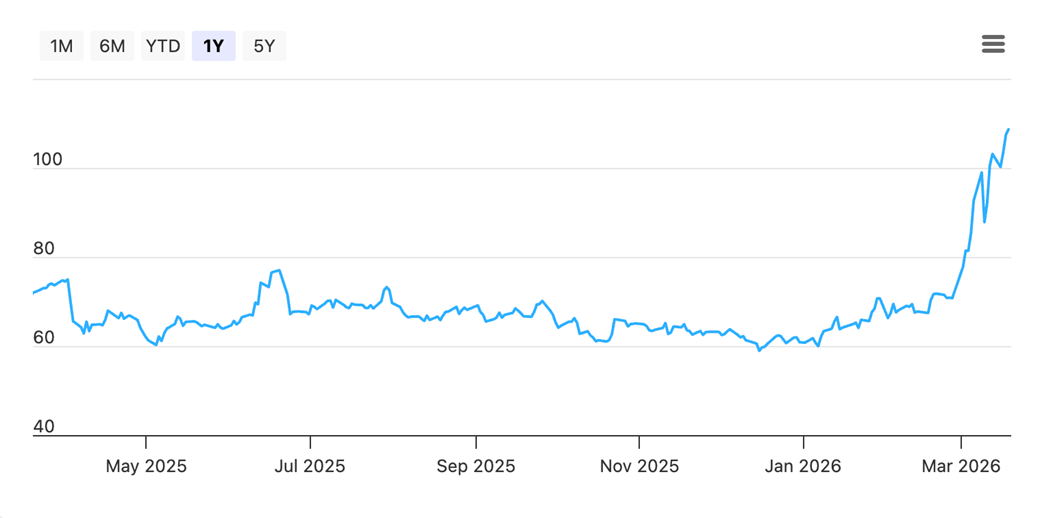
After a escalation in the Middle East conflict, oil prices have surged to their highest levels in years of above US$110 per barrel.
This has led to the US Federal Reserve warning that inflation may be higher than previously expected, leading to concerns about impact on global interest rates and economic growth.
I have seen a lot of discussion in the Beansprout Telegram community about what the higher oil price may mean for Singapore blue chip stocks.
In fact, in a poll that we did, more than half of respondents think that oil prices will reach above US$120/bbl by June this year.
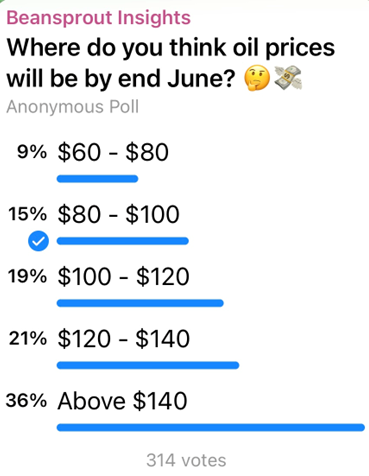
In this article, we look at what happened, why oil prices rose so quickly, and what to do with our portfolios.
What you need to know about the oil price spike
Oil prices jumped sharply after tensions in the Middle East escalated at the end of February 2026, raising fears of a disruption to global energy supply.
Within days, Brent and WTI crude surged and briefly traded above US$110 per barrel, as markets reacted to the risk that oil shipments from the Gulf could be affected.
The spike followed a series of military actions involving the United States, Israel and Iran.
After coordinated airstrikes on Iranian targets, Iran responded with missile and drone attacks on regional military bases and energy related infrastructure.
The conflict quickly began to affect shipping activity in the Strait of Hormuz, one of the most important oil transit routes in the world.
This narrow waterway between Iran and Oman connects the Persian Gulf to global markets, and around one third of the world’s seaborne crude oil passes through it.
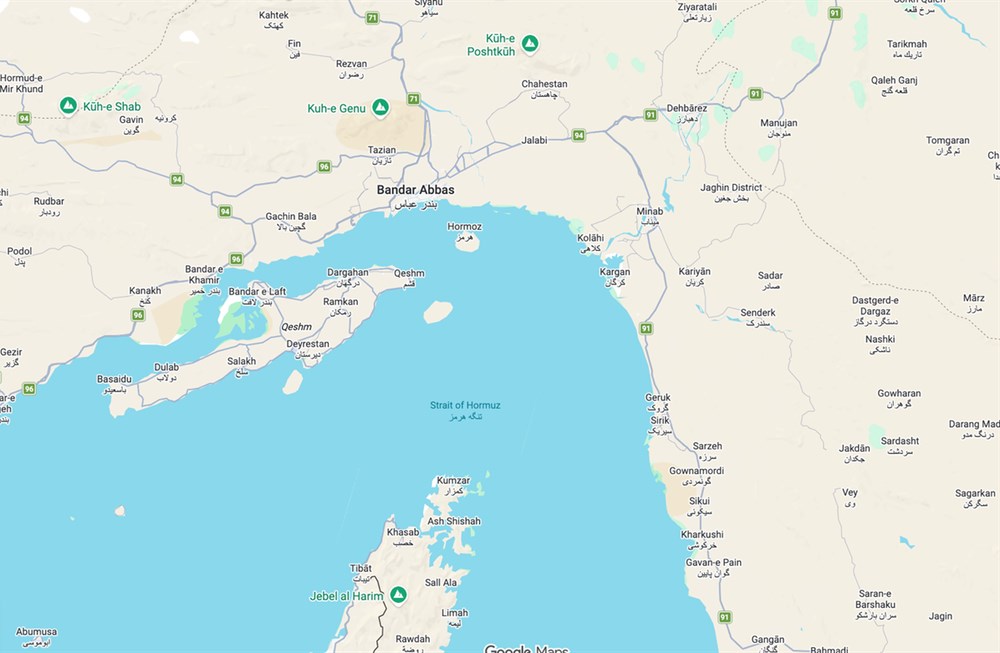
About 15 million barrels per day moved through the strait in 2025, along with roughly 20 percent of global LNG supply. Because so much energy flows through this single chokepoint, even the threat of disruption can push prices higher.
When drone attacks on oil tankers began, shipping traffic dropped sharply, with many vessels delaying entry into the strait.
The slowdown forced major producers such as Saudi Arabia, the UAE, Iraq and Kuwait to cut back exports, while some facilities in the region also faced operational disruptions. Alternative pipelines can only replace part of these volumes, so markets quickly began pricing in the risk of tighter supply.
As a result, oil prices surged as traders prepared for the possibility of a prolonged disruption.
Policymakers are already discussing potential responses, including coordinated releases of strategic oil reserves, but much will depend on how long the disruption lasts.
Can oil reserves provide a cushion?
Even though oil prices have surged, the world is not running out of oil.
Global proven reserves are estimated at around 1.7 to 1.8 trillion barrels, but most of these reserves are concentrated in a small number of countries such as Venezuela, Saudi Arabia, Iran, Canada and Iraq.
The challenge today is not how much oil exists underground, but whether it can reach global markets.
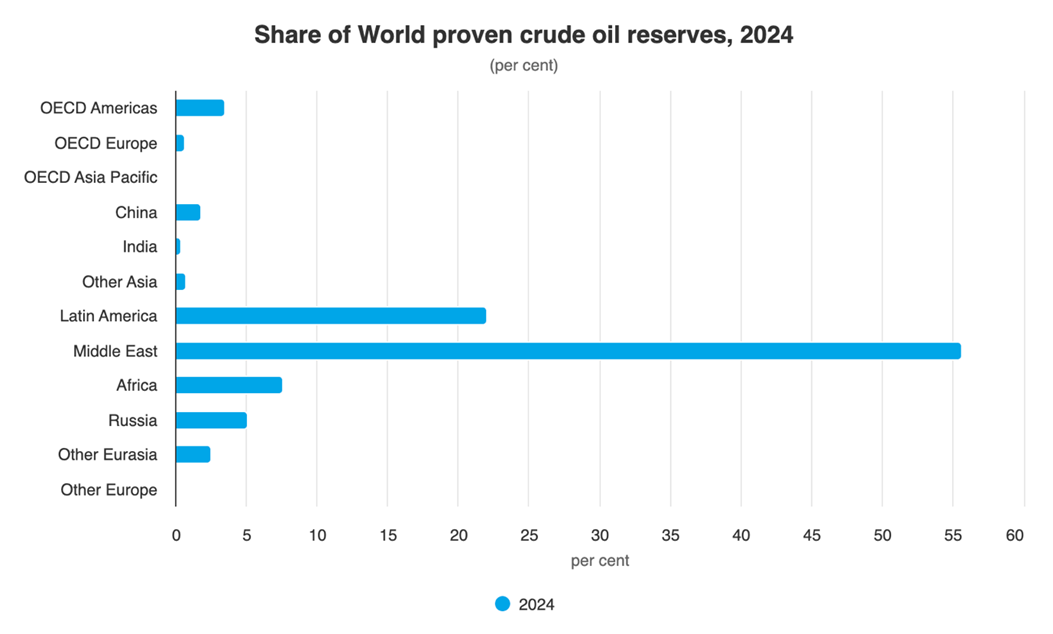
Many of the largest reserve holders are located in the Middle East, and supply still depends heavily on key transit routes such as the Strait of Hormuz, through which a significant share of global oil flows.
When shipping routes are disrupted or exports are delayed, supply can tighten quickly even if global reserves remain high. In other words, the current risk is less about running out of oil, and more about how easily that oil can be transported to where it is needed.
Can renewable energy get us out of this crisis?
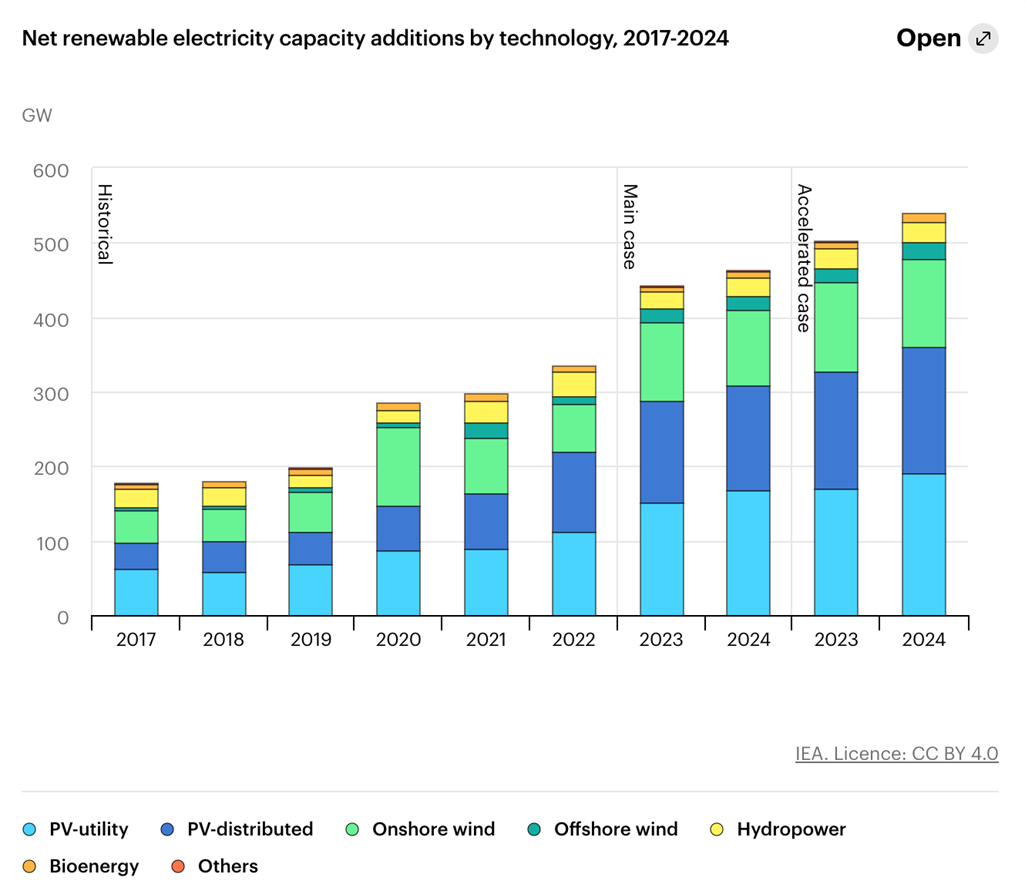
The recent oil price spike has revived the question of whether renewable energy can reduce the world’s dependence on fossil fuels. In the short term, the answer is no.
Oil and oil products, still make up 30% of total global energy supply in 2023.
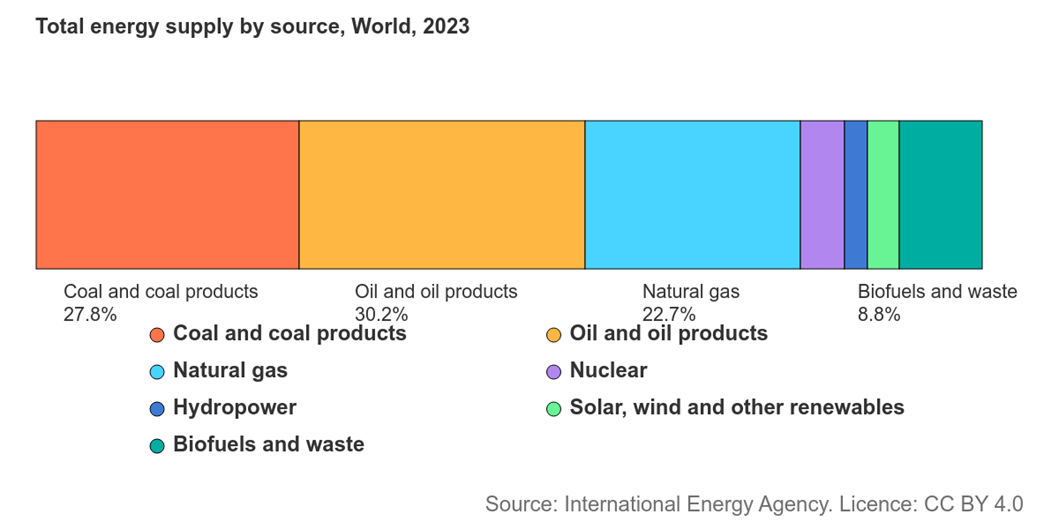
Even with rapid growth in renewables, it would take years rather than months to meaningfully reduce global oil demand.
That means supply disruptions can still have a large impact on prices and inflation today.
That said, the current oil price spike may reinforce the push towards energy diversification.
Beyond climate considerations, countries may accelerate investment in renewables, nuclear, and alternative supply routes to reduce reliance on a small number of critical chokepoints.
What we are looking out for?
Geopolitical shocks like this can feel unsettling, especially when oil prices surge and markets become more volatile.
History shows that markets often react quickly to uncertainty, and price moves can overshoot in the short term.
Rather than trying to predict every headline, we think it is more useful to focus on how higher oil prices affect inflation, interest rates and economic growth.
If energy costs stay elevated, inflation may take longer to fall, which could lead central banks to delay rate cuts or keep policy tight for longer.
Higher rates can weigh on market valuations, while more expensive fuel and transport costs may also slow economic activity and affect corporate earnings.
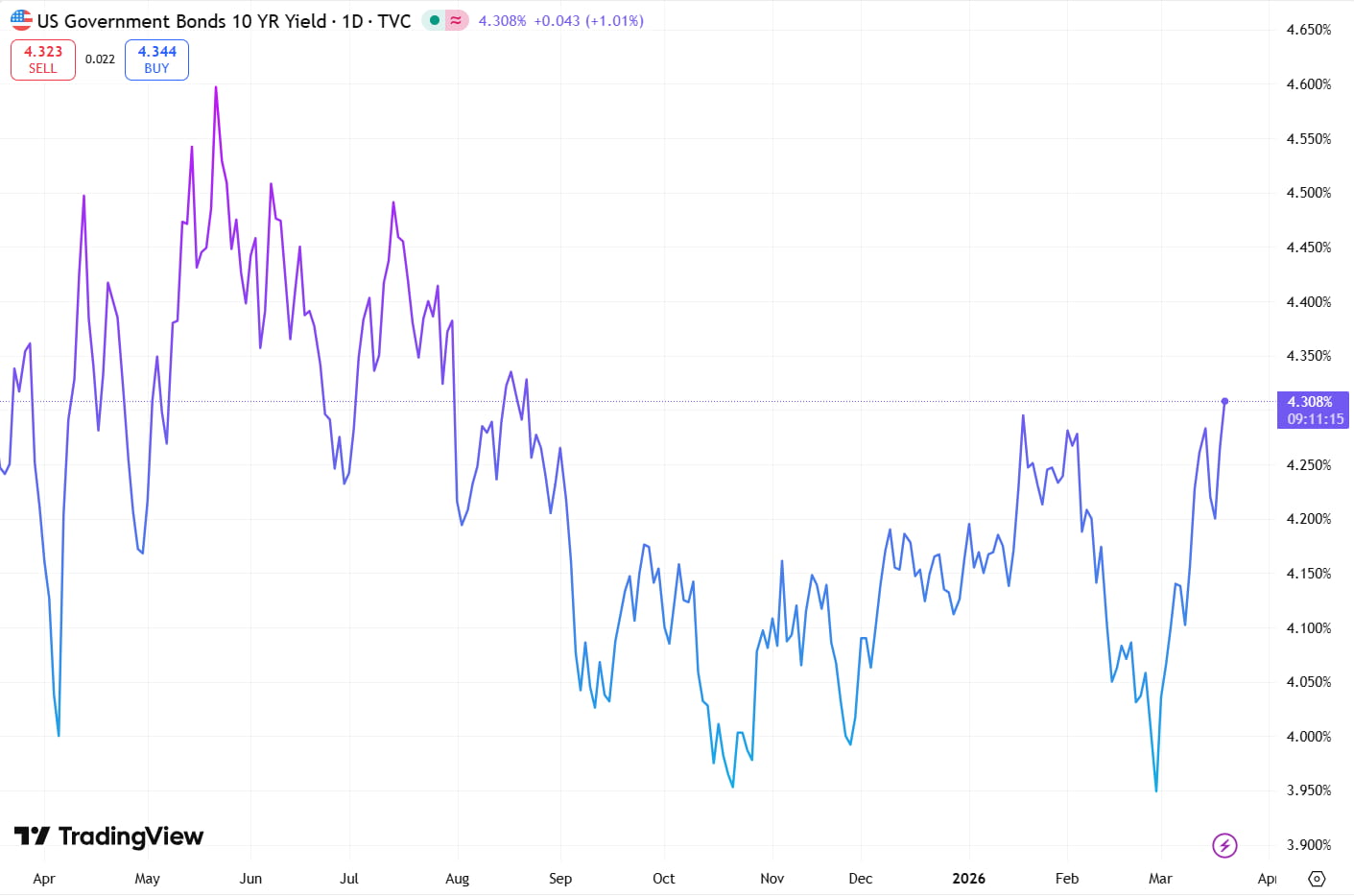
This is why investors should watch closely how oil prices feed through to inflation data, growth indicators and central bank guidance.
The key factor is how long disruptions to the Strait of Hormuz last. Because a large share of global oil supply passes through this route, the duration of the disruption will determine how serious the impact is on markets.
- If the disruption is short and shipping resumes within weeks, oil prices may ease and the impact on inflation and growth could remain limited.
- If the disruption lasts several months, oil prices could stay above US$100, keeping inflation high and making it harder for central banks to cut rates.
- If the disruption is prolonged, with the strait heavily constrained for an extended period, the world could face a larger energy shock, with higher risk of slower growth or even recession.
For investors, the key is to watch whether the oil price spike proves temporary, or whether it starts to affect inflation, interest rate expectations and economic growth in a more lasting way.
Which markets may be most significantly impacted?
Asia is likely to be most affected by any disruption at the Strait of Hormuz, as the region depends heavily on imported energy. Higher oil prices can quickly feed into inflation, trade balances and growth across Asian economies.
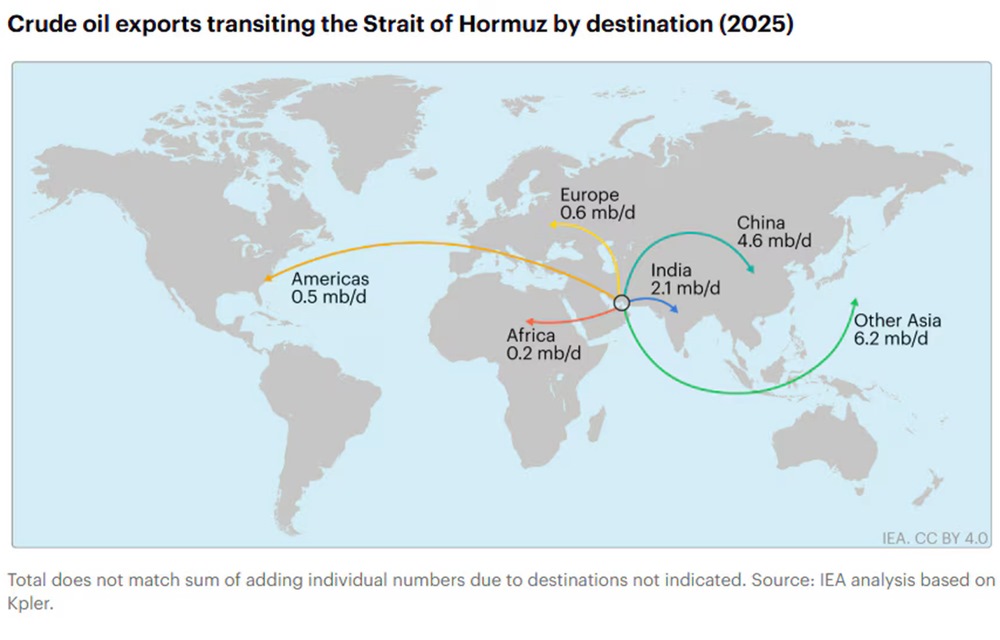
For Singapore, natural gas. all of which is imported, fuels 95% of the country's electricity generation. With global energy prices rising, this may flow into domestic electricity, transport and business costs. Higher oil prices can therefore add to inflation pressure.
As a major refining, trading and shipping hub, Singapore is also closely linked to global energy flows.
Disruptions to Middle East supply can affect petrochemicals, aviation, logistics and marine sectors, while higher fuel and transport costs can weigh on consumer spending and business confidence.
South Korea is another market to watch, as its economy is energy-dependent and sensitive to global trade. Higher oil prices can raise costs for manufacturers and weigh on growth, which may partly explain recent weakness in Korean equities.
Other Asian economies such as India, Japan and China are also exposed to higher energy prices, meaning a prolonged disruption in the Strait of Hormuz would likely have a bigger impact on Asia than on most other regions.
How the oil price spike may impact Singapore blue chip stocks
When oil prices rise, the impact on the stock market is usually uneven, with some sectors benefiting while others come under pressure.
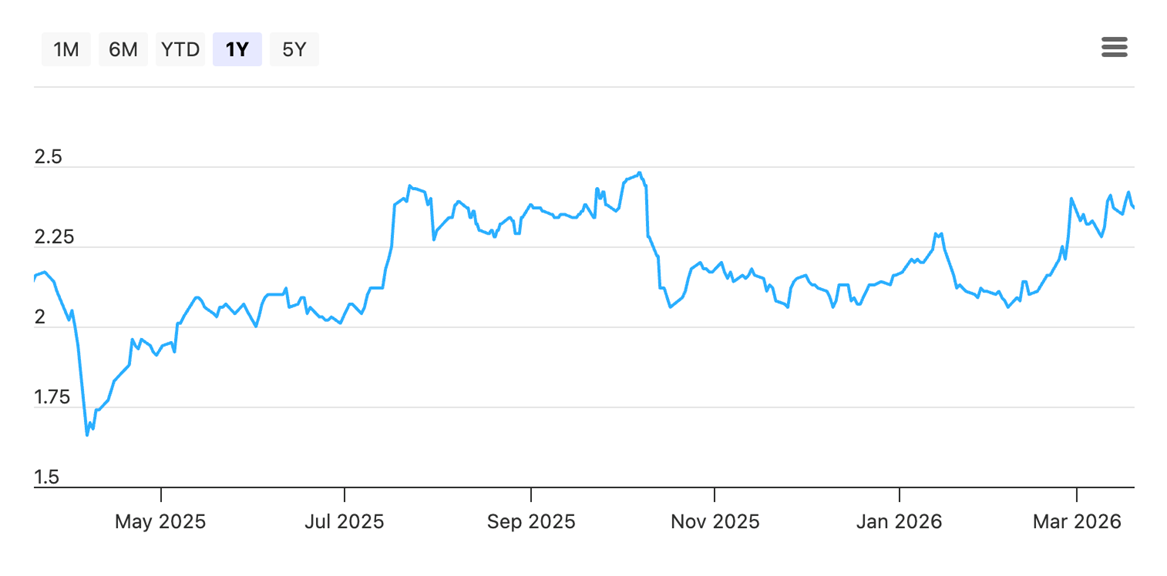
Within the Singapore market, offshore and marine companies such as Seatrium and Marco Polo Marine may also see improved sentiment if stronger oil prices lead to more spending on new equipment.
As seen in the chart below, Seatrium’s share price has been resilient following the escalation in Middle East conflict.
Energy producers tend to be more sensitive to higher crude prices. Examples include PTTEP SDR, Rex International and RH Petrogas.
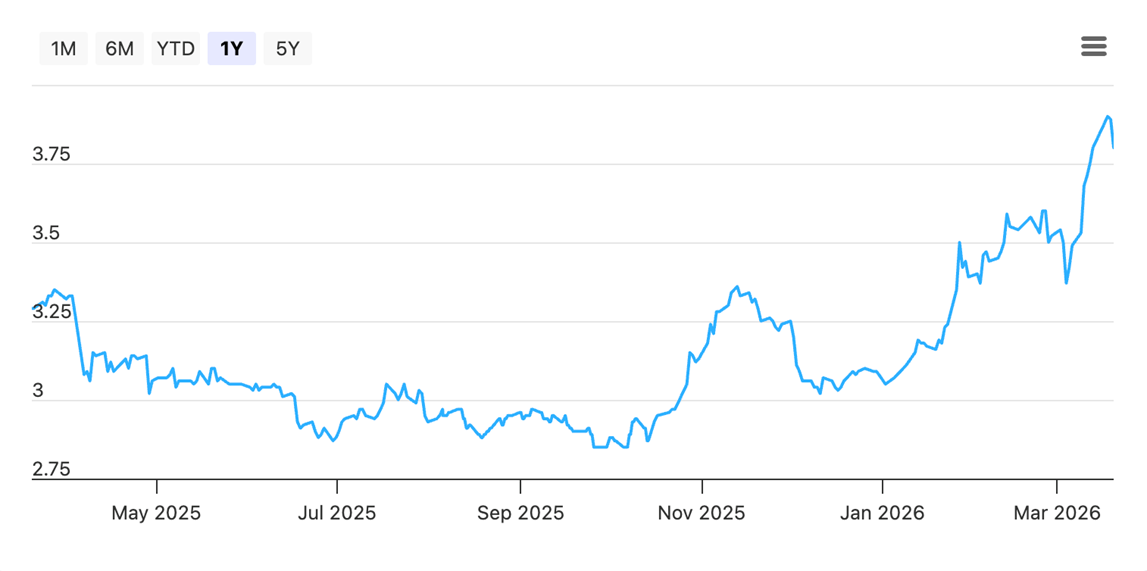
Palm oil companies like Wilmar, First Resources and Bumitama are sometimes linked to energy markets as well, as higher crude prices can support demand for biofuels and vegetable oils.
Wilmar’s share price surged to a new 52-week high of $3.93 with the surge in oil price.
On the other hand, sectors with high fuel costs may face pressure if oil prices remain elevated.
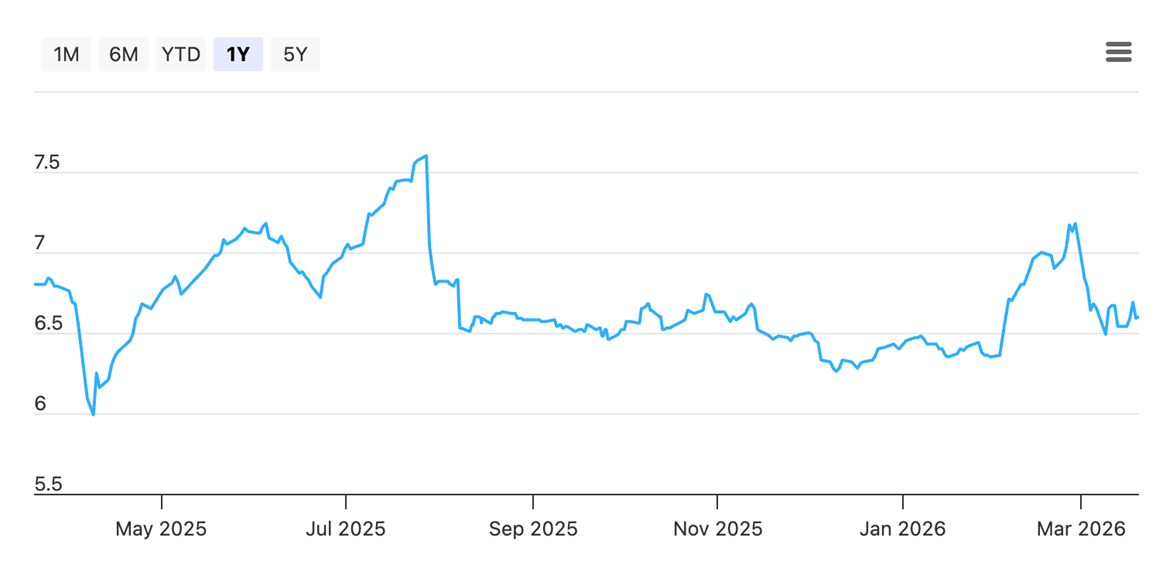
Airlines such as SIA, aviation and logistics-related companies like SATS, and transport operators such as ComfortDelGro could see margins affected as operating costs rise.
As seen in the chart below, SIA’s share price fell in the past month with concerns about how higher oil price may impact its profit.
There may also be secondary effects through inflation and interest rates. If higher oil prices keep inflation elevated, interest rates may stay higher for longer.
This could be supportive for banks, but less favourable for rate-sensitive sectors such as S-REITs and property developers, where financing costs remain high.
However, if oil prices stay elevated for an extended period and begin to slow economic growth, cyclical sectors could come under broader pressure.
In a deeper slowdown, even banks may be affected as loan growth weakens and credit costs rise.
During such periods, investors may rotate towards more defensive names, such as consumer staples like Sheng Siong, which tend to be more resilient when economic conditions soften.
What would Beansprout do?
Geopolitical shocks like this are unpredictable, and it is hard to predict what will be the next move for oil prices.
With the recent geopolitical tensions and uncertainty around the oil prices, I have been reviewing my own financial plan to make sure it still provides enough security and peace of mind. Rather than trying to predict every market move, the focus is on making sure each part of the portfolio is positioned for different scenarios.
First, I would make sure I have sufficient cash put aside for emergency uses, held in instruments such as savings accounts, fixed deposits, T-bills, Singapore Savings Bonds and money market funds. The goal here is not to maximise returns, but to ensure stability and flexibility, while earning a reasonable yield on idle cash. Find out the best place to park your cash to earn a higher yield here.
Second, I would look for income opportunities, especially during periods of market pullback. When prices fall, yields on income assets can become more attractive. For example, the recent decline in Singapore REIT prices has pushed up dividend yields, which may offer opportunities for investors looking for steady income. Read about Singapore REITs with dividend yields above 6%, Singapore blue chip stocks with dividend yields of above 5%, and ETFs with dividend yields of above 6%.
Third, for long term growth, I would continue to invest gradually rather than wait for the perfect entry point. Using a dollar cost averaging approach helps reduce the risk of mistiming the market, and allows investors to stay invested through different interest rate and market cycles. Read about best S&P 500 ETF, best STI ETF, and how to buy gold in Singapore here.
Finally, I would continue to look for opportunities in structural growth themes. Even in a slower rate cut environment, sectors supported by long term trends such as infrastructure, data centres, energy transition and regional development could still deliver earnings growth over time
As I shared earlier, this is what we are doing with our portfolios:
1. Stay disciplined and stick to your core thesis.
Volatility can be uncomfortable, but reacting out of fear rarely improves outcomes.
Most long-term investment theses already assume a certain level of geopolitical and economic risk.
Selling purely because headlines feel alarming often locks in losses and derails a well-thought-out plan.
Discipline matters most when markets are unsettled.
2. Selectively trim cyclical exposure where there are gains.
When the global environment becomes more uncertain, investors tend to demand higher returns for taking on risk.
This makes it sensible to consider taking some profit on stocks that move with the economy (like cyclical sectors) if they already have gains, especially if it allows us to sleep better at night.
3. Use volatility to build quality positions gradually.
Market selloffs often drag down strong companies along with weaker ones.
If the long-term fundamentals of a business remain intact, lower prices can offer more attractive entry points.
The key is to build positions gradually rather than all at once, focus on companies you understand well, and avoid chasing short-term rebounds.
4. Avoid trying to time the exact bottom.
This is not a routine headline-driven wobble.
It is the most serious military escalation in the region in decades.
The uncertainty around energy supply routes, especially the Strait of Hormuz, makes short-term market timing particularly difficult.
Attempting to pinpoint a precise bottom in such an environment is rarely productive.
5. Consider dollar-cost averaging if you wish to remain invested.
For those who want to remain invested but are concerned about volatility, spreading investments over time rather than doing a lump-sum entry can help manage timing risk.
Regular, disciplined deployment of capital reduces the pressure of trying to make a perfect entry decision.
6. Watch how the situation evolves.
The path of this conflict will determine whether markets stabilise or reprice more significantly.
A credible move toward de-escalation would likely support a recovery in stocks and other risky assets.
Further escalation, however, could lead to a broader reassessment of global risk and a further selloff.
7. Be prepared for longer-term economic effects if tensions persist.
If the conflict drags on, the macroeconomic consequences may become more meaningful. Higher energy prices and prolonged uncertainty could weigh on global growth, leading to downward revisions in economic forecasts.
Portfolio positioning may need to adapt if that scenario unfolds.
Overall, the key is not to move entirely to cash or try to time every shift in interest rates, but to stay diversified across liquidity, income, and growth, so the portfolio can remain resilient through different market conditions.
How are you positioning your portfolio with oil prices now above US$110? Share your thoughts in the comments, or join the discussion in our Telegram group.
Track the latest price of crude oil in Singapore here.
Follow Beansprout on Youtube, Facebook and Instagram, and add Beansprout as your preferred source on Google so you never miss an update.
Read also
Gain financial insights in minutes
Subscribe to our free weekly newsletter for more insights to grow your wealth
Most Popular

Comments
0 comments