
Apply now or wait? Singapore Savings Bonds (SSB) 10-year return rises to 2.45%
Bonds
By Gerald Wong, CFA • 20 Oct 2026
Why trust Beansprout? We’ve been awarded Best Investment Website at the SIAS Investors’ Choice Awards 2025

Make Beansprout your preferred source on Google
Add us on Google to see more of our insights in your search results
The latest Singapore Savings Bond (SSB) offers a 10-year average return of 2.45%. We assess whether to apply now or wait for the next issue and compare it to the latest fixed deposit rate and the T-bill yield.
What happened?
Singapore Savings Bond (SSB) yields continue to climb.
The latest Singapore Savings Bond offers a 10-year average return of 2.45%, up from 2.32% for the previous month's issue.
Its first-year return has also risen to 1.67%, although this remains below the latest 6-month T-bill cut-off yield and the best 6-month fixed deposit rates in Singapore.
However, the SSB allows investors to earn a potentially higher average return when held for longer, while retaining the flexibility to redeem it before maturity.
After comparing the SSB with fixed deposits, T-bills and savings accounts in October 2026, I may still consider it for my Liquidity Pot if I wanted to keep my savings accessible while earning a potentially higher return over time.
In this article, I’ll compare the latest SSB against T-bills and fixed deposits, and look at whether it may be worth applying for or waiting for the next issue.
Latest SSB offers 10-year average interest rate of 2.45%
The latest SSB issuance offers a 10-year average annual interest rate of 2.45%.
If I hold the SSB for one year, I will receive an average annual interest return of 1.67%.
If I hold it for 10 years, I will receive an average annual interest return of 2.45%.
The interest rate steps up gradually over the 10-year period, reaching 3.08% in year 10.
These are average annual interest rates over the respective holding periods, rather than the interest rate paid in every individual year. The scheduled interest payments depend on how long the bond is held.
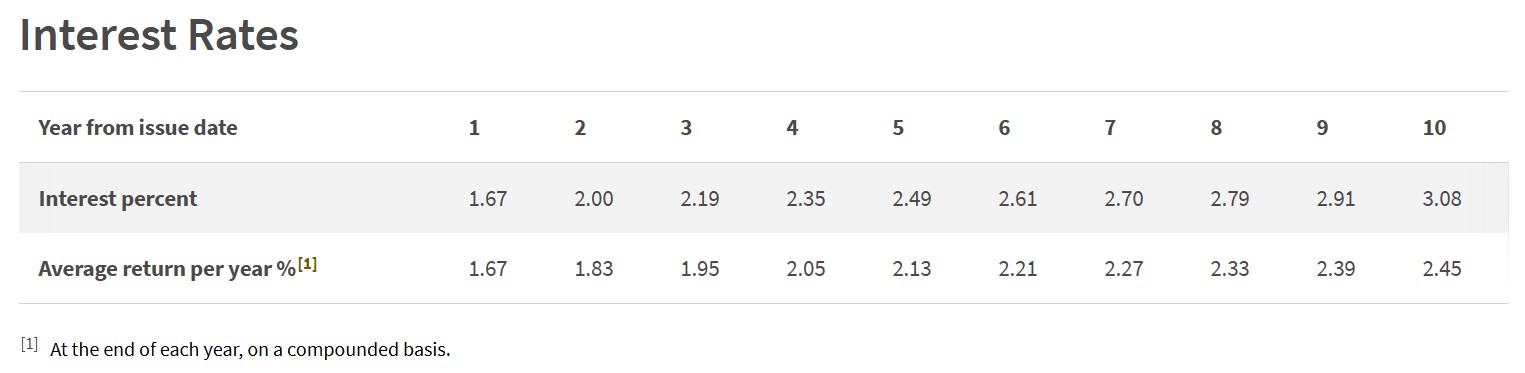
The 10-year average return of 2.45% is higher than that of the previous SSB in September 2026.
Already holding an SSB? Use our SSB swap calculator to estimate whether switching from an earlier issue to the upcoming SSB could earn you more interest.
SSB 1-year rate is lower than the best 1-year fixed deposit rate in Singapore
The 1-year rate of 1.67% p.a. is lower than the best 12-month fixed deposit rate of 2.10% p.a. and the best broadly available 6-month fixed deposit rate of 2.05% p.a..
| Tenure | Best fixed deposit interest rate (p.a.) | Bank |
|---|---|---|
| 3 months | 1.75% | Bank of China |
| 6 months | 2.05% | HL Bank and Bank of China |
| 8 months | 1.90% | Hong Leong Finance |
| 9 months | 2.00% | Bank of China |
| 12 months | 2.10% | RHB |
| Source: Various bank websites as of 18 October 2026 | ||
The main difference is flexibility. Fixed deposits generally require investors to keep their money deposited until maturity to earn the advertised interest rate, while SSBs can be redeemed monthly without an early-redemption penalty.
However, SSB redemption proceeds are only credited by the second business day of the following month, and a transaction fee applies.
Learn more about SSBs and how to apply for SSBs by reading our comprehensive SSB guide.
SSB 1-year rate is also lower than the latest 6-month Singapore T-bill yield
The SSB 1-year rate of 1.67% is also lower than the latest 6-month Singapore T-bill yield of 1.90% on 8 October 2026.
It is also still below the latest 1-year Singapore T-bill yield of 1.92% on 15 October 2026.
The table below shows the historical cut-off yields for 6-month Singapore T-bills.
| Auction Date | 6-month T-bill | Cut-off yield |
| 8 October 2026 | BS26120W | 1.90% |
| 24 September 2026 | BS26119F | 1.92% |
| 10 September 2026 | BS26118E | 1.70% |
| 27 August 2026 | BS26117A | 1.60% |
| 13 August 2026 | BS26116V | 1.56% |
| 30 July 2026 | BS26115N | 1.59% |
| 16 July 2026 | BS26114W | 1.55% |
| 2 July 2026 | BS26113X | 1.50% |
| 18 June 2026 | BS26112T | 1.47% |
| 4 June 2026 | BS26111H | 1.48% |
| 21 May 2026 | BS26110S | 1.45% |
| 7 May 2026 | BS26109N | 1.40% |
| 23 April 2026 | BS26108W | 1.40% |
| 9 April 2026 | BS26107X | 1.47% |
| 26 March 2026 | BS26106T | 1.46% |
| 12 March 2026 | BS26105H | 1.37% |
| 26 February 2026 | BS26104S | 1.36% |
| 12 February 2026 | BS26103Z | 1.36% |
| 29 January 2026 | BS26102F | 1.37% |
| 15 January 2026 | BS26101E | 1.39% |
| 31 December 2025 | BS26100A | 1.60% |

SSB interest rate projected to dip to around 2.40%
For those new to the Singapore Savings Bonds (SSB), it's important to understand that SSB interest rates are closely tied to the yields of Singapore Government Securities (SGS).
Similar to T-bills, SGS are bonds issued by the Singapore government. But, they have a longer maturity of 2 years to 30 years.
The interest rates on each SSB issuance are linked to the daily average SGS yields as published by the Monetary Authority of Singapore (MAS) in the previous month.
This means the 10-year average return of the upcoming SSB will largely mirror the yield of the 10-year Singapore government bond or SGS observed this month.
As shown in the chart below, the Singapore 10-year government bond yield has been volatile in recent months.
It climbed to nearly 2.4% in late March before easing in April and trading mostly between 2.0% and 2.2% over the following months.
The 10-year SGS yield rose again from July, briefly reaching around 2.6% before retreating to 2.34% as of 16 October 2026.
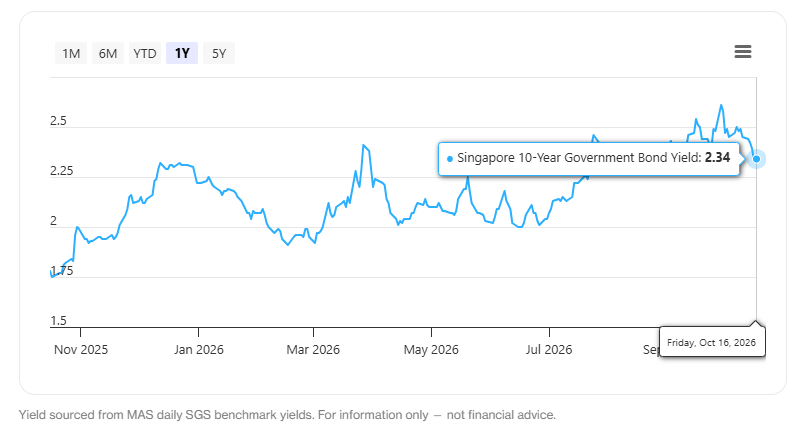
As of 16 October 2026, the closing yield on the 10-year Singapore government bond stood at approximately 2.34%.
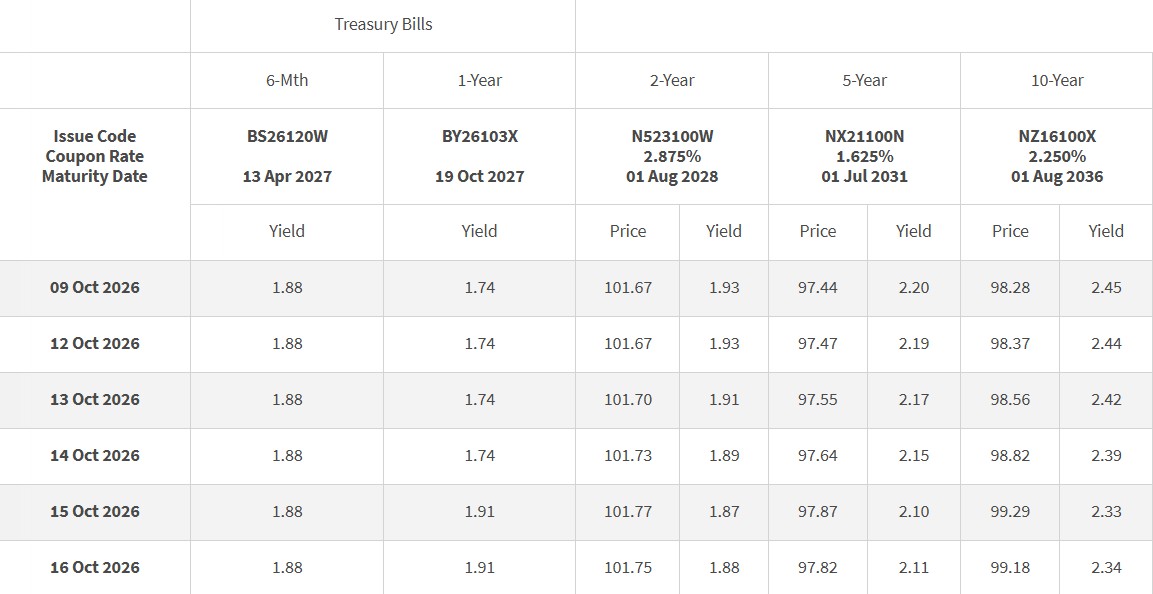
Based on the average SGS yields observed in October so far, the 10-year average return for the next SSB is likely to be lower than the current issuance.
As of 20 October 2026, our SSB interest rate projection estimates that the next SSB may offer a 1-year return of 1.81% and a 10-year average return of approximately 2.40%.
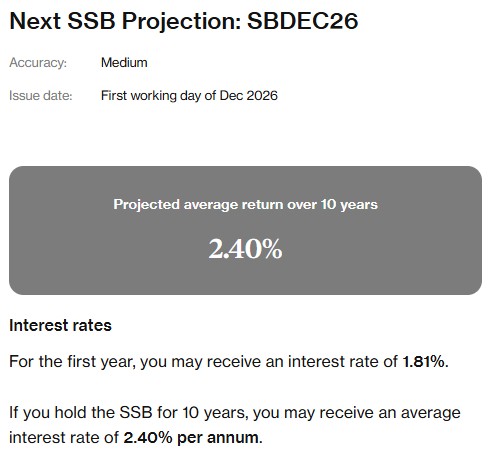
This estimate is based on the average closing yield of the 10-year Singapore Government Bond recorded so far in October, assuming the yield remains at 2.34% for the rest of the month.
The projected rates are not confirmed SSB interest rates. They could change if SGS yields move during the remaining observation period.
Demand for SSB decreased in the previous issuance
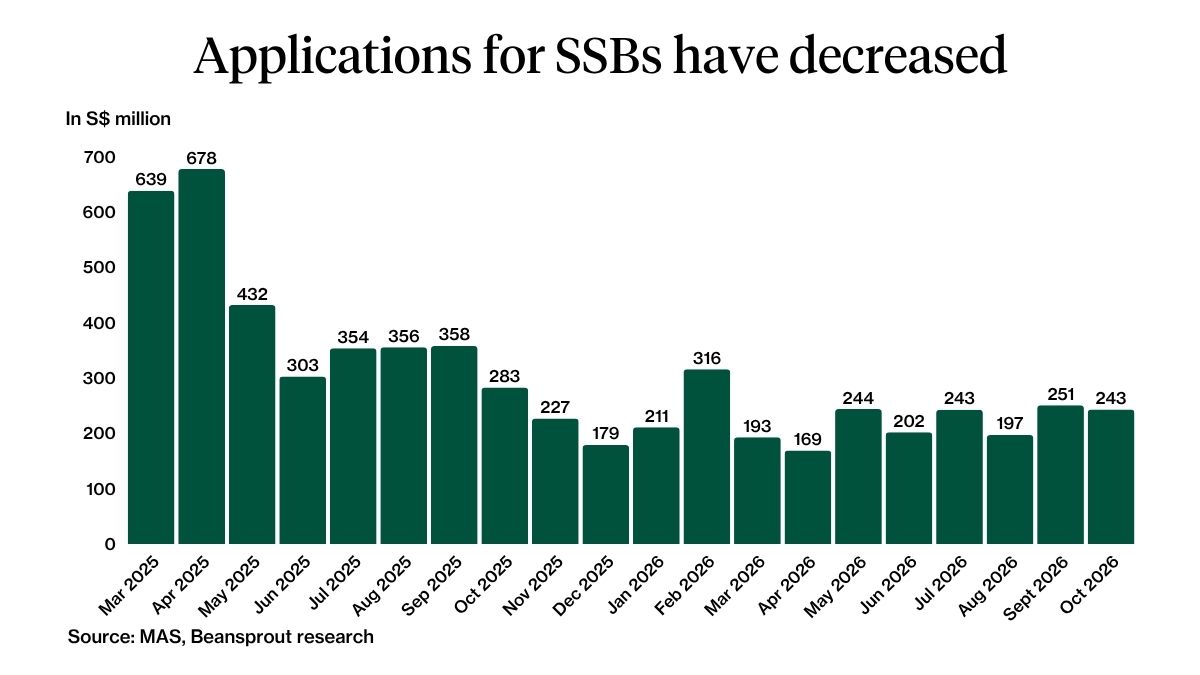
Demand for the October 2026 SSB dipped slightly, even though its 10-year average return was higher than that of the preceding issue.
Applications for the October 2026 SSB totalled about S$243 million, down from about S$251 million for the September issue.
One possible explanation is that savers were comparing SSBs with T-bills and fixed deposits, which offered higher returns over shorter holding periods. The SSB’s higher 10-year average return may be less compelling for those planning to hold it for only a year or two.
Applications remained below the S$400 million offered, allowing eligible applicants to receive their full allocation.
If demand remains below the amount offered, investors may continue to receive their full eligible allocation.
What would Beansprout do?
The latest issuance of the SSB offers a 1-year rate of 1.67%, and 10-year average return of 2.45%.
The 1-year rate of 1.67% is lower than the best 12-month fixed deposit rate, the latest 6-month T-bill yield and the latest 1-year T-bill yield.
However, I would not choose between these products based on their headline yields alone. How long I expect to hold the investment, and when I may need the cash, matter just as much.
If I expect to hold the SSB for the full 10 years, the current issue's 2.45% average annual return may be worth considering, especially if I value the flexibility to redeem it earlier.
If I expect to hold it for only one year, the projected next issue's 1.81% first-year return is higher than the current issue's 1.67%, although that projection may still change.
To find out how much more interest you can potentially earn by swapping your previous bonds to the current, check out our SSB swap calculator.
For shorter holding periods, I would also compare the SSB with T-bills, fixed deposits and savings accounts before deciding where to park my cash.
For money that I may hold for several years but still want access to, SSBs may remain worth considering within my Liquidity Pot under the Beansprout Four Pots of Wealth.
By finding the best place to park my cash, I know I can ride through market volatility without being forced to sell my investments at the wrong time.
Application for the latest SSB will close at 9pm on 27 October 2026 (Tuesday). Redemption of SSBs will also close at 9pm on 27 October 2026 (Tuesday).
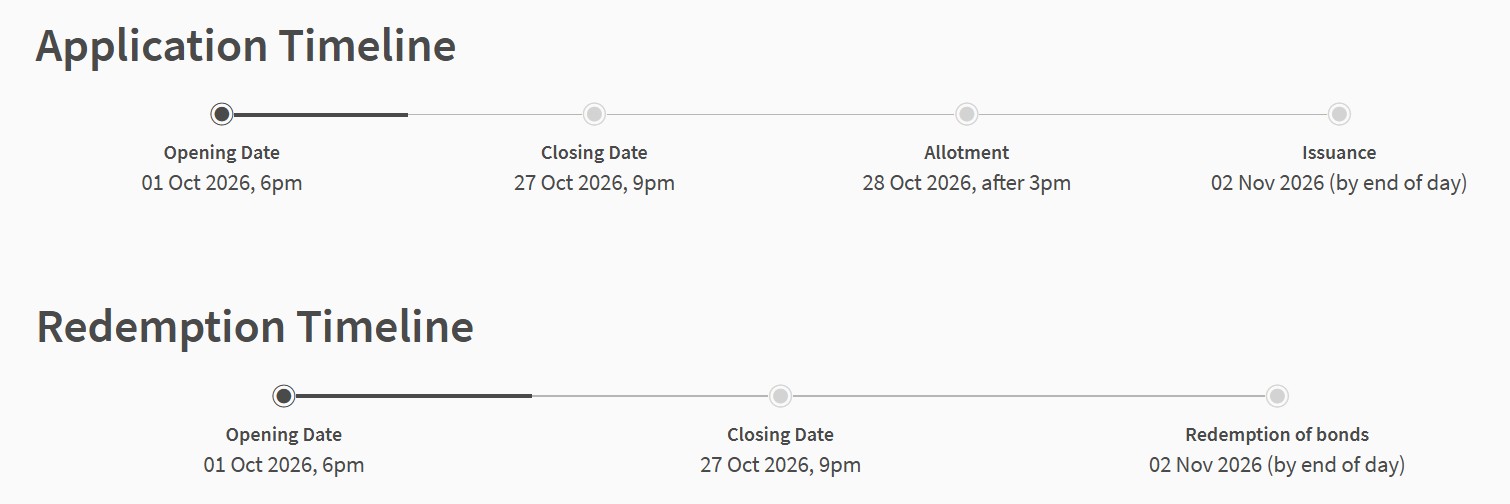
You can sign up for an email reminder to be reminded of future SSB closing dates.
Learn more about SSBs and how to apply for SSBs by reading our comprehensive SSB guide.
For a broader introduction to bonds, read our beginner’s guide to bond investing in Singapore, including how coupons, yields and duration work.
Where are you parking your cash right now? Share in the comments, or join the discussion in our Telegram group.
Enjoyed this insight? Follow Beansprout on Telegram, Youtube, Facebook and Instagram, and add Beansprout as your preferred source on Google so you never miss an update.
Read also
Gain financial insights in minutes
Subscribe to our free weekly newsletter for more insights to grow your wealth
Most Popular

Comments
0 comments