
3 SGX ETFs with dividend yields above 6%. Which offers the best income?
ETFs
By Gerald Wong, CFA • 18 Mar 2026
Why trust Beansprout? We’ve been awarded Best Investment Website at the SIAS Investors’ Choice Awards 2025
'%3e%3cpath%20fill-rule='evenodd'%20clip-rule='evenodd'%20d='M17.64%209.20455C17.64%208.56637%2017.5827%207.95273%2017.4764%207.36364H9V10.845H13.8436C13.635%2011.97%2013.0009%2012.9232%2012.0477%2013.5614V15.8195H14.9564C16.6582%2014.2527%2017.64%2011.9455%2017.64%209.20455V9.20455Z'%20fill='%234285F4'/%3e%3cpath%20fill-rule='evenodd'%20clip-rule='evenodd'%20d='M9%2018C11.43%2018%2013.4673%2017.1941%2014.9564%2015.8195L12.0477%2013.5614C11.2418%2014.1014%2010.2109%2014.4205%209%2014.4205C6.65591%2014.4205%204.67182%2012.8373%203.96409%2010.71H0.957275V13.0418C2.43818%2015.9832%205.48182%2018%209%2018V18Z'%20fill='%2334A853'/%3e%3cpath%20fill-rule='evenodd'%20clip-rule='evenodd'%20d='M3.96409%2010.71C3.78409%2010.17%203.68182%209.59318%203.68182%209C3.68182%208.40682%203.78409%207.83%203.96409%207.29V4.95818H0.957273C0.347727%206.17318%200%207.54773%200%209C0%2010.4523%200.347727%2011.8268%200.957273%2013.0418L3.96409%2010.71V10.71Z'%20fill='%23FBBC05'/%3e%3cpath%20fill-rule='evenodd'%20clip-rule='evenodd'%20d='M9%203.57955C10.3214%203.57955%2011.5077%204.03364%2012.4405%204.92545L15.0218%202.34409C13.4632%200.891818%2011.4259%200%209%200C5.48182%200%202.43818%202.01682%200.957275%204.95818L3.96409%207.29C4.67182%205.16273%206.65591%203.57955%209%203.57955V3.57955Z'%20fill='%23EA4335'/%3e%3c/g%3e%3cdefs%3e%3cclipPath%20id='clip0_0_2849'%3e%3crect%20width='18'%20height='18'%20fill='white'/%3e%3c/clipPath%3e%3c/defs%3e%3c/svg%3e)
Make Beansprout your preferred source on Google
Add us on Google to see more of our insights in your search results
Looking for income investments? We compare 3 SGX-listed ETFs with dividend yields above 6% and what investors should consider before buying.
What happened?
Markets have been volatile in March 2026.
Many in the Beansprout community are wondering what to buy during the recent dip to build long-term passive income streams.
We recently looked at 3 Singapore REITs with dividend yields above 6%.
Singapore banks are also offering more attractive dividend yields now, with DBS’ dividend yield close to 6%.
This made me wonder if there are any SGX-listed dividend ETFs offering yields above 6% for investors who want diversification without having to pick individual stocks.
In this article, we look at three dividend ETFs listed on SGX with yields above 6% in March 2026, what they invest in, how they have performed, and what investors should watch before adding them to a portfolio for income.
#1 - iShares USD Asia High Yield Bond ETF (QL3/O9P)
iShares USD Asia High Yield Bond ETF was listed on SGX on 8 December 2011.
It tracks the Bloomberg Asia USD High Yield Diversified Credit Index and provides exposure to US dollar denominated high yield bonds issued by Asian governments and Asian domiciled corporates.
As of 28 February 2026, iShares USD Asia High Yield Bond ETF had net assets of US$667.07 million. That makes it the largest ETF among the three in this article by fund size.
As of 16 March 2026, it has a distribution yield of 7.21% (based on SGX ETF Screener) and pays distributions quarterly, usually around March, June, September and December.
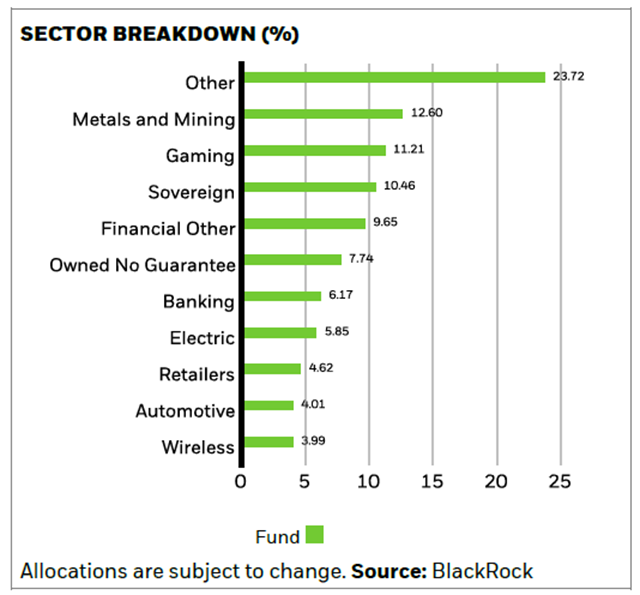
The holdings were spread across several sectors. Excluding the Other sector at 24.45%, the biggest buckets included Metals and Mining at 12.34%, Gaming at 11.03%, Sovereign at 10.46%, Financial Other at 8.87%, and Banking at 7.16%.
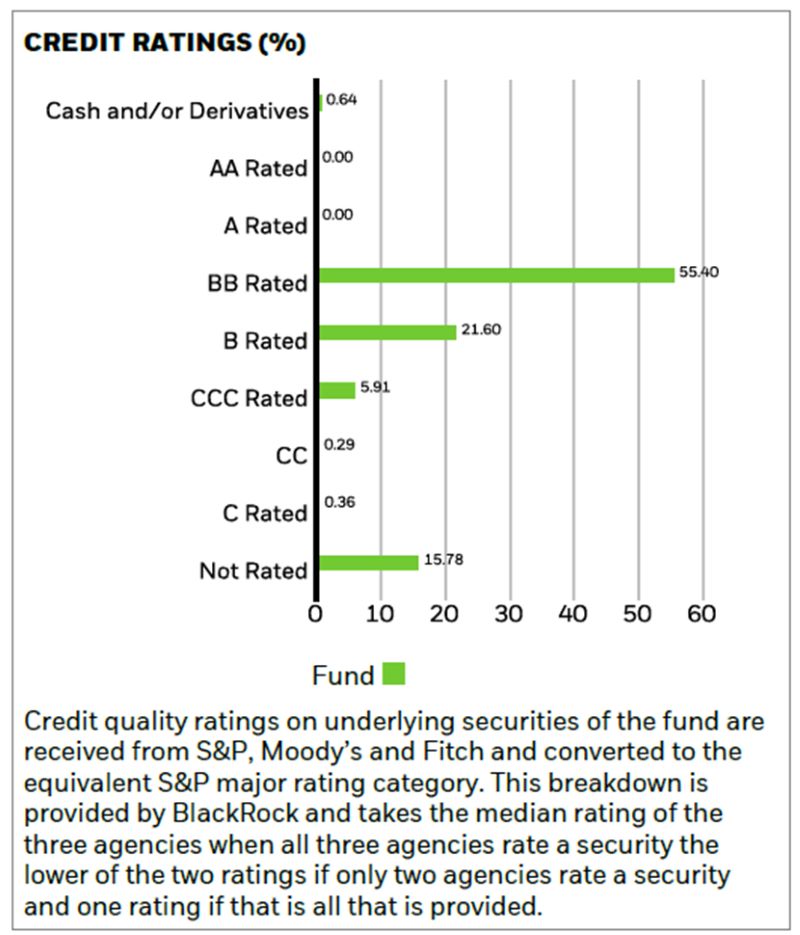
Its credit profile also helps explain the higher yield. About 56.34% of the portfolio was rated BB and 21.30% was rated B. Another 15.14% was not rated.
As of 28 February 2026, iShares USD Asia High Yield Bond ETF had an average weighted maturity of 4.61 years, a weighted average yield to maturity of 7.06%, and an effective duration of 2.67 years. Its 3-year standard deviation was 5.64%. This suggests the ETF is offering attractive income, but it still comes with meaningful credit and price volatility.
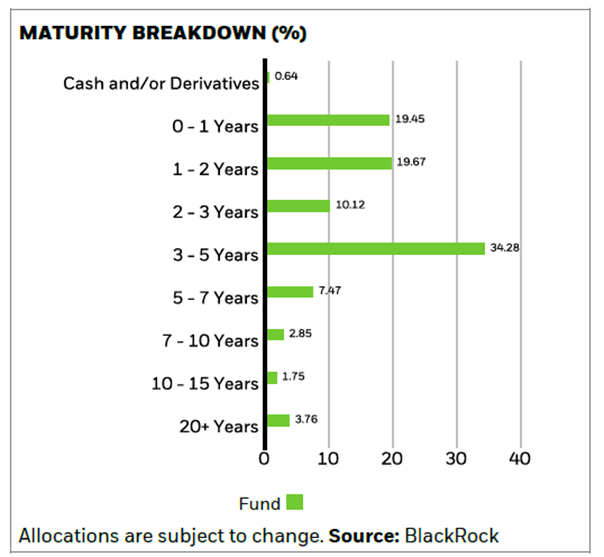
The maturity profile was tilted towards the short to intermediate end of the curve. About 18.11% of the bonds matured within a year, 18.94% in one to two years, and 32.67% in three to five years.
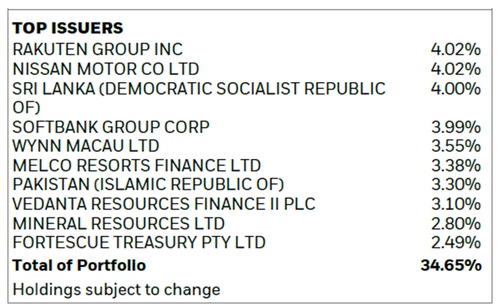
The top issuers included Rakuten and Nissan Motor at 4.02% each. Sri Lanka and SoftBank Group each made up 3.00% and 3.99% respectively. Wynn Macau was next at 3.55%.
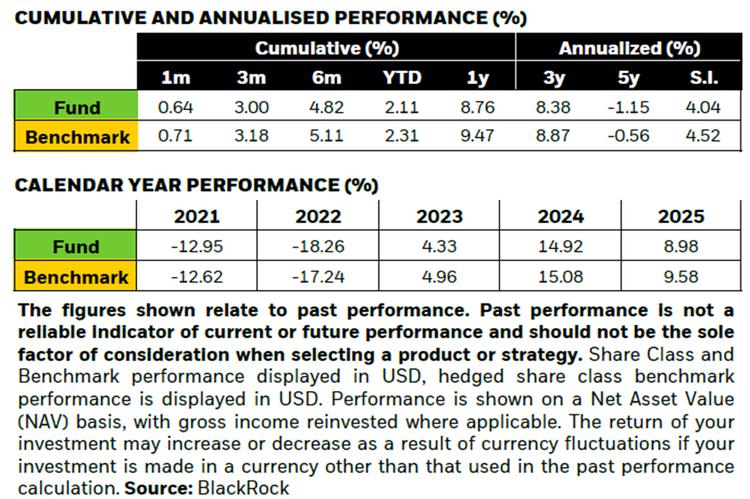
The recent performance of the iShares USD Asia High Yield Bond ETF has been decent.
As of 28 February 2026, the fund returned 0.64% over one month, 3.00% over three months, 4.82% over six months and 8.76% over one year. Since inception, its annualised return was 4.04%.
Longer term returns show that this is still a cyclical asset class. The fund delivered an annualised return of 8.38% over three years, but negative 1.15% over five years.
Calendar year returns were negative in 2021 and 2022, before recovering in 2023, 2024 and 2025.
Looking at its tracking quality, It has a rolling one year tracking difference of negative 0.70% and a rolling one year tracking error of 0.59% as of 28 February 2026.
The iShares USD Asia High Yield Bond ETF has a total expense ratio including annual management fee of 0.50% p.a..
Learn more about the iShares USD Asia High Yield Bond ETF here.
| Metric | iShares USD Asia High Yield Bond ETF |
| SGX counters | O9P for USD and QL3 for SGD |
| AUM | US$667.07 million (as of 28 February 2026) |
| Distribution yield | 7.21%^ (as of 16 March 2026) |
| Frequency of distribution | Quarterly |
| Management fee | 0.50% p.a. |
| Total expense ratio | 0.50% p.a. |
| Asset class | Fixed income |
| Geographical exposure | Asia ex Japan |
| What it holds | USD-denominated high yield bonds issued by Asian governments and Asian-domiciled corporates |
| Underlying index | Bloomberg Asia USD High Yield Diversified Credit Index |
| SRS-eligible | Yes |
| Source: SGX ETF screener as of 16 March 2026, BlackRock’s February 2026 factsheet as of 28 February 2026 ^Historical Dividend Yield over 12-month period (%) as of ex-dividend date | |
#2 - Lion-OCBC Securities Singapore Low Carbon ETF (ESG/ESU)
Lion-OCBC Securities Singapore Low Carbon ETF may feel more familiar to local investors.
It was listed on SGX on 28 April 2022 and tracks the iEdge-OCBC Singapore Low Carbon Select 40 Capped Index.
The ETF trades on SGX in SGD under ESG and in USD under ESU.
It pays distributions semi-annually, with recent regular payouts around July and January. As of 16 March 2026, Lion-OCBC Securities Singapore Low Carbon ETF had a dividend yield of 6.53%.
Lion-OCBC Securities Singapore Low Carbon ETF invests in 40 Singapore companies, including REITs and business trusts, selected from the top names by free-float market capitalisation. The index also excludes companies involved in fossil fuels and applies a carbon performance screen based on greenhouse gas emissions intensity.
The portfolio is rebalanced semi-annually in March and September.
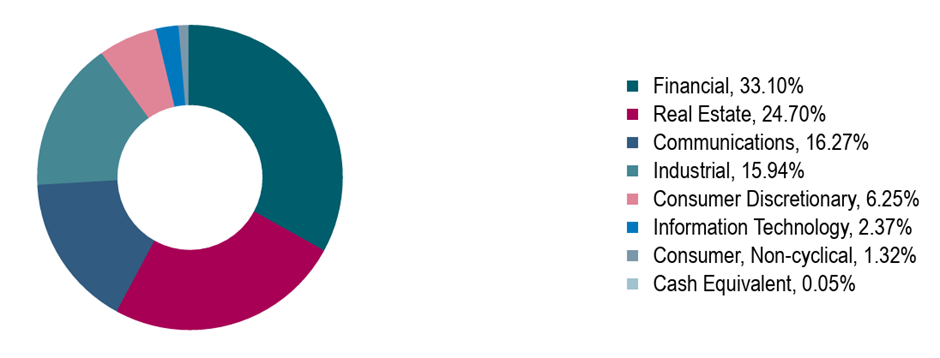
The latest sector mix shows that this is still very much a Singapore equity income ETF, even with its low carbon tilt. As of 31 January 2026, the largest sub-industry exposures were Financial at 33.10%, Real Estate at 24.70%, Communications at 16.27%, and Industrial at 15.94%.
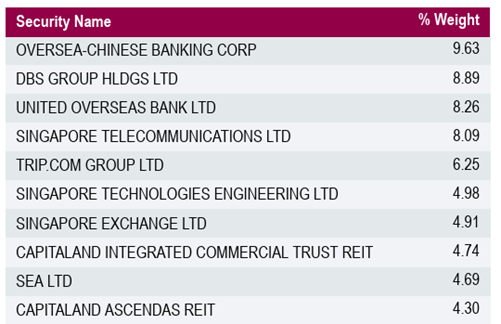
As of 31 January 2026, the largest holdings were OCBC at 9.63%, DBS at 8.89%, UOB at 8.26%, Singtel at 8.09%, and Trip.com at 6.25%.
As of 31 January 2026, Lion-OCBC Securities Singapore Low Carbon ETF returned 24.68% over one year, with a 3-year annualised return of 17.83%.
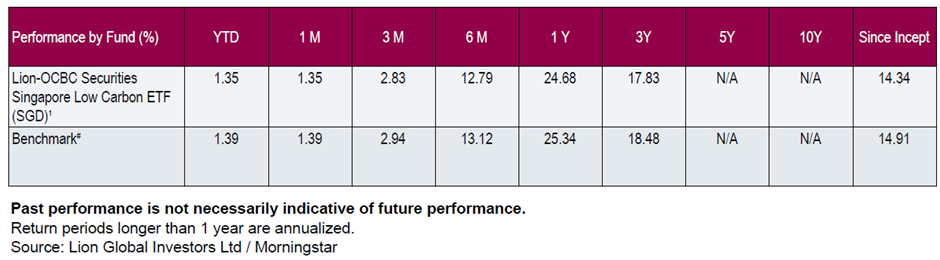
As of 28 February 2026, it had a fund size of S$114.4 million.
Its management fee was 0.40% a year, while its expense ratio is capped at 0.45% a year for the first three years from inception.
| Metric | Lion-OCBC Securities Singapore Low Carbon ETF |
| SGX counters | ESG for SGD and ESU for USD |
| AUM | S$114.4 million (As of 28 February 2026) |
| Distribution yield | 6.53%^ (As of 16 March 2026) |
| Frequency of distribution | Semi-annual |
| Management fee | 0.40% p.a. |
| Total expense ratio | Capped at 0.45% p.a. for 3 years from inception |
| Asset class | Equities |
| Geographical exposure | Singapore |
| What it holds | Top 40 Singapore companies with a low carbon screen |
| Underlying index | iEdge-OCBC Singapore Low Carbon Select 40 Capped Index |
| SRS-eligible | Yes |
| Source: SGX ETF screener as of 16 March 2026, Lion Global Investors’ official fund page as of 28 February 2026 ^Historical Dividend Yield over 12-month period (%) as of ex-dividend date | |
#3 - UOBAM Ping An FTSE ASEAN Dividend Index ETF (UPD/UPU)
UOBAM Ping An FTSE ASEAN Dividend Index ETF was listed on SGX on 29 January 2026 and hence the newest ETF in this group.
The ETF trades on SGX in SGD under UPD and in USD under UPU.
It seeks to replicate the FTSE ASEAN ex REITs Target Dividend Index as closely as possible before fees and expenses.
UOBAM Ping An FTSE ASEAN Dividend Index ETF is built around a basket of 57 constituents and focuses on dividend-paying stocks across ASEAN, excluding REITs.
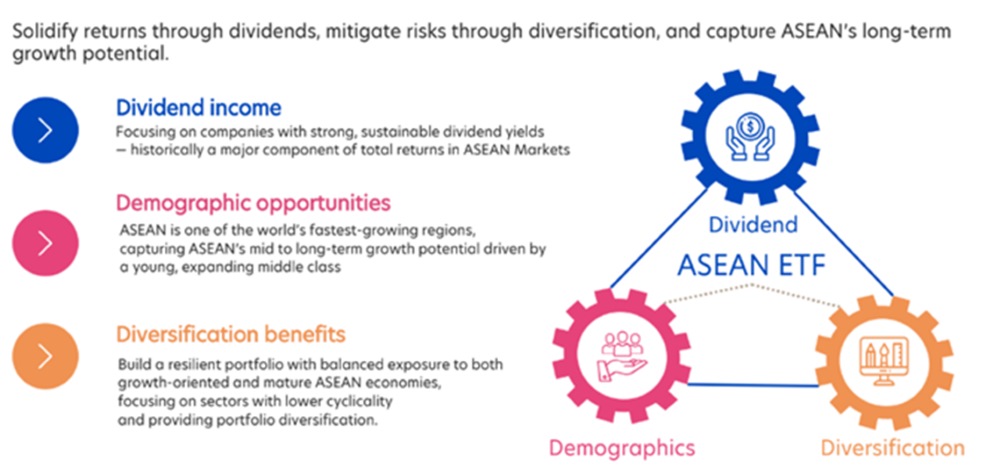
The benchmark is designed to achieve a 100% dividend yield increase compared with the FTSE ASEAN Index by assigning more weight to companies with stronger dividend yields.
The ETF has also stated a target to pay dividends of at least 6%* per annum in 2026 and 2027. However, do note that while there is a dividend target, distributions (in SGD) are not guaranteed. Distributions may also be made out of income, capital gains and/or capital.
The ETF gives exposure to dividend-paying companies across Singapore, Malaysia, Indonesia, Thailand and the Philippines, while excluding REITs.
The latest holdings show that the portfolio remains anchored by large ASEAN banks and regional blue chips. As of 11 March 2026, the top five indicative holdings were DBS at 9.58%, Bank Mandiri at 7.21%, OCBC at 6.96%, Bank Rakyat Indonesia at 6.80%, and Maybank at 4.83%.
UOBAM Ping An FTSE ASEAN Dividend Index ETF had a fund size of S$77.79 million as of 11 March 2026. That makes it the smallest ETF among the three by AUM.
The management fee is currently 0.45% a year.
This ETF may be worth considering for those who already have a lot of Singapore exposure and want broader regional diversification and access to dividend leaders across ASEAN.
Learn more about the UOBAM Ping An FTSE ASEAN Dividend Index ETF here.
| Metric | UOBAM Ping An FTSE ASEAN Dividend Index ETF |
| SGX counters | UPD for SGD and UPU for USD |
| AUM | S$77.79 million (as of 11 March 2026) |
| Distribution yield | 6.0%* p.a. target in 2026 and 2027 |
| Frequency of distribution | Semi-annual |
| Management fee | 0.45% p.a. |
| Asset class | Equities |
| Geographical exposure | ASEAN |
| What it holds | Dividend-paying stocks across Singapore, Malaysia, Indonesia, Thailand and the Philippines |
| Underlying index | FTSE ASEAN ex REITs Target Dividend Index |
| SRS-eligible | Yes |
| Source: UOBAM’s official fund materials, UOBAM Ping An FTSE ASEAN Dividend Index ETF official fund page as of 11 March 2026 | |
How are these 3 dividend ETFs different?
While the 3 ETFs may offer dividend yields of 6% and above, there are significant differences in how they generate the income.
The iShares USD Asia High Yield Bond ETF tracks a bond index and gives exposure to higher-yielding Asian corporate bonds. The Lion-OCBC Securities Singapore Low Carbon ETF tracks a Singapore equity index with a low-carbon tilt, while the UOBAM Ping An FTSE ASEAN Dividend Index ETF tracks a regional dividend index made up of ASEAN stocks.
Because of this, the source of income is quite different. For the iShares ETF, the income comes mainly from bond coupons. For the Lion-OCBC ETF, the distributions come from dividends paid by Singapore large-cap companies. For the UOBAM Ping An ETF, the income comes from dividend-paying companies across Southeast Asia.
The risks are also different. The bond ETF is more affected by changes in credit conditions and the US dollar. The Singapore equity ETF depends more on the performance of the local stock market. The ASEAN dividend ETF adds exposure to different countries, sectors and currencies across the region.
So even though all three show yields above 6%, I would not look at the yield alone. In practice, the choice is really between bond income, Singapore equity income, or regional dividend exposure, and each plays a different role within an income portfolio.
| ETF | iShares USD Asia High Yield Bond ETF (QL3/O9P) | Lion-OCBC Securities Singapore Low Carbon ETF (ESG/ESU) | UOBAM Ping An FTSE ASEAN Dividend Index ETF (UPD/UPU) |
| Assets Under Management (AUM) | US$667.07 million (as of 28 February 2026) | S$114.4 million (as of 28 February 2026) | S$75.59 million (as of 11 March 2026) |
| Underlying index / benchmark | Bloomberg Asia USD High Yield Diversified Credit Index | iEdge-OCBC Singapore Low Carbon Select 40 Capped Index | FTSE ASEAN ex REITs Target Dividend Index |
| Asset class | Fixed income | Equities | Equities |
| Geographical exposure | Asia ex Japan | Singapore | ASEAN |
| Distribution frequency | Quarterly | Semi-annual | Semi-annual |
| Distribution Yield | 7.21%^ (as of 16 March 2026) | 6.53%^ (as of 16 March 2026) | At least 6.0%* |
| Total expense ratio | 0.50% | 0.45% | 0.45% (management fee) |
| Source: SGX ETF screener as of 16 March 2026, and respective fund factsheet available as of 28 February 2026. ^Historical Dividend Yield over 12-month period (%) as of ex-dividend date | |||
What would Beansprout do?
With the recent market volatility, one way I have been thinking about making my portfolio more resilient is to ensure that my income does not come from just one source.
ETFs make this easier, as they allow me to hold a diversified basket of income-generating assets in a single position, usually at lower cost than actively managed funds.
Recently, I noticed that several ETFs on SGX are offering distribution yields of around 6% or more. But when looking at these ETFs, the key difference is not just the yield itself, but how that income is generated and how stable it is likely to be over time.
The iShares USD Asia High Yield Bond ETF had the highest distribution yield at 7.21% as of 16 March 2026 and pays quarterly distributions. It also has the largest AUM and the longest track record among the three.
However, the higher yield comes from investing in lower-rated Asian bonds and holding US dollar assets, which means the income level may fluctuate more if market conditions change. Learn more about the iShares USD Asia High Yield Bond ETF here.
The Lion-OCBC Securities Singapore Low Carbon ETF had a distribution yield of 6.53% and pays distributions semi-annually at the manager’s discretion. Its income comes from Singapore-listed companies, with large exposure to banks, REITs and telcos. Because the distributions depend on company earnings and dividends, the yield may vary if business conditions weaken.
The UOBAM Ping An FTSE ASEAN Dividend Index ETF targets at least 6.0% per annum in 2026 and 2027 and also pays semi-annually, although distributions are not guaranteed. It provides exposure to dividend-paying companies across ASEAN markets, offering more regional diversification, but it also has a shorter track record and smaller fund size. Learn more about the UOBAM Ping An FTSE ASEAN Dividend Index ETF here.
Overall, while all three ETFs offer income, I see them as serving slightly different roles in my portfolio.
When I compare them, I look at whether I am trying to get a higher yield, stay focused on Singapore, or diversify across the region.
Rather than relying on just one, I would think of them as tools that can sit within a broader income portfolio alongside other sources of cash flow.
If you’re looking to explore other bond funds, explore the best Singapore bond ETFs here.
If you prefer a broad exposure towards blue chips in Singapore, read our guide to STI ETF here.
If you are looking to diversify into Singapore REITs, check out the best Singapore REIT ETFs here.
If you’re looking for ETFs with a growth-tilted angle, check out the 5 SGX ETFs to gain exposure to Asia’s fastest-growing sectors as well as the best S&P 500 ETFs for Singapore investors.
[Beansprout Exclusive Longbridge Promotion] Get bonus S$50 FairPrice voucher within 5 working days, plus 5% p.a. interest boost coupon (worth ~S$100) when you sign up for a Longbridge account via Beansprout. Plus, stand a chance to win 1g of gold bar. Promo ends on 31 March 2026. T&Cs apply. Learn more about the Longbridge promotion here.
Check out the best stock trading platforms in Singapore with the latest promotions to invest in Singapore ETFs.
Enjoyed this insight? Follow Beansprout on Telegram, Youtube, Facebook and Instagram, and add Beansprout as your preferred source on Google so you never miss an update.
Here are other resources to help you learn more about ETFs:
- Guide to STI ETF
- Best Singapore REIT ETFs
- Best Singapore Bond ETFs
- Best S&P 500 ETFs for Singapore investors
- 7 SGX ETFs to gain exposure to China
- Best gold ETF in Singapore
- Top 10 ETFs bought by SRS investors in 2025
- 5 SGX ETFs to gain exposure to Asia’s fastest-growing sectors
- LionGlobal Singapore Physical Gold ETF vs SPDR Gold Shares - Which gold ETF to choose?
*Distributions (in SGD) are not guaranteed. Distributions may be made out of income, capital gains and/or capital. This relates to the disclosed distribution policy as set out in the Fund’s prospectus.
Read also
Gain financial insights in minutes
Subscribe to our free weekly newsletter for more insights to grow your wealth
Most Popular

Comments
1 comments
- Mercury • 10 Apr 2026 07:48 AM