
4 Singapore REITs with dividend yields of up to 7% to watch as office rents rise amid AI boom
REITs
By Goh Lay Peng • 16 Oct 2026
Why trust Beansprout? We’ve been awarded Best Investment Website at the SIAS Investors’ Choice Awards 2025
'%3e%3cpath%20fill-rule='evenodd'%20clip-rule='evenodd'%20d='M17.64%209.20455C17.64%208.56637%2017.5827%207.95273%2017.4764%207.36364H9V10.845H13.8436C13.635%2011.97%2013.0009%2012.9232%2012.0477%2013.5614V15.8195H14.9564C16.6582%2014.2527%2017.64%2011.9455%2017.64%209.20455V9.20455Z'%20fill='%234285F4'/%3e%3cpath%20fill-rule='evenodd'%20clip-rule='evenodd'%20d='M9%2018C11.43%2018%2013.4673%2017.1941%2014.9564%2015.8195L12.0477%2013.5614C11.2418%2014.1014%2010.2109%2014.4205%209%2014.4205C6.65591%2014.4205%204.67182%2012.8373%203.96409%2010.71H0.957275V13.0418C2.43818%2015.9832%205.48182%2018%209%2018V18Z'%20fill='%2334A853'/%3e%3cpath%20fill-rule='evenodd'%20clip-rule='evenodd'%20d='M3.96409%2010.71C3.78409%2010.17%203.68182%209.59318%203.68182%209C3.68182%208.40682%203.78409%207.83%203.96409%207.29V4.95818H0.957273C0.347727%206.17318%200%207.54773%200%209C0%2010.4523%200.347727%2011.8268%200.957273%2013.0418L3.96409%2010.71V10.71Z'%20fill='%23FBBC05'/%3e%3cpath%20fill-rule='evenodd'%20clip-rule='evenodd'%20d='M9%203.57955C10.3214%203.57955%2011.5077%204.03364%2012.4405%204.92545L15.0218%202.34409C13.4632%200.891818%2011.4259%200%209%200C5.48182%200%202.43818%202.01682%200.957275%204.95818L3.96409%207.29C4.67182%205.16273%206.65591%203.57955%209%203.57955V3.57955Z'%20fill='%23EA4335'/%3e%3c/g%3e%3cdefs%3e%3cclipPath%20id='clip0_0_2849'%3e%3crect%20width='18'%20height='18'%20fill='white'/%3e%3c/clipPath%3e%3c/defs%3e%3c/svg%3e)
Make Beansprout your preferred source on Google
Add us on Google to see more of our insights in your search results
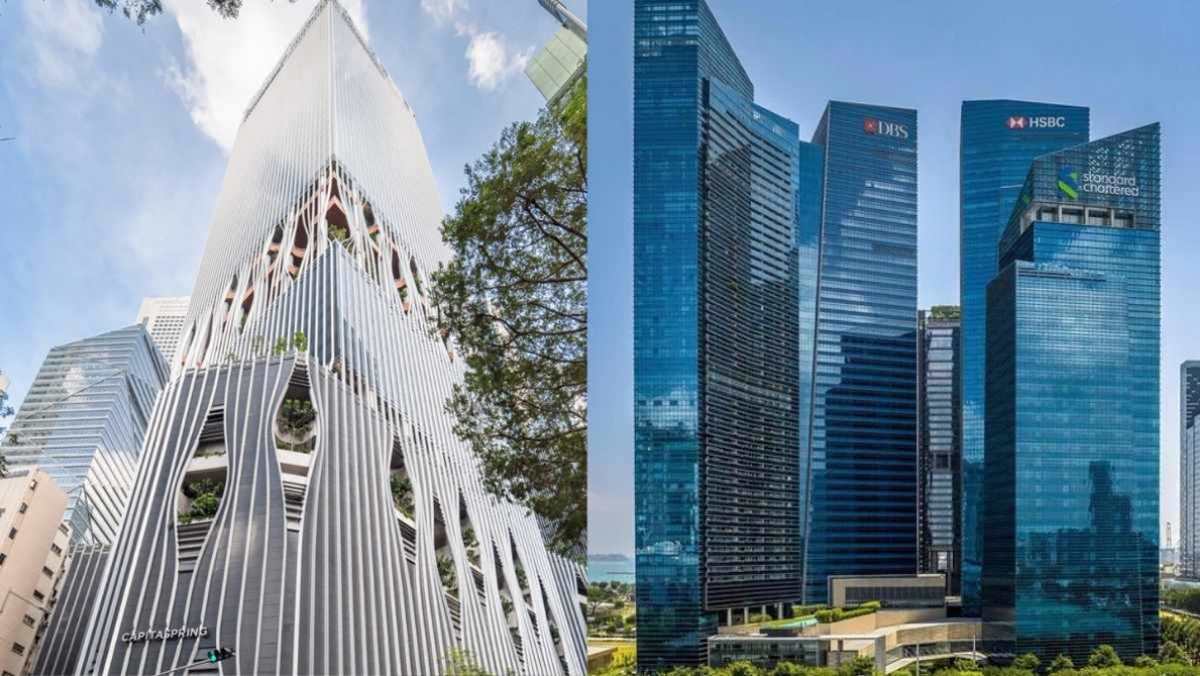
Singapore office rents are rising amid the AI boom. We compare 4 REITs with dividend yields of up to 7% on rental growth, financial strength and dividends to see which could benefit.
What happened?
Singapore REITs with office exposure are seeing a tighter office market.
According to CBRE, Core Central Business District (CBD) Grade A vacancy fell to 2.6% in the third quarter of 2026, while rents rose 2.0% quarter-on-quarter to S$12.75 per square foot per month.
JLL also reported CBD Grade A rents rising 1.0% quarter-on-quarter and 2.8% year-to-date in the third quarter.
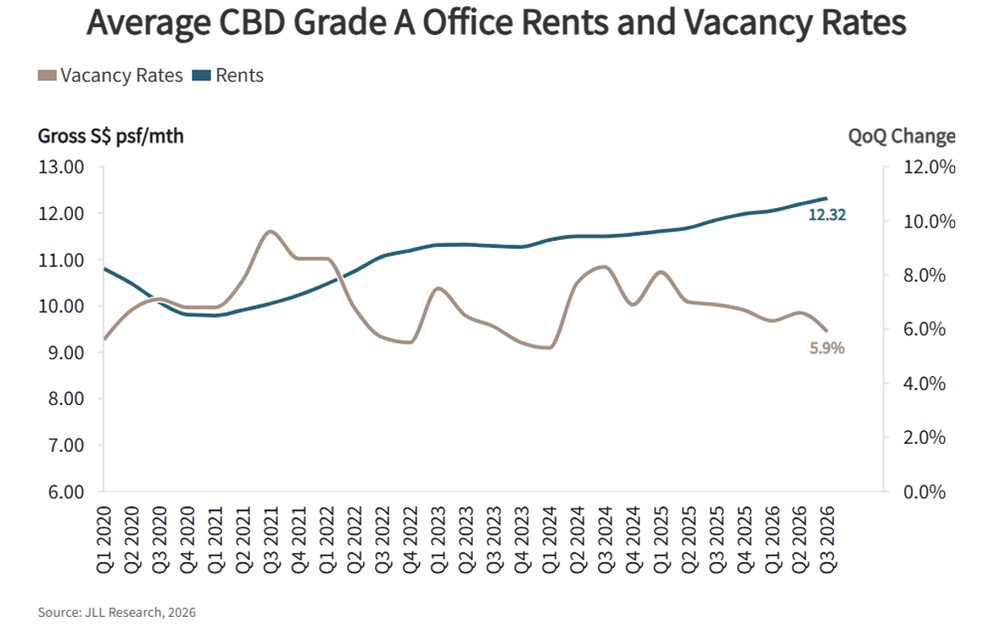
With limited new office supply, CBRE expects full-year rental growth to exceed 5% in 2026.
JLL also highlighted AI and technology companies as a growing source of leasing demand, while the Financial Times reported that OpenAI is in talks to lease around 100,000 square feet in central Singapore, alongside expansion plans by Anthropic and Databricks.
At the same time, we recently looked at how higher US rates could affect Singapore REITs and which S-REITs offered the highest dividend yields in 1H26.
With rising office rents adding another factor for income investors to watch, we compare four Singapore REITs with exposure to prime CBD offices, namely Suntec REIT, Keppel REIT, OUE REIT and CapitaLand Integrated Commercial Trust (CICT), to see which are better positioned to benefit from rising rents and what this could mean for their distributions.
Why rising office rents could benefit Singapore REITs
Higher office rents can support a REIT's rental income when existing leases are renewed at higher rates.
However, higher rents do not automatically translate into higher dividends for REIT investors.
I would focus on three factors: occupancy, rental reversion and lease expiries, and balance-sheet strength.
High occupancy gives landlords more pricing power, while shorter leases provide more opportunities to reset rents towards market levels.
A shorter weighted average lease expiry (WALE) also creates more leasing risk if tenants do not renew.
That is why rental reversion needs to be considered together with occupancy.
Balance sheets matter because stronger rents do not automatically lead to higher distribution per unit (DPU).
Financing costs, asset sales and new equity can offset the benefit from rental growth.
For income investors, I would therefore look beyond the AI headlines and assess which REITs have the best combination of office exposure, opportunities to raise rents and financial flexibility.
Four Singapore REITs that could benefit from higher office rents
#1 - Keppel REIT: Prime CBD exposure with an improving balance sheet
Keppel REIT has direct exposure to Singapore's prime CBD through Marina Bay Financial Centre, One Raffles Quay and Ocean Financial Centre.
After the divestment of T Tower in Seoul and the earlier sale of KR Ginza II in Tokyo, management expects Singapore to account for 81.1% of portfolio value.
This increases its exposure to the market where office vacancy is currently tight.
According to its first-half 2026 presentation, rental reversion was positive at 12.8% and committed portfolio occupancy was 96.0% as at 30 June 2026.
Its Singapore portfolio had a WALE of 2.8 years, giving it room to capture higher rents as leases roll over.
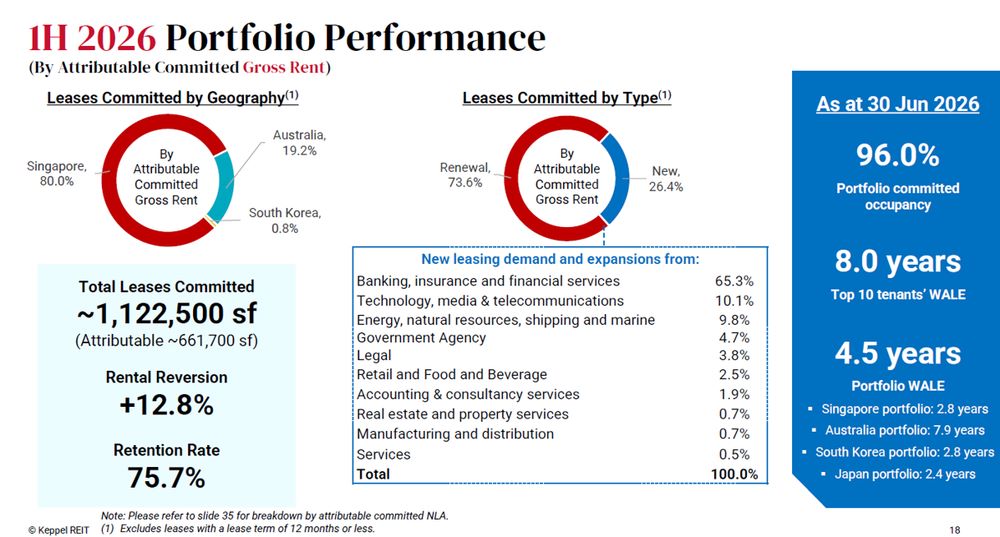
The weaker point is DPU. First-half 2026 DPU fell 4.0% year-on-year to 2.61 cents, after FY2025 DPU declined to 5.23 cents from 5.60 cents in FY2024. Keppel REIT offers a forward yield of 6.0%.
Aggregate leverage was 40.0% at June 2026. Management expects this to fall to around 38.0% on a pro forma basis if divestment proceeds are used to repay debt.
For me, Keppel REIT offers relatively direct exposure to prime CBD rents, but the next step is to see rental growth translate into recurring DPU growth.
Find out how much dividends you would have received as a shareholder of Keppel REIT in the past 12 months with the calculator below.
Related links:
#2 - Suntec REIT: Near-full occupancy, but higher gearing
Suntec REIT's Singapore office portfolio includes Suntec City Office, One Raffles Quay and Marina Bay Financial Centre Towers 1 and 2.
Committed Singapore office occupancy was 99.5% as at 30 June 2026, while rental reversion was positive at 10.1% in the first half. WALE was 2.4 years.
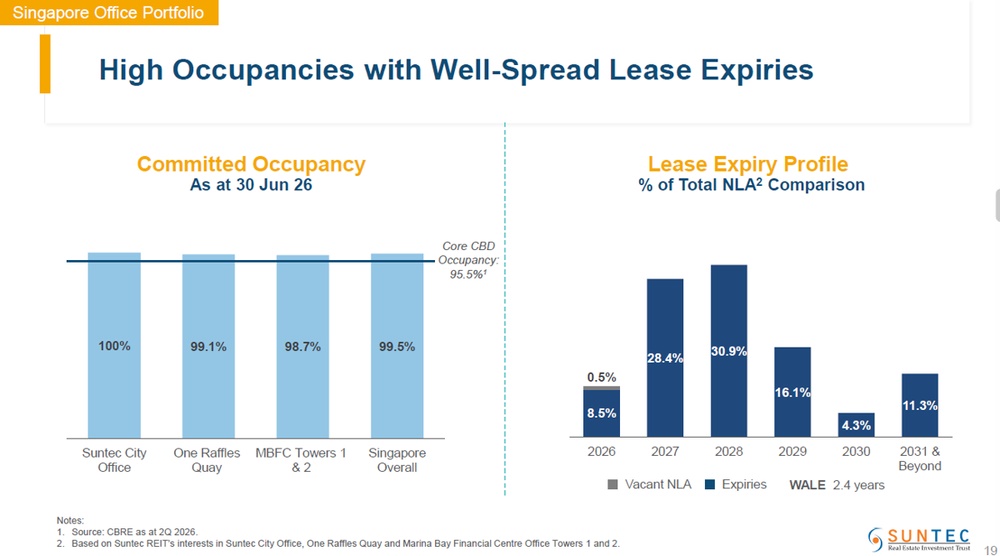
That combination gives Suntec REIT meaningful rent-reset opportunities if the market remains tight.
With occupancy already near full, most of the upside has to come through lease renewals rather than filling vacant space.
First-half 2026 DPU rose 24.8% year-on-year to 3.936 cents. Suntec REIT’s forward yield is about 6.0%.
Following a strategic review announced in September 2026, the REIT also intends to reduce overseas exposure, starting with the proposed divestment of three Australian properties.
The trade-off is leverage.
Aggregate leverage was 43.0% at June 2026, the highest among the four REITs here, although management has completed a S$100 million refinancing to extend its debt maturity profile.
Suntec REIT therefore has one of the clearest near-term rent-capture profiles, but I would watch whether asset recycling can reduce its balance-sheet risk.
Find out how much dividends you would have received as a shareholder of Suntec REIT in the past 12 months with the calculator below.
Related Links:
- Suntec REIT latest valuation, share price and analysis
- Suntec REIT dividend history and dividend forecasts
#3 - OUE REIT: More rent-reset potential, with more leasing risk
OUE REIT's Singapore office portfolio includes One Raffles Place, OUE Downtown Office and a 50% interest in OUE Bayfront.
According to its first-half 2026 presentation, office occupancy was 91.5%, average passing rent was S$11.10 per square foot and rental reversion was positive at 4.7%. WALE was 1.9 years by net lettable area and 2.0 years by gross rental income.
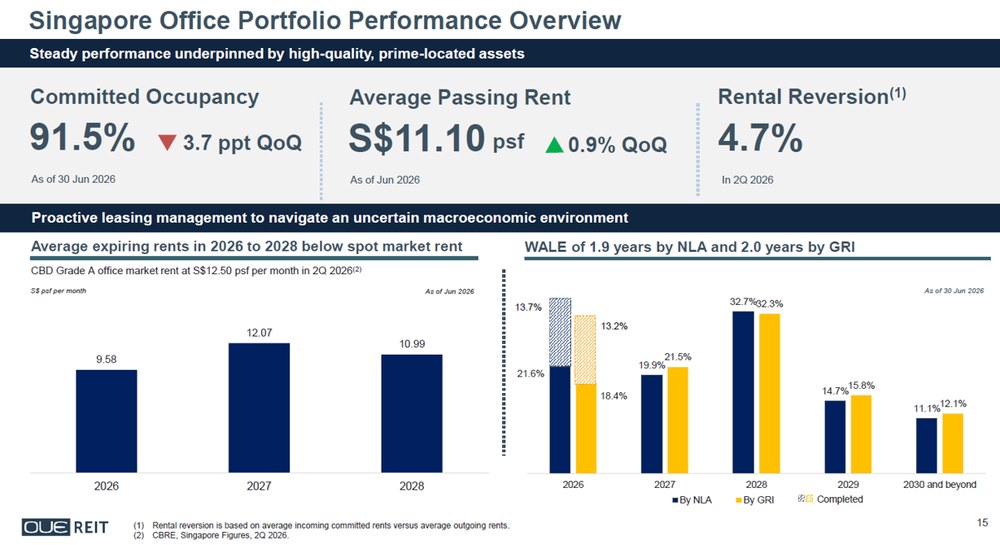
The same presentation showed average expiring rents of S$9.58 for 2026 and S$10.99 for 2028, below the S$12.50 CBD Grade A spot market reference used in the slide.
That creates potential rental upside if leases can be renewed closer to market levels.
The trade-off is occupancy.
OUE REIT has more vacant space than Keppel REIT and Suntec REIT, so the same lease turnover that creates rent-reset upside also creates more execution risk.
First-half 2026 distributable income rose 28.6% year-on-year, although the improvement also reflected hospitality performance, capital recycling and lower finance costs.
Its recurring DPU offers a forward yield of 7.1%.
I would therefore avoid treating the earnings improvement as an office-rental story alone.
Its proposed S$500 million divestment of Crowne Plaza Changi Airport could reduce aggregate leverage from 41.5% to 36.6% on a pro forma basis if remaining proceeds after the planned special distribution are used to repay debt.
Find out how much dividends you would have received as a shareholder of OUE REIT in the past 12 months with the calculator below.
Related links:
#4 - CapitaLand Integrated Commercial Trust: Diversified exposure with lower leverage
CapitaLand Integrated Commercial Trust (CICT) is not a pure office REIT because its portfolio also includes retail and integrated developments.
However, it has meaningful exposure to prime Singapore offices including CapitaSpring, Capital Tower, CapitaGreen, Six Battery Road and CapitaSky.
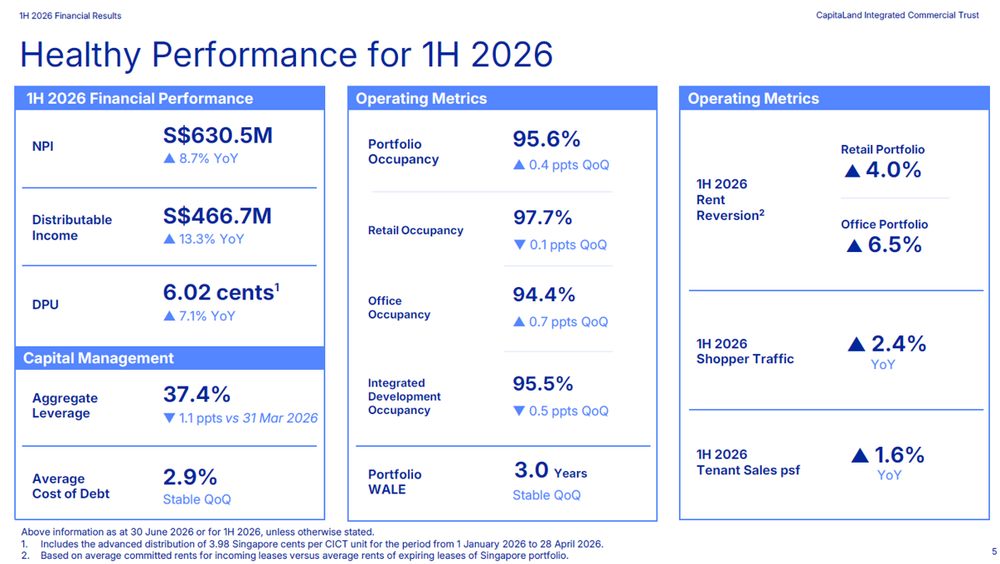
CICT's Singapore office portfolio had 94.4% committed occupancy as at June 2026, up from 93.7% in March.
Office rental reversion was positive at 6.5% in the first half, while average Singapore office rent rose 2.0% year-on-year to S$11.03 per square foot per month.
There is also rent-reset potential.
CICT’s average rents of S$11.42 for leases expiring in 2026 and S$11.87 for 2027 are below CBRE's S$12.50 Grade A Core CBD market rent reference as at June 2026.
Technology-related tenants are already part of CICT's leasing mix.
In the second quarter of 2026, information technology and telecommunications was one of the top three areas of leasing interest, although this does not mean the demand was specifically AI-driven.
CICT also has the strongest reported balance sheet of the four on this measure.
Aggregate leverage was 37.4% as at June 2026, while first-half 2026 DPU rose 7.1% year-on-year to 6.02 cents.
At a unit price of S$2.27, CICT offers a forward yield of 5.3%.
The trade-off is that CICT is less sensitive to a pure office upswing because retail and other assets contribute to its earnings.
For income investors, that diversification can also make the office thesis less dependent on a single property segment.
Find out how much dividends you would have received as a shareholder of CapitaLand Integrated Commercial Trust (CICT) in the past 12 months with the calculator below.
Related links:
- Capitaland Integrated Commercial Trust latest valuation, share price and analysis
- Capitaland Integrated Commercial Trust dividend history and forecast
Which of these four REITs are better positioned to benefit from rising office rents?
The four REITs have different levels of exposure to Singapore's office market and opportunities to benefit from rising rents.
Suntec REIT has near-full Singapore office occupancy, while Keppel REIT achieved the strongest rental reversion in 1H 2026.
OUE REIT has more opportunities to fill vacant office space, while CICT offers more diversified income sources and lower reported leverage.
| Keppel REIT | Suntec REIT | OUE REIT | CICT | |
| Singapore exposure | 81.1% of portfolio value | Large Singapore portfolio | Significant Singapore CBD exposure | 94.4% of portfolio value |
| Singapore office exposure | Prime CBD | Prime CBD | Prime CBD | Prime CBD |
| Office occupancy | ~96.2% portfolio | 99.5% Singapore office | Lower than peers | ~94.4% portfolio |
| Recent rental reversion | 12.8% in 1H26 | 10.1% in 1H26 | Positive | 6.5% in 1H26 |
| Lease profile | Singapore WALE 2.8 years | Office WALE 2.4 years | WALE 1.9 years by NLA | Overall WALE ~3.0 years |
| Key assets | MBFC, ORQ, OFC | Suntec City, ORQ, MBFC | OUE Bayfront, One Raffles Place | CapitaSpring, Capital Tower, CapitaGreen, Six Battery Road, CapitaSky |
| Key catalyst | Singapore rental growth + deleveraging | Singapore focus + asset recycling | Lease rollover + rental mark-to-market | Rental growth + asset enhancement |
| Key risk | Prime office valuations / rates | Higher gearing | Occupancy and leasing execution | Diversified exposure means less pure office upside |
Source: Respective REITs’ 1H 2026 financial results and business updates. Occupancy, rental reversion and WALE figures follow each REIT's reported definitions and may cover different portfolio segments. | ||||
While Keppel REIT and Suntec REIT have relatively direct exposure to rising office rents, OUE REIT offers more opportunities to raise rents as leases expire, and CICT provides greater diversification.
However, stronger office fundamentals do not necessarily translate into higher distributions.
For income investors, I would also consider how leasing risks, financing costs and balance-sheet strength could affect each REIT's ability to sustain its distributions.
What are the risks of Singapore REITs with office exposure?
AI demand may support the overall market without translating into leases for these four REITs.
A tighter market also does not remove leasing risk.
Shorter leases create more opportunities to reset rents, but tenants may downsize, relocate or negotiate differently when leases expire.
Financing remains another key variable.
Higher borrowing costs or weak capital management can offset rental growth and reduce the amount available for distribution.
What would Beansprout do?
I see the growing demand for Singapore office space, including from AI companies, as a positive development for office landlords.
However, I would not invest in a Singapore REIT based on the AI growth story alone.
I would use it as an additional reason to look at the REITs that already have prime CBD assets, strong occupancy, lease expiries and manageable gearing.
For my Income Pot within Beansprout's Four Pots of Wealth, I would focus on REITs that can translate higher rental income into sustainable distributions.
As a starting point, I would apply the three checks from our Singapore REIT screening framework, which look at DPU growth, financial health and distribution yield.
| Income REIT screening check | Keppel REIT | Suntec REIT | OUE REIT | CICT |
| DPU growth | ❌ Fail — 1H26 DPU fell 4.0% YoY to 2.61 cents | ✅ Pass — 1H26 DPU rose 24.8% YoY to 3.936 cents | ✅ Pass — 1H26 DPU rose 28.6% YoY to 1.26 cents | ✅ Pass — 1H26 DPU rose 7.1% YoY to 6.02 cents |
| Aggregate leverage <45% | ✅ Pass — 40.0% | ✅ Pass — 43.0% | ✅ Pass — 41.5% | ✅ Pass — 37.4% |
| Dividend yield >5% | ✅ Pass — 6.0%* | ✅ Pass — 6.0% | ✅ Pass — 7.1% | ✅ Pass — 5.3% |
| Overall | 2/3 checks | 3/3 checks | 3/3 checks | 3/3 checks |
Based on the initial checks using 1H 2026 DPU growth, reported leverage and an indicative yield threshold of 5%, CICT, Suntec REIT and OUE REIT meet all three criteria, while Keppel REIT falls short on DPU growth.
However, passing all three checks does not automatically mean that a REIT is an attractive investment for my Income Pot.
I would still need to look more closely at the underlying fundamentals to assess whether its distributions can be sustained, particularly whether rental growth can offset financing costs and support recurring DPU.
Among the four, Suntec REIT stands out for its near-full office occupancy and 10.1% rental reversion, but I would want to see progress in reducing its 43.0% leverage.
Keppel REIT is a close alternative, with strong rental reversion and a potentially improving leverage profile. However, I would want recurring DPU to stabilise.
CICT offers a different balance. Its office portfolio is benefiting from positive rental reversion and below-market expiring rents, while 37.4% leverage and DPU growth provide a stronger starting point for income investors. I would see CICT as the more diversified option rather than the purest way to capture the office cycle.
OUE REIT offers the greatest rent-reset runway, but its lower occupancy makes leasing execution more important.
Ultimately, I would use our screening framework to narrow down the REITs worth researching, rather than make an investment decision based on dividend yield alone.
You can find which other REITs that meet these checks in our Income REITs Screener.
With a higher interest rate environment, I’d also diversify my income sources with quality Singapore dividend stocks to avoid relying too heavily on one sector.
To find out which stocks and REITs we would hold in our model portfolio, check out how we would invest $100,000 in Singapore today.
For more of our investment views and portfolio thinking, explore Beansprout Pro.
Which matters more to you in this office cycle: Suntec REIT's near-full occupancy, Keppel REIT's prime CBD exposure, CICT's stronger balance sheet, or OUE REIT's shorter lease profile? Share your view in the Beansprout Telegram community.
Follow Beansprout on Youtube, Facebook and Instagram, and add Beansprout as your preferred source on Google so you never miss an update.
Read also
Gain financial insights in minutes
Subscribe to our free weekly newsletter for more insights to grow your wealth
Most Popular

Comments
0 comments