
UCITS ETFs in Singapore: How to compare CSPX, VWRA and IWDA
ETFs
By Gerald Wong, CFA • 16 Sep 2026
Why trust Beansprout? We’ve been awarded Best Investment Website at the SIAS Investors’ Choice Awards 2025
'%3e%3cpath%20fill-rule='evenodd'%20clip-rule='evenodd'%20d='M17.64%209.20455C17.64%208.56637%2017.5827%207.95273%2017.4764%207.36364H9V10.845H13.8436C13.635%2011.97%2013.0009%2012.9232%2012.0477%2013.5614V15.8195H14.9564C16.6582%2014.2527%2017.64%2011.9455%2017.64%209.20455V9.20455Z'%20fill='%234285F4'/%3e%3cpath%20fill-rule='evenodd'%20clip-rule='evenodd'%20d='M9%2018C11.43%2018%2013.4673%2017.1941%2014.9564%2015.8195L12.0477%2013.5614C11.2418%2014.1014%2010.2109%2014.4205%209%2014.4205C6.65591%2014.4205%204.67182%2012.8373%203.96409%2010.71H0.957275V13.0418C2.43818%2015.9832%205.48182%2018%209%2018V18Z'%20fill='%2334A853'/%3e%3cpath%20fill-rule='evenodd'%20clip-rule='evenodd'%20d='M3.96409%2010.71C3.78409%2010.17%203.68182%209.59318%203.68182%209C3.68182%208.40682%203.78409%207.83%203.96409%207.29V4.95818H0.957273C0.347727%206.17318%200%207.54773%200%209C0%2010.4523%200.347727%2011.8268%200.957273%2013.0418L3.96409%2010.71V10.71Z'%20fill='%23FBBC05'/%3e%3cpath%20fill-rule='evenodd'%20clip-rule='evenodd'%20d='M9%203.57955C10.3214%203.57955%2011.5077%204.03364%2012.4405%204.92545L15.0218%202.34409C13.4632%200.891818%2011.4259%200%209%200C5.48182%200%202.43818%202.01682%200.957275%204.95818L3.96409%207.29C4.67182%205.16273%206.65591%203.57955%209%203.57955V3.57955Z'%20fill='%23EA4335'/%3e%3c/g%3e%3cdefs%3e%3cclipPath%20id='clip0_0_2849'%3e%3crect%20width='18'%20height='18'%20fill='white'/%3e%3c/clipPath%3e%3c/defs%3e%3c/svg%3e)
Make Beansprout your preferred source on Google
Add us on Google to see more of our insights in your search results
Learn how UCITS ETFs work in Singapore. Compare CSPX, VWRA and IWDA, including market exposure, Ireland domicile, dividend withholding taxes, estate tax, fees, risks and how to invest.
What happened?
If you are comparing Exchange Traded Funds (ETFs) such as iShares Core S&P 500 UCITS ETF (CSPX), Vanguard FTSE All-World UCITS ETF (VWRA) or iShares Core MSCI World UCITS ETF (IWDA), you may have noticed that all three have "UCITS" in their names.
However, UCITS does not tell you what an ETF invests in, nor does it automatically mean that the ETF is domiciled in Ireland.
For Singapore investors, this distinction is important because many of the tax considerations commonly associated with UCITS ETFs actually come from the fund's domicile rather than the UCITS label itself.
The more important decision is therefore what market exposure you want first, followed by how the fund's domicile, dividend policy, fees and trading costs affect your investment.
In this guide, we explain how UCITS ETFs work, the tax considerations for Singapore investors, and the differences between CSPX, VWRA and IWDA. We also cover the costs, risks and practical checks before investing.
What is a UCITS ETF?
UCITS stands for Undertakings for Collective Investment in Transferable Securities.
It is a European regulatory framework for investment funds, with rules covering diversification, risk management, safekeeping of assets and disclosure to investors.
A UCITS ETF is an exchange-traded fund that complies with this framework.
Importantly, UCITS describes how a fund is structured and regulated. It does not describe what the fund invests in.
For example:
- CSPX invests in large US companies.
- IWDA covers developed markets.
- VWRA includes both developed and emerging markets.
This means two UCITS ETFs can have very different investment exposures.
In other words, UCITS describes how a fund is structured and regulated. It is not an investment strategy or a guarantee against losses.
Is a UCITS ETF the same as an Ireland-domiciled ETF?
UCITS refers specifically to the regulatory framework surrounding the structure of the fund, while domicile refers to where the fund is legally established.
Many investors might mistakenly believe that UCITS ETFs automatically mean that it is domiciled in Ireland.
In reality, a UCITS ETF may be domiciled in Ireland, Luxembourg or any other eligible European jurisdictions.
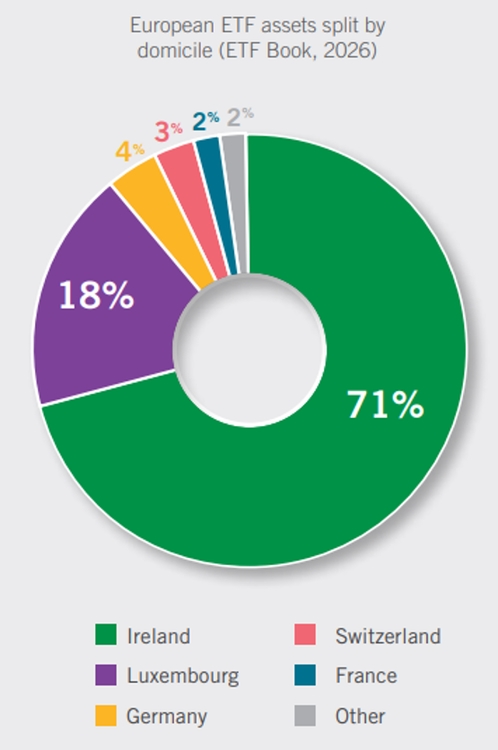
However, over 70% of the UCITS ETFs listed today are domiciled in Ireland, according to the Irish Funds Industry Association.
Why are Ireland-domiciled UCITS ETFs popular with Singapore investors compared to US-domiciled ETFs?
For Singapore investors comparing these UCITS ETFs with US-domiciled ETFs, there are usually three main considerations.
- Lower withholding tax incurred on dividends received from US-listed companies.
- US estate tax treatment on qualifying US assets when we pass on.
- Availability of accumulating share classes that automatically reinvest the dividends received back into the fund which may make long term growth more seamless.
How does dividend withholding tax work for UCITS ETFs?
The difference in withholding tax is easiest to understand by comparing VUSA, an Ireland-domiciled ETF, with VOO, a US-domiciled ETF. Both ETFs passively track the S&P 500 Index, which invests in the 500 largest companies listed in the US.
For this example, assume an individual Singapore tax resident who is not a US tax person and has no entitlement to a reduced treaty rate. Singapore does not have a comprehensive US income tax treaty that reduces ordinary portfolio dividend withholding tax.
Ordinary dividend distributions from a US-domiciled ETF such as VOO are therefore generally subject to 30% US withholding tax before it is paid to the investor.
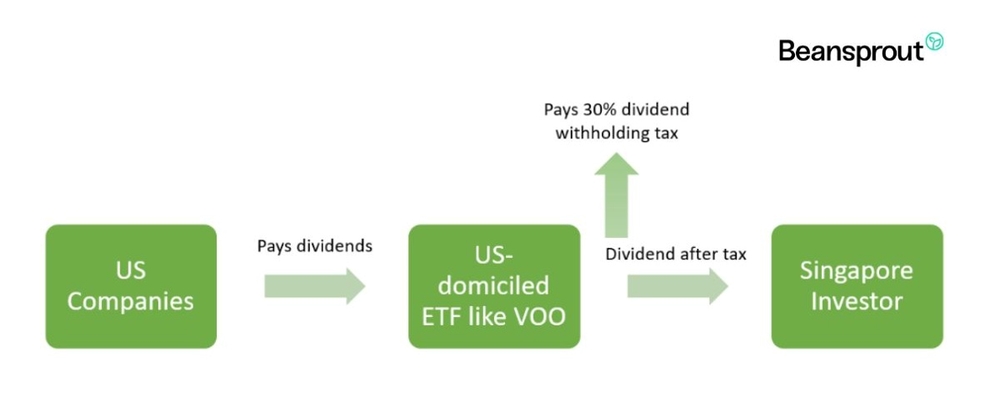
Meanwhile, VUSA, as an Ireland-domiciled fund, generally benefits from the 15% treaty rate on the qualifying dividends it receives from US companies. When the fund distributes these dividends to the Singapore investor, there are no further taxes imposed on the dividend and so the dividend would only be subject to a 15% withholding tax rate.
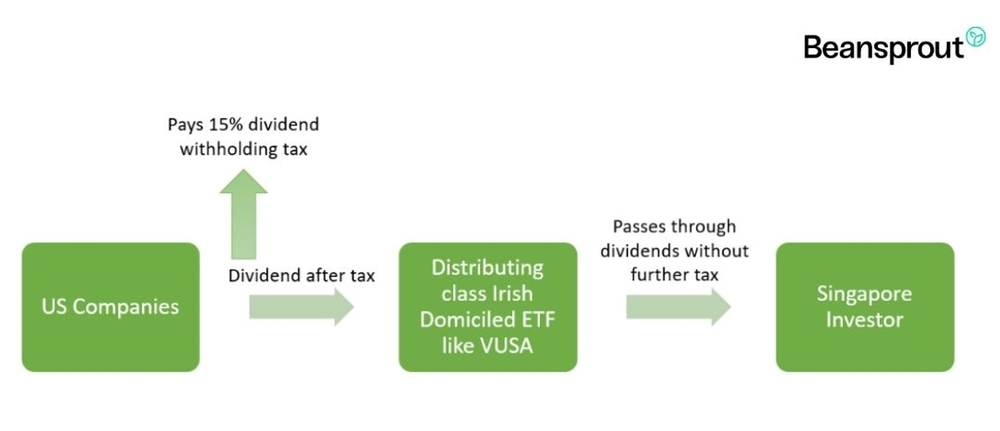
For Ireland-domiciled funds with an accumulating dividend policy instead, like CSPX, the dividends received net of the 15% withholding tax would be automatically reinvested into the fund.
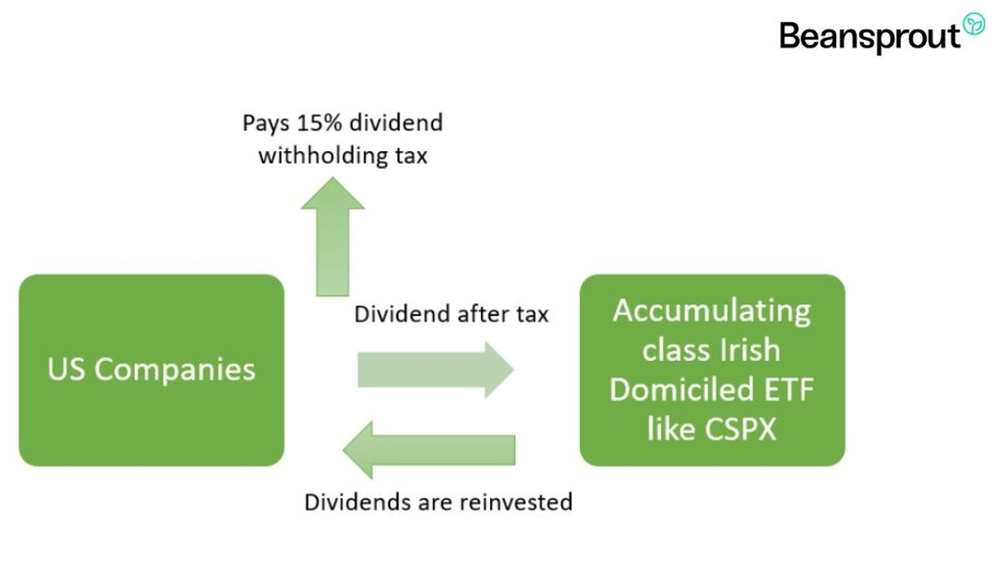
Here is a simplified illustration using US$100 of gross dividends from the underlying US shares, before fund fees and other costs. Actual tax treatment can vary:
| Illustration | VOO | VUSA | CSPX |
| Domicile | US | Ireland | Ireland |
| Dividend Policy | Distributing | Distributing | Accumulating |
| Gross US dividends | US$100 | US$100 | US$100 |
| US withholding tax | 30% at investor level | Generally 15% at fund level | Generally 15% at fund level |
| Amount after US withholding | US$70 paid to investor | US$85 paid to investor | US$85 reinvested into the fund |
In the VOO example, US$70 reaches the investor as a cash distribution.
Meanwhile, in the VUSA example, US$85 would be distributed to the investor instead.
For accumulating class ETFs like CSPX, the US$85 would be automatically reinvested into the fund.
The 15-percentage-point difference applies to the dividend amount, not the value of the entire investment or its capital gains.
Does the 15% withholding tax rate apply to VWRA and IWDA too?
The 15% withholding tax generally applies to US dividends received by these Ireland-domiciled funds, but not automatically to every dividend they receive if the funds receive dividends from countries outside of the US.
VUSA focuses on US equities, so the US withholding tax comparison is relatively straightforward.
On the other hand, VWRA and IWDA own companies across several countries. Dividends from their non-US holdings can be subject to different local rules and treaty rates.
Therefore, it is important to remember that the commonly used 15% dividend withholding tax typically refers to US dividends received by an Irish fund. It is not a universal tax rate for ETFs that invest in countries outside of the US.
Depending on the tax treatment from the other countries that the fund invests in, the final tax rate the fund incurs could be lower or higher than the stated 15%.
What about US estate tax when choosing an ETF?
US estate tax is another consideration when choosing between US-domiciled and Ireland-domiciled UCITS ETFs.
For someone who is neither a US citizen nor domiciled in the US for estate tax purposes, US-situated assets can fall within the US estate tax rules.
The IRS states that an estate tax return is generally required when the value of US-situated assets at death exceeds US$60,000, with a progressive estate tax from 18% up to 40% on assets exceeding that threshold.
Since CSPX, VWRA and IWDA are funds domiciled in Ireland, they are not considered US-situated assets.
Therefore, Singapore investors holding Ireland-domiciled UCITS ETFs are generally not subjected to US estate tax on these investments.
However, tax and estate planning can be a complex topic. If you own a significant amount of overseas assets, it might be worth engaging a professional tax consultant to discuss your financial situation in detail.
CSPX vs VWRA vs IWDA: How do these UCITS ETFs compare?
Once we understand the fund structure, the next question is what we actually want to invest in.
CSPX, VWRA and IWDA are all Ireland-domiciled, accumulating UCITS ETFs, but they provide different market exposure.
#1 - CSPX: Exposure to large US companies
CSPX tracks the S&P 500. Choosing it means making a deliberate allocation to invest only in the largest 500 US companies, rather than the global stock market as a whole.
Many S&P 500 companies earn revenue around the world. However, overseas business operations are not the same as directly owning companies from other markets.
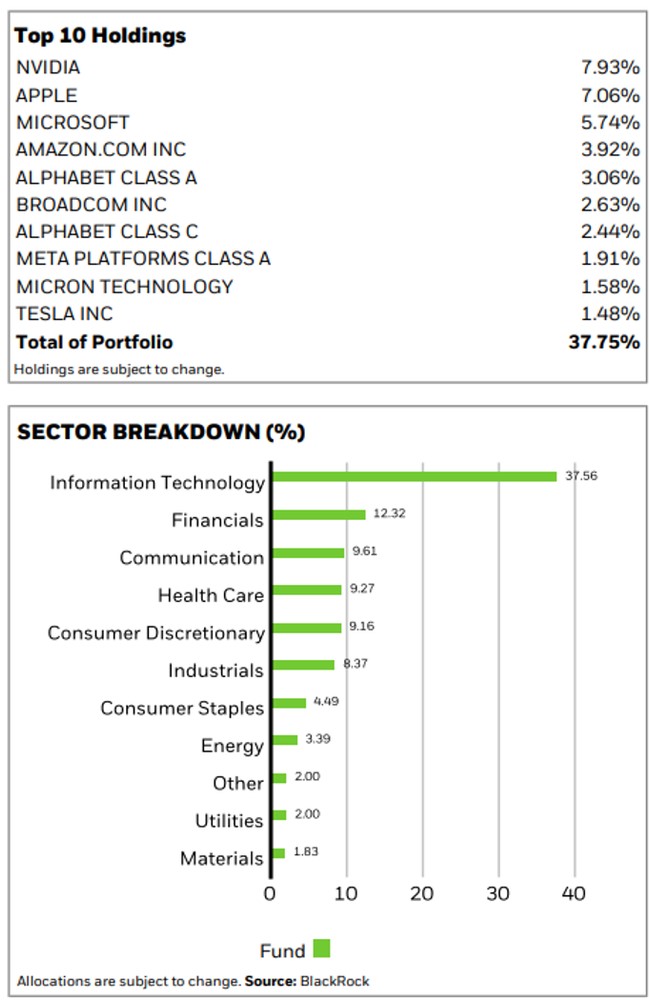
So choosing CSPX means making a deliberate allocation towards large US companies.
You can learn more in our CSPX and investing in the S&P 500 from Singapore.
#2 - IWDA: Exposure to global developed markets
IWDA tracks the MSCI World Index, encompassing developed markets, including the US, Europe and Japan, making it more diversified than CSPX.
However, the US still accounts for a substantial majority of the portfolio. So, broader geographic coverage does not mean each country receives an equal weighting.
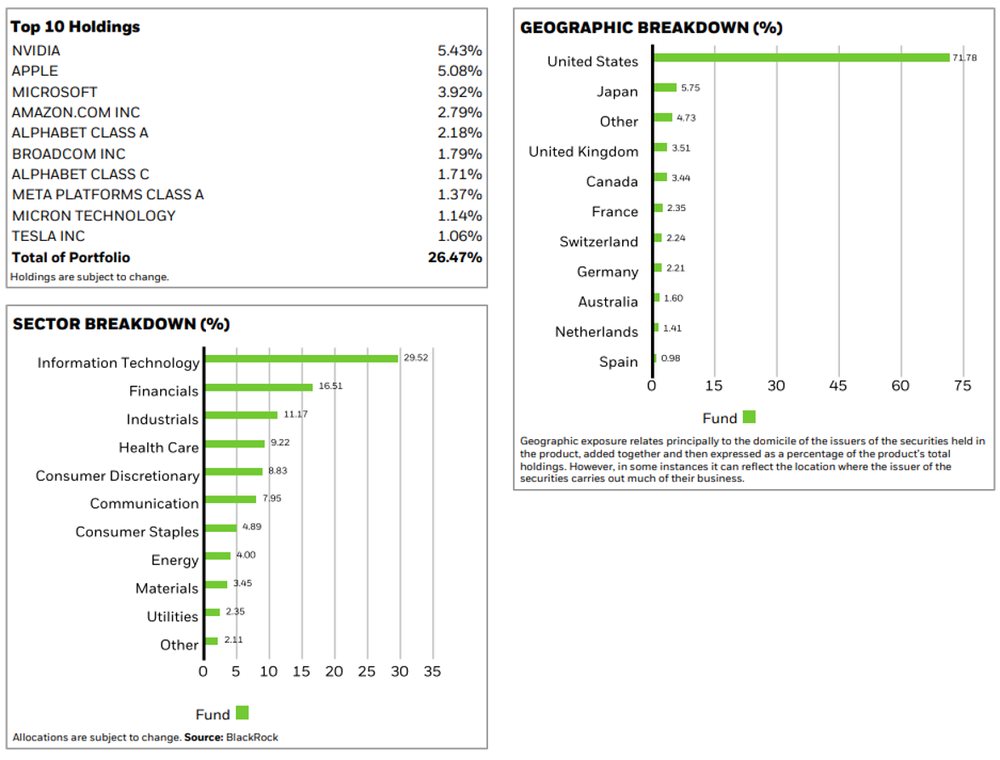
The main distinction is that IWDA only includes developed markets and does not invest in emerging markets like China, India, Taiwan, and so on.
Therefore, investors seeking emerging-market exposure alongside IWDA would need to add another ETF separately.
#3 - VWRA: Developed and emerging markets in one ETF
VWRA offers the broadest geographic coverage of these three ETFs.
It tracks the FTSE All-World Index, which includes large and mid-sized companies across developed and emerging markets. According to FTSE Russell, the FTSE All-World Index represents approximately 90-95% of the world's investable market capitalisation.
VWRA provides exposure to markets such as the US, Europe, Japan, China, India, Taiwan, and more through one fund.
It can simplify a global equity allocation because investors do not need to select separate developed-market and emerging-market funds. However, it does not provide exposure to smaller companies.
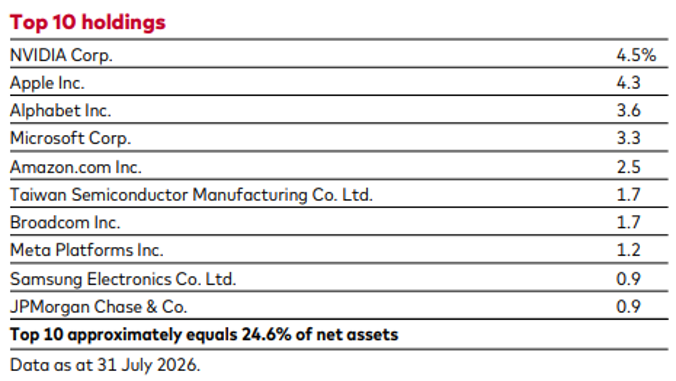

You can read our separate VWRA ETF guide for Singapore investors for a deeper look at the fund.
What does accumulating mean for CSPX, VWRA and IWDA?
CSPX, VWRA, and the IWDA ETFs discussed here are accumulating ETFs.
Rather than paying dividends to investors as cash, they reinvest the income received within the fund, after applicable taxes and costs.
For someone building a long-term portfolio, this can be convenient because there is no need to manually reinvest small dividend payments, and the remaining income stays invested.
However, accumulating does not mean tax-free. The funds will still incur the 15% withholding tax before reinvesting the remaining income received.
For investors who prefer to receive the dividends paid out as cash into their accounts instead of automatically being reinvested, a distributing share class is better aligned with that goal.
Therefore, it is important for investors to decide whether they prefer automatic reinvestment in an accumulating share class, or to receive the cash paid out as dividends in the distributing share class.
Why not simply buy a US-domiciled ETF?
US-domiciled ETFs have their own advantages.
They often offer a large range of choices, high trading liquidity and, in some cases, lower headline expense ratios.
However, a lower expense ratio does not necessarily mean a lower overall cost for a Singapore investor.
I would compare the fund’s expense ratio alongside other costs including tax considerations like the withholding tax and estate tax, and then look at the practical costs of buying and holding the ETF.
For example, if the underlying companies of the ETFs do not pay substantial dividends, the benefit of having lower fees might outweigh the potential withholding taxes incurred.
Does the currency I buy the ETF in matter?
It helps to separate three things: the fund domicile, the currency used to trade the ETF, and the investments held inside it.
Using VWRA as an example, it is domiciled in Ireland, its base currency is US dollars, and its London Stock Exchange listing trades in US dollars. Yet, its portfolio contains companies from around the world trading in multiple different currencies.
The same accumulating share class also trades in GBP on the London Stock Exchange under the ticker VWRP. Both listings are for the same fund.
Similarly, IWDA is the US-dollar London listing of its accumulating share class, while SWDA is the GBP-denominated London listing.
Changing the trading currency does not change the underlying portfolio or automatically protect against currency movements.
For a Singapore investor, the trading currency can affect the cost of converting SGD to buy the ETF.
At the same time, movements in the currencies of the underlying investments can still affect returns when measured in Singapore dollars.
What are the disadvantages of investing in UCITS ETFs?
#1 - Expense ratios may not be the lowest
A US-domiciled ETF typically has a lower headline fee than an equivalent Ireland-domiciled fund which tracks the same benchmark. For example, CSPX has an expense ratio of 0.07% per year while VOO is 0.03% per year. Both funds track the same underlying S&P 500 index.
#2 - Broker access may be more limited and trading costs may be higher
Most brokers offer easy access to the US stock market, but access to the London Stock Exchange (LSE), where many of these UCITS ETFs are listed in, may be more limited.
Commissions, platform charges and minimum fees for London-listed trades may also differ from US-listed securities.
#3 - Trading hours differ from Singapore market hours
The London Stock Exchange main market normally trades from 8am to 4.30pm London time.
That is generally 3pm to 11.30pm Singapore time during Daylight Saving Time, which starts on the last Sunday of March till the last Sunday of October, or 4pm to 12.30am during Standard Time.
#4 - UCITS does not mean there is no investment risk
The UCITS framework does not protect an investor from falling markets.
CSPX, IWDA and VWRA are equity funds, and all three are exposed to market volatility and can suffer substantial losses during a market drawdown.
While the diversification offered from these ETFs can reduce reliance on individual companies or markets to perform, it does not protect a portfolio from a broad market decline.
How can I buy CSPX, VWRA or IWDA in Singapore?
UCITS ETFs listed on the LSE can be bought and sold through a brokerage account that supports the London Stock Exchange.
Before opening or funding an account specifically to invest in UCITS ETFs, I would check:
- whether the broker offers the relevant LSE listing
- trading commission
- minimum commission
- platform or custody fees
- foreign exchange conversion costs
- recurring investment features, if relevant
You can compare these in our guide on the best online brokerage and trading platform in Singapore to find out which brokers have access to LSE, their fee structures, and features.
What should I look for when choosing a UCITS ETF?
There are plenty of ETF options available that fit a wide variety of goals in our portfolio.
Most of the information we need to know about an ETF can be found from their ETF factsheet and product highlights sheet.
Read our beginner guide to ETF investing to learn how to choose your first ETF in more detail.
| Question | Why it matters |
| What market exposure do I want? | This determines whether a US, developed-market or broader global index better matches the role of the investment. |
| Where is the ETF domiciled? | Domicile can affect dividend withholding tax and estate tax treatment. |
| Is it accumulating or distributing? | This determines whether income is reinvested within the fund or paid out as cash. |
| What does the ETF cost? | Compare expense ratios as well as brokerage, FX and trading costs. |
| What currency is the listing traded in? | This affects the currency conversion needed to transact, but does not by itself change the underlying investment exposure. |
| How large and liquid is the ETF? | Trading volume and bid-ask spreads can affect the cost of buying and selling. |
| Can my broker access it efficiently? | LSE availability and fees differ between brokerages. |
What would Beansprout do?
UCITS describes how an ETF is structured and regulated, while the fund's domicile can affect its tax treatment.
For Singapore investors, Ireland-domiciled ETFs may benefit from a 15% US withholding tax rate on qualifying US dividends instead of 30% for US-domiciled ETFs, while also generally avoiding US estate tax exposure on the ETF holding itself.
However, I would not choose an ETF based on its UCITS label or tax treatment alone.
I would first decide what market exposure I want the investment to provide.
CSPX gives me exposure to large US companies. IWDA broadens this to developed markets, while VWRA also includes emerging markets.
Only after deciding on that exposure would I compare the fund structure, including its domicile, dividend policy, expense ratio, liquidity, trading currency and brokerage costs.
As accumulating ETFs, they will automatically reinvest any dividends they receive back into the fund which may be convenient to make long term compounding more seamless.
If the goal is long-term equity growth, a diversified broad-based ETF could form part of my Growth Pot within the Four Pots of Wealth framework.
This allows me to build diversified equity exposure through regular investments over time, rather than trying to pick the next winning stock.
When choosing an ETF, I would pay attention to the underlying exposure, costs and tax considerations. Small differences in expense ratios can add up over many years, while an Ireland-domiciled structure may also reduce withholding tax on qualifying US dividends and avoid potential US estate tax exposure compared with a US-domiciled ETF.
Ultimately, I would choose a low-cost ETF that fits my investment preferences and that I am comfortable holding for the long term, rather than frequently switching funds to chase small differences in fees or performance.
Once I decide on the the ETF to invest in, I may use dollar-cost averaging to invest regularly in broad-market index funds rather than trying to time short-term movements in the market.
Finally, I would remember that a global ETF is just one part of a diversified portfolio.
If you want to invest in an ETF that has a heavier weightage towards the largest US-listed companies only, take a look at our best S&P 500 ETF for Singapore investors.
We continue to see Singapore as a core portfolio holding, while global ETFs can provide broader geographic diversification. Depending on the role each plays in my portfolio, I may hold both STI ETFs and global ETFs as part of a long-term portfolio.
If you're new to ETFs, find out more about Exchange Traded Funds (ETFs) here.
Which ETFs are you considering? Leave a comment below or share with us in the Beansprout telegram group.
Planning to invest in global ETFs? Compare the best Singapore brokerages to find the right trading platform, and see the latest promotions and sign-up rewards available.
Follow Beansprout on Youtube, Facebook and Instagram, and add Beansprout as your preferred source on Google so you never miss an update.
Read also
Gain financial insights in minutes
Subscribe to our free weekly newsletter for more insights to grow your wealth
Most Popular

Comments
0 comments