
CSPX ETF Guide: How to Invest in the S&P 500 from Singapore
ETFs
By Gerald Wong, CFA • 08 Sep 2026
Why trust Beansprout? We’ve been awarded Best Investment Website at the SIAS Investors’ Choice Awards 2025
'%3e%3cpath%20fill-rule='evenodd'%20clip-rule='evenodd'%20d='M17.64%209.20455C17.64%208.56637%2017.5827%207.95273%2017.4764%207.36364H9V10.845H13.8436C13.635%2011.97%2013.0009%2012.9232%2012.0477%2013.5614V15.8195H14.9564C16.6582%2014.2527%2017.64%2011.9455%2017.64%209.20455V9.20455Z'%20fill='%234285F4'/%3e%3cpath%20fill-rule='evenodd'%20clip-rule='evenodd'%20d='M9%2018C11.43%2018%2013.4673%2017.1941%2014.9564%2015.8195L12.0477%2013.5614C11.2418%2014.1014%2010.2109%2014.4205%209%2014.4205C6.65591%2014.4205%204.67182%2012.8373%203.96409%2010.71H0.957275V13.0418C2.43818%2015.9832%205.48182%2018%209%2018V18Z'%20fill='%2334A853'/%3e%3cpath%20fill-rule='evenodd'%20clip-rule='evenodd'%20d='M3.96409%2010.71C3.78409%2010.17%203.68182%209.59318%203.68182%209C3.68182%208.40682%203.78409%207.83%203.96409%207.29V4.95818H0.957273C0.347727%206.17318%200%207.54773%200%209C0%2010.4523%200.347727%2011.8268%200.957273%2013.0418L3.96409%2010.71V10.71Z'%20fill='%23FBBC05'/%3e%3cpath%20fill-rule='evenodd'%20clip-rule='evenodd'%20d='M9%203.57955C10.3214%203.57955%2011.5077%204.03364%2012.4405%204.92545L15.0218%202.34409C13.4632%200.891818%2011.4259%200%209%200C5.48182%200%202.43818%202.01682%200.957275%204.95818L3.96409%207.29C4.67182%205.16273%206.65591%203.57955%209%203.57955V3.57955Z'%20fill='%23EA4335'/%3e%3c/g%3e%3cdefs%3e%3cclipPath%20id='clip0_0_2849'%3e%3crect%20width='18'%20height='18'%20fill='white'/%3e%3c/clipPath%3e%3c/defs%3e%3c/svg%3e)
Make Beansprout your preferred source on Google
Add us on Google to see more of our insights in your search results
Learn how the CSPX ETF gives Singapore investors exposure to the S&P 500, including its fees, Irish domicile, tax considerations, risks and how to invest.
What happened?
The S&P 500 has long been one of the most popular indices used to track the US stock market.
These are some of the largest multinational companies in the world.
However, choosing to invest in the S&P 500 is only the first decision. Since it is just an index, you cannot buy the S&P 500 directly.
The next question is how to actually invest in it.
One of the easiest and most popular ways to get exposure to the S&P 500 is through Exchange Traded Funds, also known as ETFs.
There are dozens of different ETFs tracking the S&P 500 that we can choose from, including the popular iShares Core S&P 500 UCITS ETF, better known by its ticker CSPX, or the Vanguard S&P 500 ETF (VOO).
Although both ETFs track the same index, there are some important differences between them, particularly when it comes to fund domicile, dividend withholding tax, and estate tax.
In this guide, we look in more detail at what the CSPX ETF is, why it is popular among global investors, and how it compares with other famous alternatives such as VOO, VUAA, VUSA, SPYL, and VWRA.
What is the CSPX ETF?
CSPX is the ticker for the iShares Core S&P 500 UCITS ETF, which is managed by the world’s largest asset management company, BlackRock.
It is an ETF listed on the London Stock Exchange (LSE), meaning that you can easily buy or sell units of the ETF as long as you have a brokerage account with access to the LSE.
The ETF aims to passively track the S&P 500 Index, giving investors exposure to around 500 of the largest listed companies in the US.
This means that the ETF will not have fund managers actively picking which stocks to invest in and how much to invest in each stock. This helps to reduce running costs and is one reason why passive ETFs tend to have lower expenses compared to actively managed ones.
As of 1 September 2026, the CSPX ETF had about US$158 billion in assets under management. It was launched in May 2010 and has a total expense ratio of 0.07% per year. The fund is domiciled in Ireland and uses physical replication to track the S&P 500.
| CSPX ETF | Details |
| Fund name | iShares Core S&P 500 UCITS ETF |
| Management Style | Passive |
| Benchmark | S&P 500 Index |
| Domicile | Ireland |
| Dividend policy | Accumulating |
| Trading currency | USD |
| Total expense ratio | 0.07% per year |
| Investment method | Physical replication |
| Inception date | May 2010 |
| ISIN | IE00B5BMR087 |
| Source: CSPX ETF Website, 1 September 2026 | |
What does CSPX invest in?
By investing in CSPX, you are effectively buying a portfolio of the largest US-listed companies that form the S&P 500 index.
These companies are from various sectors such as information technology, healthcare, financial services, consumer, and more.
Many of these companies also typically carry out business across the world.
It’s worth noting that the S&P 500 is weighted by market capitalisation. This means larger companies make up a bigger proportion of the index.
As a result, CSPX currently has significant exposure to companies such as Nvidia, Apple, Microsoft, Amazon and Alphabet. These companies alone make up over 25% of the ETF as of 1 September 2026.
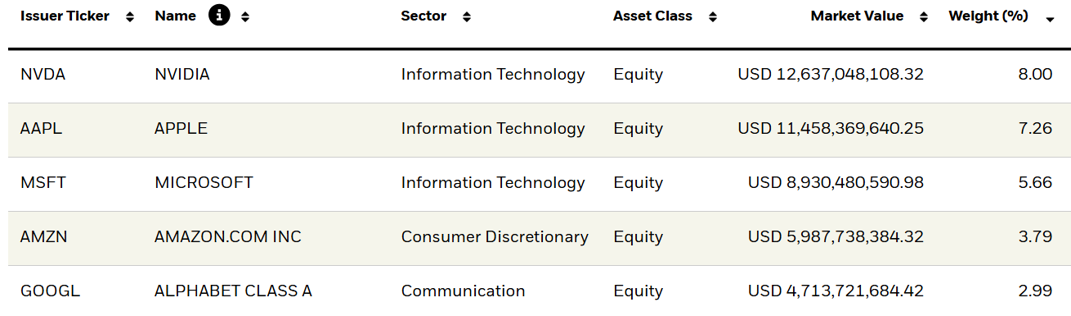
Buying the CSPX ETF gives you exposure to around 500 companies, but your investment is heavily weighted towards the largest of them, and not equally spread across all 500 companies. Therefore, the performance of the largest companies in the fund can have a significant impact on how it performs.
Nevertheless, CSPX will go through a rebalancing on a quarterly basis. So, companies which perform well will get a higher weightage in the fund while companies which continue to underperform will eventually get replaced by new ones automatically.
CSPX also invests only in US large cap equities and therefore does not provide geographical diversification like an ETF that invests globally instead.
Does CSPX pay dividends?
CSPX is an accumulating ETF so you will not receive regular cash dividend payments from CSPX.
Instead, when the companies in the S&P 500 pay dividends, the fund automatically reinvests the income it receives back into the portfolio.
For investors who are still building their portfolios, this can be convenient because the dividends are automatically put back to work and makes long term compounding more seamless because you do not need to manually reinvest the dividends yourself.
However, if you are looking to receive regular income from your investments, you may prefer a distributing ETF instead.
It’s worth noting that CSPX, at the fund level, will still incur a 15% withholding tax on the dividends it receives from the US-listed companies before reinvesting the dividends back into the fund. However, the tax is automatically deducted inside the fund itself, so investors do not need to do anything about it.
Why is CSPX popular among Singapore investors?
There are many ETFs available that track the S&P 500, so why do Singapore investors often consider CSPX?
Compared with alternatives like VOO which also track the same index, CSPX’s 0.07% expense ratio is higher than the 0.03% of its competitor.
However, CSPX is domiciled in Ireland while VOO is domiciled in the US.
This has significant tax implications for Singapore investors.
#1 - Lower withholding tax on US dividends
Singapore does not have a tax treaty with the US that reduces withholding tax on US dividends.
In general, US-sourced dividends paid to a non resident investor are subject to withholding tax of 30%, unless a lower treaty rate applies.
This means that if a Singapore investor holds a US-domiciled ETF such as VOO directly, dividends distributed by the fund are generally subject to 30% US withholding tax.
Because CSPX is domiciled in Ireland, the fund can benefit from the US-Ireland tax treaty. US dividends received by an Irish fund are generally subject to a withholding tax of 15% only rather than 30%.
For example, suppose the underlying shares pay out US$100 of dividends.
With a 30% withholding tax, US$70 would remain after tax.
With a 15% withholding tax, US$85 would remain.
The difference may look small in any single year, especially when the S&P 500 has historically had a relatively low dividend yield.
But over a long investment period, the additional amount being reinvested can add up and become a significant difference to compounding portfolio growth.
#2 - US estate tax
Another consideration is US estate tax.
Foreign investors holding US-domiciled ETFs and assets may be subject to US estate tax of up to 40% on assets exceeding US$60,000 in the unfortunate event of our passing.
This may severely impact estate and legacy planning if we have a substantial amount invested in US-domiciled ETFs.
Meanwhile, since CSPX is domiciled in Ireland, Singapore Investors are generally not subject to the same estate tax.
However, tax treatment depends on your individual circumstances and investors with significant overseas assets may wish to seek professional tax or estate planning advice for avoidance of doubt.
CSPX vs VOO: Which is better for Singapore investors?
CSPX and VOO both track the S&P 500, so their underlying investments are very similar.
The main difference is in where the ETFs are domiciled.
| CSPX | VOO | |
| Index | S&P 500 | S&P 500 |
| Domicile | Ireland | US |
| Expense ratio | 0.07% | 0.03% |
| Dividend policy | Accumulating | Distributing |
| US dividend withholding tax | Generally 15% at fund level | Generally 30% for a Singapore investor |
| US estate tax consideration | May not incur estate tax | May incur up to 40% tax on assets above US$60,000 |
| Source: CSPX and VOO ETF websites, 1 September 2026 | ||
VOO has a lower expense ratio of 0.03% and is one of the largest and most liquid ETFs globally.
However, as discussed above, the withholding tax and US estate tax considerations may be more important than the expense ratios alone. After all, the difference in expense ratios between the two ETFs is just 0.04%, or roughly US$4 for every US$10,000 per year.
Therefore, the more favourable tax treatment of an Ireland-domiciled ETF may outweigh CSPX’s higher expense ratio.
Besides that, CSPX automatically reinvests dividends, while VOO distributes them quarterly.
For Singapore investors who want S&P 500 exposure and prefer an accumulating ETF domiciled in Ireland to pay lower withholding tax, CSPX may be more attractive.
However, if you prefer an ETF with a lower expense ratio and don’t mind the tax implications, then VOO may be more attractive.
CSPX vs VUAA vs VUSA vs SPYL
Besides CSPX, there are also other Ireland-domiciled S&P 500 ETF.
Alternatives include, but are not limited to, the Vanguard S&P 500 UCITS ETF, traded under the ticker VUAA for its accumulating class or VUSA for its distributing class, and the State Street SPDR S&P 500 UCITS ETF, which trades as SPYL.
All of them give investors very similar exposure.
| CSPX | VUAA | VUSA | SPYL | |
| Provider | BlackRock | Vanguard | Vanguard | State Street |
| Index | S&P 500 | S&P 500 | S&P 500 | S&P 500 |
| Domicile | Ireland | Ireland | Ireland | Ireland |
| Management Style | Passive | Passive | Passive | Passive |
| Dividend policy | Accumulating | Accumulating | Distributing | Accumulating |
| Annual fund cost | 0.07% | 0.07% | 0.07% | 0.03% |
| Assets under management | US$158b | US$36b | US$53b | US$43b |
| Inception | 2010 | 2019 | 2012 | 2023 |
| Source: Respective ETF Websites, 1 September 2026. | ||||
SPYL has the lowest fees with a total expense ratio of 0.03% compared with 0.07% for CSPX, VUAA, and VUSA.
VUSA meanwhile provides an option as a distributing class ETF for investors who prefer to receive the dividends in cash instead of it being automatically reinvested while incurring 15% withholding tax instead of the 30% withholding tax of its US-domiciled peers.
However, CSPX has the longest track record and the largest asset base. This may provide better trading liquidity and tighter bid-ask spreads so that investors can buy or sell at a better price.
Ultimately, any of these Ireland-domiciled ETFs could be used to fit your goals, whether to automatically reinvest dividends or receive the dividends in cash, get the lowest expense ratio, or if you prefer investing into an ETF with a larger asset base and longer operating history.
CSPX vs a global ETF such as VWRA
There is another question I would also consider before comparing the various S&P 500 ETFs.
Do I want to invest only in the US, or do I want broader global exposure?
S&P 500 ETFs like CSPX, VOO and so on invest only in the largest US companies.
Meanwhile, a global ETF such as the Vanguard FTSE All-World UCITS ETF, commonly known as VWRA, invests in companies around the whole world including both developed and emerging markets.
| ETF Ticker | CSPX | VWRA |
| Fund name | iShares Core S&P 500 UCITS ETF | Vanguard FTSE All-World UCITS ETF |
| Management Style | Passive | Passive |
| Benchmark | S&P 500 Index | FTSE All-World Index |
| Domicile | Ireland | Ireland |
| Dividend policy | Accumulating | Accumulating |
| Trading currency | USD | USD |
| Total expense ratio | 0.07% per year | 0.14% per year |
| Inception year | 2010 | 2019 |
| Source: CSPX and VWRA ETF websites, 1 September 2026 | ||
That being said, the US still represents a large part of a global equity index, so buying a global ETF like VWRA will still provide exposure to US-listed companies such as Nvidia, Apple or Microsoft and have many overlaps with CSPX although with different weightages.
The difference is that you can also gain exposure to companies in markets such as Europe, Japan, China, Korea, Taiwan, India, and more.
In reality, this is not a “this-or-that” situation, and you are free to invest in both an S&P 500 ETF and a global ETF at the same time at your desired weightages.
What are the fees for investing in CSPX?
CSPX has a total expense ratio of 0.07% per year.
This means that for every US$10,000 invested, the annual fund expense works out to about US$7.
The fee is already deducted within the fund, so you will not need to make any separate payments to anyone to continue to hold the ETF.
However, besides the ETF’s expense ratio, you may incur brokerage fees, platform fees, and currency conversion charges whenever you buy or sell units in the ETF.
These frictional charges can be significant if you are investing small amounts frequently. You can utilize a well-planned Dollar-cost averaging strategy to help reduce transaction costs by varying the scheduled investment amount and frequency that fits your portfolio.
Check out our beginner's guide to dollar-cost averaging (DCA) to learn how to use this strategy to build a disciplined habit of investing over the long term.
You can also refer to our review of the best online brokerage & trading platform in Singapore to find the pros and cons of the available brokers and find the most suitable one for you.
What are the risks of investing in CSPX?
There are a few risks I would pay particular attention to.
#1 - Market risks
While CSPX is diversified across hundreds of companies, it is still an equity investment and can experience significant declines and volatility.
During periods of market downturn, the value of the S&P 500 can drop significantly. For example, in 2025, the S&P 500 dropped over 20% in a short period of time when the US declared global import tariffs and shocked the world.
While the index has historically recovered from its downturns, there’s no guarantees that this will always be the case.
At the same time, if you are forced to sell during the drawdown, you risk realising permanent loss of capital.
#2 - Concentration risk
CSPX invests in the 500 largest US companies with heavier weightage in the largest companies, such as Nvidia, Apple, Microsoft and so on. This has also led it to become concentrated in the information technology sector.
This also means that CSPX does not have global diversification.
The performance of the fund is therefore significantly influenced by the share price movements of these companies, which may not reflect the global economy as a whole.
#3 - Foreign currency risk
For Singapore investors, your total returns will be impacted by the movements of currency pairs between the USD and SGD.
This matters especially if we eventually want to sell the ETF and convert the money back into SGD.
How can I buy CSPX in Singapore?
To buy CSPX, you will need a brokerage account that provides access to the London Stock Exchange.
If you have not yet opened your own brokerage account, find out the best online brokerage & trading platform in Singapore to find the pros and cons of the available brokers.
Next, fund your account and convert your Singapore dollars into US dollars if required.
You can then search for CSPX and check that the ISIN is IE00B5BMR087 before placing your order.
It is worth comparing brokerage commission, foreign exchange conversion costs and custody fees before deciding which platform to use.
Is CSPX the best S&P 500 ETF for Singapore investors?
CSPX remains one of the popular ways for a Singapore investor to gain long term exposure to the S&P 500.
It has been around since 2010, has a large asset base, and charges a relatively low 0.07% expense ratio.
Its Ireland domicile and accumulating structure are also relevant for Singapore investors.
VOO has an even lower headline fee, but it is US-domiciled and has different dividend withholding tax and estate tax considerations for a Singapore investor.
However, CSPX is no longer the only option if you want an Ireland-domiciled S&P 500 ETF.
VUAA provides a very similar structure, VUSA is a distributing class alternative, while SPYL offers the same benchmark tracking exposure with a lower expense ratio of 0.03%.
Therefore, the best ETF for you would be one that fits your goals and requirements in an efficient way, rather than a universally best ETF.
To see how CSPX compares against the other S&P 500 ETFs in more detail, check out our guide to the best S&P 500 ETF for Singapore investors.
What would Beansprout do?
If I wanted simple, long-term exposure to the US stock market, an S&P 500 ETF could form part of my Growth Pot within the Four Pots of Wealth framework.
This allows me to build diversified exposure to the world's largest companies through regular investments over time, rather than trying to pick the next winning stock
When choosing an S&P 500 ETF, I would pay close attention to costs and tax efficiency. While the differences in expense ratios may seem small, they can compound over many years.
Likewise, choosing an Ireland-domiciled ETF may help reduce dividend withholding taxes and avoid potential US estate tax considerations.
iShares Core S&P 500 UCITS ETF (CSPX) is a low-cost ETF that passively tracks the S&P 500 index. As an accumulating ETF, it will automatically reinvest any dividends it receives back into the fund which may be convenient to make long term compounding more seamless.
As CSPX is domiciled in Ireland, the dividends it receives is taxed at 15% withholding tax rate compared to ETFs that are domiciled in the US. Investors from Singapore may also be able avoid US estate taxes when investing in Irish-domiciled ETFs compared to US-domiciled ones.
Compared to its other Ireland-domiciled peers, CSPX has the largest assets under management and one of the longest operating histories. This may provide investors with tighter bid-ask spreads so we can buy or sell a position with a better price.
Ultimately, I would choose a low-cost ETF that fits my investment preferences and that I am comfortable holding for the long term, rather than frequently switching funds to chase small differences in fees or performance.
To see how CSPX compares against the other S&P 500 ETFs in more detail and find the best one for you, check out our guide to the best S&P 500 ETF for Singapore investors.
Once I decided on the S&P 500 ETF to invest in, I may use dollar-cost averaging to invest regularly in broad-market index funds rather than trying to time short-term movements in the market.
Finally, I would remember that an S&P 500 ETF is just one part of a diversified portfolio.
If you want to invest in an ETF that tracks the whole world instead of just the US, take a look at Vanguard FTSE All-World UCITS ETF (VWRA).
We continue to see Singapore as a core portfolio holding. This is why I may consider holding both STI ETFs and S&P 500 ETFs as part of a diversified long-term portfolio.
If you're new to ETFs, find out more about Exchange Traded Funds (ETFs) here.
Which S&P 500 ETFs are you considering? Leave a comment below or share with us in the Beansprout telegram group.
Planning to invest in S&P 500 ETFs? Compare the best Singapore brokerages to find the right trading platform, and see the latest promotions and sign-up rewards available.
Follow Beansprout on Youtube, Facebook and Instagram, and add Beansprout as your preferred source on Google so you never miss an update.
Read also
Gain financial insights in minutes
Subscribe to our free weekly newsletter for more insights to grow your wealth
Most Popular

Comments
0 comments