
4 new UCITS ETFs on SGX: What Singapore investors should know
ETFs
By Gerald Wong, CFA • 24 Sep 2026
Why trust Beansprout? We’ve been awarded Best Investment Website at the SIAS Investors’ Choice Awards 2025
'%3e%3cpath%20fill-rule='evenodd'%20clip-rule='evenodd'%20d='M17.64%209.20455C17.64%208.56637%2017.5827%207.95273%2017.4764%207.36364H9V10.845H13.8436C13.635%2011.97%2013.0009%2012.9232%2012.0477%2013.5614V15.8195H14.9564C16.6582%2014.2527%2017.64%2011.9455%2017.64%209.20455V9.20455Z'%20fill='%234285F4'/%3e%3cpath%20fill-rule='evenodd'%20clip-rule='evenodd'%20d='M9%2018C11.43%2018%2013.4673%2017.1941%2014.9564%2015.8195L12.0477%2013.5614C11.2418%2014.1014%2010.2109%2014.4205%209%2014.4205C6.65591%2014.4205%204.67182%2012.8373%203.96409%2010.71H0.957275V13.0418C2.43818%2015.9832%205.48182%2018%209%2018V18Z'%20fill='%2334A853'/%3e%3cpath%20fill-rule='evenodd'%20clip-rule='evenodd'%20d='M3.96409%2010.71C3.78409%2010.17%203.68182%209.59318%203.68182%209C3.68182%208.40682%203.78409%207.83%203.96409%207.29V4.95818H0.957273C0.347727%206.17318%200%207.54773%200%209C0%2010.4523%200.347727%2011.8268%200.957273%2013.0418L3.96409%2010.71V10.71Z'%20fill='%23FBBC05'/%3e%3cpath%20fill-rule='evenodd'%20clip-rule='evenodd'%20d='M9%203.57955C10.3214%203.57955%2011.5077%204.03364%2012.4405%204.92545L15.0218%202.34409C13.4632%200.891818%2011.4259%200%209%200C5.48182%200%202.43818%202.01682%200.957275%204.95818L3.96409%207.29C4.67182%205.16273%206.65591%203.57955%209%203.57955V3.57955Z'%20fill='%23EA4335'/%3e%3c/g%3e%3cdefs%3e%3cclipPath%20id='clip0_0_2849'%3e%3crect%20width='18'%20height='18'%20fill='white'/%3e%3c/clipPath%3e%3c/defs%3e%3c/svg%3e)
Make Beansprout your preferred source on Google
Add us on Google to see more of our insights in your search results
Explore the four new Xtrackers UCITS ETFs on SGX, including their fees, market exposure, SRS eligibility and how Singapore investors can access them.
What happened?
Singapore investors will soon have more ways to access global markets through SGX.
Four Irish domiciled UCITS ETFs are tentatively scheduled to list on SGX on 13 October 2026, covering the S&P 500, MSCI World, S&P 500 Equal Weight and Nasdaq 100 indices.
I noticed that this has sparked quite a bit of discussion in the Beansprout community over the past few days, especially around whether the new listings could change how we build our portfolios.
For Singapore investors, UCITS ETFs such as CSPX (offering exposure to S&P 500) and VWRA (offering exposure to large and mid-sized companies in developed and emerging markets) are not new. Many investors already access Irish domiciled ETFs through overseas exchanges such as the London Stock Exchange.
What is different is that these ETFs will now be available directly through SGX.
We look at how the four ETFs differ, what the SGX listings could change, what we would check before investing, which might be relevant for your portfolio and how to buy.
| ETF | SGX ticker | Exposure | TER |
| Xtrackers S&P 500 UCITS ETF | XUS | 500 large US companies, weighted by market capitalisation | 0.03% |
| Xtrackers MSCI World UCITS ETF | XWR | Large and mid cap companies across developed markets | 0.12% |
| Xtrackers S&P 500 Equal Weight UCITS ETF | EUS | S&P 500 companies, with each stock given an equal weight | 0.15% |
| Xtrackers Nasdaq 100 UCITS ETF | XND | 100 large non financial companies listed on Nasdaq | 0.20% |
| Source: Xtrackers by DWS | |||
What are the four new Xtrackers UCITS ETFs on SGX?
The four new Xtrackers UCITS ETFs on SGX offer different types of equity exposure, with annual total expense ratios (TERs) ranging from 0.03% to 0.20%.
They will:
- trade in SGD on SGX
- Trade in Singapore dollars during Singapore market hours.
- Have a minimum lot size of one share once trading begins.
- Be expected to qualify for SRS investment, subject to eligibility requirements and platform support.
Based on indicative prices as of 15 September 2026, XUS was around S$20 per share, XWR around S$200, EUS around S$85 and XND around S$150.
Like CSPX and VWRA, all four ETFs are Irish-domiciled UCITS ETFs. UCITS is a European regulatory framework for investment funds, with rules covering diversification and investor protection.
Their Irish domicile can also offer a withholding tax advantage.
Under the Ireland and US tax treaty framework, US dividends received by an Irish domiciled UCITS ETF are generally subject to a 15% withholding tax at the fund level.
By comparison, ordinary distributions from US-domiciled ETFs to Singapore investors who are not US tax persons generally face 30% US withholding tax, unless a reduced treaty rate applies.
This tax treatment comes from the fund’s domicile, rather than the UCITS label or its SGX listing. Read our guide to UCITS ETFs in Singapore to understand how fund structure, domicile and dividend policy affect your investment.
The ETFs are issued by Xtrackers, the global ETF platform of DWS.
These are SGX cross listings of existing Xtrackers UCITS ETFs, rather than newly launched funds.
The existing funds had assets under management ranging from about US$2.6 billion to US$30.7 billion as of end August 2026.
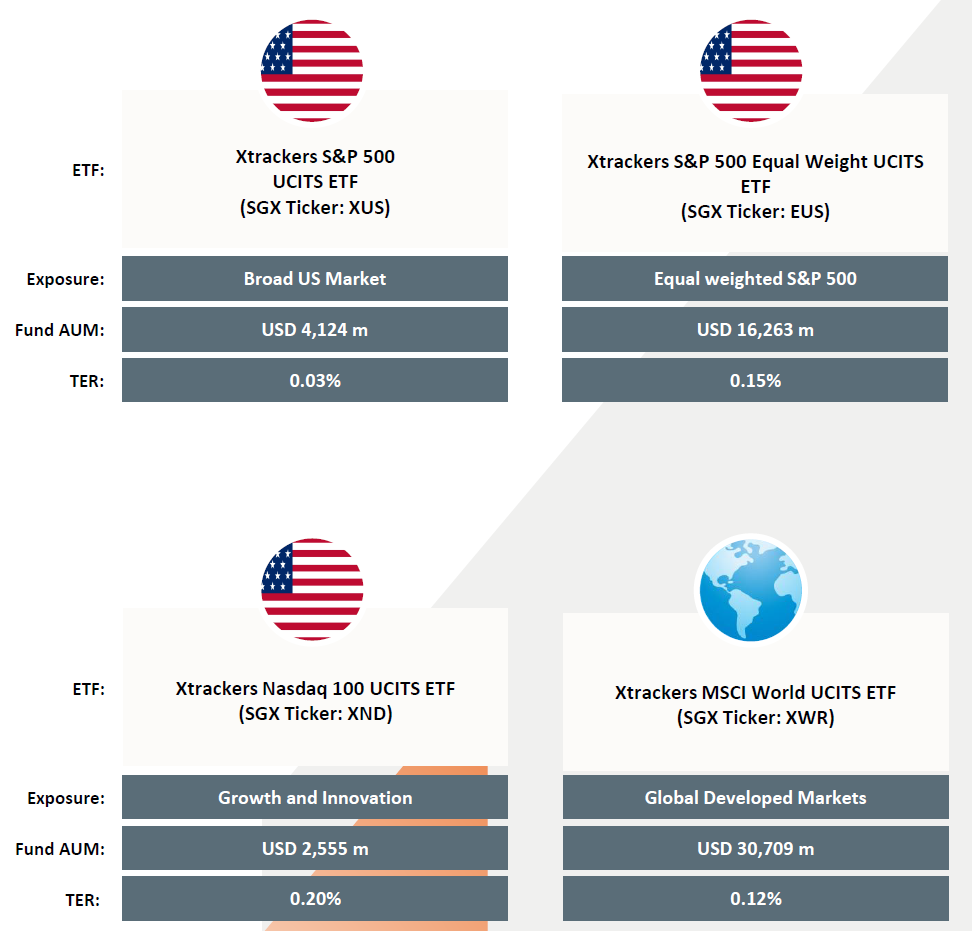
These ETFs offer different market exposures. XUS focuses on large US companies, while XWR extends across developed markets. EUS changes how S&P 500 companies are weighted, and XND provides a more concentrated Nasdaq 100 allocation.
XUS: S&P 500 exposure through SGX
XUS tracks the traditional S&P 500 Index.
It provides exposure to 500 of the largest companies listed in the US and covers about 80% of US free float market capitalisation. The index is weighted according to free float adjusted market capitalisation.
With a TER of 0.03%, XUS offers another way to invest in the S&P 500 through an Irish-domiciled ETF.

For investors already holding iShares Core S&P 500 UCITS ETF (CSPX), the underlying market exposure would be broadly similar.
Buying XUS alongside CSPX would therefore largely add to the same US equity allocation, rather than provide a new source of diversification.
The more relevant question is therefore whether accessing the S&P 500 through SGX offers enough advantages in accessibility, SRS investing, custody or cost.
XWR: Developed-market global exposure, with an important difference from VWRA
XWR tracks the MSCI World Index.
It provides exposure to large and mid cap companies across developed markets and covers around 85% of the free float market capitalisation in those markets. Its TER is 0.12%.

One important point is that MSCI World is not the same as an all world index.
An ETF such as Vanguard FTSE All-World UCITS ETF (VWRA) includes both developed and emerging markets. XWR only provides developed market exposure.
So investors considering XWR should first decide whether they want developed markets only, or developed and emerging markets within a single ETF.
An existing ETF with a more directly comparable benchmark is iShares Core MSCI World UCITS ETF (IWDA), which also tracks MSCI World.
Read our VWRA ETF guide for a closer look at investing in developed and emerging markets through one fund.
EUS: Equal-weight S&P 500 exposure with less concentration on the US largest companies
EUS also invests across the S&P 500 universe, but uses a different weighting approach from XUS.
Rather than allowing the largest companies to have the biggest weights, the S&P 500 Equal Weight Index assigns approximately the same weight to each constituent.
Xtrackers describes this as providing broader US market exposure with reduced mega cap concentration. Its TER is 0.15%.

This means EUS should not simply be viewed as another version of XUS.
The two ETFs hold broadly the same universe of companies, but the weighting methodology can produce significantly different sector and company exposures.
EUS could therefore perform quite differently from XUS.
For investors concerned about the growing concentration of the traditional S&P 500 in its largest companies, the equal weighted approach may be worth understanding.
We would consider it a deliberate choice to reduce mega-cap concentration. It does not guarantee better returns or smaller losses during a market downturn.
XND: Nasdaq 100 exposure with a stronger technology tilt
XND tracks the Nasdaq 100 Index.
It provides exposure to 100 of the largest US and global non financial companies listed on Nasdaq. Its TER is 0.20%.

The index has a much stronger tilt towards technology and growth companies than a broad market index.
Based on the launch materials, information technology represented about 58.5% of the portfolio as of end August 2026.
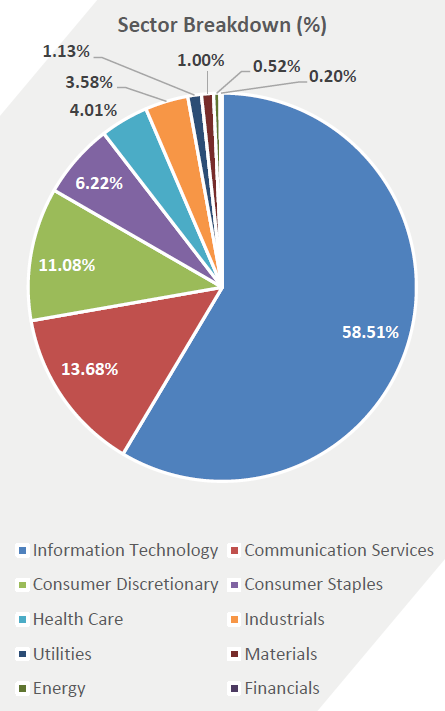
We would therefore view XND as a more concentrated exposure rather than a direct substitute for an S&P 500 ETF or global market ETF.
How could the new UCITS ETF listings on SGX change the way we invest in global index funds?
1. More brokers offer low cost access to SGX
One of the biggest practical differences is accessibility.
Investors looking for Irish domiciled UCITS ETFs have typically needed a brokerage account that provides access to an overseas exchange such as the London Stock Exchange.
By comparison, SGX is supported by a wider range of brokers commonly used by Singapore investors, including several that offer relatively low cost access to Singapore listed stocks and ETFs.
This could make it easier for investors to gain UCITS ETF exposure without opening another brokerage account purely for overseas market access.
Investors should still compare brokerage fees, custody arrangements and other charges across platforms.
2. We can potentially invest using SRS
All four ETFs are expected to be eligible for investment using SRS funds from listing, subject to eligibility requirements.
This could be particularly useful for investors who want to use their SRS savings to build their Growth Pot for long term compounding.
For example, someone looking for broad US or developed market equity exposure could potentially use their SRS balance to invest through SGX rather than being limited by whether their SRS brokerage arrangement provides access to an overseas UCITS ETF.
Investors should still check whether the individual ETF is supported by their SRS operator and brokerage platform once the ETFs start trading.
Looking to put your SRS savings to work? Explore our guide to SRS investment options in Singapore to compare the ways you can invest for retirement.
3. Investors have the option of holding them through CDP
The SGX listing may also give investors the option of holding the ETFs through their CDP account, where supported by their broker.
For investors who prefer having their SGX listed investments held directly in their own CDP account, this could be useful.
However, a CDP account is not necessary.
Many brokers now provide custodian access to SGX listed shares and ETFs, where the securities are held by the broker or its nominee on behalf of the investor.
Investors can therefore choose the custody arrangement that works for them.
You can read our comparison of CDP and custodian accounts, as well as our brokerage account comparison to see the different custody arrangements available.
Other considerations before investing in the new UCITS ETF listings on SGX
#1 - Total cost matters more than the headline TER
The TERs of the four ETFs range from 0.03% for XUS to 0.20% for XND.
However, the ETF with the lowest TER is not necessarily the cheapest way for every investor to gain a particular exposure.
The total cost can also depend on:
- brokerage fees
- bid ask spreads
- FX conversion costs
- custody or platform charges
- tracking difference
One key unknown is liquidity.
The underlying funds themselves may already be established, but the SGX trading lines will be new. We therefore do not yet know what bid ask spreads investors will experience once the ETFs start trading on SGX.
This makes it difficult to compare their total trading costs with established overseas listed ETFs based on TER alone.
We will update our comparisons after the ETFs start trading and there is actual liquidity and bid ask spread data to assess.
#2 - Trading in SGD does not remove currency exposure
All four ETFs will trade in SGD on SGX.
However, these are cross listings of existing ETFs, and the NAV of these ETFs will be calculated and reported in USD.
For investors funding their accounts in Singapore dollars, this means they would not need to make a separate SGD to USD conversion through their broker when buying the SGX counter.
The price investors see and trade at on SGX will be in SGD. That SGD market price will reflect, among other factors, the USD value of the ETF and movements in the SGD/USD exchange rate.
Importantly, trading in SGD does not mean the investment is SGD hedged. Investors remain exposed to currency movements through the underlying investments.
#3 - Trading during Singapore market hours may be more convenient
The ETFs will trade during Asian market hours.
Some investors may find this more convenient than waiting for an overseas exchange to open later in the day.
However, the underlying investments span markets in different time zones.
For example, XUS will trade on SGX while the underlying US cash market is closed. For XWR, some markets represented in the index will also be closed at different points during the SGX trading day.
Market makers therefore rely on available market information and other instruments when pricing ETFs while some underlying markets are closed.
For a long term investor who invests regularly and rarely sells, we would see trading hours mainly as a matter of convenience rather than a reason on its own to choose one ETF over another.
#4 - All investments come with market risks
While the new SGX listings may make these UCITS ETFs easier to access, the value of the ETFs can rise or fall depending on market and economic conditions,
The risks will also differ depending on which ETF you choose.
For example, XUS provides broad exposure to the S&P 500, while XND has a much heavier tilt towards technology and growth companies. EUS uses an equal weighted approach, while XWR invests across developed markets globally.
This is why I would not start with which ETF has the lowest fee or is easiest to buy.
The more important question is whether the underlying exposure fits the role you want the investment to play in your portfolio, and whether you are comfortable with the risks that come with it.
Where can you buy the new UCITS ETFs on SGX?
The initial offer period (IOP) for the four Xtrackers UCITS ETFs opened on 21 September 2026, with moomoo as the exclusive participating dealer.
The minimum subscription is S$1,000 per ETF, with no subscription fee when subscribing through moomoo during the initial offer period.
The subscription deadlines differ by ETF:
| ETF | Subscription deadline |
| XWR — MSCI World | 30 September 2026, 12pm SGT |
| XUS — S&P 500 | 1 October 2026, 12pm SGT |
| EUS — S&P 500 Equal Weight | 1 October 2026, 12pm SGT |
| XND — Nasdaq 100 | 1 October 2026, 12pm SGT |
For more details on subscribing through moomoo, read our guide to the Xtrackers UCITS ETF launch on moomoo.
All four ETFs are tentatively scheduled to start trading on SGX on 13 October 2026.
Once trading begins, investors are expected to be able to buy and sell the ETFs in Singapore dollars through any brokerage platform that support the respective SGX counters.
If you prefer to buy after listing, you can compare platforms offering SGX access and their fees in our guide to the best online brokerages in Singapore.
What would Beansprout do?
We welcome more options for investors looking to build their Growth Pot for long-term
The new SGX listings could make Irish domiciled UCITS ETFs easier to access through brokerage platforms already used by Singapore investors, while also expanding the choices available for SRS investing and potentially allowing investors to hold the ETFs through CDP.
However, we would start with understanding what role each of these ETFs can play within our portfolio, rather than just look at the exchange or headline fee.
- XUS provides traditional S&P 500 exposure.
- XWR provides developed market global exposure, but does not include emerging markets.
- EUS provides a different way of investing in the S&P 500 by reducing the influence of the largest companies.
- XND provides more concentrated exposure to the Nasdaq 100.
For investors already using overseas listed UCITS ETFs like CSPX or VWRA, we would observe the total cost of gaining exposure before determining if the new UCITS ETFs on the SGX are cheaper simply because some have low TERs.
This would involve comparing the brokerage fees, FX considerations and, importantly, the bid ask spreads and liquidity once they start trading.
If you’re looking to buy these UCITS ETFs after they start trading on SGX, you can explore our guide to the best online brokerages in Singapore to compare platforms offering SGX access and their fees.
If you’re new to ETFs, read our beginner’s guide to ETF investing in Singapore to understand how they work and what to consider before investing.
Which of these four UCITS ETFs are you considering for your portfolio? Leave a comment below or share your thoughts in the Beansprout Telegram group.
Follow Beansprout on Youtube, Facebook and Instagram, and add Beansprout as your preferred source on Google so you never miss an update.
Read also
Gain financial insights in minutes
Subscribe to our free weekly newsletter for more insights to grow your wealth
Most Popular

Comments
0 comments