
3 Singapore blue chip stocks with dividend yield around 5% in November 2026. What income investors should watch
Stocks
By Goh Lay Peng • 25 Nov 2026
Why trust Beansprout? We’ve been awarded Best Investment Website at the SIAS Investors’ Choice Awards
We look at 3 Singapore blue chips with forward yields around 5% and examine whether their latest earnings and cash flows can support their payouts.
What happened?
Singapore blue chip stocks remain under pressure.
After the Straits Times Index fell below 5,200, we made changes to our model portfolio, and I started looking more closely at opportunities to build my Income Pot.
We recently looked at Singapore blue chips near their 52-week lows, blue chip REITs yielding around 7% and three blue chips going ex-dividend in November.
Meanwhile, I noticed growing interest in the Beansprout community around Singtel following the completion of its Special Discounted Shares (SDS) scheme, as well as Singapore banks following their latest quarterly results.
Against this backdrop, I took a closer look at DBS, Singtel and Venture, three Singapore blue chip stocks offering forward dividend yields of around 5% following the recent pullback in their share prices.
In this article, I examine their latest financial results, dividend sustainability and valuations to see what income investors should watch.
3 Singapore blue chip stocks yielding around 5% in November 2026
| Stock | Latest dividend per share | Forecast full-year dividend per share | Closing price on 24 Nov 2026 | Forward dividend yield |
| DBS Group (D05) | 81 cents for 3Q, including 15 cents of capital return | S$3.24 for FY2026 | S$66.24 | 4.9% |
| Singtel (Z74) | 9 cents, including 1.9 cents of value realisation dividend | About S$0.2066 for FY2027 | S$4.13 | 5.0% |
| Venture Corporation (V03) | 30 cents, ordinary interim | S$0.80 for FY2026 | S$14.15 | 5.7% |
| Dividend yields are calculated using the indicated full-year dividend forecasts or annualised quarterly payouts, divided by closing share prices on 24 November 2026. Actual dividends may differ. | ||||
#1 – DBS Group (SGX: D05)
DBS is Singapore's largest bank and one of the country's most widely followed dividend stocks.
Following its strong performance earlier this year, DBS shares have pulled back amid concerns over higher bond yields, market volatility and the outlook for bank earnings.
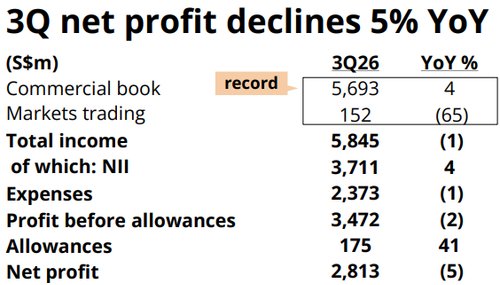
In DBS’ latest third-quarter 2026 results, DBS reported a 5% year-on-year decline in net profit to S$2.81 billion.
The decline was largely due to weaker markets trading income, which fell 65% year on year to S$152 million.
However, several areas of DBS's core business continued to grow.
Net interest income rose 4% year on year to S$3.71 billion, supported by loan growth and hedging activities. Its net interest margin remained stable quarter on quarter at 1.87%, although it declined from 1.96% a year earlier.
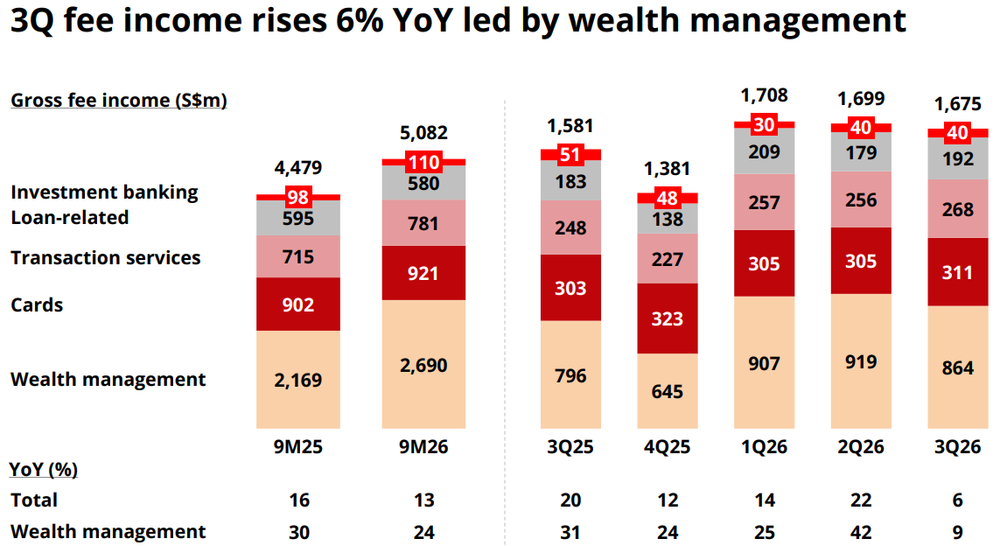
DBS also benefited from growth in wealth management, with fees increasing 9% year on year and assets under management reaching a record S$544 billion.
For the first nine months of 2026, net profit increased 2% year on year to a record S$8.82 billion, suggesting that its broader earnings performance remained relatively resilient despite weaker quarterly trading income.
DBS's annualised dividend yield is close to 5%
Despite the decline in quarterly profit, DBS maintained its total dividend at S$0.81 per share for 3Q2026.
This comprises:
- Ordinary dividend of S$0.66 per share.
- Capital Return dividend of S$0.15 per share.
The bank has distributed S$2.43 per share in total dividends over the first nine months of 2026.
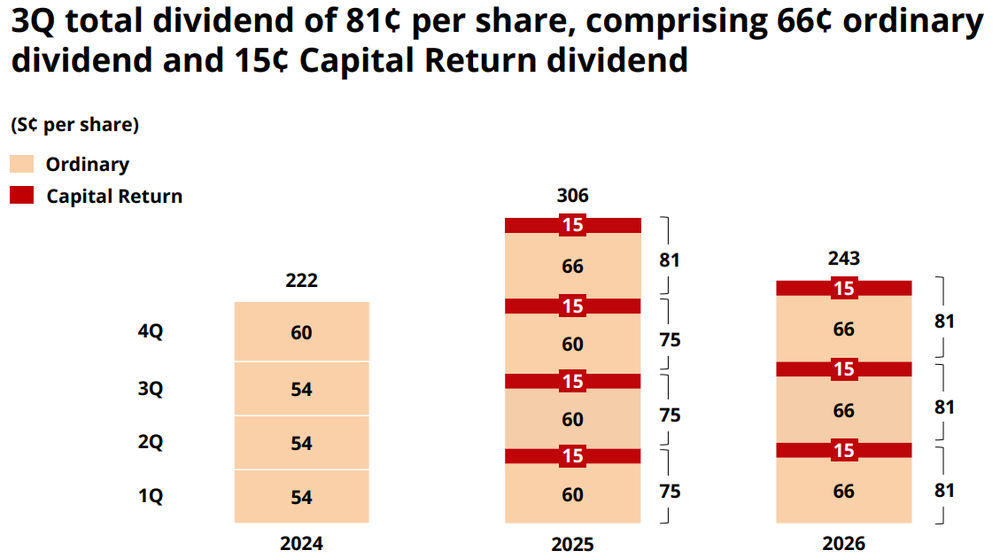
If DBS maintains its latest quarterly dividend of S$0.81 per share over four quarters, this would translate to an annual dividend of S$3.24 per share.
Based on its closing share price of S$66.24 on 24 November 2026, the annualised dividend yield would be approximately 4.9%.
However, it is important to distinguish between the ordinary and Capital Return dividends.
DBS has committed to distributing an additional S$0.15 per share every quarter through 2027 as part of its capital return programme.
Excluding this additional distribution, the ordinary dividend of S$0.66 per quarter would translate to S$2.64 annually, equivalent to a yield of approximately 4.0% at the same share price.
This distinction matters because the additional capital returns are not guaranteed to continue beyond 2027. DBS's ability to maintain or grow its ordinary dividends will depend on its earnings performance and capital position.
How does DBS fare on our Fundamental Checklist?
DBS passed two out of three fundamental checks, covering its revenue and earnings, as well as its balance sheet.
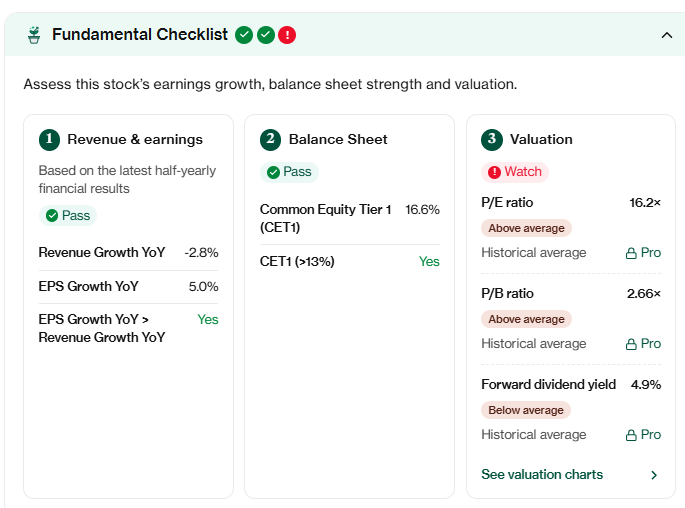
While revenue declined 2.8% year on year in the first half of 2026, EPS increased 5.0%, indicating that DBS managed to grow earnings despite weaker revenue.
However, DBS's more recent 3Q2026 results showed a 5% year-on-year decline in net profit, mainly due to weaker markets trading income. Despite this, its core banking business remained resilient, with net interest income rising 4% year on year and wealth management fees increasing 9%.
DBS also maintained a strong balance sheet, with a Common Equity Tier 1 (CET1) ratio of 15.9% as at September 2026, above the checklist's threshold of 13%.
However, valuation remains an area to watch. Both DBS's P/E and P/B ratios are above their historical averages, while its forward dividend yield of approximately 4.9% is below its historical average.
To assess whether DBS's current valuation offers an attractive entry point and how DBS's current P/E and P/B ratios compare with their historical averages, subscribe to Beansprout Pro and explore the DBS stock valuation page.
What to watch for DBS
DBS continues to benefit from its strong wealth management franchise and resilient loan growth.
However, I would monitor whether higher funding costs, market volatility and potential credit losses could weigh on earnings.
Its dividend outlook is another consideration. While DBS has committed to maintaining its additional Capital Return dividend through 2027, future distributions beyond this period will depend on its capital requirements and management decisions.
For my Income Pot, I would therefore look at the sustainability of DBS's ordinary dividend separately from its additional capital returns.
Investors can also read our comparison of DBS, OCBC and UOB following their 3Q2026 results to assess how their earnings, dividend yields and valuations compare.
Related links
- DBS: Profit falls 5% in 3Q26 as bank declares S$0.81 in total dividends
- DBS share price and analysis
- DBS dividend history and forecast
- DBS valuation
#2 – Singtel (SGX: Z74)
Singtel is one of Singapore's largest telecommunications groups, with operations in Singapore, Australia and investments across regional markets.
The company has recently attracted attention following its higher interim dividend and the conclusion of its Special Discounted Shares (SDS) scheme. Around two-thirds of SDS holders chose to retain their Singtel shares, while the remaining shareholders opted to sell.
In the first half of FY2026/27, Singtel reported a 10% year-on-year increase in underlying net profit to S$1.49 billion.
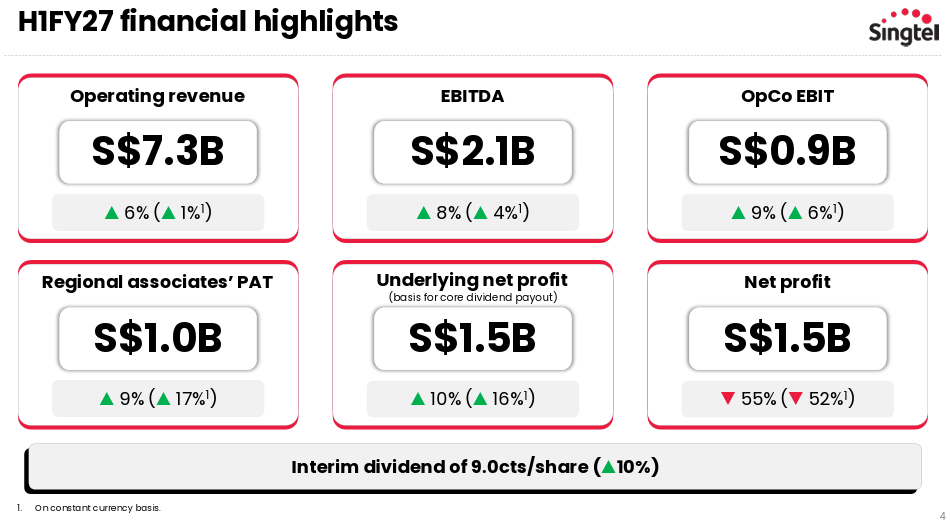
Operating revenue rose 6% to S$7.29 billion, supported by stronger contributions from Optus, NCS and its regional associates, including Airtel and AIS.
However, reported net profit declined 55% year on year to S$1.54 billion, largely due to the absence of significant exceptional gains recorded in the previous year.
The improvement in underlying earnings suggests that Singtel's operating performance has remained resilient.
Singtel raised its interim dividend by 10%
Following its latest results, Singtel declared an interim dividend of S$0.09 per share, approximately 10% higher than a year ago.
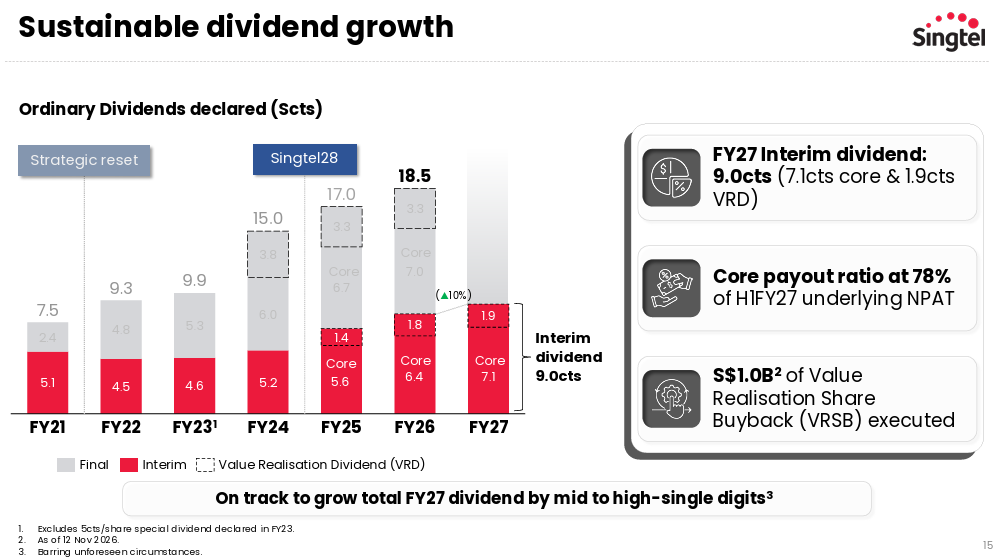
This comprises a core dividend of S$0.071 per share and a value realisation dividend of S$0.019 per share.
Singtel shares will go ex-dividend on 30 November 2026, with payment scheduled for 11 December 2026.
Based on its FY2025/26 dividend of S$0.185 per share and closing share price of S$4.13 on 24 November 2026, Singtel offers a historical dividend yield of approximately 4.5%.
Its indicative forward dividend yield is higher at approximately 5.0%, based on a forecast annual dividend of S$0.207 per share.
However, part of Singtel's dividend comes from value realisation distributions, which depend on its ability to unlock value from investments and may not be recurring.
How does Singtel fare on our Fundamental Checklist?
Singtel passed one out of three fundamental checks, covering its balance sheet.
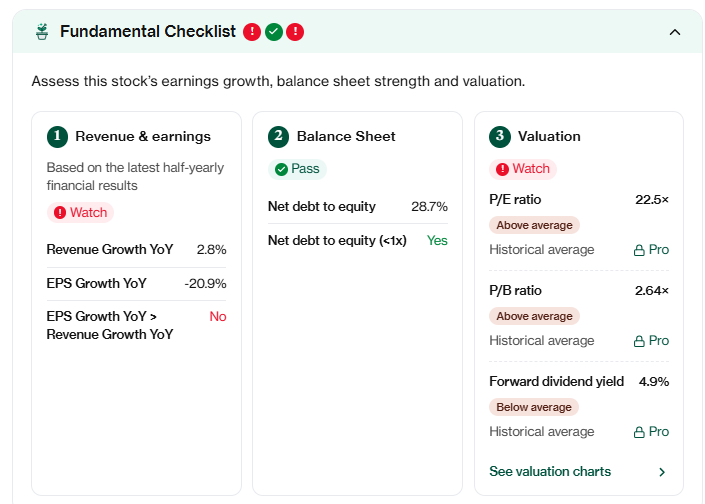
Singtel's latest half-year results showed revenue growth of 2.8% year on year, while EPS declined 20.9%. The decline in reported earnings was partly due to the absence of exceptional gains recorded in the previous year, although underlying earnings continued to improve.
Singtel maintained a relatively healthy balance sheet, with a net debt-to-equity ratio of 28.7%, providing some financial flexibility to support its operations and dividends.
However, valuation remains an area to watch. Both Singtel's P/E and P/B ratios are above their historical averages, while its forward dividend yield of approximately 4.9% is below its historical average.
To assess whether Singtel's current valuation offers an attractive entry point and how its current P/E and P/B ratios compare with their historical averages, subscribe to Beansprout Pro and explore the Singtel stock valuation page
What to watch for Singtel
Singtel's improving underlying earnings and higher interim dividend are encouraging for income investors.
However, I would monitor whether its earnings and free cash flow can sustain future core dividend growth, particularly as value realisation distributions may fluctuate.
Competition is another consideration, following the proposed merger between StarHub and M1, which could reshape Singapore's telecommunications market.
For my Income Pot, I would focus on the sustainability of Singtel's core dividend rather than relying solely on its headline dividend yield.
Related links
#3 – Venture Corporation (SGX: V03)
Venture designs and manufactures products such as medical devices, networking equipment and testing instruments.
Its third-quarter results showed that customers were ordering more.
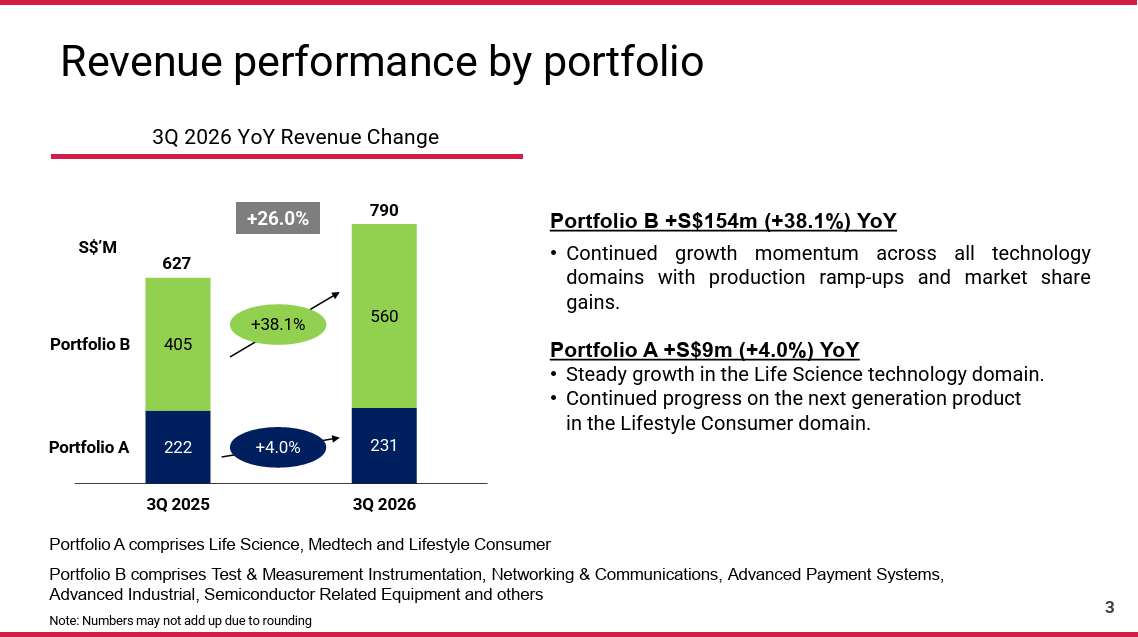
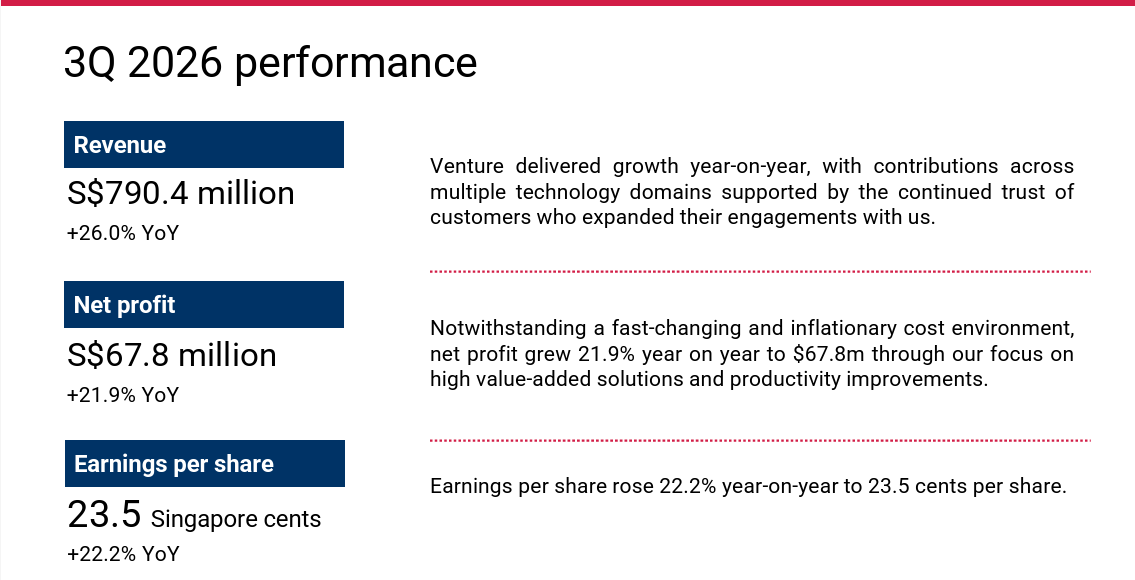
Revenue rose 26.0% year on year to S$790.4 million, while net profit increased 21.9% to S$67.8 million. Earnings per share also rose 22.2% to 23.5 Singapore cents.
Growth also picked up over the course of the year.
Third-quarter revenue growth of 26.0% followed increases of 1.9% in the first quarter and 12.5% in the second.
For the first nine months, net profit reached S$187.1 million, up 11.0% year on year.
Venture offers a dividend yield of around 5.7%
Venture paid a final dividend of S$0.50 per share in May 2026 and an interim dividend of S$0.30 per share in September 2026.
This brings its total dividends paid over the past 12 months to S$0.80 per share, translating to a dividend yield of approximately 5.7% based on its share price of S$14.15 on 24 November 2026.
Notably, Venture increased its ordinary interim dividend by 20% from S$0.25 to S$0.30 per share in 2026.
However, shareholders received the same total interim payout of S$0.30 per share in 2025, comprising an ordinary dividend of S$0.25 and a special dividend of S$0.05.
The increase in ordinary dividends is encouraging, although Venture's ability to sustain its payouts will depend on its future earnings and cash flow.
How does Venture fare on Beansprout’s Fundamental Checklist?
Venture Corporation passes two of our three fundamental checks, supported by its balance sheet and valuation.
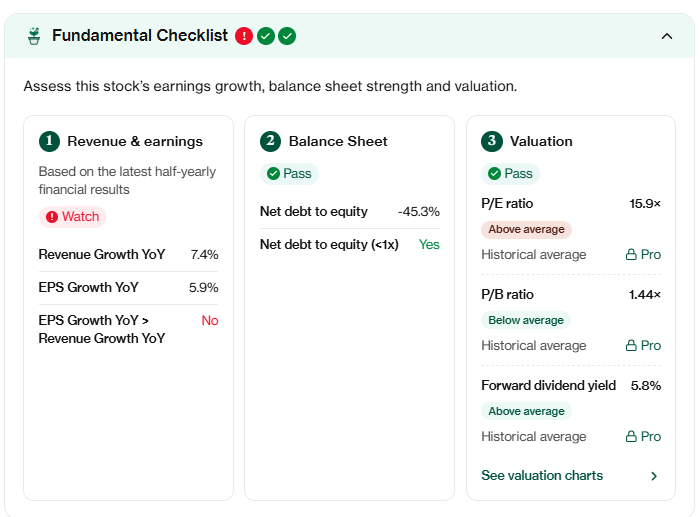
For revenue and earnings, Venture's first-half results showed revenue growth of 7.4% year on year, while EPS increased by a slower 5.9%.
However, its more recent 3Q2026 results showed an improvement, with revenue growth accelerating to 26.0% year on year and net profit increasing 21.9%. This suggests that Venture's earnings recovery is gaining momentum, supported by growth across both business portfolios.
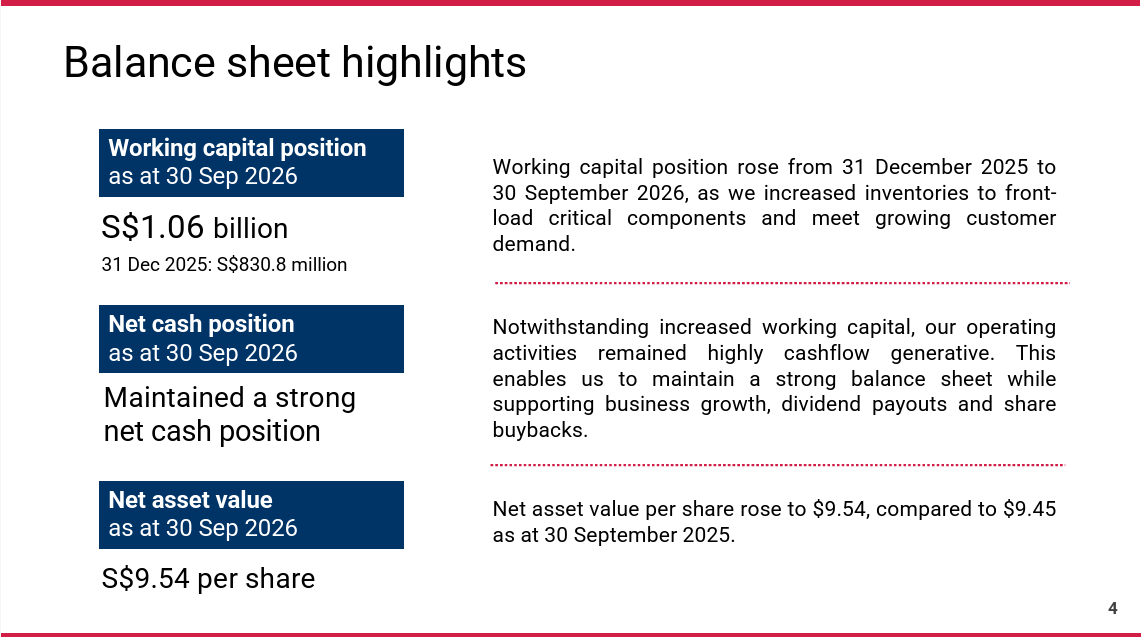
Venture's balance sheet remains strong, with a net cash position and a net debt-to-equity ratio of -45.3%, providing financial flexibility to support its operations and dividends.
In terms of valuation, Venture's P/E ratio is above its historical average, while its P/B ratio is below its historical average. Its forward dividend yield of approximately 5.7% is also above its historical average.
To assess whether Venture's current valuation offers an attractive entry point and how its valuations compares to historical averages, subscribe to Beansprout Pro and explore the Venture stock valuation page.
What to watch for Venture
Venture's improving revenue and earnings growth are encouraging, particularly as both business portfolios have returned to growth.
However, I would monitor whether the company can sustain this momentum as demand for technology and manufacturing products remains cyclical.
Profit margins are another area to watch, as higher component costs and production expenses could limit how much revenue growth translates into earnings.
While Venture's net cash position offers some support for its dividends, I would also assess whether its earnings recovery can translate into stronger cash flow and support its S$0.80 annual payout.
For a more detailed assessment of its latest results, read our Venture Corporation investment analysis on Beansprout Pro.
Related links
- Venture Corporation: Venture’s growth accelerates as both portfolios return to growth
- Venture Corporation share price and analysis
- Venture Corporation dividend history and forecast
- Venture Corporation valuation
What would Beansprout do?
Venture, DBS and Singtel offer dividend yields of around 5%, but their latest results highlight different considerations for income investors.
For my Income Pot, I would focus on the sustainability of their recurring dividends, their earnings outlook and whether their valuations offer an attractive entry point.
| Stock | Forward yield at 24 Nov 2026 close | What supports the payout | What I would watch |
| DBS | 4.9% at S$66.24 | Record nine-month profit, a capital buffer and a low non-performing loan ratio | How the ordinary dividend develops as DBS returns surplus capital. |
| Singtel | 5.0% at S$4.13 | Higher underlying earnings supported a larger core dividend | Whether core earnings keep growing and how much of future payouts comes from value realisation. |
| Venture | 5.7% at S$14.15 | Growing earnings, a net cash balance sheet and a higher ordinary interim dividend | Whether cash collections improve as Venture delivers products from its expanded inventory. |
Venture would be the first stock I would research further for dividend income. Its forward dividend yield of 5.7% is the highest among the three, supported by improving earnings in 3Q2026. However, I would monitor whether stronger earnings translate into cash flow to sustain future dividends.
Singtel stands out for its growing core dividend. Its forward dividend yield is around 5.0%, supported by improving underlying earnings. I would monitor whether this growth can sustain future core dividends, while assessing value realisation payouts separately.
DBS continues to offer resilient earnings and dividend income. Its annualised dividend yield is close to 5%, although quarterly profit declined. I would monitor its earnings outlook and distinguish between ordinary dividends and additional capital returns, which are committed only through 2027.
Overall, I would also use Beansprout's three checks for dividend stocks to assess earnings growth, financial strength and whether the dividend yield is attractive relative to the risks, including compared with Singapore government bonds.
These checks help me identify stocks worth researching further, rather than serving as standalone buy decisions.
To explore more Singapore dividend stocks, you can use our Income Stock Screener to identify companies that pass Beansprout's three checks for dividend stocks, based on their fundamental strength, financial health and valuation.
For a closer look at how we would build a Singapore stock portfolio, see how we would invest S$100,000 in Singapore stocks today.
You can also explore Beansprout Pro for our latest market views, top ideas, portfolio thinking and the reasoning behind our investment decisions.
Which of these blue chips are you watching for your income pot? Share your thoughts in the comments below or join the discussion in our Telegram group!
Planning to invest in Singapore stocks? Compare the best Singapore brokers to find the right trading platform, and see the latest promotions and sign-up rewards available.
Follow Beansprout on YouTube, Facebook and Instagram, and add Beansprout as your preferred source on Google so you never miss an update.
Read also
Gain financial insights in minutes
Subscribe to our free weekly newsletter for more insights to grow your wealth
Most Popular

Comments
0 comments