
3 Singapore blue chip REITs near historical price-to-book lows with dividend yield around 7%
REITs
By Goh Lay Peng • 20 Nov 2026
Why trust Beansprout? We’ve been awarded Best Investment Website at the SIAS Investors’ Choice Awards
We look at three Singapore blue chip REITs trading near their historical price-to-book lows, with dividend yields of around 7%, and assess their latest earnings, financial health and valuations.

What happened?
Several Singapore blue chip REITs are trading near their historical valuation lows.
Following the recent market correction, I have been taking a closer look at Singapore stocks and REITs for potential dividend income, especially as bond yields remain elevated.
Last month, we looked at Singapore blue chip REITs trading near their 52-week lows with dividend yields above 6%.
More recently, we examined three Singapore blue chip stocks that announced dividends alongside their latest earnings as well as Singapore blue chip stocks near 52-week lows.
With more REITs announcing their latest earnings and business updates, we noticed that three familiar Singapore blue chip REITs are trading near their historical price-to-book (P/B) lows, with dividend yields of around 7%.
However, lower share prices do not necessarily mean that valuations are attractive, especially if earnings and distributions remain under pressure.
In this article, I examine their latest earnings, valuations and financial health using Beansprout's Fundamental Checklist to assess whether they warrant a closer look.
3 Singapore blue chip REITs near historical price-to-book lows with dividend yield around 7%
Using Beansprout's Stocks Near Historical P/B Lows screener, we identified three Singapore blue chip REITs with P/B ratios close to their historical lows as of 19 November 2026.
| REIT | Unit price | Current P/B | Forward dividend yield |
| CapitaLand Ascendas REIT (A17U) | S$2.17 | 0.95x | 7.2% |
| Mapletree Industrial Trust (ME8U) | S$1.65 | 1.02x | 7.2% |
| Mapletree Pan Asia Commercial Trust (N2IU) | S$1.12 | 0.65x | 7.0% |
| Source: Beansprout historical P/B low screener, as of 19 November 2026. Prices and yields are reproduced from the same screener snapshot and are not labelled as closing prices. Distances from historical lows use the screener’s calculations, which may differ from calculations using the rounded P/B ratios shown. | |||
The P/B ratio compares a REIT's unit price with its net asset value per unit.
A ratio below 1.0x indicates that its units are trading at a discount to reported book value, while a ratio above 1.0x indicates a premium.
However, book values depend on property valuations, which may change with rental expectations, capitalisation rates and market conditions.
#1 – CapitaLand Ascendas REIT (SGX: A17U)
CapitaLand Ascendas REIT (CLAR) owns business space, industrial properties, logistics facilities and data centres across Singapore, Australia, the United States, the United Kingdom, Europe and Japan.
As at September 2026, Singapore accounted for approximately 66% of its S$20.7 billion portfolio.
CapitaLand Ascendas REIT was trading at S$2.17 as of 19 November 2026, with a P/B ratio of 0.95x.
Occupancy and rental reversions improved
CLAR’s latest 3Q 2026 business update, released on 29 October, showed improving operating indicators.
Portfolio occupancy rose to 90.1%, from 89.1% at the end of June.
Rental reversion was positive at 9.9% for the quarter, bringing the figure for the first nine months of 2026 to 9.0%.
This means renewed leases generally secured higher rents, which may support income as the leases take effect.
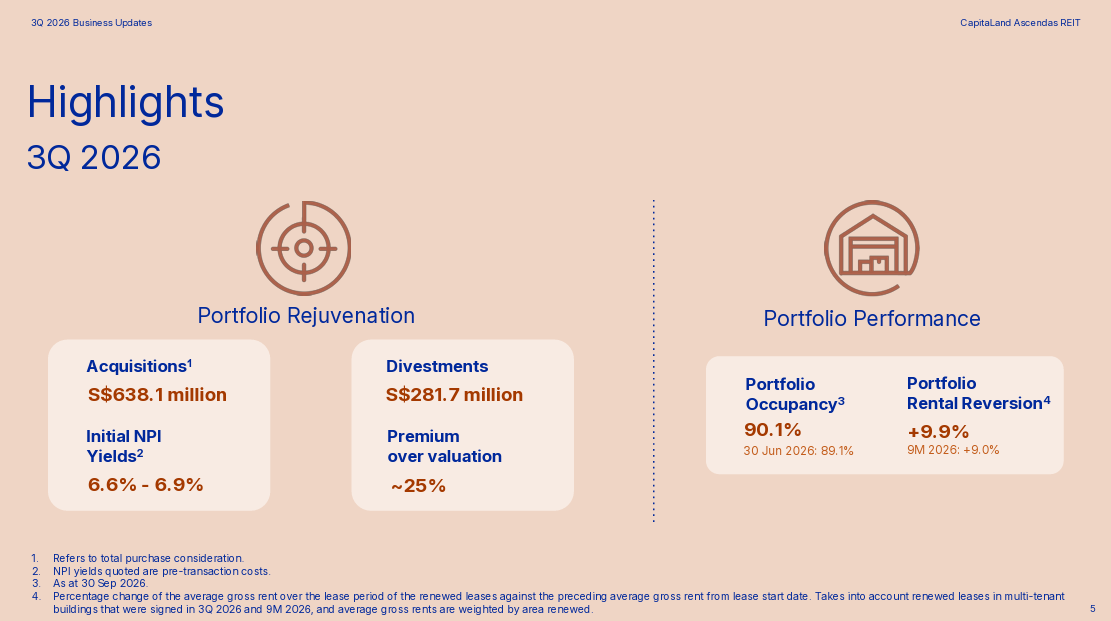
CLAR also completed the acquisition of two Singapore logistics properties for S$638.1 million during the quarter.
Both properties were fully occupied and included annual rental increases, providing additional sources of income.
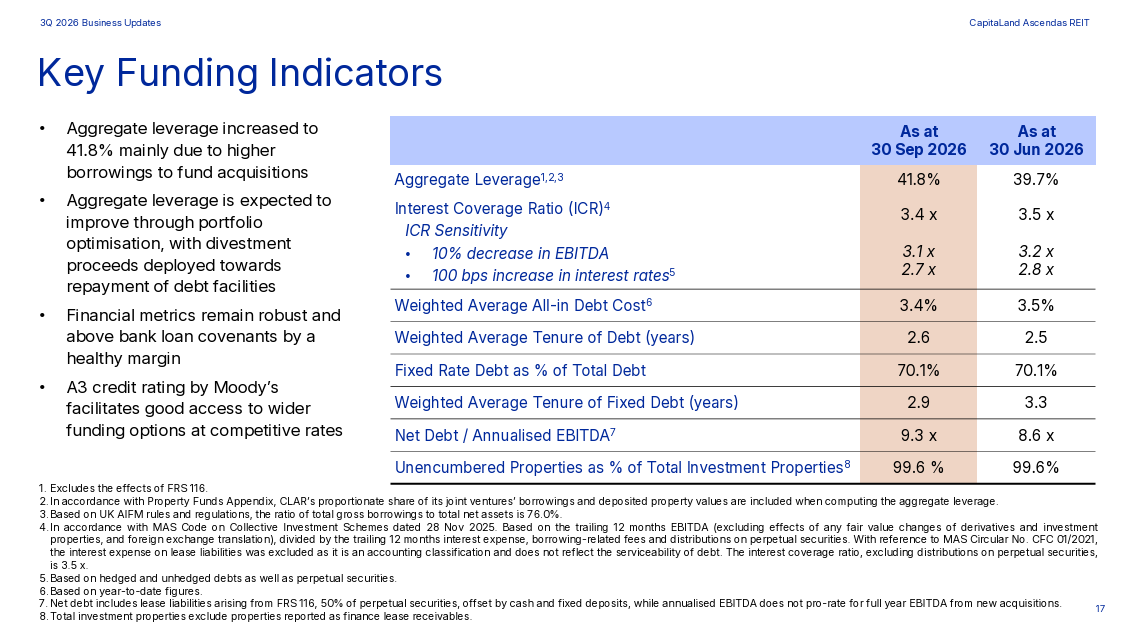
However, aggregate leverage increased to 41.8% in September, from 39.7% in June. Its cost of debt for the first nine months was 3.4%.
Management indicated that using estimated proceeds from ongoing divestments to repay borrowings would reduce aggregate leverage to approximately 41% on a pro forma basis. This remains conditional on completing the divestments and deploying the proceeds.
Higher income has yet to translate into meaningful DPU growth
The October announcement was a business update, so CLAR’s latest reported distribution per unit remains its 1H 2026 DPU of 7.482 cents, up 0.1% year-on-year.
First-half revenue increased 6.7% to S$805.5 million, while distributable income rose 8.6% to S$359.4 million.
However, an enlarged unit base meant the higher total income was spread across more units, limiting the increase in DPU.
CapitaLand Ascendas REIT: What does the fundamental checklist show?
Based on its latest half-year financial results, CapitaLand Ascendas REIT's revenue grew 5.8% year on year, while earnings per share (EPS) declined 12.8%. This suggests that higher revenue has yet to translate into stronger earnings for unitholders.
Its balance sheet remains relatively healthy, with net debt to equity at 71.1%, below the 100% threshold used in Beansprout's Fundamental Checklist.
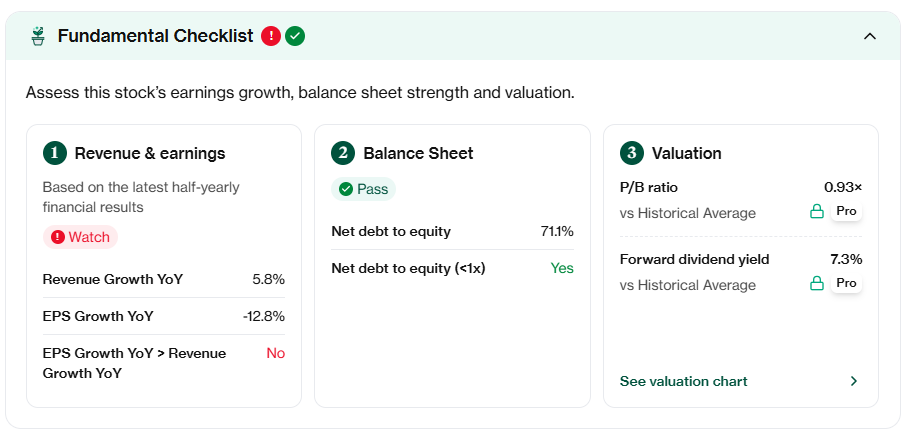
On valuation, CLAR trades at a P/B ratio of approximately 0.95x, with a forward dividend yield of 7.2% as of 19 November 2026.
I would watch whether improving occupancy, positive rental reversions and recent acquisitions can translate into stronger earnings and distributions, particularly after its recent increase in borrowings.
To see how CLAR's current P/B and P/E ratios compare with their historical averages, subscribe to Beansprout Pro.
Find out how much dividend income you would have received as a CapitaLand Ascendas REIT unitholder over the past 12 months using the dividend calculator below.
Related links:
- CapitaLand Ascendas REIT latest share price and analysis
- CapitaLand Ascendas REIT dividend history and forecast
- CapitaLand Ascendas REIT latest valuation
#2 – Mapletree Industrial Trust (SGX: ME8U)
Mapletree Industrial Trust, or MIT, provides exposure to industrial properties and data centres, including assets in Singapore, North America and Japan.
As at 30 September 2026, MIT had approximately S$8.3 billion in assets under management.
At S$1.65 as of 19 November 2026, its P/B ratio was 1.02 times, with a forward dividend yield of approximately 7.2%.
Unlike CapitaLand Ascendas REIT, MIT still trades at a slight premium to its book value despite being near its historical P/B low.
Distributions remained under pressure
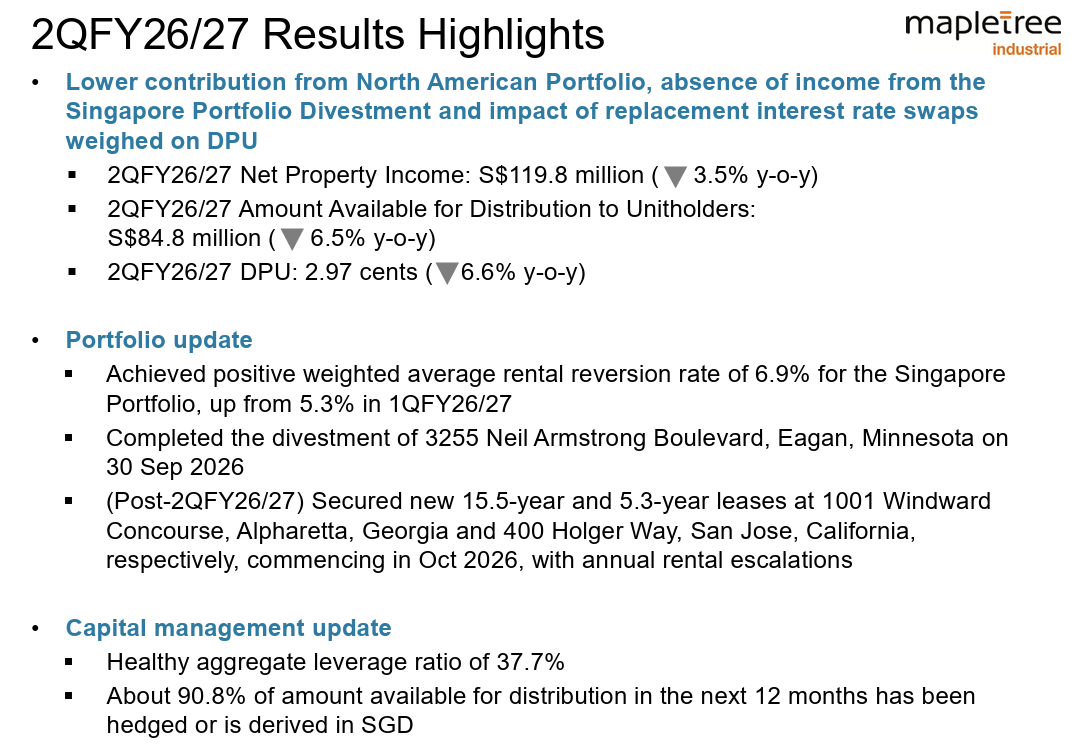
MIT's latest financial results for the second quarter of FY2026/27, released on 27 October 2026, showed that distributions remained under pressure.
Second-quarter DPU fell 6.6% year-on-year to 2.97 cents, while first-half DPU declined 5.7% to 6.08 cents.
Meanwhile, the amount available for distribution to unitholders declined 6.5% in 2QFY27 to S$84.8 million.
First-half revenue fell 4.8% to S$329.3 million, and net property income declined 6.1% to S$242.0 million.
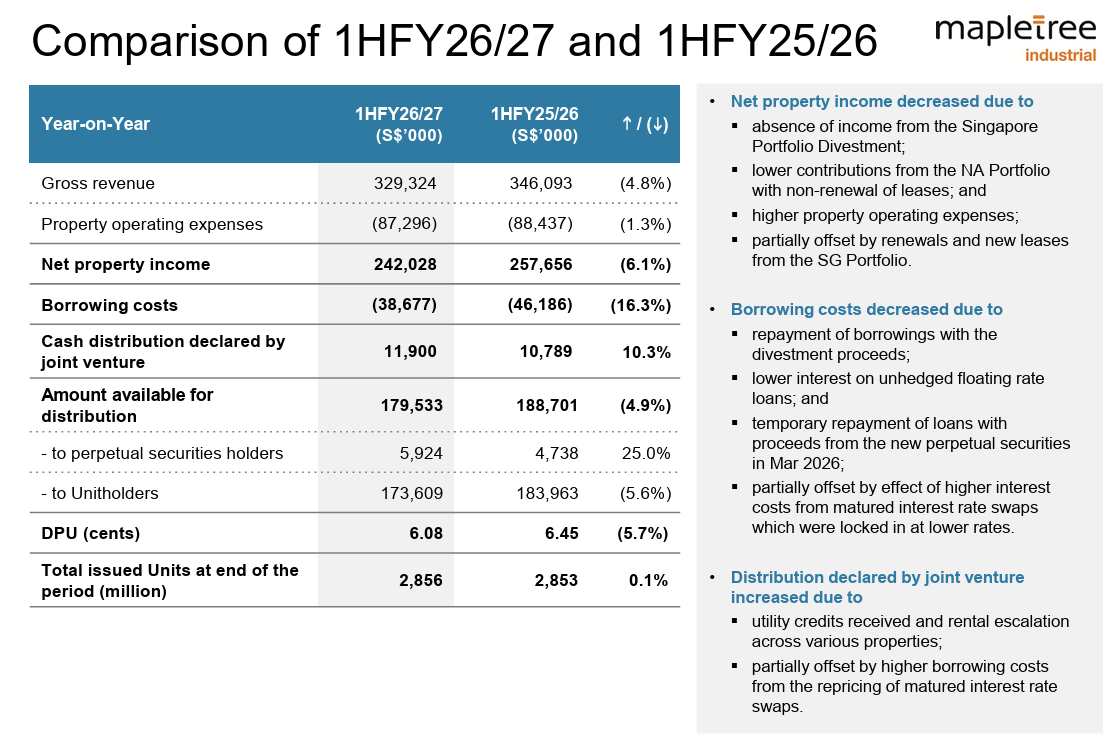
Management attributed the weaker performance mainly to lower contributions from its North American portfolio, the absence of income from previously divested Singapore properties and the impact of replacement interest-rate swaps.
New data-centre leases offer a potential recovery driver
Average portfolio occupancy fell to 89.7% in the second quarter, from 90.7% in the preceding quarter.
However, Singapore rental reversion improved to 6.9%, from 5.3%.
MIT also secured new leases at its Alpharetta and San Jose data centres, commencing in October 2026.
The leases run for 15.5 years and 5.3 years, respectively, with annual rental increases. These may help rebuild income from the North American portfolio.
Aggregate leverage was 37.7% at the end of September, providing some balance-sheet flexibility.
For MIT, we would watch whether new leases improve occupancy and stabilise DPU, while monitoring the financing costs associated with maturing debt hedges.
Mapletree Industrial Trust: What does the fundamental checklist show?
Based on its latest half-year financial results, Mapletree Industrial Trust's revenue declined 4.8% year on year, while earnings per share (EPS) fell 10.4%. Its first-half distribution per unit (DPU) also declined 5.7%, reflecting continued pressure on distributions.
Its balance sheet remains relatively healthy, with net debt to equity at 43.1%, below the 100% threshold used in Beansprout's Fundamental Checklist. Aggregate leverage stood at 37.7% as at September 2026, the lowest among the three REITs.
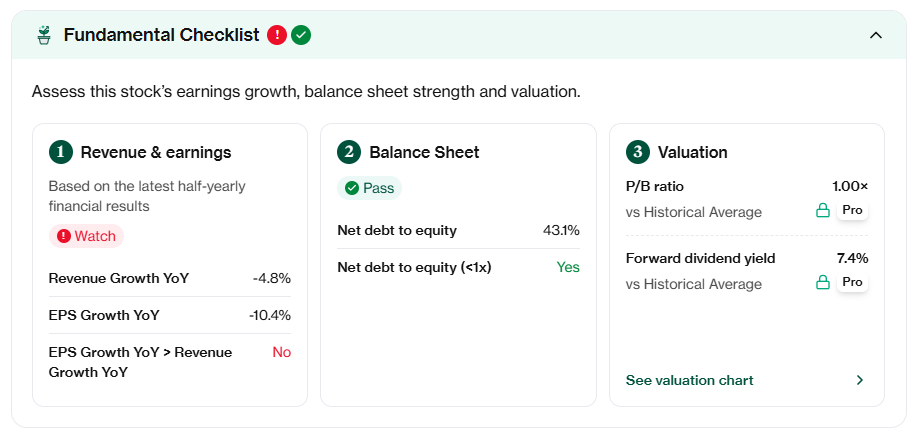
On valuation, MIT trades at a P/B ratio of approximately 1.02x, with a forward dividend yield of 7.2% as of 19 November 2026.
I would watch whether new data-centre leases in North America and positive rental reversions in Singapore can help stabilise earnings and distributions.
To see how MIT's current P/B and P/E ratios compare with their historical averages, subscribe to Beansprout Pro.
Find out how much dividend income you would have received as a Mapletree Industrial Trust unitholder over the past 12 months using the dividend calculator below.
Related links:
- Mapletree Industrial Trust latest share price and analysis
- Mapletree Industrial Trust dividend history and forecast
- Mapletree Industrial Trust latest valuation
#3 – Mapletree Pan Asia Commercial Trust (SGX: N2IU)
Mapletree Pan Asia Commercial Trust, or MPACT, owns retail and office properties across Singapore and other Asian markets.
Its portfolio includes familiar Singapore assets such as VivoCity and Mapletree Business City.
Singapore remains the largest contributor to its portfolio, accounting for approximately 61% of assets under management and 68% of net property income.
At S$1.12 as of 19 November 2026, it traded at 0.65 times book value with a forward dividend yield of around 7.0%.
Overseas weakness continued to weigh on distributions
MPACT released its 2Q and 1H FY26/27 results on 30 October 2026.
Second-quarter DPU fell 3.5% year-on-year to 1.94 cents. First-half DPU declined 3.0% to 3.90 cents.
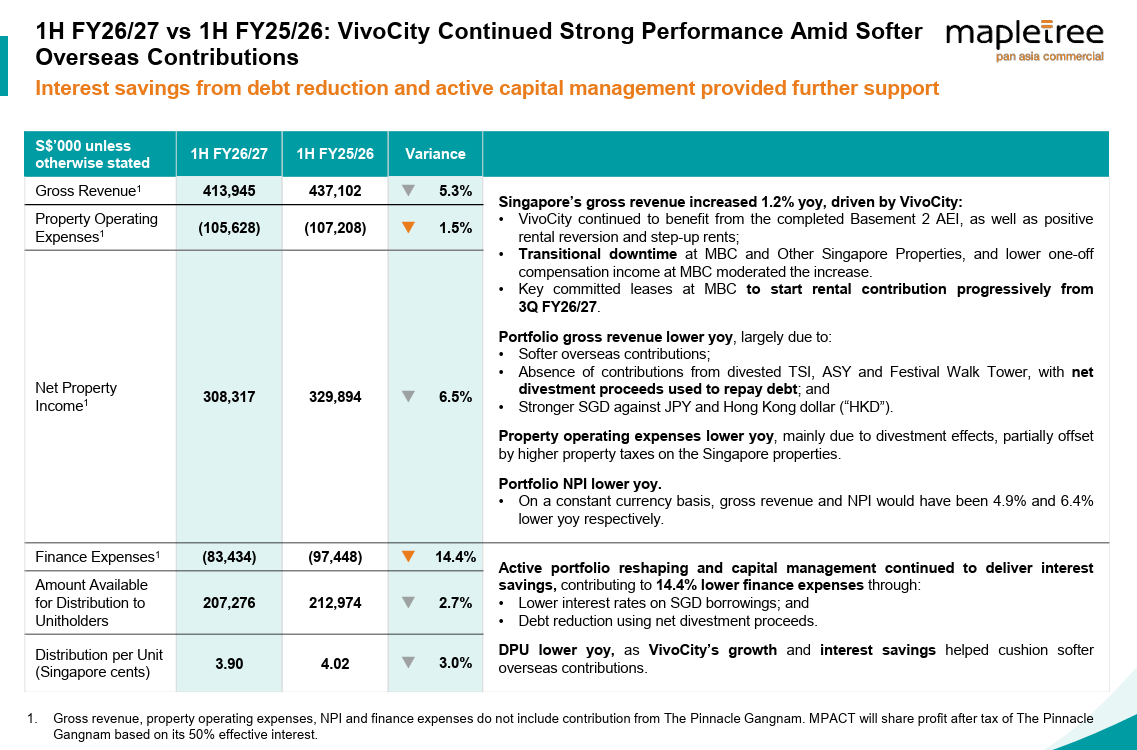
First-half revenue fell 5.3% to S$413.9 million, while net property income declined 6.5% to S$308.3 million.
Meanwhile, DPU declined 3.5% to 1.94 cents, compared with 2.01 cents in the same quarter last year. For the first half of FY2026/27, DPU fell 3.0% to 3.90 cents.
Lower financing expenses helped cushion the impact on distributions.
VivoCity and improving occupancy provide support
Despite the weaker overall results, MPACT's Singapore properties continued to provide some support.
VivoCity remained a bright spot, with second-quarter net property income rising 5.0% year-on-year.
It maintained 100% committed occupancy, while reported rental reversion was positive at 15.0%.
At Mapletree Business City, committed occupancy improved to 95.4%, with key committed leases expected to start contributing rental income progressively from the third quarter.
Across the portfolio, committed occupancy rose to 85.6%, from 84.4% in June.
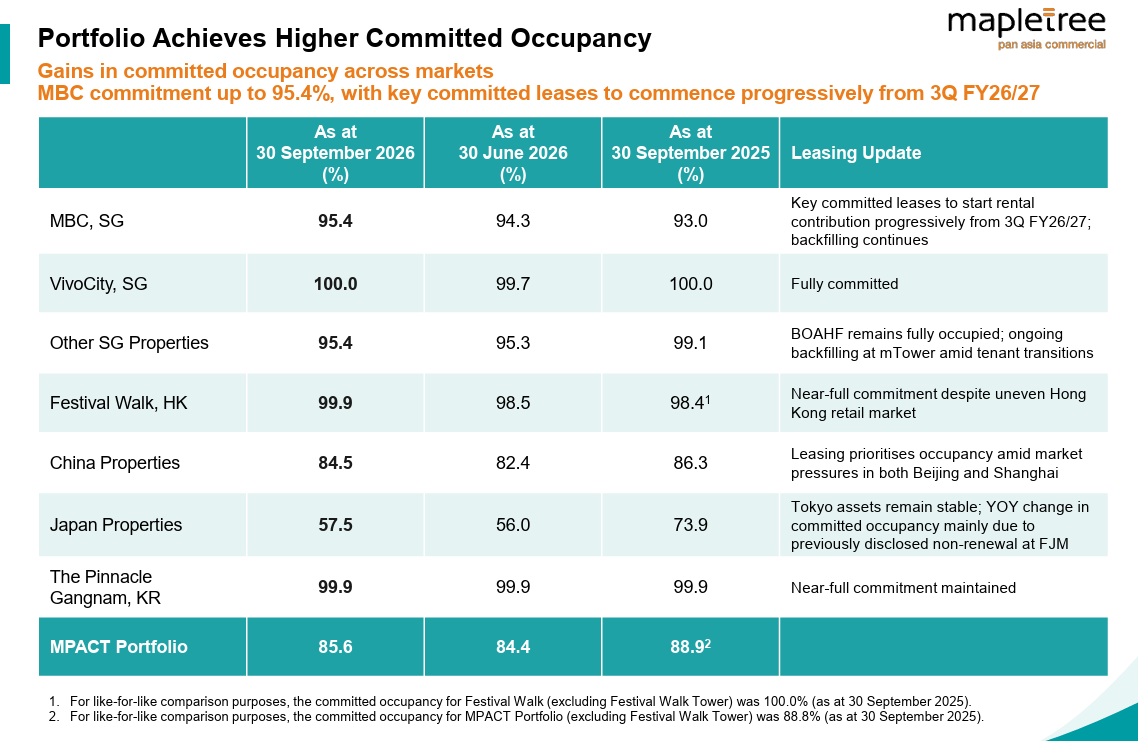
However, overseas contributions remained affected by the Fujitsu Makuhari lease non-renewal, challenging conditions in China and Hong Kong, and the absence of income from divested properties.
Aggregate leverage was 38.1%, while the weighted average all-in cost of debt was 2.95%. Management cautioned that further financing-cost savings may narrow as rates rise.
Mapletree Pan Asia Commercial Trust: What does the fundamental checklist show?
Based on its latest half-year financial results, Mapletree Pan Asia Commercial Trust's revenue declined 5.3% year on year, while earnings per share (EPS) fell 4.0%. Its first-half DPU also declined 3.0%, as resilient performance from VivoCity was insufficient to fully offset weaker overseas contributions.
Its balance sheet remains relatively stable, with net debt to equity at 57.5%, below the 100% threshold used in Beansprout's Fundamental Checklist. Aggregate leverage stood at 38.1% as at September 2026.
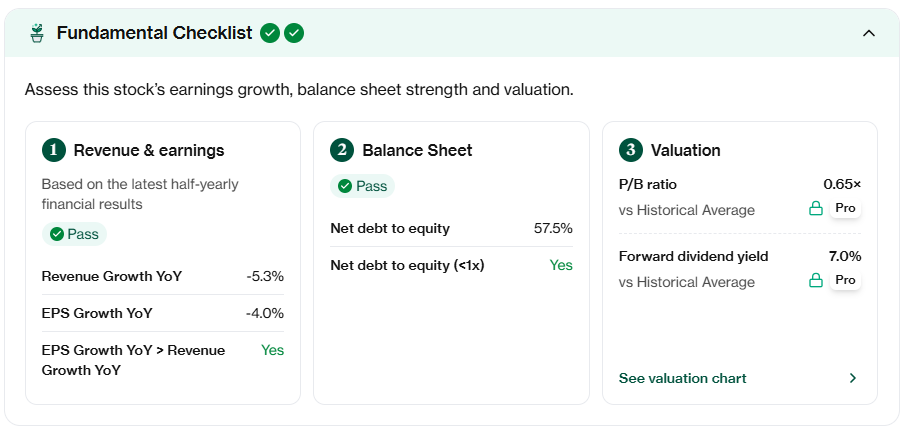
On valuation, MPACT trades at a P/B ratio of approximately 0.65x, representing a discount of around 35% to book value. Its forward dividend yield stood at 7.0% as of 19 November 2026.
However, I would assess whether rental income and occupancy across its overseas properties can stabilise before viewing the discount as an attractive investment opportunity.
To see how MPACT's current P/B and P/E ratios compare with their historical averages, subscribe to Beansprout Pro.
Find out how much dividend income you would have received as a Mapletree Pan Asia Commercial Trust unitholder over the past 12 months using the dividend calculator below.
Related links:
- Mapletree Pan Asia Commercial Trust latest share price and analysis
- Mapletree Pan Asia Commercial Trust dividend history and forecast
- Mapletree Pan Asia Commercial Trust latest valuation
What would Beansprout do?
The recent pullback in Singapore REITs has brought the valuations of several blue chip REITs close to their historical P/B lows.
CapitaLand Ascendas REIT, Mapletree Industrial Trust and Mapletree Pan Asia Commercial Trust are now offering forward dividend yields of around 7%.
However, I would not assume that these REITs are attractive simply because their valuations are near historical low.
For my Income Pot within Beansprout's Four Pots of Wealth, I would focus on whether their rental income and financial health can support sustainable distributions.
| REIT | Forward dividend yield | What stands out | What I would watch |
| CapitaLand Ascendas REIT | 7.2% | Improving occupancy, positive rental reversions and diversified portfolio | Whether stronger rental income translates into DPU growth, particularly with higher leverage |
| Mapletree Industrial Trust | 7.2% | Relatively healthy balance sheet, with the lowest aggregate leverage among the three | Whether new US data-centre leases and Singapore rental growth can stabilise declining distributions |
| Mapletree Pan Asia Commercial Trust | 7.0% | Trades at approximately 34% below book value, with resilient Singapore assets | Whether weaker overseas rental income and occupancy can stabilise |
| Source: Beansprout and respective REIT financial announcements. Valuations and estimated forward yields are as of 19 November 2026. | |||
Among the three, CapitaLand Ascendas REIT has shown the most encouraging recent operating trends, with improving occupancy and strong rental reversions. However, I would monitor whether these improvements translate into higher DPU, particularly after its recent acquisitions increased borrowings.
Mapletree Industrial Trust has a relatively healthy balance sheet, but its latest results showed that distributions remain under pressure. I would look for signs that its North American portfolio is stabilising and that stronger Singapore rental contributions are improving DPU.
Meanwhile, Mapletree Pan Asia Commercial Trust has the deepest discount to book value among the three REITs, while VivoCity continues to perform well. However, I would assess whether its overseas properties are showing signs of recovery before relying on its current dividend yield.
For me, the key is to distinguish between a REIT that is temporarily undervalued and one whose lower valuation reflects a deterioration in its fundamentals.
Historical P/B lows can be a useful starting point for identifying opportunities, but I would also consider changes in net asset values, rental income, borrowing costs and the sustainability of distributions.
You can use Beansprout's Stocks Near Historical P/B Lows screener to identify other Singapore stocks and REITs trading close to their historical valuation lows.
For investors looking to narrow down REITs worth researching, you can also use Beansprout's REIT screening framework and explore REITs that meet our criteria through the Income REITs Screener.
With interest rates remaining elevated, I would also consider diversifying my income sources with quality Singapore dividend stocks, rather than relying too heavily on the REIT sector.
To see how we would balance REITs with other investments, check out how we would invest S$100,000 in Singapore stocks today.
You can also explore Beansprout Pro for our latest market views, portfolio thinking and the reasoning behind our investment decisions.
Which Singapore blue chip REITs are you watching at current levels? Share your views in the Beansprout Telegram community.
Follow Beansprout on YouTube, Facebook and Instagram, and add Beansprout as your preferred source on Google so you never miss an update.
Read also
Gain financial insights in minutes
Subscribe to our free weekly newsletter for more insights to grow your wealth
Most Popular

Comments
0 comments