
3 Singapore blue-chip REITs near 52-week lows with dividend yields above 6%
REITs
By Goh Lay Peng • 21 Oct 2026
Why trust Beansprout? We’ve been awarded Best Investment Website at the SIAS Investors’ Choice Awards 2025

Make Beansprout your preferred source on Google
Add us on Google to see more of our insights in your search results
We look at three Singapore blue-chip REITs offering forward dividend yields above 6%, comparing their DPU trends, gearing and income sustainability.
What happened?
Several Singapore blue-chip REITs are trading near their 52-week lows.
We recently looked at what the STI’s pullback means for Singapore stock investors, as rising bond yields put pressure on income investments.
At the same time, we explored how rising Singapore office rents could support rental income for REITs with office exposure, even as their unit prices remain under pressure.
With some blue-chip REITs still trading near their 52-week lows, many in the Beansprout community are wondering whether their higher dividend yields are sustainable.
For me, the key question is whether their distributions can hold up, rather than whether their unit prices have fallen enough.
In this article, I look at three Singapore blue-chip real estate investment trusts (REITs) offering forward dividend yields above 6% and assess whether their distributions are sustainable using Beansprout’s three REIT screening checks.
3 Singapore blue chip REITs with dividend yields above 6% near 52-week lows
#1 – Frasers Logistics & Commercial Trust (SGX: BUOU)
Frasers Logistics & Commercial Trust (FLCT) owns logistics, industrial and commercial properties across Australia, Germany, the Netherlands, Singapore and the United Kingdom.
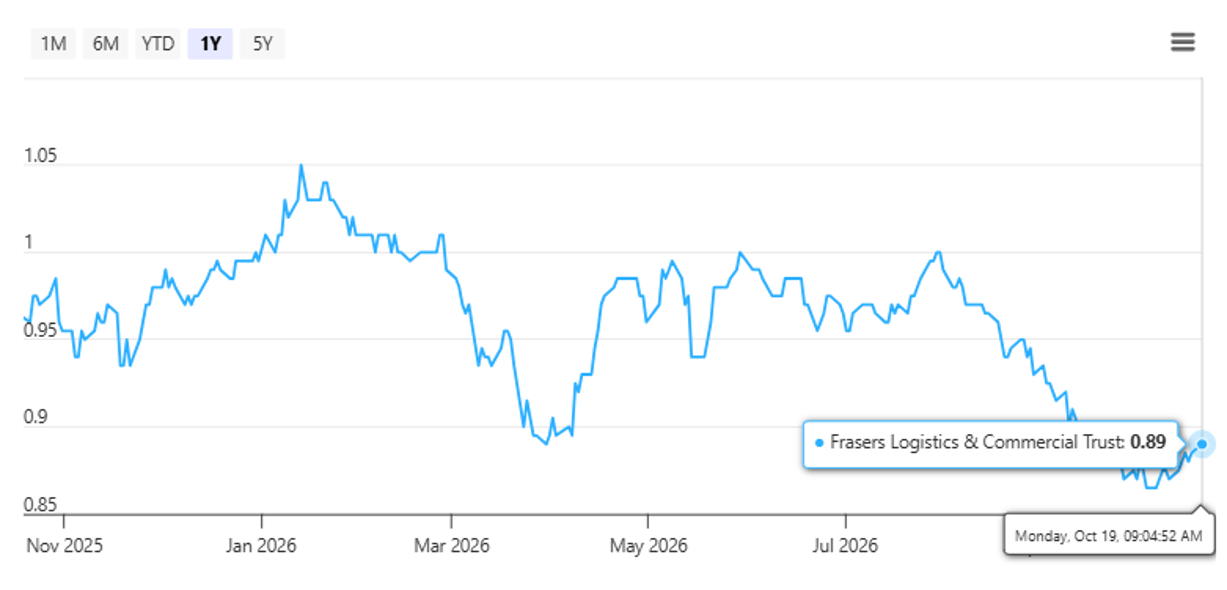
Frasers Logistics & Commercial Trust was trading at S$0.89 as at 19 October 2026, approximately 3.5% above its 52-week low of S$0.86.
Its latest distribution results cover the six months ended 31 March 2026, or 1H FY2026.
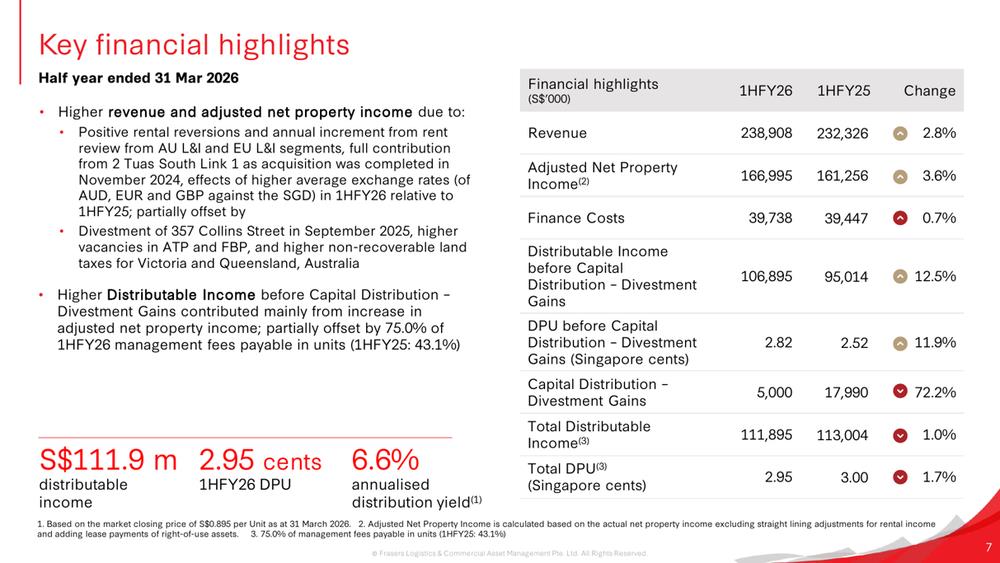
Revenue rose 2.8% year on year to S$238.9 million, while adjusted net property income increased 3.6% to S$167.0 million.
However, reported distribution per unit fell 1.7% to 2.95 cents, from 3.00 cents.
The breakdown offers a more encouraging picture. DPU excluding capital distributions from divestment gains rose 11.9% to 2.82 cents. Lower distributions of divestment gains offset this improvement, resulting in the decline in total DPU.
A larger proportion of management fees paid in units also supported distributable income, so I would assess the improvement alongside this change.
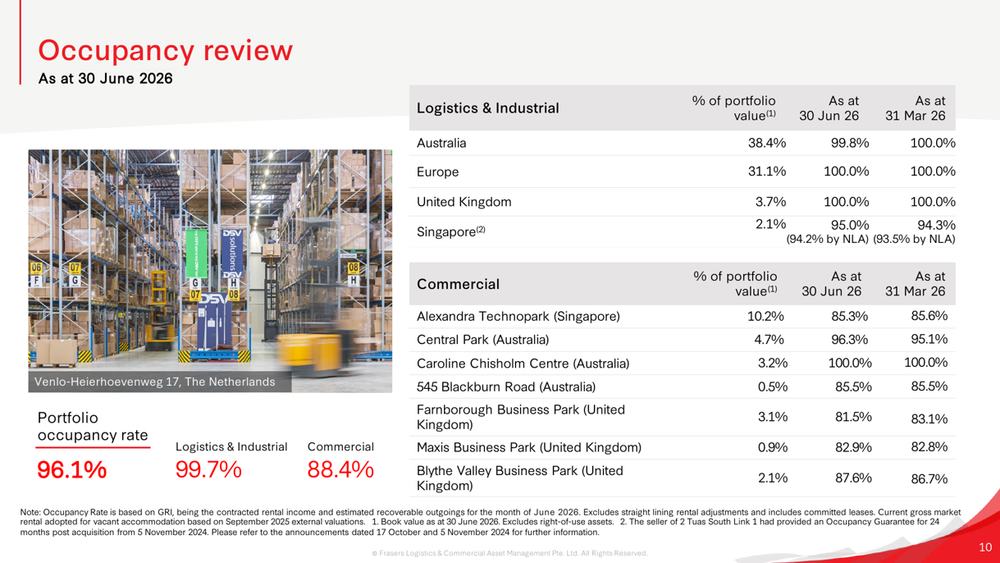
Its subsequent business update for the quarter ended 30 June 2026 showed portfolio occupancy of 96.1%. Logistics and industrial occupancy remained high at 99.7%, compared with 88.4% for its commercial properties.
Portfolio rental reversions were positive at 8.2%, measured using incoming rents against outgoing rents. This suggests leasing activity could support income, although commercial vacancies remain an area to watch.
FLCT also completed the acquisition of interests in four properties in Germany and the Netherlands on 31 July 2026. This adds to its European logistics exposure.
The question is whether its improved leasing performance and acquisitions can translate into sustainable DPU growth.
To assess this, I would apply the three checks in our Singapore REIT screening framework.
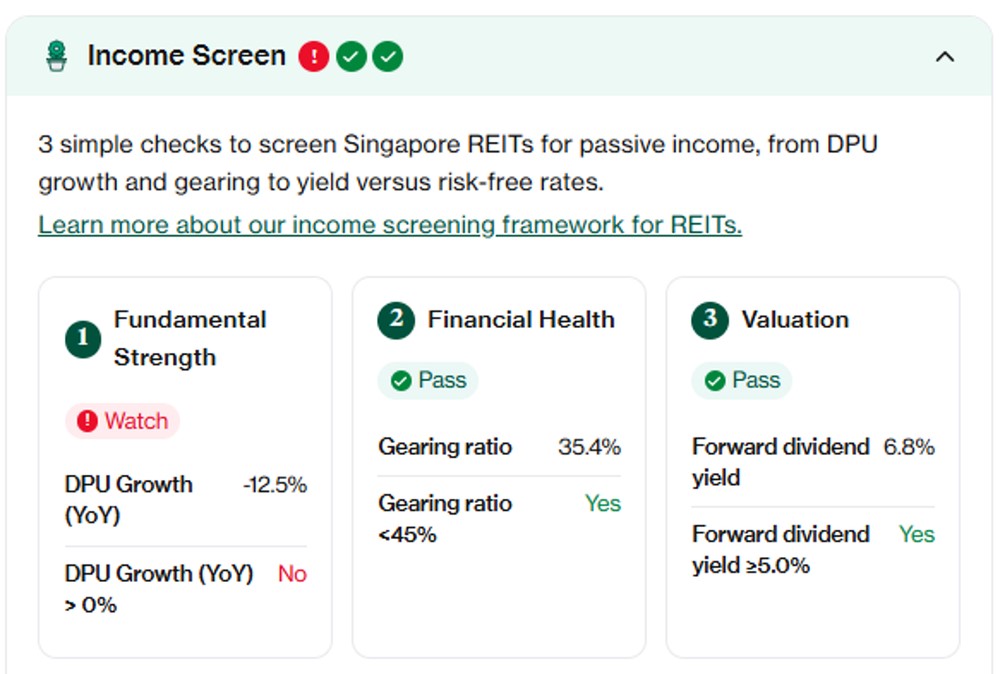
For the first check, FLCT does not pass on reported DPU growth. FY2025 DPU fell 12.5% to 5.95 cents, followed by a further decline in 1H FY2026. However, the improvement excluding divestment gains is worth monitoring.
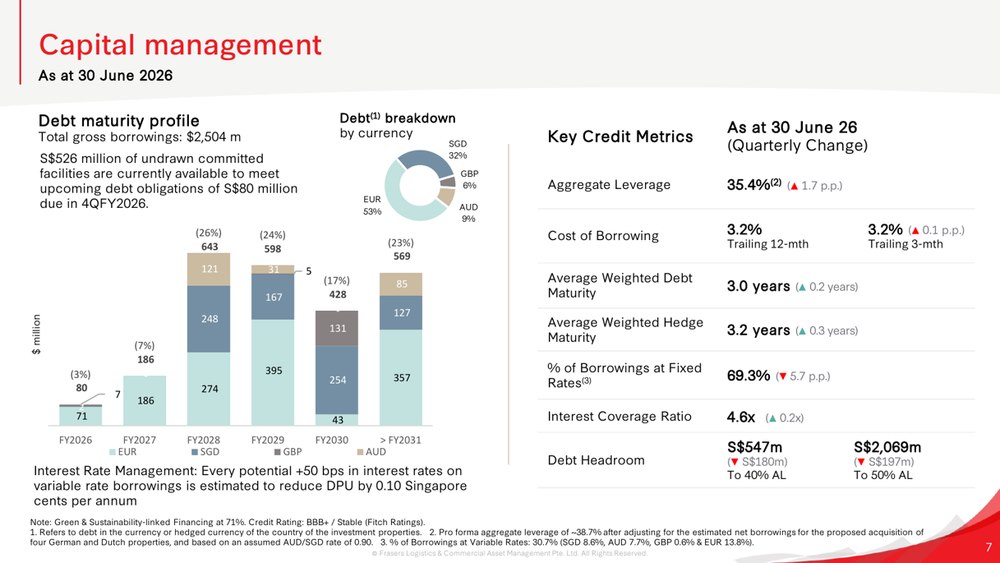
For the second check, FLCT passes on reported gearing. Aggregate leverage stood at 35.4% at 30 June 2026, below our preferred threshold of 45%. Its average cost of borrowing was 3.2%, with 69.3% of borrowings on fixed rates.
However, June gearing did not include its subsequent European acquisition. Management estimated pro forma gearing of approximately 38.7% after the transaction, which remains below our preferred threshold.
The third check looks at its forward dividend yield. According to consensus forecasts, Frasers Logistics & Commercial Trust is expected to pay a distribution per unit of approximately S$0.06 for FY2026.
FLCT’s forward dividend yield stands at approximately 6.8%, above the Income Screen’s threshold of 5%. It therefore passes the dividend yield check.
This also offers a spread of more than three percentage points over the latest SSB’s 2.45% ten-year average return. However, the forecast payout is an estimate and actual distributions may differ.
Overall, FLCT passes the gearing and forward dividend yield checks, but does not pass the reported DPU growth check. I would want to see whether improving distributions excluding divestment gains can translate into sustained growth in the total payout.
Find out how much dividends you would have received as a unitholder of Frasers Logistics & Commercial Trust in the past 12 months with the calculator below.
Related links:
- Frasers Logistics & Commercial Trust share price and analysis
- Frasers Logistics & Commercial Trust dividend history and forecast
- Frasers Logistics & Commercial Trust valuation and price-to-book ratio
#2 - Mapletree Pan Asia Commercial Trust (SGX: N2IU)
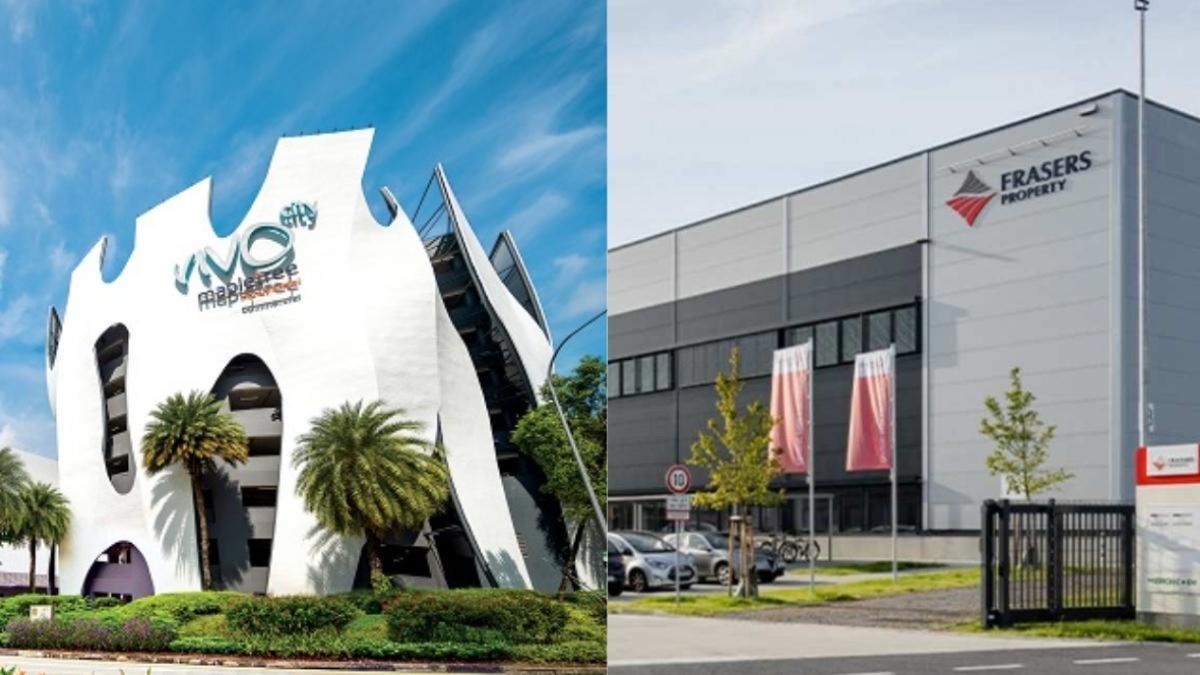
Mapletree Pan Asia Commercial Trust (MPACT) owns retail, office and business park properties across Singapore and other Asian markets, including VivoCity and Mapletree Business City.
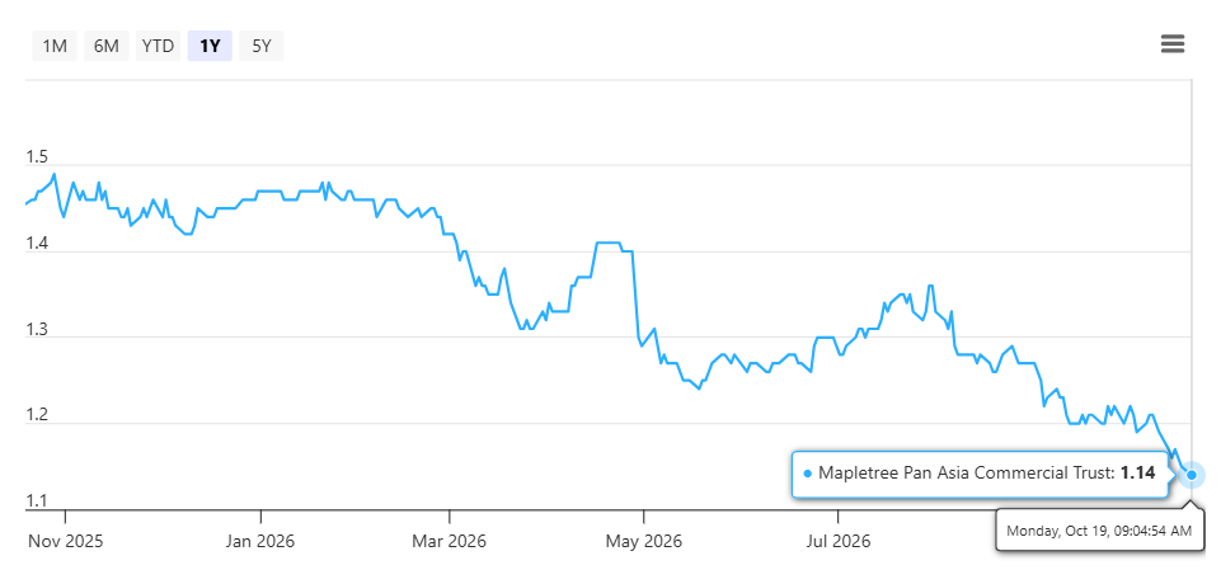
Mapletree Pan Asia Commercial Trust was trading at S$1.14 as at 19 October 2026, matching its 52-week low of S$1.14.
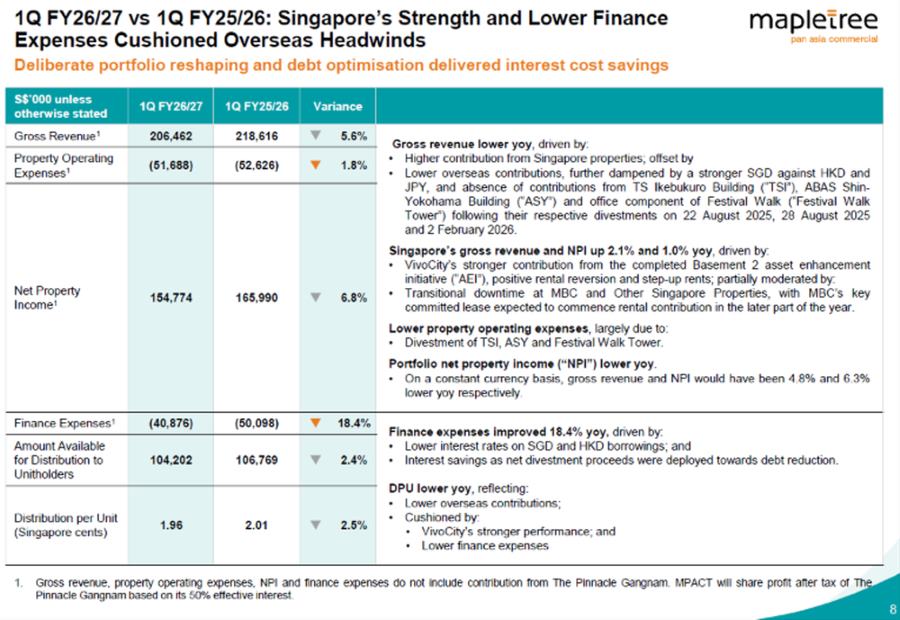
For 1Q FY2026/27, revenue fell 5.6% year on year to S$206.5 million, while net property income declined 6.8% to S$154.8 million. DPU fell 2.5% to 1.96 cents.
Lower overseas contributions, currency movements and divestments weighed on earnings. An 18.4% reduction in finance expenses helped cushion the impact.
VivoCity remained a bright spot, with net property income up 8.9% and rental reversion of 13.5%.
However, the strength of one mall does not tell the whole portfolio story.
Committed portfolio occupancy was 84.4% at 30 June 2026. Japan’s occupancy stood at 56.0%, compared with 99.7% at VivoCity.
This leaves a substantial leasing challenge outside its flagship Singapore mall.
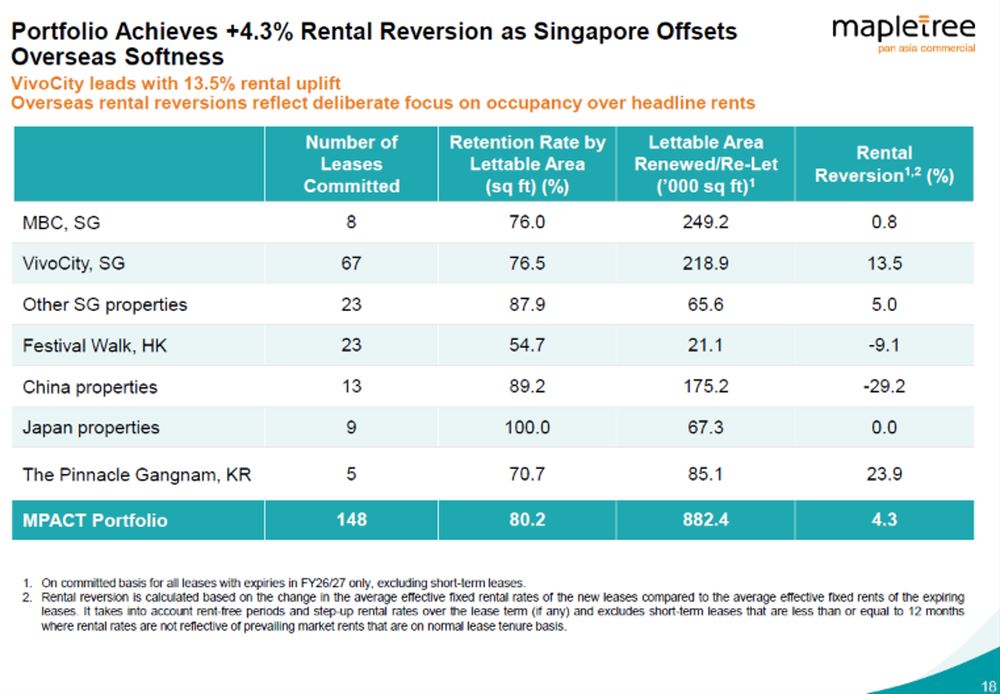
Management highlighted a committed lease at Mapletree Business City expected to start contributing later in 2026.
Festival Walk’s 18,800 sq ft space reconfiguration was also completed and operational from July.
I would watch whether these initiatives translate into higher occupied space and income, rather than assuming that the latest DPU decline has ended.
I would then apply the three checks in our Singapore REIT screening framework.
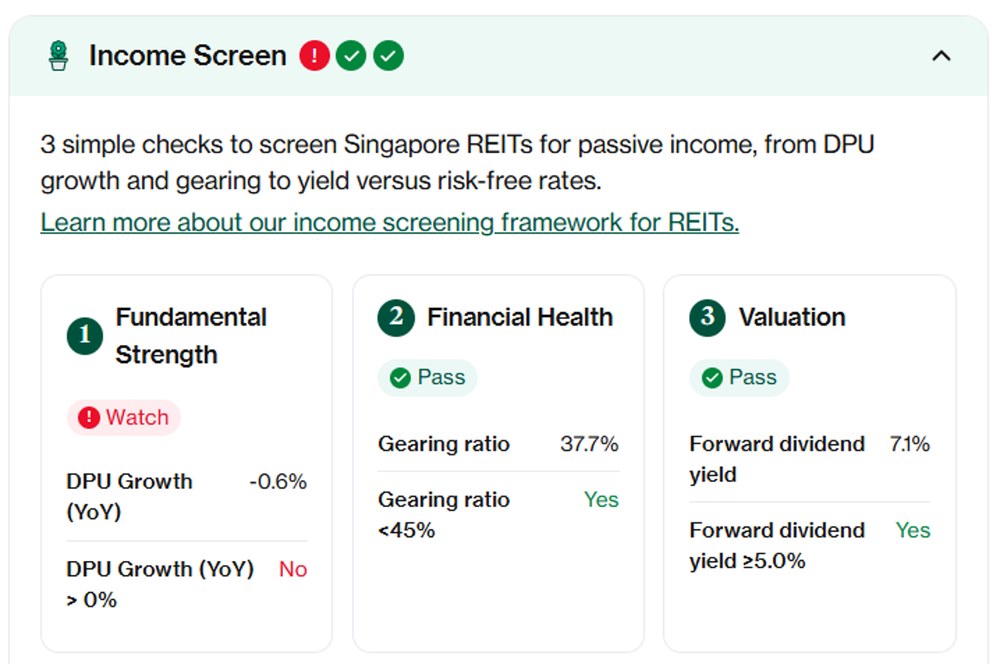
For the first check, MPACT’s DPU performance is mixed. Reported FY2025/26 DPU fell 0.6% to 7.97 cents, so it does not pass the growth check on a reported basis.
However, excluding a one-off tax charge linked to the Festival Walk Tower disposal, full-year DPU would have risen 1.1% to 8.11 cents. This provides a more encouraging picture, although its latest quarterly DPU still fell 2.5%.
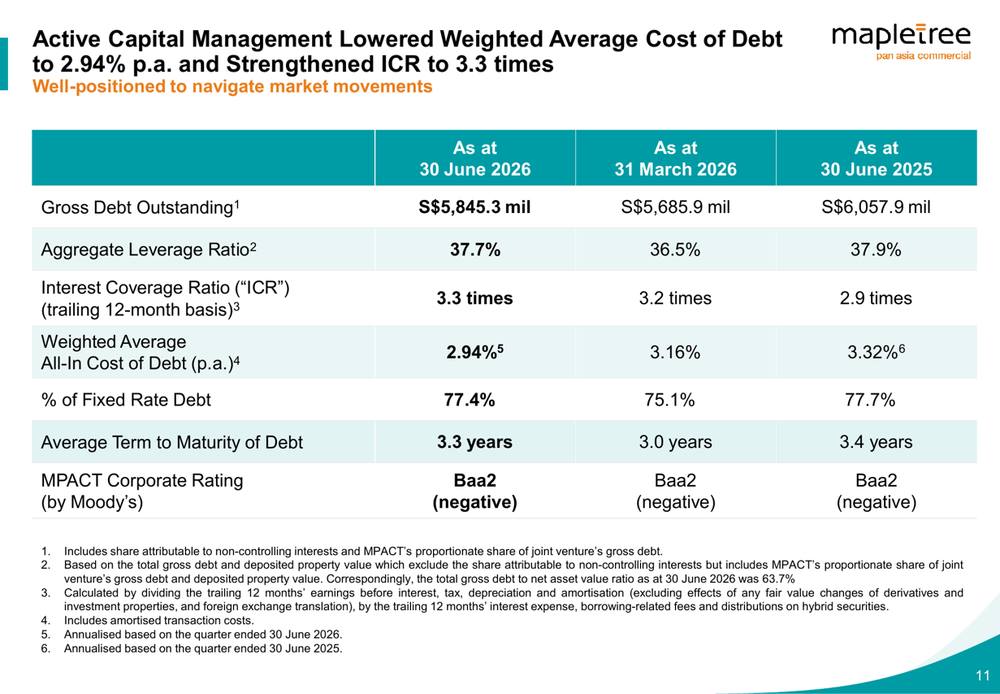
For the second check, MPACT passes on gearing. Aggregate leverage stood at 37.7% at 30 June 2026, below 45%, although higher than 36.5% in March. Its all-in cost of debt declined to 2.94%, with interest coverage of 3.3 times.
The third check looks at its forward dividend yield. According to consensus forecasts, Mapletree Pan Asia Commercial Trust is expected to pay a distribution per unit of approximately S$0.08 for FY2026/27.
MPACT’s forward dividend yield stands at approximately 7.1%, the highest among these three REITs. This exceeds the Income Screen’s threshold of 5%, so it passes the dividend yield check.
This also offers a spread of more than three percentage points over the latest SSB’s 2.45% ten-year average return. However, the forecast payout is an estimate and actual distributions may differ.
Overall, MPACT passes the gearing and forward dividend yield checks, but its DPU trend remains mixed. I would want clearer evidence that leasing progress and financing savings can support sustained distribution growth.
Find out how much dividends you would have received as a unitholder of Mapletree Pan Asia Commercial Trust in the past 12 months with the calculator below.
Related links:
- Mapletree Pan Asia Commercial Trust latest share price and analysis
- Mapletree Pan Asia Commercial Trust dividend history and forecast
- Mapletree Pan Asia Commercial Trust valuation and price-to-book ratio
#3 - Mapletree Logistics Trust (SGX: M44U)
Mapletree Logistics Trust (MLT) owns logistics properties across Asia-Pacific.
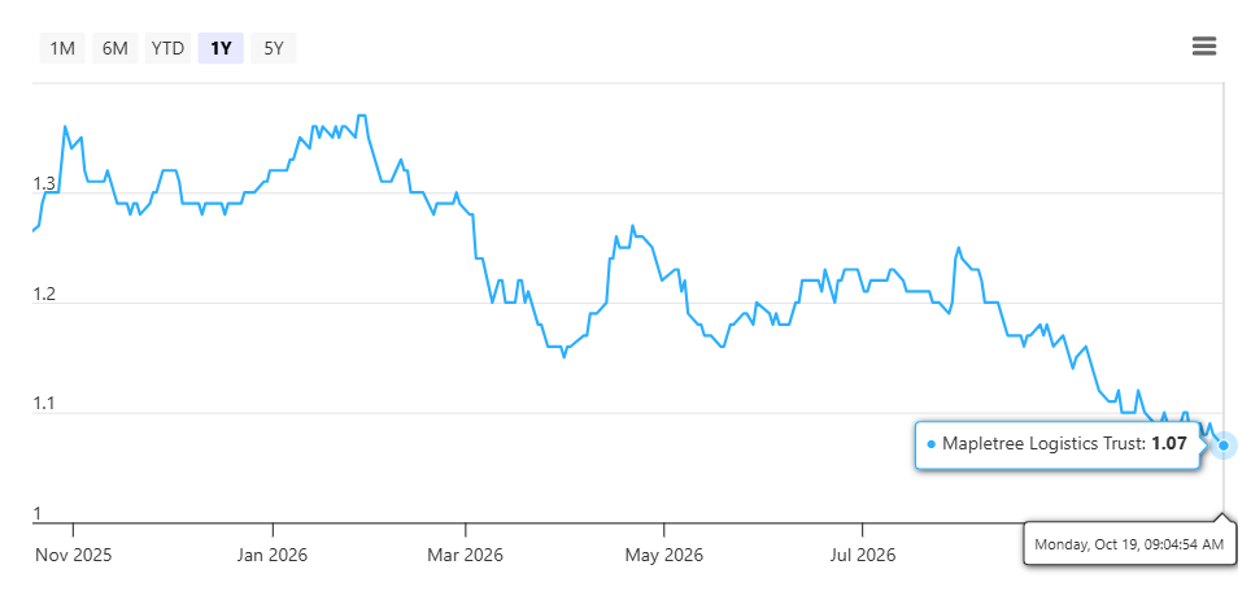
Mapletree Logistics Trust was trading at S$1.07 as at 19 October 2026, near its 52-week low.
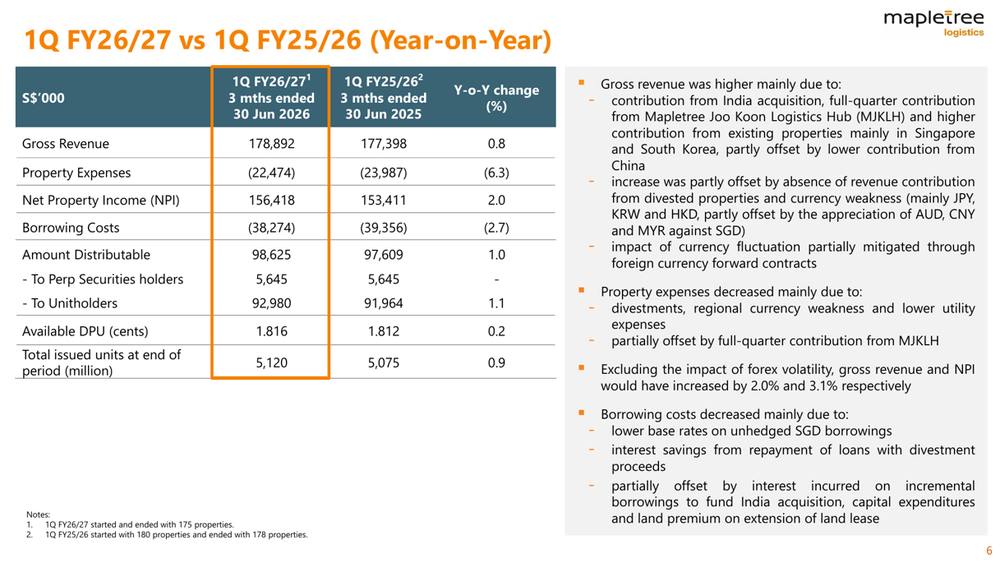
For 1Q FY2026/27, net property income increased 2.0% year on year to S$156.4 million, while DPU edged up 0.2% to 1.816 cents.
The improvement was modest, but it suggests that recent operating performance has become more resilient after a weaker full year.
Portfolio occupancy remained healthy at 96.4% at 30 June 2026.
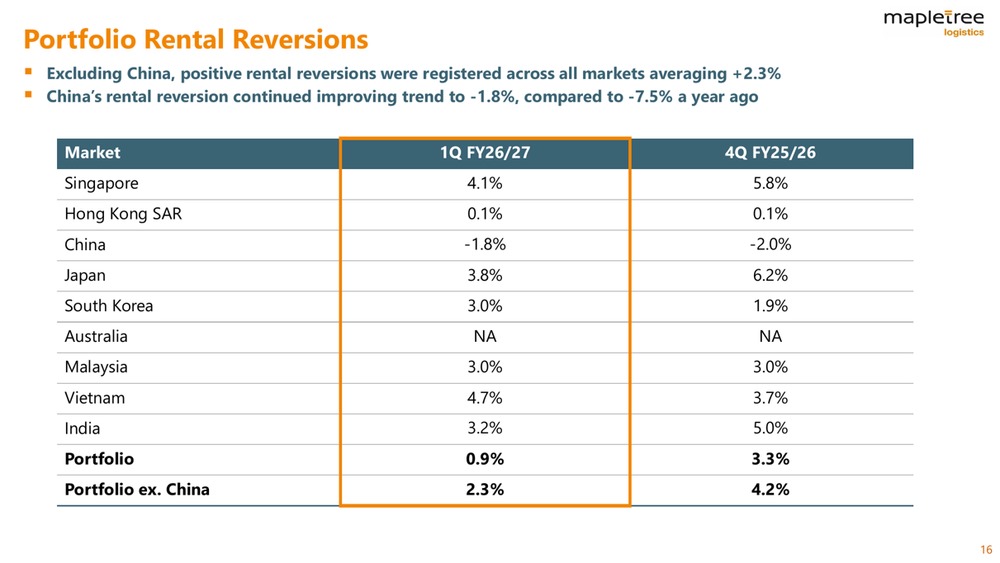
Rental reversion was positive at 0.9% overall, or 2.3% excluding China.
China’s rental reversion improved to negative 1.8%, from negative 7.5% a year earlier. Rents were still being renewed lower, but the decline had moderated.
MLT has continued to reshape its portfolio.
On 5 October 2026, it completed the disposal of 39 Changi South Avenue 2, taking its property count to 174.
Separately, it announced a further nine-month extension of Prima’s leases and licences at 201 Keppel Road to 31 January 2028, subject to relevant approvals where applicable. Redevelopment options remain under evaluation.
I would monitor how MLT uses its divestment proceeds, as asset sales can release capital but also remove rental income.
To assess whether its recent stabilisation supports the income case, I would apply the three checks in our Singapore REIT screening framework.
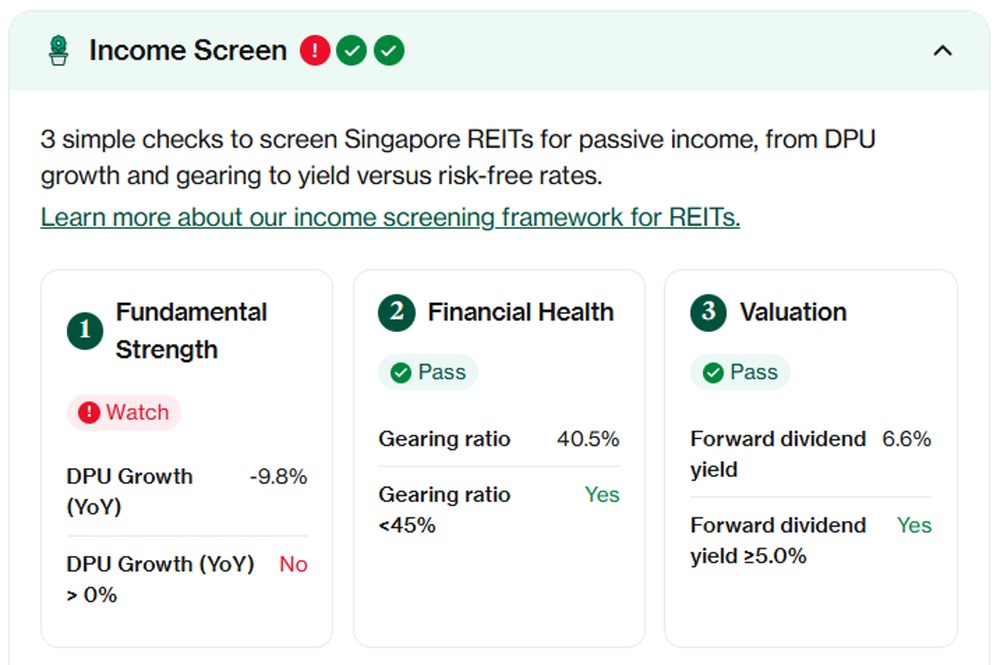
For the first check, MLT does not pass on full-year DPU growth. FY2025/26 reported DPU fell 9.8% to 7.262 cents, partly because distributions from divestment gains ceased.
Excluding those gains, DPU still fell 3.4%. The latest quarterly increase of 0.2% is encouraging, but I would want to see it sustained before concluding that the decline has reversed.
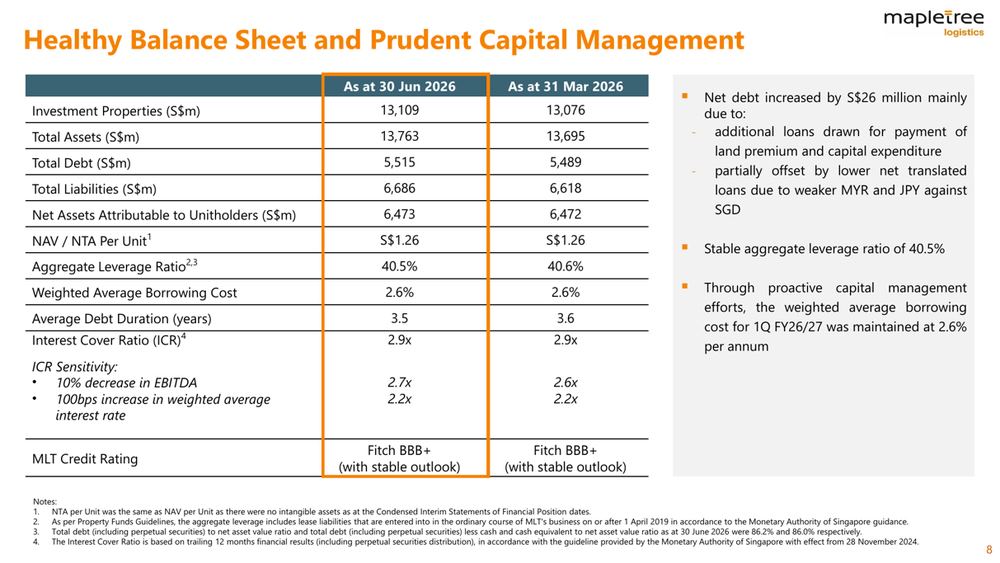
For the second check, MLT passes on gearing. Aggregate leverage stood at 40.5% at 30 June 2026, below 45%, but the highest among these three REITs. Its weighted average borrowing cost was 2.6%, with interest coverage of 2.9 times.
The third check looks at its forward dividend yield. According to consensus forecasts, Mapletree Logistics Trust is expected to pay a distribution per unit of approximately S$0.07 for FY2026/27.
MLT’s forward dividend yield stands at approximately 6.6%, above the Income Screen’s threshold of 5%. It therefore passes the dividend yield check.
This also offers a spread of more than three percentage points over the latest SSB’s 2.45% ten-year average return. However, the forecast payout is an estimate and actual distributions may differ.
Overall, MLT passes the gearing check and meets the indicative yield spread, but falls short on full-year DPU growth. I would watch whether improving rental trends can turn quarterly stabilisation into sustained growth in recurring income.
Find out how much dividends you would have received as a Mapletree Logistics Trust unitholder in the past 12 months with the dividend calculator below.
Related links:
- Mapletree Logistics Trust latest share price and analysis
- Mapletree Logistics Trust dividend history and forecast
- Mapletree Logistics Trust valuation and price-to-book ratio
What would Beansprout do?
For my Income Pot, I would look beyond how close a REIT is to its 52-week low.
A lower unit price can lift its dividend yield, but that yield is only meaningful if the distributions behind it can hold up.
This is why I would run through the screening checks in our framework to select the best Singapore REITs before considering them further.
Here is how the three REITs compare.
| REIT | DPU check | Gearing check | Forward dividend yield check* |
| FLCT | Does not pass: Reported FY2025 DPU fell 12.5%. Latest half-year DPU fell 1.7%, but rose 11.9% excluding divestment gains | Pass: Reported gearing of 35.4%; approximately 38.7% pro forma after the European acquisition | Pass: Forward dividend yield of 6.8%, above the 5% threshold |
| MPACT | Does not pass on a reported basis: FY2025/26 DPU fell 0.6%; excluding the one-off tax charge, it rose 1.1%. Latest quarterly DPU fell 2.5% | Pass: Gearing of 37.7%, although higher than March | Pass: Forward dividend yield of 7.1%, above the 5% threshold |
| MLT | Does not pass: Reported FY2025/26 DPU fell 9.8%, or 3.4% excluding divestment gains. Latest quarterly DPU rose 0.2%. | Pass: Gearing of 40.5%, with less headroom than the other two | Pass: Forward dividend yield of 6.6%, above the 5% threshold |
| *Forward dividend yields are those displayed on Beansprout’s dividend pages as at 20 October 2026, using consensus forecasts for FY2026 for FLCT and FY2026/27 for MPACT and MLT. Forecast distributions are not guaranteed, and yields change with unit prices and forecast revisions. Gearing figures are as at 30 June 2026, except FLCT’s separately stated pro forma estimate. | |||
FLCT offers a forward dividend yield of 6.8%. Its improvement in DPU excluding divestment gains is encouraging, but its reported payout has yet to return to growth. I would watch whether its recent acquisitions and leasing progress translate into higher distributions per unit, while keeping gearing manageable.
MPACT offers the highest forward dividend yield among the three at 7.1%. However, I would want to see overseas occupancy and quarterly DPU improve to gain more confidence in the sustainability of its distributions.
MLT offers a forward dividend yield of 6.6%, with its latest quarter showing signs of stabilisation. I would want that improvement to continue and eventually reverse the decline in full-year DPU excluding divestment gains.
Although all three meet our gearing threshold and offer a meaningful indicative yield spread, DPU trends warrant closer attention.
You can find REITs that meet all three checks using Beansprout’s Income REIT screener, or explore the list of Singapore REITs to compare distribution yields, valuations and debt levels.
Passing an initial screen would put a REIT on my research shortlist. I would still examine its tenants, lease expiries, debt maturities and recurring income before considering it for my Income Pot.
To find out which REIT we would hold in our model portfolio, check out how we would invest $100,000 in Singapore today.
Beyond selecting individual REITs, I would also consider how they fit into a broader income portfolio. With a higher interest rate and rising bond yield environment, I’d diversify my income sources with quality Singapore dividend stocks to avoid relying too heavily on one sector.
If you prefer diversification without picking individual REITs, you can gain exposure through Singapore REIT ETFs.
Are there any other Singapore blue chip REITs you are watching for income? Share your thoughts in the comments below or join the discussion in our Telegram group.
Follow Beansprout on Youtube, Facebook and Instagram, and add Beansprout as your preferred source on Google so you never miss an update.
Read also
Gain financial insights in minutes
Subscribe to our free weekly newsletter for more insights to grow your wealth
Most Popular

Comments
0 comments