
S$70,000 Child Support Package: How I'd choose between CPF top up and investing
CPF & Retirement
By Gerald Wong, CFA • 29 Aug 2026
Why trust Beansprout? We’ve been awarded Best Investment Website at the SIAS Investors’ Choice Awards 2025
'%3e%3cpath%20fill-rule='evenodd'%20clip-rule='evenodd'%20d='M17.64%209.20455C17.64%208.56637%2017.5827%207.95273%2017.4764%207.36364H9V10.845H13.8436C13.635%2011.97%2013.0009%2012.9232%2012.0477%2013.5614V15.8195H14.9564C16.6582%2014.2527%2017.64%2011.9455%2017.64%209.20455V9.20455Z'%20fill='%234285F4'/%3e%3cpath%20fill-rule='evenodd'%20clip-rule='evenodd'%20d='M9%2018C11.43%2018%2013.4673%2017.1941%2014.9564%2015.8195L12.0477%2013.5614C11.2418%2014.1014%2010.2109%2014.4205%209%2014.4205C6.65591%2014.4205%204.67182%2012.8373%203.96409%2010.71H0.957275V13.0418C2.43818%2015.9832%205.48182%2018%209%2018V18Z'%20fill='%2334A853'/%3e%3cpath%20fill-rule='evenodd'%20clip-rule='evenodd'%20d='M3.96409%2010.71C3.78409%2010.17%203.68182%209.59318%203.68182%209C3.68182%208.40682%203.78409%207.83%203.96409%207.29V4.95818H0.957273C0.347727%206.17318%200%207.54773%200%209C0%2010.4523%200.347727%2011.8268%200.957273%2013.0418L3.96409%2010.71V10.71Z'%20fill='%23FBBC05'/%3e%3cpath%20fill-rule='evenodd'%20clip-rule='evenodd'%20d='M9%203.57955C10.3214%203.57955%2011.5077%204.03364%2012.4405%204.92545L15.0218%202.34409C13.4632%200.891818%2011.4259%200%209%200C5.48182%200%202.43818%202.01682%200.957275%204.95818L3.96409%207.29C4.67182%205.16273%206.65591%203.57955%209%203.57955V3.57955Z'%20fill='%23EA4335'/%3e%3c/g%3e%3cdefs%3e%3cclipPath%20id='clip0_0_2849'%3e%3crect%20width='18'%20height='18'%20fill='white'/%3e%3c/clipPath%3e%3c/defs%3e%3c/svg%3e)
Make Beansprout your preferred source on Google
Add us on Google to see more of our insights in your search results
Singapore’s new SG Child Support Package provides around S$70,000 per child. We look at how much is actually cash, whether to invest any excess or top up CPF, and what the money could grow to.

What happened?
Singapore’s new SG Child Support Package has generated plenty of attention amongst my friends who are planning to have a child.
Under the package announced at the National Day Rally 2026, every Singapore Citizen child will receive up to around S$70,000 of direct financial support from birth to age 17.
Many families will need this support for childcare, healthcare, education and daily expenses. Those needs should come first.
But if any money remains after the child’s needs have been provided for, parents may consider investing the excess, as a child has time on their side.
I saw a question asking how to maximise the SG Child Support Package to grow a nest for the child.
In this article, I look at how much of the support can actually be invested, how investing compares with topping up CPF, and the different ways to build a long term portfolio for a child.
How much of the S$70,000 child support can parents actually use for CPF top up or investing?
The first thing to recognise is that your child is not receiving a S$70,000 cheque.
The headline figure of almost S$70,000 refers to the total direct financial support available to a Singaporean child from birth to age 17.
It combines up to S$62,000 under the new SG Child Support Package with two existing benefits:
| Support | Amount |
| Baby Gift | S$10,000 |
| Child Credits | S$32,000 |
| CDA First Step Grant | S$5,000 |
| Government CDA co-matching | Up to S$5,000 |
| PSEA top-up | S$10,000 |
| Newly announced SG Child Support Package | Up to S$62,000 |
| Existing MediSave Grant for Newborns | S$5,000 |
| Existing Edusave contributions | Around S$2,500 |
| Total SG Child Support Package | Around S$70,000 |
However, not all of this money can be freely used or invested by parents.
The CDA, PSEA, MediSave and Edusave funds have specific permitted uses. The Government’s CDA co-matching also requires parents to contribute their own money to receive the matching amount.
The two components offering parents the greatest flexibility are the Baby Gift and Child Credits.
The S$10,000 Baby Gift will be paid in two cash tranches within the child’s first year.
The S$32,000 of Child Credits will also be paid in cash, at S$2,000 a year from the year the child turns one until the year they turn 16.
| Cash support | Amount |
|---|---|
| Baby Gift | S$10,000 |
| Child Credits, S$2,000 a year for 16 years | S$32,000 |
| Total | S$42,000 |
For parents considering whether to invest some of the support for their child’s future, S$42,000 is therefore the more relevant figure. Even then, it will be received gradually rather than as a single lump sum.
That does not mean the full S$42,000 should be invested. Parents should first set aside what they need to support their child and meet household expenses. Only money that is genuinely not required for these purposes should be considered for long-term investing or a CPF top-up.
Parents may also want to consider the dollar-for-dollar Government matching on CDA contributions, up to S$5,000. If they expect to use the CDA for eligible child-related expenses, making full use of this matching could come before investing the excess elsewhere.
I would treat this separately from the long-term investment decision because CDA funds can only be used for approved expenses.
For existing children, the transition arrangements will also differ according to age. The almost S$70,000 figure represents the total support available to a child across the full period from birth to age 17. It is not a lump sum, nor will every existing child receive S$70,000 retrospectively.
Before choosing CPF top up or investing, ask what do you want the Child Credits to do for your child?
Imagine your child is a newborn today. What would you like this money to eventually help them do?
Perhaps you want to give them a financial head start when they become an adult.
The money could help pay for university, contribute towards their first home, allow them to pursue an opportunity overseas, start a business, or simply give them an investment portfolio they can continue building themselves.
In that case, the investment horizon might be 18 to 30 years.
That is a long period to invest, but flexibility still matters. You want the money to grow while retaining the option to use it when your child eventually needs it.
There is another possibility.
You may decide your child does not need this money in their 20s or 30s at all. Instead, you want to give them an unusually early start on retirement savings.
Money set aside at birth could then potentially compound for more than 60 years. That is when CPF becomes much more interesting.
These are two different objectives, even though both can be described as “investing for your child”.
How you can invest the Child Credits for your child’s future
If my goal is to give my child more financial choices when they become an adult, I would think about building a long term investment portfolio for them.
Within Beansprout’s Four Pots of Wealth framework, I would think of this as part of my child’s Growth Pot, which is meant for money that can be invested over the long term to grow in value.
The objective is straightforward: grow the money over a long period while keeping enough flexibility to use it for different purposes later.
For a newborn, an investment horizon of close to 20 years means that on paper, I can potentially take more investment risk than if I needed the money five years from now.
That makes a diversified equity portfolio worth considering.
Equities will not deliver positive returns every year. There will almost certainly be market downturns along the way, and a stock portfolio can fall 20%, 30% or more during a major bear market.
A long investment horizon gives me more time to ride through these periods.
The other advantage is flexibility.
If my child turns 18 and does not need the money, I do not have to sell the portfolio. If they do not need it at 25 either, it can remain invested.
I can make the eventual decision when I know much more about my child's needs rather than making that decision when they are still a newborn.
How much could S$42,000 grow to if you invest it for your child?
This is where starting early can make a meaningful difference.
Suppose I invested the S$10,000 Baby Gift when my child was born.
I then invested each S$2,000 Child Credit when it was received from age one to 16.
In total, I would have invested S$42,000.
Here is what it could potentially grow to by the time my child turns 18:
| Illustrative annual return | Portfolio at age 18 |
|---|---|
| 4% | About S$67,500 |
| 6% | About S$86,200 |
| 8% | About S$110,700 |
These figures assume each payment is invested when received. They are illustrations rather than forecasts, and actual investment returns could be significantly higher or lower.
The effect gets more interesting if my child does not spend the portfolio immediately.
| Illustrative annual return | Age 18 | Age 30 |
|---|---|---|
| 4% | S$67,500 | S$108,000 |
| 6% | S$86,200 | S$173,500 |
| 8% | S$110,700 | S$278,800 |
By age 30, an illustrative 6% return would turn the S$42,000 of government cash support into about S$173,500, assuming no withdrawals and no additional contributions.
Again, 6% is not guaranteed.
What the example shows is how much of the eventual outcome comes from time rather than simply the amount you start with.
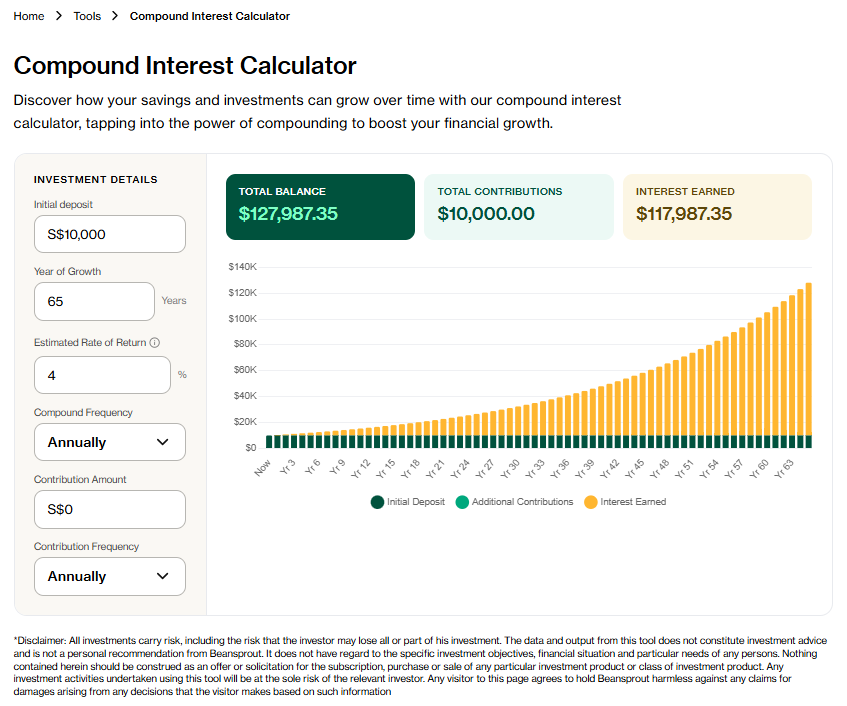
You can use Beansprout's compound interest calculator to test different return assumptions and time periods.
There is also a natural regular investing schedule built into the new Child Credits. Rather than receiving S$32,000 at once, parents receive S$2,000 each year.
If I invested the money as it arrived, I would effectively be dollar-cost averaging over 16 years.
Should you top up your child’s CPF instead of investing the money?
The question I have seen several parents ask is whether it would be simpler to just put the money into CPF.
There is a strong argument for doing so.
Parents can make a cash top up directly to their child’s Special Account. CPF Board currently states that the Special Account earns 4% per year.
Members below age 55 also receive an additional 1% interest on the first S$60,000 of their combined CPF balances, subject to CPF rules.
There is no investment portfolio to manage and no market volatility to worry about.
If the money can compound for several decades, the numbers can become meaningful.
For example, S$10,000 compounding at 4% a year from birth would grow to about S$128,000 by age 65, even without another dollar being added.
But I would not compare CPF and equities based on returns alone.
The bigger difference is flexibility.
CPF top ups are irreversible. A child cannot simply turn 25 and decide to withdraw the money because an unexpected opportunity has come along.
The money remains subject to CPF rules governing housing, healthcare and retirement.
It is also worth noting that CPF Board states that cash top ups to a child’s CPF accounts do not qualify for tax relief.
So I would not think of CPF as simply a lower-risk version of investing in equities.
I would view it as money with an entirely different purpose.
By making the CPF top-up, I am deliberately deciding that my child does not need full flexibility over that money for many decades.
Investing vs CPF: Which is better for your child’s S$42,000?
Once I stop focusing only on which option has the higher return, the comparison becomes clearer.
| Long term investment portfolio | CPF Special Account | |
|---|---|---|
| What am I trying to achieve? | Build wealth for adulthood and beyond | Build wealth for retirement savings |
| Time horizon | Potentially 18 years or more | Potentially several decades |
| Return | Market driven and uncertain. Not guaranteed | Based on CPF interest rates |
| Volatility | Yes | No market volatility |
| Flexibility | High | Low |
| Can the money be accessed for other opportunities? | Yes | Subject to CPF rules |
| Effort required | Some investment decisions | Very little |
It can be tempting to ask whether equities will earn more than CPF over the next 20 years.
While there is such a possibility, I do not think that is the most important distinction, as flexibility itself has value.
I have no idea today whether a newborn will eventually want to study overseas, buy a home, start a company or pursue something that I cannot predict today.
Keeping the money outside CPF preserves those choices.
If I have already provided sufficiently for those needs and want to give my child something specifically for retirement, CPF becomes more relevant.
Splitting the money may also make more sense than trying to optimise everything into one account.
I could keep most of it invested in a portfolio for my child’s future goals, while putting a smaller amount into CPF to compound for much later in life.
Another approach is to keep more of the money invested outside CPF while my child is young.
As my child grows older and their likely needs become clearer, I can decide whether part of the portfolio should eventually be set aside for a much longer-term purpose.
There is an asymmetry here that I would keep in mind.
Money kept outside CPF can still be contributed to CPF later.
Once money has been topped up into CPF for retirement, I cannot simply take it back because my plans have changed.
For me, that flexibility matters when I am making a financial decision for someone whose needs 20 years from now are impossible to predict.
So if I want the money to remain available for my child's needs in adulthood, I would think of it as part of their Growth Pot.
If I am specifically setting it aside for retirement decades later, CPF becomes more relevant.
What can you invest the Child Credits in?
Once I have decided to build a long term investment portfolio, the product choice becomes relatively straightforward.
The main options would include a diversified ETF, mutual fund or robo adviser portfolio.
If I am comfortable managing the investments myself, I could consider a low-cost broad-market ETF, such as a S&P 500 ETF or STI ETF. If you are deciding between broad market ETFs, we have also compared VOO, VWRA and a Singapore STI ETF for long-term growth.
Apart from ETFs, I can also gain broad based market exposure through unit trusts. A robo adviser could make regular investing easier.
To decide, I would ask myself a few questions:
- Is the portfolio well diversified?
- Are the fees reasonable?
- Is it easy for me to add the S$2,000 every year?
- Am I comfortable enough with the approach that I will keep investing through market downturns?
That last question is important because a portfolio can look perfect on paper. It is less useful if I abandon it during the next market downturn.
How can you start investing for your child?
Once I have decided how I want to invest the money, the next step is choosing a platform to do it through.
If I decide to invest through ETFs, I can compare the best online brokerage platforms in Singapore, including their fees and market access.
If I prefer investing through unit trusts, I can compare the best unit trust platforms in Singapore, including their fees and range of funds available.
If I would rather have the portfolio built and managed for me, I can compare the best robo-advisers in Singapore and see how their portfolios, fees and investment approaches differ.
What would Beansprout do?
If I had a newborn and did not need the S$42,000 of cash support for household expenses or other short term needs, I would think about how I can use it to give my child a financial headstart.
One of the questions I'd ask myself is what I want the money to do for my child, and how much flexibility I would want.
If flexibility is important and I am able to take the risks of investing, I would probably invest it for long term growth rather than top up CPF.
Within Beansprout’s Four Pots of Wealth framework, I would think of this as part of my child’s Growth Pot, where the aim is to grow wealth over a long investment horizon.
A newborn has close to two decades before adulthood. That gives the portfolio time to ride through market cycles and potentially benefit from long-term economic growth.
My starting point would be a simple, diversified portfolio. For example, I may consider a broad-based ETF that provides diversified exposure to markets such as the US, global equities or Singapore.
The reason is not that I am certain equities will outperform CPF. It is that I would value the combination of a long investment horizon and flexibility.
On the other hand, if I wanted to give my child a separate retirement gift, I could put the money into their CPF and allow that to grow and compound quietly for decades.
It is also worth noting that I do not have to choose strictly between the two for any excess cash from the SG Child Support Package.
The bigger opportunity is starting early. With a long time horizon, the Child Credits that are not needed to support the child's current spending could compound to much more than the original sum.
Would you invest it, top up their CPF, or do both? Share with us in the comments below or in our Telegram group!
Follow Beansprout on Telegram, Youtube, Facebook and Instagram, and add Beansprout as your preferred source on Google so you never miss an update.
Read also
Gain financial insights in minutes
Subscribe to our free weekly newsletter for more insights to grow your wealth
Most Popular

Comments
0 comments