
CSPX vs XUS: How the new S&P 500 UCITS ETF on SGX compares
ETFs
By Gerald Wong, CFA • 12 Oct 2026
Why trust Beansprout? We’ve been awarded Best Investment Website at the SIAS Investors’ Choice Awards 2025
'%3e%3cpath%20fill-rule='evenodd'%20clip-rule='evenodd'%20d='M17.64%209.20455C17.64%208.56637%2017.5827%207.95273%2017.4764%207.36364H9V10.845H13.8436C13.635%2011.97%2013.0009%2012.9232%2012.0477%2013.5614V15.8195H14.9564C16.6582%2014.2527%2017.64%2011.9455%2017.64%209.20455V9.20455Z'%20fill='%234285F4'/%3e%3cpath%20fill-rule='evenodd'%20clip-rule='evenodd'%20d='M9%2018C11.43%2018%2013.4673%2017.1941%2014.9564%2015.8195L12.0477%2013.5614C11.2418%2014.1014%2010.2109%2014.4205%209%2014.4205C6.65591%2014.4205%204.67182%2012.8373%203.96409%2010.71H0.957275V13.0418C2.43818%2015.9832%205.48182%2018%209%2018V18Z'%20fill='%2334A853'/%3e%3cpath%20fill-rule='evenodd'%20clip-rule='evenodd'%20d='M3.96409%2010.71C3.78409%2010.17%203.68182%209.59318%203.68182%209C3.68182%208.40682%203.78409%207.83%203.96409%207.29V4.95818H0.957273C0.347727%206.17318%200%207.54773%200%209C0%2010.4523%200.347727%2011.8268%200.957273%2013.0418L3.96409%2010.71V10.71Z'%20fill='%23FBBC05'/%3e%3cpath%20fill-rule='evenodd'%20clip-rule='evenodd'%20d='M9%203.57955C10.3214%203.57955%2011.5077%204.03364%2012.4405%204.92545L15.0218%202.34409C13.4632%200.891818%2011.4259%200%209%200C5.48182%200%202.43818%202.01682%200.957275%204.95818L3.96409%207.29C4.67182%205.16273%206.65591%203.57955%209%203.57955V3.57955Z'%20fill='%23EA4335'/%3e%3c/g%3e%3cdefs%3e%3cclipPath%20id='clip0_0_2849'%3e%3crect%20width='18'%20height='18'%20fill='white'/%3e%3c/clipPath%3e%3c/defs%3e%3c/svg%3e)
Make Beansprout your preferred source on Google
Add us on Google to see more of our insights in your search results
The Xtrackers S&P 500 UCITS ETF (XUS) is expected to list on SGX on 13 October. Compare CSPX and XUS on fees, SGD trading, SRS access and switching costs before choosing an S&P 500 UCITS ETF in Singapore.
What happened?
A new S&P 500 UCITS ETF is coming to SGX.
The Xtrackers S&P 500 UCITS ETF, which will trade in Singapore dollars under the ticker XUS, is one of four Irish-domiciled UCITS ETFs expected to list on SGX on 13 October 2026.
For investors already holding the iShares Core S&P 500 UCITS ETF (CSPX), this introduces another way to access broadly the same US equity exposure.
After our comparison of XWR and VWRAI, I saw a discussion in the Beansprout community about how the Xtrackers S&P 500 UCITS ETF (XUS) compares to iShares Core S&P 500 UCITS ETF (CSPX) for those wanting to invest in a diversified basket of US stocks.
In this article, we look at how to choose between CSPX and XUS, and what we would consider investing in either of the two ETFs.
What is the Xtrackers S&P 500 UCITS ETF (XUS)?
The Xtrackers S&P 500 UCITS ETF aims to passively track the S&P 500 Index.
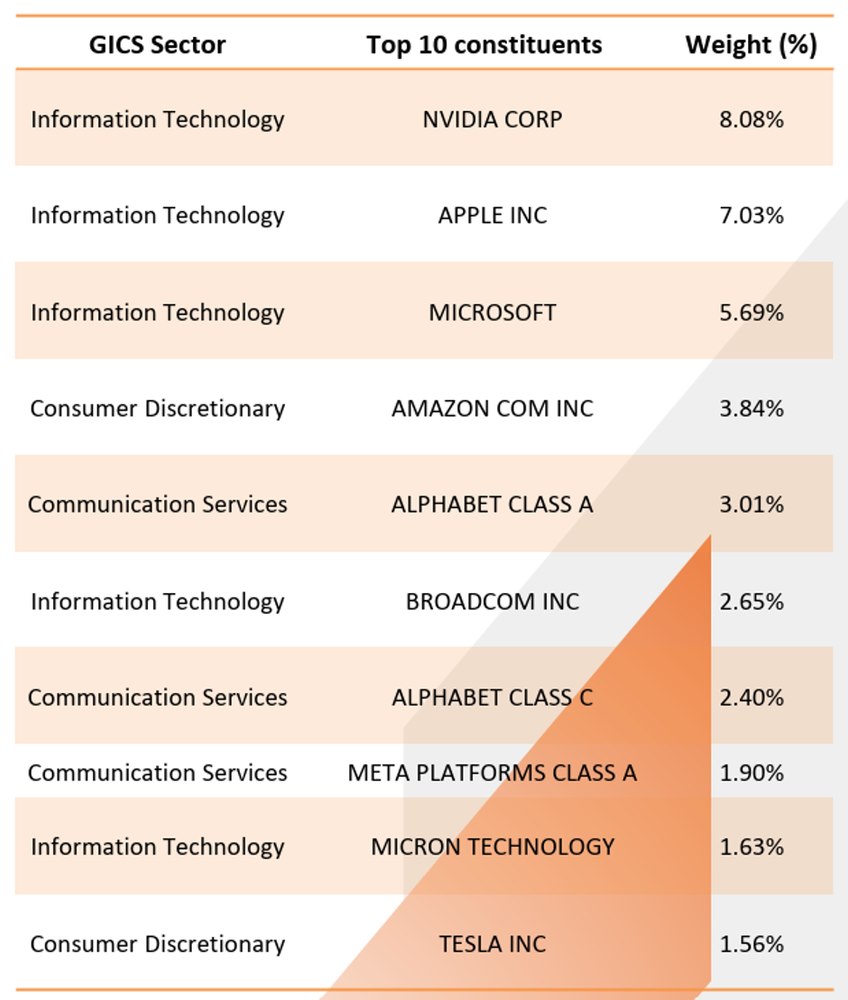
It provides exposure to 500 of the largest companies listed in the US and covers about 80% of US free float market capitalisation. The index is weighted by free float adjusted market capitalisation and reviewed quarterly.
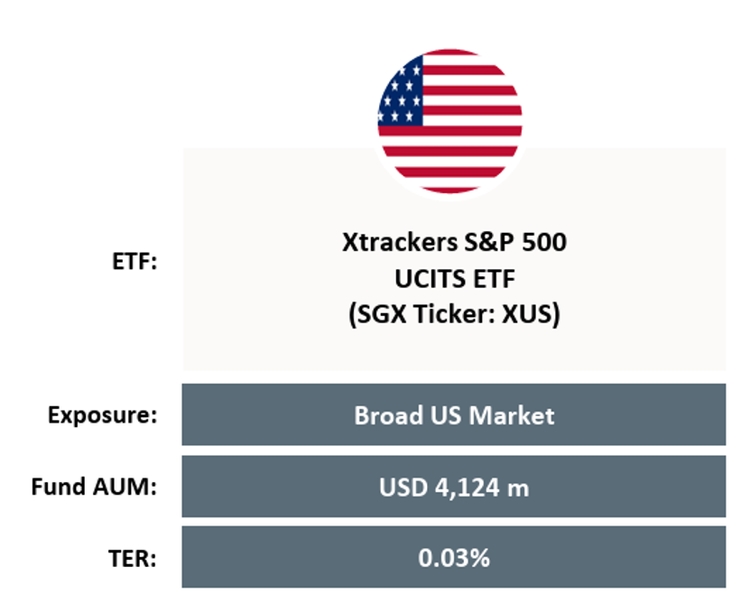
The ETF will trade using SGD on the SGX under the ticker XUS and trading name XT S&P 500 SGD. It has a total expense ratio (TER) of 0.03%, uses physical replication and has an accumulating share class.
The ETF’s accumulating share class means that dividends received by the fund are automatically reinvested instead of being distributed to investors, which may make it more convenient for compounding.
It is also expected to be eligible for investment using Supplementary Retirement Scheme, or SRS, funds, subject to eligibility requirements.
| Ticker | XUS |
| Index | S&P 500 |
| Trading currency on SGX | SGD |
| Total expense ratio | 0.03% |
| Replication | Physical |
| Domicile | Ireland |
| Dividend treatment | Accumulating |
| SRS eligible | Expected from listing, subject to eligibility requirements |
| Minimum lot size | 1 share |
| Indicative unit price | About S$20 per share as of 29 September 2026 |
It’s worth noting that XUS is a cross-listing on the SGX of the existing Xtrackers S&P 500 UCITS ETF which was launched back in 2015.
The fund had about US$4.1 billion in assets under management as of end August 2026.
Comparing CSPX against XUS: Similar exposure, different access
The key similarity is that both provide S&P 500 exposure through an Irish-domiciled, accumulating UCITS ETF.
| Feature | XUS | CSPX |
| Underlying exposure | S&P 500 | S&P 500 |
| Listing compared in this article | SGX, expected from 13 October 2026 | London Stock Exchange, USD trading line |
| Trading currency | SGD | USD |
| Domicile | Ireland | Ireland |
| Dividend treatment | Accumulating | Accumulating |
| Replication | Physical | Physical |
| Current annual fund fee / TER | 0.03% | 0.07% |
| SRS access | Expected, subject to eligibility and operator/broker support | Not available through the usual direct SRS brokerage route |
| Personal CDP holding for cash purchases | Possible through a supporting CDP-linked broker | Overseas custody arrangement |
| Minimum whole-share purchase | Expected lot size of 1 share | 1 share; fractional access depends on broker |
| Source: Respective Fund Factsheets and prospectuses | ||
Unlike XWR and VWRA, where the indices cover different markets, choosing between CSPX and XUS largely changes how you access your investment.
Holding both would add to the same S&P 500 allocation. It would not meaningfully broaden your market diversification.
Their shared Irish domicile also means there is no new domicile-based tax advantage from switching CSPX to XUS. The main differences are fees and how you buy and hold the investment.
To explore other options beyond CSPX and XUS, read our comparison of the best S&P 500 ETFs in Singapore.
What could make XUS ETF on SGX worth considering compared to CSPX?
#1 - It may be easier to access through your existing broker
One of the biggest practical differences is where the ETF is listed.
CSPX is commonly bought through the London Stock Exchange, which means investors need a brokerage account that provides access to the LSE.
By comparison, SGX is supported by a wider range of brokers commonly used by Singapore investors, including several that offer relatively low cost access to SGX listed stocks and ETFs.
For someone whose existing broker does not offer LSE access, XUS could therefore make it easier to invest in an Irish-domiciled S&P 500 UCITS ETF without opening another brokerage account.
Even for investors who already have access to CSPX, the SGX listing gives them another option to compare based on brokerage fees, FX conversion costs, custody arrangements and overall ease of investing.
You can see our comparison of the best online brokerage accounts in Singapore for the different costs and features across brokers.
So, we see the biggest benefit here as accessibility and choice of brokerage platform, rather than a change in the underlying investment.
#2 - Eligibility to use SRS to invest
Another meaningful difference is the ability to invest using funds in our SRS accounts.
According to the launch materials, XUS is expected to be eligible for investment using SRS funds from listing, subject to eligibility requirements.
This could be particularly useful for investors who want to use their SRS savings to build their Growth Pot for long term compounding.
Until now, an investor who preferred an Irish-domiciled S&P 500 UCITS ETF such as CSPX may not have been able to use their SRS funds to buy the LSE-listed ETF through their usual SRS brokerage arrangement.
XUS could therefore provide another way to put SRS savings to work in broad US equities, while keeping the focus on long term growth and compounding.
Learn more about how to use SRS for tax relief here.
#3 - The option of holding XUS through CDP
The SGX listing also gives investors the option of holding XUS through their CDP account, where supported by their broker.
For investors who prefer direct ownership of their SGX listed investments, this could be an advantage compared with buying CSPX through an overseas custodian. With a CDP account, the securities are held directly under the investor's name.
However, a CDP account is not necessary to invest in XUS.
Many brokers in Singapore also offer custodian accounts for SGX listed stocks and ETFs. Under a custodian arrangement, the broker or its nominee holds the securities on behalf of the investor, while the investor remains the beneficial owner.
Investors can therefore choose the custody arrangement that works for them.
You can read our comparison of CDP versus custodian accounts to understand the differences in ownership, fees and shareholder rights.
We also compare the brokerages in Singapore that offer CDP and custodian accounts, including their fees, market access and custody arrangements.
#4 - The minimum investment amount is significantly lower
XUS is expected to have a minimum lot size of one share, with an indicative unit price of around S$20 as of 29 September 2026.
By comparison, CSPX had a market price of about US$829 per share on 29 September 2026.
This makes the difference in minimum investment quite significant for investors who have to buy whole shares.
For example, an investor putting a few hundred dollars into the market regularly may be able to deploy the money more easily with XUS, rather than waiting until they have accumulated enough to buy one share of CSPX.
This could make XUS more practical for investors using a dollar cost averaging strategy, where a fixed amount is invested regularly over time.
Investors who prefer to automate this process can also consider a Regular Savings Plan, or RSP, which allows them to invest a fixed amount at regular intervals.
The lower unit price could therefore make it easier to invest consistently and reduce the amount of cash left uninvested.
What we would consider when choosing between CSPX to XUS
#1 - CSPX has an established trading history
CSPX’s accumulating share class launched in May 2010 and has an established trading history on the London Stock Exchange. Investors can already observe its bid-ask spreads and trading conditions.
The underlying Xtrackers fund is also established. However, its SGX trading line will be new.
We would watch how XUS actually trades after listing, including the difference between its buy and sell prices, the size of available orders and how consistently quotes are available throughout the day.
Trading volume alone does not tell us whether we can buy or sell at a reasonable price. Equally, a large underlying fund does not guarantee tight spreads on every exchange.
#2 - Total cost matters more than the headline fund fee
XUS has a current annual fund fee of 0.03%, compared with CSPX’s TER of 0.07%.
On a S$10,000 investment, this works out to approximately S$3 a year for XUS and S$7 for CSPX, assuming the portfolio value and fee rates remain unchanged.
| ETF | Annual fund fee / TER | Approximate annual cost on S$10,000 | Approximate annual cost on S$100,000 |
| CSPX | 0.07% | S$7 | S$70 |
| XUS | 0.03% | S$3 | S$30 |
The annual fee difference is therefore approximately S$4 for every S$10,000 invested. These expenses are reflected in the fund’s net asset value rather than billed separately.
However, the fund fee is only one part of the total cost.
We would also compare brokerage commissions, platform charges, bid-ask spreads, custody fees and any currency conversion costs. For smaller regular purchases, minimum trading fees can have a greater impact than the difference in annual fund fees.
We would also look at tracking difference, which measures how the ETF’s actual return compares with its benchmark. This reflects fees and other fund-level factors, so it should not simply be added to TER as another charge.
For existing CSPX holders, switching introduces another layer of costs.
Selling CSPX and buying XUS could involve commissions, bid-ask spreads on both transactions and potentially currency conversion charges. Settlement and funding arrangements could also leave you temporarily out of the market.
For example, a S$100,000 portfolio would have an annual fund fee difference of approximately S$40. If switching cost S$200 in total, it would take roughly five years to recover that cost through the fee difference alone.
This illustration assumes unchanged fees, a constant portfolio value and identical returns before the fee difference. It excludes any market movements while making the switch.
That is why we would consider keeping existing CSPX holdings and assessing XUS for future contributions, rather than treating the decision as all-or-nothing.
CSPX and XUS are separate funds, so moving between them generally means selling one and buying the other. It is not simply a change of trading currency or ticker for the same holding.
#3 - SGD trading simplifies purchases, but does not remove currency risk
XUS will trade in SGD on SGX, while the CSPX trading line compared here is bought in USD on the London Stock Exchange.
For investors funding their purchases in Singapore dollars, XUS removes the need to make a separate SGD-to-USD conversion through their broker.
This may simplify the process and avoid an explicit broker conversion charge. However, we would still compare the overall transaction cost, including the ETF’s bid-ask spread.
Trading in SGD does not mean XUS is hedged against currency movements.
Its SGD price will still reflect the value of the underlying US equity portfolio and movements in the USD/SGD exchange rate.
If the SGD strengthens against the USD, it would reduce the SGD value of the investment, all else being equal. The same effect applies when we measure a CSPX holding in Singapore dollars.
For someone who already has USD available to invest, buying CSPX may also avoid a new currency conversion. Converting those funds into SGD to buy XUS could introduce an additional cost.
We would therefore choose between the two based on our funding currency, broker charges and investing process, while recognising that both retain underlying currency exposure.
#4 - Trading hours
XUS will trade during Singapore market hours, which may be more convenient for local investors.
However, the underlying US stock market will be closed during SGX trading hours. Market makers will use futures and other available information to price the ETF.
By comparison, part of the London trading day overlaps with US market hours, allowing investors to buy CSPX while its underlying shares are trading.
For long-term investors, we would view trading hours mainly as a matter of convenience. We would still compare actual bid-ask spreads and trading costs before choosing between CSPX and XUS.
Where to access the XUS ETF on SGX?
XUS is expected to begin trading on SGX on 13 October 2026. The initial offer period has already closed.
Once trading begins, investors should be able to buy through brokerage platforms that support the SGX counter. Do check the fund name, exchange, trading currency and product documents before placing an order, as tickers can be reused on other exchanges.
For SRS purchases, confirm support with your operator and broker separately.
You can compare online brokerages in Singapore for market access, fees and custody arrangements, and read our UCITS ETF guide for more on fund structure and dividend treatment.
What would Beansprout do?
For us, the starting point is that XUS and CSPX offer broadly the same underlying S&P 500 exposure through an Irish-domiciled UCITS structure.
So, the potential tax benefits associated with that domicile are broadly similar as well.
The main difference is not what you are investing in, but how you access it.
XUS can be bought through SGX, is expected to be available for SRS investing, gives investors the option of holding it through CDP, and has a much lower unit price that may make regular investing easier.
XUS has an expense ratio of 0.03% which is lower than CSPX's 0.07%, but total cost also depends on brokerage fees, FX costs and the bid-ask spread. CSPX already has an established liquidity track record, while we will need to see how XUS actually trades on SGX.
Overall, the launch of XUS makes an Irish-domiciled S&P 500 UCITS ETF more accessible to Singapore investors, and provide additional options for investors looking to build their Growth Pot.
If you’re looking to buy Xtrackers S&P 500 UCITS ETF (XUS) and the other 3 UCITS ETFs after they start trading on SGX, you can explore our guide to the best online brokerages in Singapore to compare platforms offering SGX access and their fees.
Looking beyond CSPX and XUS? Our comparison of the best S&P 500 ETFs in Singapore looks at other options and how they differ in fees, fund structure and accessibility.
If you’re new to ETFs, read our beginner’s guide to ETF investing in Singapore to understand how they work and what to consider before investing.
Which S&P 500 UCITS ETFs are you considering for your portfolio? Leave a comment below or share your thoughts in the Beansprout Telegram group.
Follow Beansprout on Telegram, Youtube, Facebook and Instagram, and add Beansprout as your preferred source on Google so you never miss an update.
Read also
Gain financial insights in minutes
Subscribe to our free weekly newsletter for more insights to grow your wealth
Most Popular

Comments
0 comments