
4 SGX ETFs with exposure to clean energy as oil prices jump
ETFs
Powered by

By Gerald Wong, CFA • 07 Apr 2026
Why trust Beansprout? We’ve been awarded Best Investment Website at the SIAS Investors’ Choice Awards 2025
'%3e%3cpath%20fill-rule='evenodd'%20clip-rule='evenodd'%20d='M17.64%209.20455C17.64%208.56637%2017.5827%207.95273%2017.4764%207.36364H9V10.845H13.8436C13.635%2011.97%2013.0009%2012.9232%2012.0477%2013.5614V15.8195H14.9564C16.6582%2014.2527%2017.64%2011.9455%2017.64%209.20455V9.20455Z'%20fill='%234285F4'/%3e%3cpath%20fill-rule='evenodd'%20clip-rule='evenodd'%20d='M9%2018C11.43%2018%2013.4673%2017.1941%2014.9564%2015.8195L12.0477%2013.5614C11.2418%2014.1014%2010.2109%2014.4205%209%2014.4205C6.65591%2014.4205%204.67182%2012.8373%203.96409%2010.71H0.957275V13.0418C2.43818%2015.9832%205.48182%2018%209%2018V18Z'%20fill='%2334A853'/%3e%3cpath%20fill-rule='evenodd'%20clip-rule='evenodd'%20d='M3.96409%2010.71C3.78409%2010.17%203.68182%209.59318%203.68182%209C3.68182%208.40682%203.78409%207.83%203.96409%207.29V4.95818H0.957273C0.347727%206.17318%200%207.54773%200%209C0%2010.4523%200.347727%2011.8268%200.957273%2013.0418L3.96409%2010.71V10.71Z'%20fill='%23FBBC05'/%3e%3cpath%20fill-rule='evenodd'%20clip-rule='evenodd'%20d='M9%203.57955C10.3214%203.57955%2011.5077%204.03364%2012.4405%204.92545L15.0218%202.34409C13.4632%200.891818%2011.4259%200%209%200C5.48182%200%202.43818%202.01682%200.957275%204.95818L3.96409%207.29C4.67182%205.16273%206.65591%203.57955%209%203.57955V3.57955Z'%20fill='%23EA4335'/%3e%3c/g%3e%3cdefs%3e%3cclipPath%20id='clip0_0_2849'%3e%3crect%20width='18'%20height='18'%20fill='white'/%3e%3c/clipPath%3e%3c/defs%3e%3c/svg%3e)
Make Beansprout your preferred source on Google
Add us on Google to see more of our insights in your search results
Oil prices have surged after the Iran conflict escalated. Here are 4 SGX ETFs with exposure to China EV, climate and green investment themes worth watching.
This post was created in partnership with SGX. All views and opinions expressed in this article are Beansprout's objective and professional opinions.
What happened?
Oil prices are back in focus.
After the war involving Iran escalated, concerns over energy supply and shipping disruption sent crude prices sharply higher.
That has renewed worries that fuel costs may remain elevated for longer.
If higher oil prices persist, this could accelerate efforts to diversify energy sources and invest in renewables and alternative supply routes.
This has led me to pay closer attention to SGX-listed ETFs linked to electrification, climate transition and greener real assets.
In this article, I look at four SGX ETFs that offer different ways to gain exposure to that trend.
Why higher oil prices could put China EV and green transition ETFs back in focus
Higher oil prices do not just affect energy stocks.
They can also bring more attention to themes linked to energy efficiency, electrification and greener assets.
If fuel costs stay elevated for longer, investors may start paying closer attention to companies that could benefit from the shift away from fossil fuels.
That does not mean all green-related ETFs will rise immediately.
But it does mean that parts of the market linked to climate transition, future mobility and lower-carbon assets may come back into focus.
#1 - Higher oil prices can strengthen interest in electrification
When petrol prices rise, the cost of running traditional vehicles becomes more noticeable.
Over time, that can make electric vehicles and hybrids look more attractive, especially for consumers thinking about long-term running costs rather than just upfront prices.
This is one reason higher oil prices can support interest in electrification.
The impact may not be immediate, but it can strengthen the long-term case for businesses linked to EV adoption, battery technology and future mobility.
#2 - The investment opportunity goes beyond EV makers
This theme is not just about car companies.
It also includes battery makers, raw material suppliers, component manufacturers, charging-related businesses and other companies linked to the wider clean mobility ecosystem.
That is important when looking at ETFs.
Some funds offer more direct exposure to EV and future mobility names, while others provide broader exposure to the climate transition through technology, manufacturing, infrastructure or greener real assets.
#3 - China remains central, but this is still a broader transition theme
China remains an important part of this discussion because it is central to the global EV and clean-tech supply chain.
It is not just a large EV market. It is also a major exporter of electric vehicles and other clean-tech products.
That helps explain why ETFs with exposure to China EV and future mobility names may attract more attention when investors look at this theme.
Investor demand for sustainability-linked ETFs has been building on SGX
Investor demand for sustainability-linked ETFs has grown steadily on SGX in recent years.
According to SGX, assets under management in sustainability-linked ETFs rose from S$85 million in 2021 to S$2.65 billion in 2025.
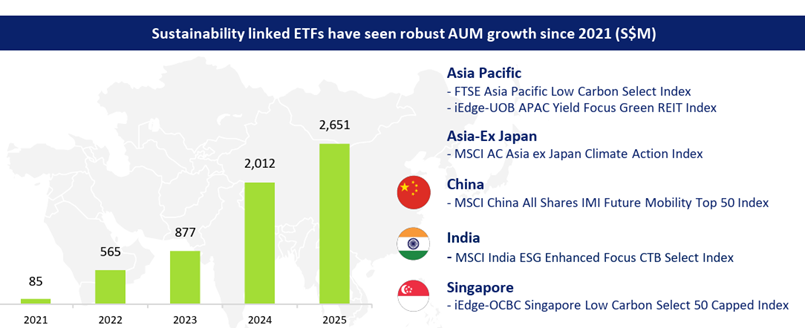
That may indicate investors are increasingly looking for listed funds that offer exposure to climate transition, low-carbon and future mobility themes.
4 SGX ETFs with green tilt to watch
#1 - Amova-StraitsTrading MSCI China Electric Vehicles and Future Mobility Index ETF (SGX: EVS / EVD)
If I want the ETF that fits the electrification narrative most directly, Amova-StraitsTrading MSCI China Electric Vehicles and Future Mobility Index ETF (SGX: EVS) would be the clearest place to start.
Amova-StraitsTrading MSCI China Electric Vehicles and Future Mobility Index ETF covers the scope of electric vehicles as well as future mobility, which is a broader concept covering the future of transport.
It aims to achieve long-term capital growth by replicating the returns of the MSCI China All Shares IMI Future Mobility Top 50 Index before fees and expenses.
As of 28 February 2026,Amova-StraitsTrading MSCI China Electric Vehicles and Future Mobility Index ETF had a fund size of S$35.82 million.
The fund has a total expense ratio (TER) of 0.70%, and a 1-year return of 29.19% and 3 year annualised return of 2.91%.
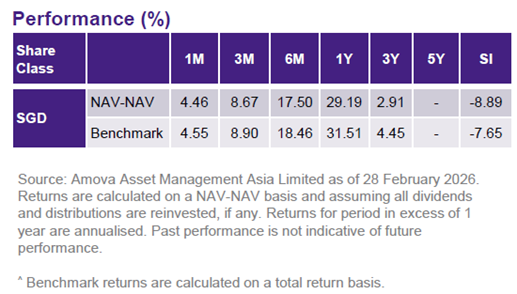
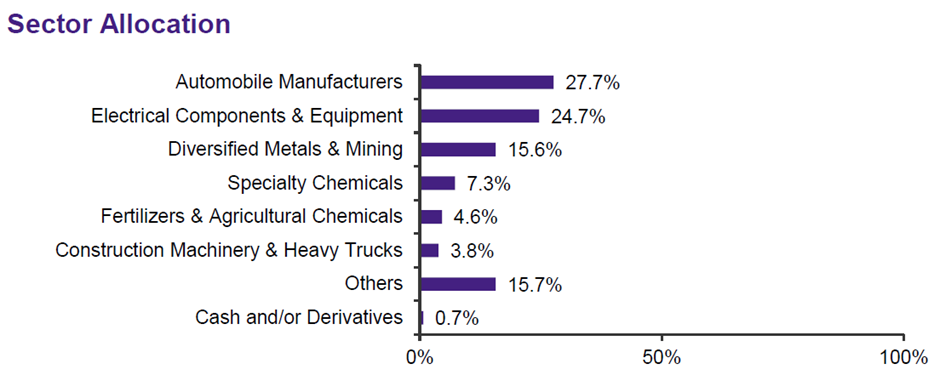
In 2025, EVS delivered the highest return among SGX-listed sustainability-linked ETFs, reflecting how strongly investors responded to the recovery in China EV and future mobility names.
Its top holdings included CATL, BYD, CMOC, Geely and Li Auto. That means investors are getting exposure not just to EV makers, but also to batteries, metals and the wider supply chain behind electrification.
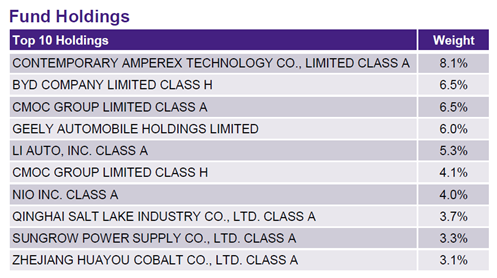
If the view is that structurally higher oil prices could reinforce the move towards EVs over time, EVS expresses that idea more clearly than the rest.
However, it is a narrower, more concentrated and volatile fund. It is also exposed to China policy changes, sector competition and shifts in sentiment around EV names.
#2 - iShares MSCI Asia ex Japan Climate Action ETF (SGX: ICM / ICU)
If I like the same broad direction but want something less concentrated, iShares MSCI Asia ex Japan Climate Action ETF (SGX: ICM) looks more balanced.
It seeks to track the results of an index that selects the top 50% of companies in each GICS sector based on their relative climate transition risk and the steps taken to mitigate those risks.
As of 28 February 2026, it had US$1.61 billion in net assets with 487 holdings.
It has a total expense ratio (TER) of 0.18%, and a 1-year return of 26.79%. It is also an accumulating ETF.
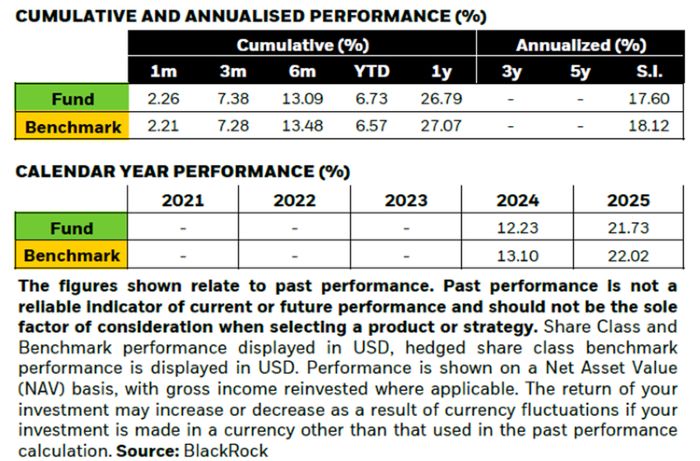
ICM is not a pure China EV ETF, but it does have meaningful exposure to Asia’s broader transition story.
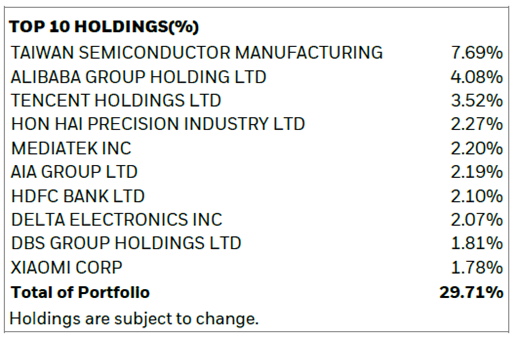
Its top holdings included TSMC, Alibaba, Tencent, Hon Hai, MediaTek, AIA, HDFC Bank, Delta Electronics, DBS and Xiaomi.
ICM also spreads its exposure across many more companies, sectors and countries. More than half of the portfolio are in information technology and financials, while geographically China and Taiwan are the largest exposures, followed by India.
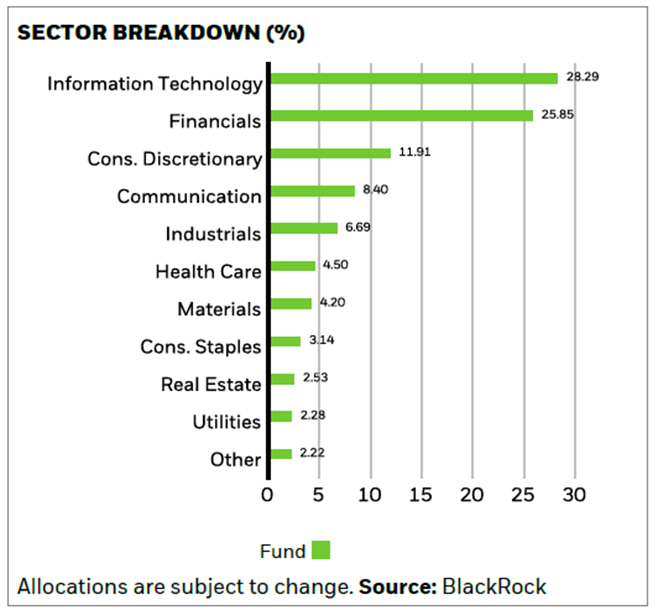
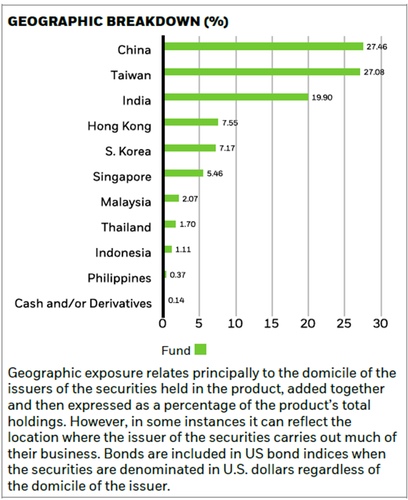
That can make it easier to hold through volatility, especially if I like the decarbonisation angle but do not want to rely too heavily on a single theme or a single market.
Among SGX-listed sustainability-linked ETFs, ICM also stood out in SGX’s ETF Market Highlights 4Q2025 as the largest by AUM, which reinforces its role as the broadest and most established option in this group.
If EVS is the cleaner electrification trade, ICM is the broader climate-transition building block.
#3 - Lion-OCBC Securities Singapore Low Carbon ETF (SGX: ESG / ESU)
If I want to stay closer to Singapore equities while still leaning into a lower-carbon theme, Lion-OCBC Securities Singapore Low Carbon ETF (SGX: ESG) is the more familiar option.
The fund aims to replicate the iEdge-OCBC Singapore Low Carbon Select 40 Capped Index.
As of 28 February 2026, it had a fund size of S$114.41 million, a 0.45% total expense ratio (TER), a 1-year return of 24.9%, and a 3-year annualised return of 19.2%.
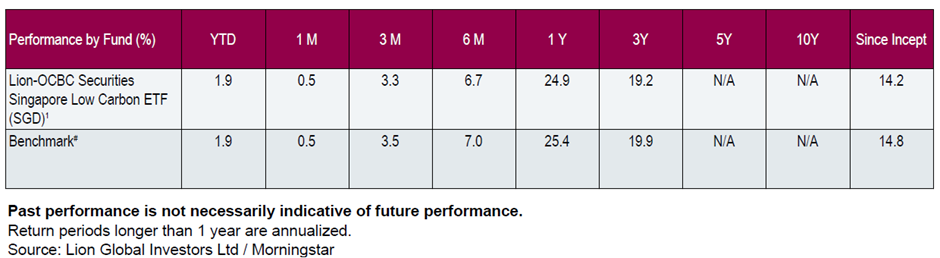
The SGD class has semi-annual distributions at the manager’s discretion. As of 24 March 2026, it has a trailing twelve month distribution yield of 6.53%.
ESG offers exposure to Singapore companies with a lower-carbon tilt.
Its top holdings included OCBC, Singtel, DBS, UOB, Trip.com, ST Engineering, SGX, CapitaLand Integrated Commercial Trust, Keppel and Sea.
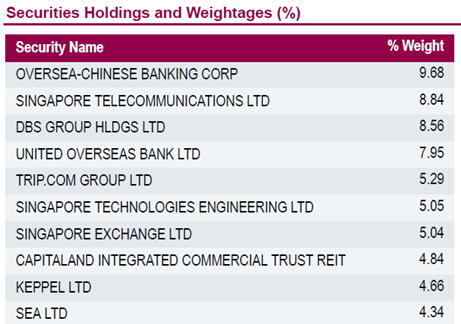
ESG’s portfolio is led by financials, real estate, industrials and communications, which gives it a more familiar Singapore equity profile despite its lower-carbon screening.
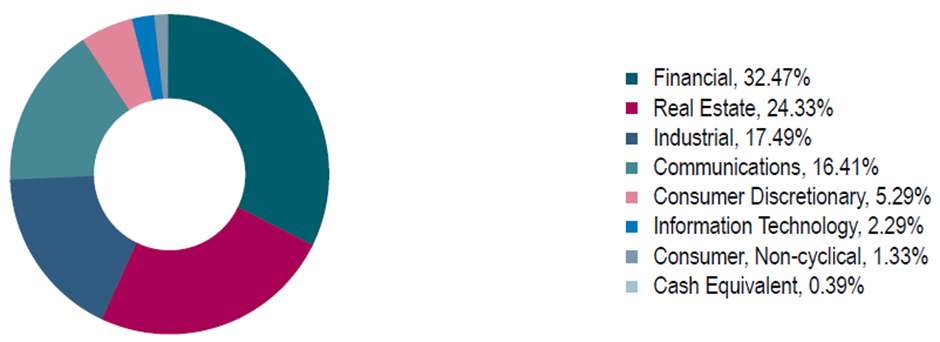
It may appeal more to those looking for a lower-carbon Singapore equity allocation within a broader portfolio.
#4 - UOB APAC Green REIT ETF (SGX: GRN / GRE)
UOB APAC Green REIT ETF is the most different ETF in this group as it is a green real estate income fund.
It tracks the iEdge-UOB APAC Yield Focus Green REIT Index, giving investors exposure to APAC REITs with greener real estate credentials.
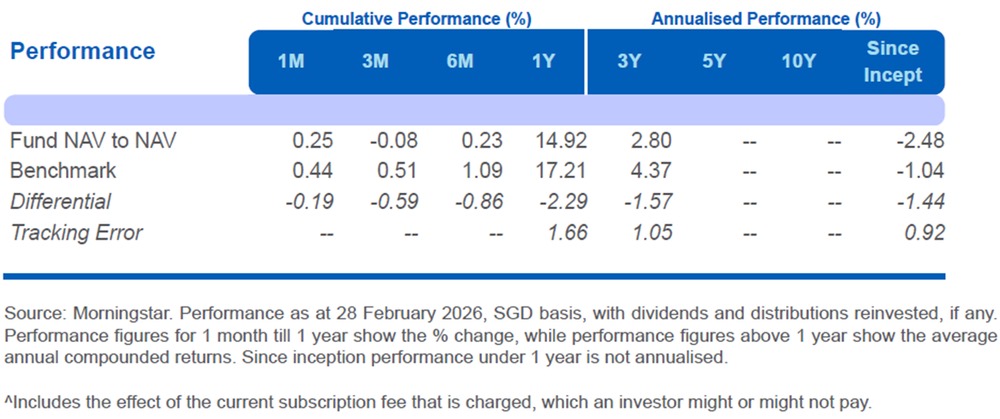
As of 28 February 2026, the fund size was S$28.92 million, has a total expense ratio (TER) of 0.82%, and the ETF delivered a 1-year NAV return of 14.92%. Its 3-year annualised return was 2.80%.
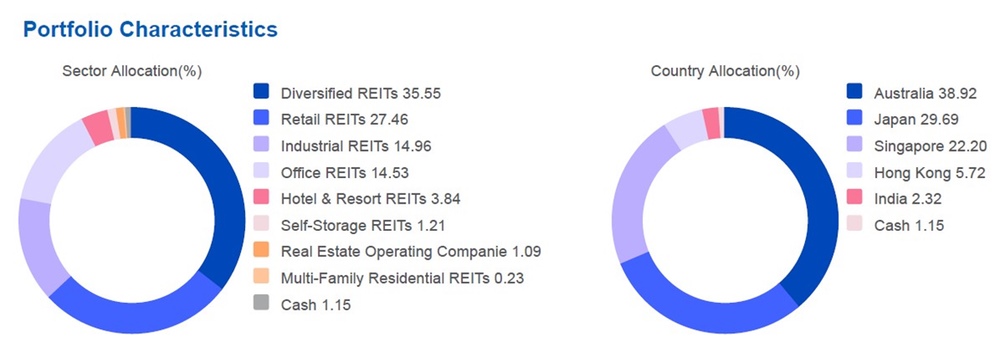
By sector, the ETF had the largest exposure to diversified REITs at 35.55%, followed by retail REITs at 27.46%, industrial REITs at 14.96%, and office REITs at 14.53%.
Geographically, the portfolio was led by Australia at 38.92%, Japan at 29.69%, and Singapore at 22.20%. It also had smaller exposure to Hong Kong at 5.72% and India at 2.32%.
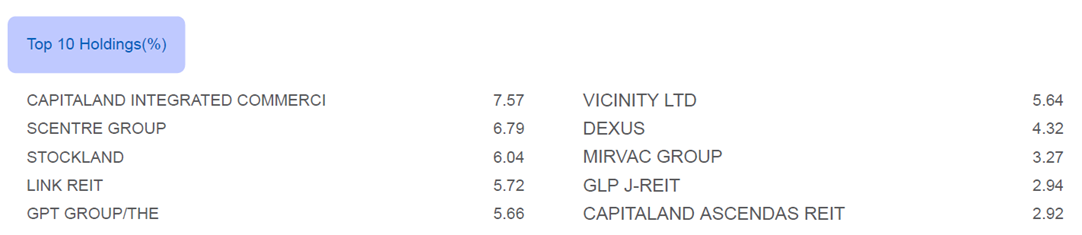
Its top holdings included CapitaLand Integrated Commercial Trust, Scentre Group, Stockland, Link REIT, GPT Group, Vicinity, Dexus, Mirvac Group, GLP J-REIT, and CapitaLand Ascendas REIT.
GRN also has a clearer income angle than the other ETFs on this list.
The ETF has an expected semi-annual distribution frequency. It has a trailing twelve month distribution yield of 3.91% as of 24 March 2026.
That gives investors a greener real asset angle within a listed income portfolio.
For those looking to combine sustainability themes with an income focus, GRN offers a differentiated way to participate in the broader transition story.
How these 4 SGX ETFs compare
While all four ETFs offer exposure to China EV, climate-transition or greener asset themes, they play very different roles in a portfolio.
EVS is the most direct China EV and future mobility ETF.
ICM is the broadest Asia climate-transition ETF.
ESG offers a more familiar Singapore low-carbon equity angle.
GRN is the most income-focused of the four, with exposure to APAC green REITs.
Among the four ETFs, GRN has the longest SGX track record, followed by EVS and ESG, while ICM is the newest listing.
All four ETFs are available in both SGD and USD trading lines on SGX, which gives investors some flexibility depending on the currency they prefer to use for trading.
| Feature | Amova-StraitsTrading MSCI China Electric Vehicles and Future Mobility Index ETF (EVS/EVD) | iShares MSCI Asia ex Japan Climate Action ETF (ICM/ICU) | Lion-OCBC Securities Singapore Low Carbon ETF (ESG/ESU) | UOB APAC Green REIT ETF (GRN/GRE) |
| SGX tickers | EVS (SGD), EVD (USD) | ICM (SGD), ICU (USD) | ESG (SGD), ESU (USD) | GRN (SGD), GRE (USD) |
| Main exposure | China EV and future mobility | Asia climate transition | Singapore low-carbon equities | APAC green REITs |
| Benchmark / index tracked | MSCI China All Shares IMI Future Mobility Top 50 Index | MSCI AC Asia ex Japan Climate Action Index | iEdge-OCBC Singapore Low Carbon Select 40 Capped Index | iEdge-UOB APAC Yield Focus Green REIT Index |
| SGX listing date | 20-Jan-22 | 14-Sep-23 | 28-Apr-22 | 23-Nov-21 |
| Fund size / AUM | S$35.82 million | US$1.61 billion | S$114.41 million | S$28.92 million |
| Total Expense Ratio | 0.70% | 0.18% | 0.45% | 0.82% |
| Distribution or accumulation | Accumulating | Accumulating | Distributing | Distributing |
| Distribution frequency | Nil | Nil | Semi-annual | Semi-annual |
| Latest dividend / distribution yield | Nil | Nil | 6.53%^ | 3.91%^ |
| Source: Respective fund factsheet as of 28 February 2026. SGX ETF Screener as of 24 March 2026. ^Historical Dividend Yield over 12-month period (%) as of ex-dividend date. | ||||
Which ETF has the highest 1-year return?
Among the four ETFs, the Amova-StraitsTrading MSCI China Electric Vehicles and Future Mobility Index ETF (EVS/EVD) had the highest 1-year return at 29.19% as of 28 February 2026.
This was followed by the iShares MSCI Asia ex Japan Climate Action ETF (ICM/ICU) at 26.79%, the Lion-OCBC Securities Singapore Low Carbon ETF (ESG/ESU) at 24.9%, and the UOB APAC Green REIT ETF (GRN/GRE) at 14.92%.
EVS likely led the group because it has the most direct exposure to China EV and future mobility names, including holdings such as CATL, BYD, CMOC, Geely and Li Auto.
By comparison, ICM is a broader Asia climate-transition ETF, ESG is a Singapore low-carbon equity ETF, and GRN is a green REIT ETF whose performance is influenced more by property and interest-rate conditions.
That difference in portfolio construction helps explain why the returns were not the same across the four funds.
| ETF | 1-year return |
| Amova-StraitsTrading MSCI China Electric Vehicles and Future Mobility Index ETF (EVS/EVD) | 29.19% |
| iShares MSCI Asia ex Japan Climate Action ETF (ICM/ICU) | 26.79% |
| Lion-OCBC Securities Singapore Low Carbon ETF (ESG/ESU) | 24.9% |
| UOB APAC Green REIT ETF (GRN/GRE) | 14.925 |
| Source: Respective fund factsheet, with performance as of 28 February 2026. | |
What would Beansprout do?
The recent surge in oil prices is a reminder that themes like electrification and energy transition may continue to remain relevant over the long term.
Instead of trying to pick individual EV, battery or clean-tech stocks across different markets, SGX-listed ETFs offer a practical and accessible way to gain diversified exposure to this theme.
If I want the most direct exposure to China EV and future mobility names, the Amova-StraitsTrading MSCI China Electric Vehicles and Future Mobility Index ETF (EVS) stands out. It offers a more focused way to invest in companies across the China EV value chain, including carmakers, battery makers and materials players.
If I want broader exposure to the green transition in Asia rather than a narrow EV bet, the iShares MSCI Asia ex Japan Climate Action ETF (ICM) looks more balanced. It provides diversified exposure across sectors and markets, and may be considered by investors who want to capture the wider decarbonisation trend in Asia.
If I want to stay closer to Singapore equities while still adding a lower-carbon tilt, the Lion-OCBC Securities Singapore Low Carbon ETF (ESG) offers a more familiar angle. It gives exposure to Singapore-listed names while screening for lower-carbon characteristics, which may be useful for investors who want some growth exposure without moving too far away from the local market. Since it is a distributing ETF, the Lion-OCBC Securities Singapore Low Carbon ETF offers a trailing twelve months dividend yield of 6.53% as of 24 March 2026.
If I am looking for an income angle, the UOB APAC Green REIT ETF (GRN) offers a different way to participate. It gives exposure to APAC REITs with greener real estate credentials and may be more relevant for investors looking for income alongside sustainability themes. It has an expected semi-annual distribution frequency, and offers a trailing dividend yield of 3.91% as of 24 March 2026.
As these ETFs provide exposure to growth, transition and thematic sectors, they may be more volatile than broader market ETFs such as the STI ETFs.
As such, I would see these ETFs as a way to provide diversification to a resilient portfolio.
You can find out more about these ETFs on the SGX ETF screener page, or read our guide on how to choose the best ETF as a SRS investor.
For investors planning for retirement or managing an SRS account, adding growth ETFs may help build your SRS account without the need to pick individual stocks.
Don’t have a brokerage account yet? Check out our guide to the best online brokers in Singapore to get started.
Once again, here are some resources to help you familiarize yourself with the world of ETFs:
- Guide to STI ETF
- Best Singapore REIT ETFs
- Best Singapore Bond ETFs
- Best S&P 500 ETFs for Singapore investors
- 5 SGX ETFs to gain exposure to Asia’s fastest-growing sectors
- 3 SGX ETFs with dividend yields above 6%. Which offers the best income?
- 7 SGX ETFs to gain exposure to China
- Best gold ETF in Singapore
- Top 10 ETFs bought by SRS investors in 2025
- Top 10 Singapore ETFs with highest dividend yields in 2025
Disclaimer
This advertisement has not been reviewed by the Monetary Authority of Singapore.
Any information provided in this article is meant purely for informational and investor education purposes and should not be relied upon as financial or investment advice, or advice on corporate finance.
This article is not and does not constitute or form part of any offer, recommendation, invitation or solicitation to purchase any financial product or subscribe or enter any transaction. This article also does not take into account your personal circumstances, e.g. investment objectives, financial situation or particular needs and shall not constitute financial advice. You should consult your own independent financial, accounting, tax, legal or other competent professional advisors.
The information provided in this article are on an “as is” and “as available” basis without warranty of any kind, whether express or implied. Beansprout does not recommend any particular course of action in relation to any investment product or class of investment products. No information is presented with the intention to induce any person to buy, sell, or hold a particular investment product or class of investment products.
Read also
Gain financial insights in minutes
Subscribe to our free weekly newsletter for more insights to grow your wealth
Most Popular

Comments
0 comments