
Singlife Account savings product to close in 2027: 5 ways to earn a higher yield on spare cash
Savings Account
By Beansprout • 23 Nov 2026
Why trust Beansprout? We’ve been awarded Best Investment Website at the SIAS Investors’ Choice Awards
Singlife Account will close by December 2027. We compare 5 alternatives, including savings accounts, fixed deposits, T-bills and SSBs, to earn higher returns.
What happened?
Singlife is discontinuing its Singlife Account savings and insurance product, with all remaining accounts to close by 16 December 2027.
However, some customers will see their accounts close earlier, starting from December 2026. New applications have also stopped.
The announcement got me thinking about where to move the spare cash I have been keeping in the account, especially with several savings accounts, fixed deposits, SSB and T-bills offering competitive returns.
Here's what Singlife Account holders should know about the closure, the returns they currently earn, and five alternatives to consider for their savings.
What happens to your Singlife Account when it closes?
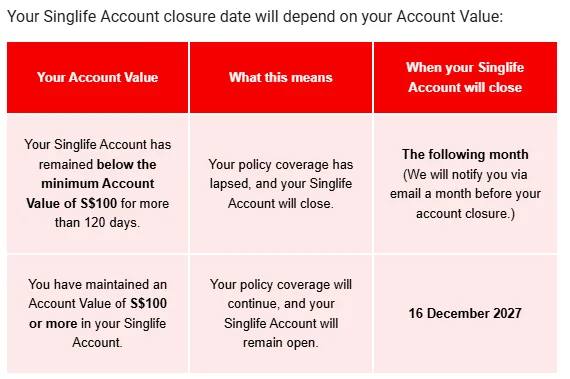
Accounts that remained below S$100 for more than 120 days as at 11 November 2026 will start closing from 16 December 2026.
Accounts that subsequently reach the 120-day threshold will close in the following month.
Until their accounts close, customers can continue topping up or withdrawing money, subject to the applicable rules.
Any remaining balance, including returns earned, will be returned to their linked bank account.
If you hold a Singlife Account, check that your linked bank details are valid. The bundled insurance coverage will end when your account closes, although your other Singlife policies will be unaffected.
How much interest does Singlife Account currently offer?
Singlife currently offers a non-guaranteed base return of 1.5% a year on the first S$10,000, and 1% a year on amounts above S$10,000 up to S$100,000. There are no returns on balances above S$100,000.
For someone with a larger balance, the effective base return is therefore below the headline 1.5%.
For example, S$50,000 would earn approximately S$550 over a year, equivalent to 1.1%, assuming the base rates remain unchanged and excluding bonuses.
There are alternatives offering higher interest or potential returns, although they differ in their withdrawal flexibility, eligibility conditions and protection.
Here are five options I would consider when moving my Singlife savings, starting with fixed deposits for money I can set aside for a fixed period.
1. Fixed deposits: Choose a tenure that matches when you need the money
Fixed deposits would be one of the first options I consider for money I do not need in the near term.
Unlike Singlife Account's non-guaranteed returns, fixed deposits allow me to secure an agreed interest rate for a fixed period, provided I hold the deposit to maturity.
I noticed that the best fixed deposit rates in Singapore have remained competitive, with rates reaching 2.30% p.a. in November 2026.
For someone moving a smaller Singlife Account balance, I have shortlisted the highest fixed deposit rates across different periods, with minimum placements below S$100,000.
| Bank or finance company | Period | Interest rate p.a. | Minimum placement |
| Singapura Finance (Counter FD) | 3 months | 2.18% | S$20,000 |
| CIMB | 6 months | 2.20% | S$10,000 |
| Singapura Finance (Vivid FD) | 8 months | 2.12% | S$10,000 |
| CIMB | 9 months | 2.20% | S$10,000 |
| CIMB | 12 months | 2.30% | S$10,000 |
| RHB | 12 months | 2.30% | S$20,000 |
| Source: Selected highest rates by period from our fixed deposit guide updated on 17 November 2026, excluding offers requiring placements of S$100,000 or more. Promotional rates, placement channels and other conditions apply. | |||
For someone moving S$10,000 from Singlife Account, CIMB offers a choice between a six- or nine-month placement at 2.20% p.a., and a 12-month placement at 2.30% p.a.
The main trade-off is early access. Withdrawing a fixed deposit before maturity may mean receiving reduced or no interest, while charges may also apply depending on the bank's terms.
I would consider splitting a larger sum into separate placements with different maturity dates. That would give me opportunities to access part of the money without having to break one large deposit.
For the latest rates across different periods and minimum placements, refer to our best fixed deposit rates guide.
2. Savings accounts: Earn more while keeping your cash accessible
If I want to retain the flexibility to access my money, I would consider transferring my Singlife balance to another savings account.
One option is the SingFinance GoSavers Account, which offers an interest rate of 1.60% p.a. on the first S$100,000, without requiring salary crediting, card spending or fresh funds.
This is slightly higher than Singlife Account's 1.5% p.a. base return on the first S$10,000.
GoSavers has no minimum balance requirement or lock-in period, with interest calculated daily and credited monthly. The account also supports online FAST transfers, although its interest rate is variable and may change.
Another option is the UOB Stash Account, which offers an effective interest rate of up to 1.92% p.a. on S$100,000, following an increase in rates from 1 November 2026.
There are no salary-crediting or card-spending requirements. However, I would need to maintain or increase my monthly average balance compared with the previous month to qualify for bonus interest.
For those willing to meet additional conditions, several savings accounts offer higher promotional rates.
For example, CIMB FastSaver offers an effective interest rate of approximately 2.12% p.a. on S$100,000, assuming the entire balance qualifies for its November fresh-funds promotion.
Maybank iSAVvy and Trust Bank's Level Up promotion also offer up to 2.20% p.a. on qualifying incremental fresh funds, subject to their respective eligibility requirements.
However, these promotional rates are temporary, with the November offers running until 31 January 2027.
I would therefore compare the effective interest rate on my actual balance, the conditions required and how easily I can access my savings.
For more options, you can refer to our guide to the best savings accounts in Singapore to compare the latest interest rates and find an account that meets your savings needs.
3. Singapore T-bills: Consider government-backed returns over six months
Singapore Treasury bills, or T-bills, are another option for cash that you can leave untouched until maturity.
The latest six-month T-bill auction on 19 November 2026 saw the cut-off yield rise to 2.07% p.a., its highest level in 2026.
This was above Singlife Account's 1.5% headline base return, although below several fixed deposit promotions in our comparison.

However, the 2.07% cut-off yield is a historical auction result. The yield at the next auction may be higher or lower, so it should not be treated as a rate I can secure at any time.
T-bills are issued at a discount to their face value. You receive the face value at maturity, with the difference representing your return. They do not pay regular coupons during the holding period.
The minimum investment is S$1,000, in multiples of S$1,000. Cash applications can be made through the participating local banks.
One attraction is that T-bills are fully backed by the Singapore Government. Unlike savings-account promotions, there are no salary-crediting or card-spending requirements to earn the allotted auction yield.
However, T-bills cannot be redeemed early. If you need to exit before maturity, you would have to sell in the secondary market, where the price may be above or below what you paid.
There is also a decision to make when the T-bill matures. If you reinvest, the available yield could have fallen.
For those unfamiliar with how they work, our Singapore T-bill guide explains how to apply, how returns are calculated and what happens at maturity.
I would use T-bills for a portion of cash with a clear six-month horizon, while leaving money for immediate expenses in a savings account.
4. Singapore Savings Bonds: Lock in an interest-rate schedule for up to ten years
Singapore Savings Bonds, or SSBs, offer a longer-term option with flexibility to redeem monthly.
The latest December 2026 Singapore Savings Bond offers a first-year interest rate of 1.83% and an average annual return of 2.39% if held for the full ten years.
The distinction is important. If you expect to redeem after one year, the relevant comparison is 1.83%. You would need to hold the bond for the full decade to receive the quoted ten-year average return.
SSB interest rates step up over time, and the entire schedule is fixed when the bond is issued. Interest is paid every six months.
For example, S$10,000 invested in this issue would earn S$183 in the first year, before transaction fees. That compares with S$150 at Singlife’s 1.5% base rate, assuming the latter remains unchanged.
As the SSB interest rates change from month to month, you can use our SSB interest rate projection tool to find out the projected returns for upcoming SSB issues.
The minimum investment is S$500, in multiples of S$500, with a maximum individual holding of S$200,000 across SSB issues.
A useful feature is the ability to redeem in any month without an early-exit penalty. You receive your principal and accrued interest, although transaction fees apply. Unlike selling a conventional bond, you do not have to accept a market price that could be below your original investment.
However, redemption is not immediate. Proceeds arrive by the second business day of the following month.
I would consider SSBs for money I may keep for several years but still want the option to access. I would retain a separate cash buffer for expenses that cannot wait for the monthly redemption cycle.
Learn more about SSBs and how to apply for SSBs by reading our comprehensive SSB guide.
5. Money market funds: Compare potential returns and understand the risks
Money market funds provide another way to put spare cash to work, often through a brokerage or cash management platform.
These funds typically invest in relatively low-risk, short-term instruments such as bank deposits and short-term debt securities.
Several platforms, including Longbridge Cash Plus, Moomoo Cash Plus, Webull Moneybull and Tiger Vault, provide access to money market funds or other cash management solutions.
Some platforms also offer promotional incentives that could increase the overall return for eligible users.
[Exclusive Beansprout Promotion] Get an 8.8% p.a. interest boost coupon for 90 days on up to S$10,000 (worth approximately S$217) with Longbridge Cash Plus when you sign up through Beansprout. Plus, receive an S$80 FairPrice voucher within five working days, subject to eligibility requirements. Learn more about the Longbridge promotion here.
However, Longbridge Cash Plus invests in money market funds, where capital and underlying returns are not guaranteed.
The quoted yields from money market funds are also backward-looking and may change with market conditions. It is also not covered by Singapore's Deposit Insurance Scheme.
I would therefore compare the returns and underlying investments before choosing a cash management account.
Our guide to money market funds in Singapore explains how these funds work and what investors should consider.
What would Beansprout do?
With the Singlife Account closing by December 2027, I would take the opportunity to review where to park my spare cash.
Within my Liquidity Pot, I would first divide the money according to when I expect to use it.
For daily spending and unexpected expenses, I would compare savings accounts based on the interest my actual balance qualifies for. A promotion with a high minimum balance may be less useful than a lower headline rate that applies to more of my money.
For a known expense six or twelve months away, I would compare fixed deposits and T-bills with matching maturities.
For money I can set aside for longer, I would consider whether an SSB’s fixed interest-rate schedule is attractive. You can refer to our latest SSB analysis to see how its returns compare with T-bills and fixed deposits in November 2026.
Money market funds are another option, although I would weigh their potential returns against the investment risks and lack of capital guarantee.
[Exclusive Beansprout Promotion] Get 8.8% p.a. interest boost coupon for 90 days on S$10,000 (worth S$217) with Longbridge Cash Plus when you sign up for a Longbridge account via Beansprout. Plus get S$80 Fairprice voucher within 5 working days. Learn more about the Longbridge promotion here.
I would also check the protection offered by each option. Eligible Singapore-dollar deposits are insured up to S$100,000 per depositor per Deposit Insurance Scheme member, aggregated across eligible accounts at that institution.
Opening both a savings account and a fixed deposit at the same bank does not create two separate limits. Investment funds are also excluded from deposit insurance.
For a broader comparison, you can refer to our latest coverage of T-bill, fixed deposit, Singapore Savings Bond (SSB) and savings account rates to find out where you can earn a competitive return on your cash in November 2026.
Before transferring my Singlife balance, I would confirm the replacement account is ready, check its latest terms and update my linked bank details in the Singlife app.
Ultimately, I would not move my money simply because another option offers a higher headline yield.
The aim would be to earn more from spare cash while keeping it available for the expenses it is meant to cover.
Follow Beansprout on Telegram, Youtube, Facebook and Instagram, and add Beansprout as your preferred source on Google so you never miss an update.
Read also
Gain financial insights in minutes
Subscribe to our free weekly newsletter for more insights to grow your wealth
Most Popular

Comments
0 comments