
3 Singapore blue chip REITs with dividend yields above 6% and near 52-week lows
REITs
By Goh Lay Peng • 26 Sep 2026
Why trust Beansprout? We’ve been awarded Best Investment Website at the SIAS Investors’ Choice Awards 2025
'%3e%3cpath%20fill-rule='evenodd'%20clip-rule='evenodd'%20d='M17.64%209.20455C17.64%208.56637%2017.5827%207.95273%2017.4764%207.36364H9V10.845H13.8436C13.635%2011.97%2013.0009%2012.9232%2012.0477%2013.5614V15.8195H14.9564C16.6582%2014.2527%2017.64%2011.9455%2017.64%209.20455V9.20455Z'%20fill='%234285F4'/%3e%3cpath%20fill-rule='evenodd'%20clip-rule='evenodd'%20d='M9%2018C11.43%2018%2013.4673%2017.1941%2014.9564%2015.8195L12.0477%2013.5614C11.2418%2014.1014%2010.2109%2014.4205%209%2014.4205C6.65591%2014.4205%204.67182%2012.8373%203.96409%2010.71H0.957275V13.0418C2.43818%2015.9832%205.48182%2018%209%2018V18Z'%20fill='%2334A853'/%3e%3cpath%20fill-rule='evenodd'%20clip-rule='evenodd'%20d='M3.96409%2010.71C3.78409%2010.17%203.68182%209.59318%203.68182%209C3.68182%208.40682%203.78409%207.83%203.96409%207.29V4.95818H0.957273C0.347727%206.17318%200%207.54773%200%209C0%2010.4523%200.347727%2011.8268%200.957273%2013.0418L3.96409%2010.71V10.71Z'%20fill='%23FBBC05'/%3e%3cpath%20fill-rule='evenodd'%20clip-rule='evenodd'%20d='M9%203.57955C10.3214%203.57955%2011.5077%204.03364%2012.4405%204.92545L15.0218%202.34409C13.4632%200.891818%2011.4259%200%209%200C5.48182%200%202.43818%202.01682%200.957275%204.95818L3.96409%207.29C4.67182%205.16273%206.65591%203.57955%209%203.57955V3.57955Z'%20fill='%23EA4335'/%3e%3c/g%3e%3cdefs%3e%3cclipPath%20id='clip0_0_2849'%3e%3crect%20width='18'%20height='18'%20fill='white'/%3e%3c/clipPath%3e%3c/defs%3e%3c/svg%3e)
Make Beansprout your preferred source on Google
Add us on Google to see more of our insights in your search results
We assess three Singapore blue chip REITs with annualised dividend yields above 6%, examining dividend growth, gearing and income sustainability.

What happened?
Singapore REIT dividend yields are back in focus as interest rates rise.
We recently shared what the Fed’s September rate hike could mean for REITs and blue chip stocks, including potential pressure from higher refinancing costs.
We also previously examined dividend yields and performance across the Singapore REIT sector and later compared REITs yield with Singapore bank dividends to see which is better for income.
With many REITs trading near their 52-week lows, members of the Beansprout community have asked whether these lower valuations have made REITs more attractive for income investors.
For me, the key question is whether their distributions can hold up well enough to make current prices attractive.
In this article, I look at three Singapore blue chip REITs with dividend yields above 6% and assess their distribution per unit (DPU) growth, gearing and yield using Beansprout’s three REIT screening checks.
3 Singapore blue chip REITs with dividend yields of 6% or more near 52-week lows
#1 – CapitaLand Ascendas REIT (SGX: A17U)
CapitaLand Ascendas REIT (CLAR) owns a diversified portfolio of business spaces, industrial properties, logistics facilities and data centres.
Its portfolio is anchored in Singapore, with additional properties in Australia, the United States, the United Kingdom, Europe and Japan. As at 30 Jun 2026, its Singapore assets were valued at S$13.1 billion, accounting for 65% of the portfolio asset under management.
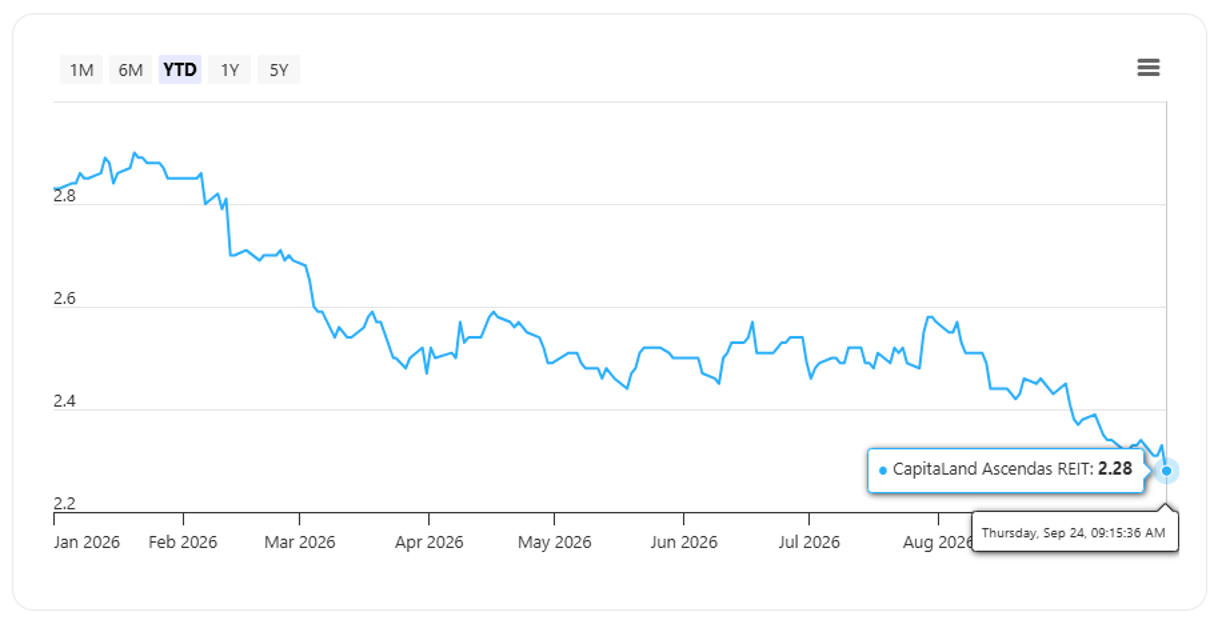
CapitaLand Ascendas REIT was trading at S$2.28 as at 24 September 2026, down approximately 19.4% year to date from S$2.83 at the end of 2025.
Its latest results showed higher income, although the improvement in DPU was modest.
For the first half of 2026, distributable income increased 8.6% year on year to S$359.4 million, while DPU rose just 0.1% to 7.482 cents.
The difference reflects the enlarged unit base, which means higher total income has to be shared across more units.
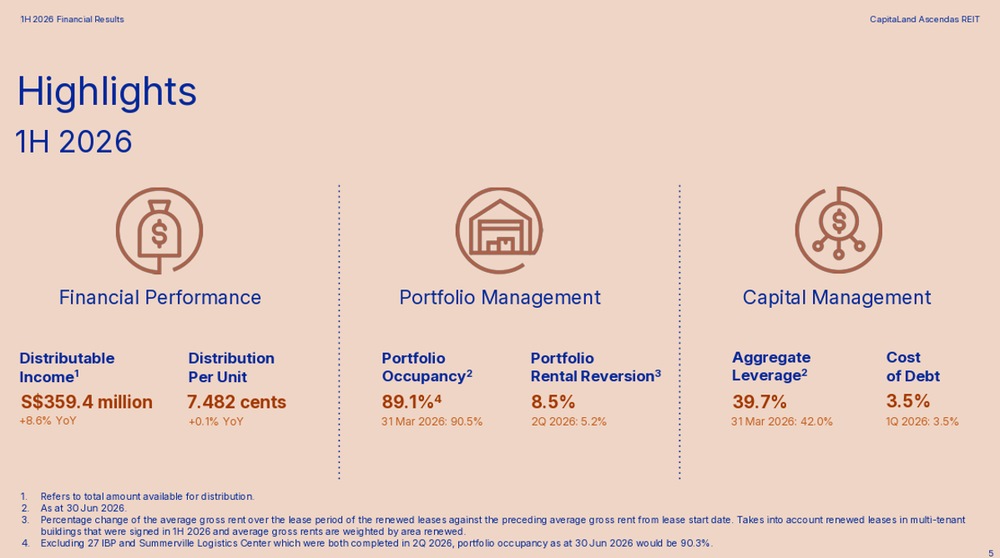
Operating indicators were mixed.
Rental reversion was positive at 8.5%, indicating that renewed leases generally secured higher rents.
Management expects rental reversion for FY2026 to remain positive in the high single-digit range.
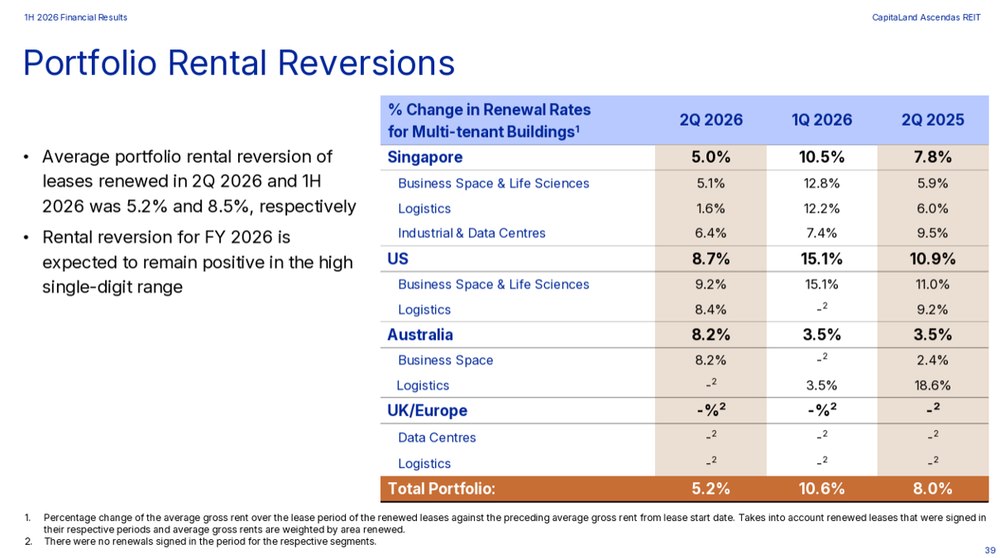
However, portfolio occupancy stood at 89.1% at the end of June. Excluding two properties completed during the quarter, occupancy would have been 90.3%.
Since the June reporting period, CapitaLand Ascendas REIT has completed further logistics acquisitions. It announced the completion of a ramp-up logistics property acquisition on 18 August, followed by a Singapore logistics acquisition and leaseback on 27 August.
These assets could provide additional contributions to second-half income, although their impact on DPU will also depend on financing costs and the number of units outstanding.
CapitaLand Ascendas REIT also announced the proposed sale of Kim Chuan Telecommunications Complex for S$200.4 million, approximately 32% above its June valuation.
The property’s previous single tenant had occupied it until April 2026. Management expects net proceeds of approximately S$180 million and does not expect a material impact on FY2026 DPU.
With its latest DPU broadly stable, I would apply the three checks in our Singapore REIT screening framework to assess its income outlook, balance sheet and yield.
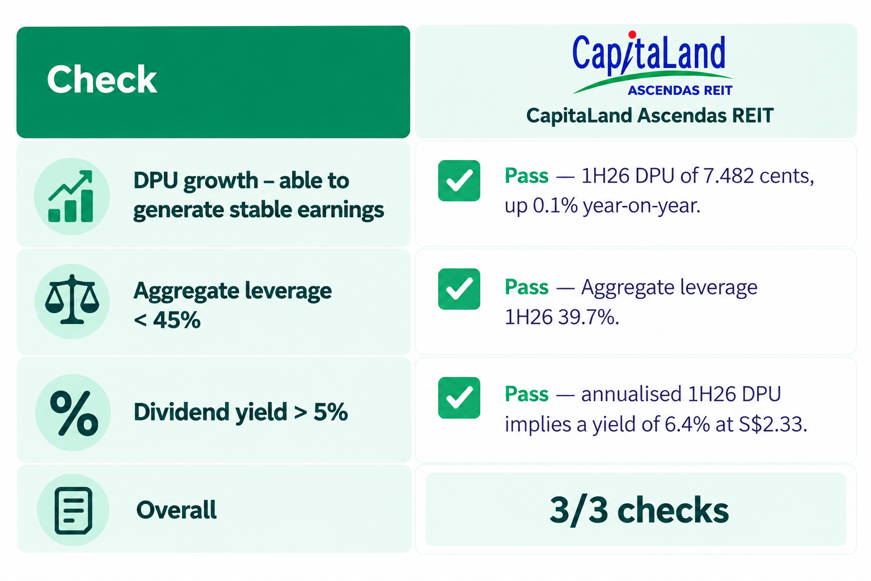
The first check looks at whether DPU grew year on year in the latest reported half-year period.
CapitaLand Ascendas REIT’s 1H2026 DPU rose 0.1% to 7.482 cents, allowing it to pass the DPU growth check.
However, the increase was marginal. Its FY2025 DPU had declined 1.3%, so I would want to see further evidence that the latest stabilisation can develop into sustained growth.
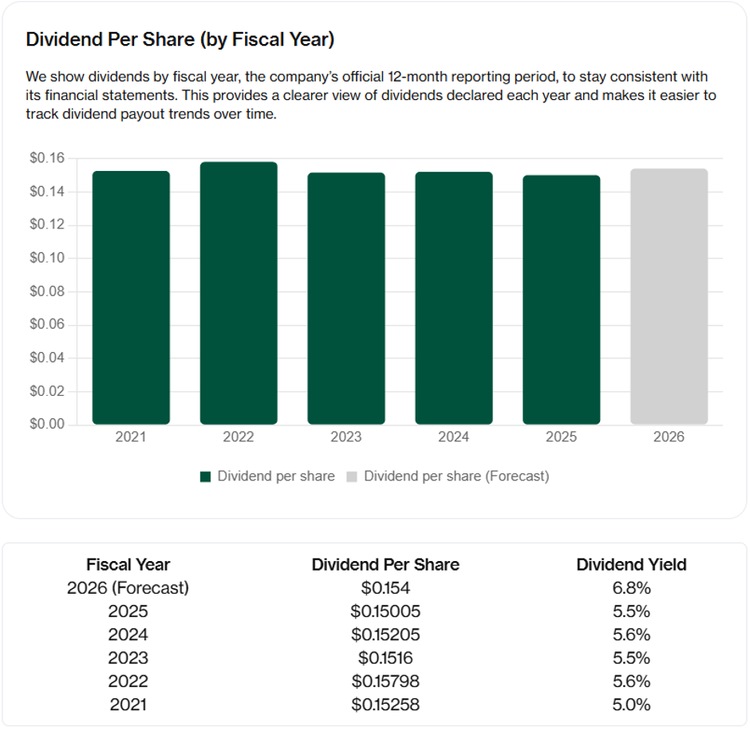
Annualising its first-half DPU of 7.482 cents gives a payout of 14.964 cents per year. At its unit price of S$2.28 as at 24 September 2026, this translates to an annualised distribution yield of approximately 6.6%.
For the second check, aggregate leverage improved to 39.7%, from 42.0% at the end of March. Its cost of debt remained at 3.5%.
CapitaLand Ascendas REIT therefore passes the gearing check, with leverage below our preferred threshold of 45%. These are June figures, so I would monitor the balance sheet after the subsequent acquisitions and disposals.
The third check is whether its dividend yield offers sufficient compensation for the risks.
Its annualised distribution yield of approximately 6.6% offers a spread of about 4.2 percentage points over the latest Singapore Savings Bond’s 2.32% average annual return over 10 years.
CapitaLand Ascendas REIT therefore passes the yield check, although REIT distributions and unit prices can fluctuate.
As additional valuation context, CapitaLand Ascendas REIT is trading at approximately 0.99 times book value, close to the reported value of its net assets.
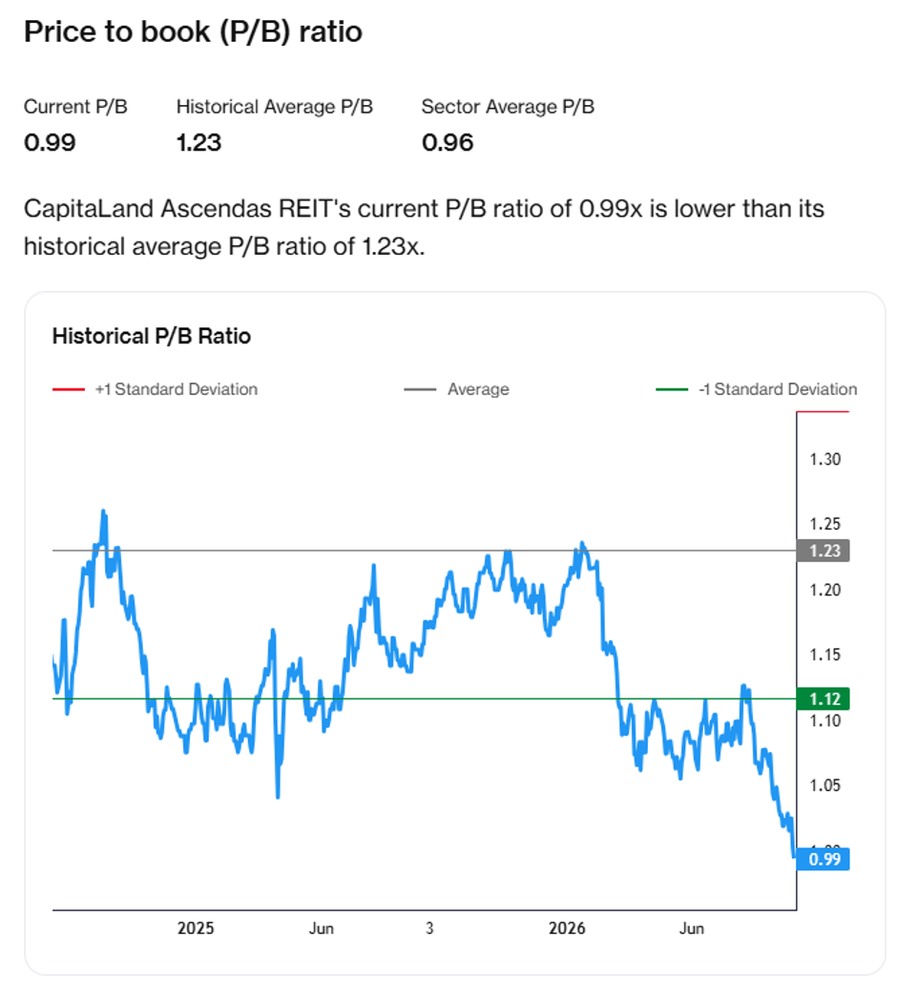
Overall, CapitaLand Ascendas REIT passes all three initial screening checks.
However, passing the screen does not establish that its distributions will continue to grow. I would want to see completed acquisitions and stronger rents translate into sustained DPU growth, alongside an improvement in occupancy.
Find out how much distribution income you would have received as a CapitaLand Ascendas REIT unitholder over the past 12 months using the dividend calculator.
Related links:
- CapitaLand Ascendas REIT latest valuation, share price and analysis
- CapitaLand Ascendas REIT dividend history and forecast
#2 – Mapletree Industrial Trust (SGX: ME8U)
Mapletree Industrial Trust (MIT) owns industrial properties and data centres across Singapore, North America and Japan.
Mapletree Industrial Trust was trading at S$1.87 as at 24 September 2026, down approximately 10.1% year to date from S$2.08 at the end of 2025.
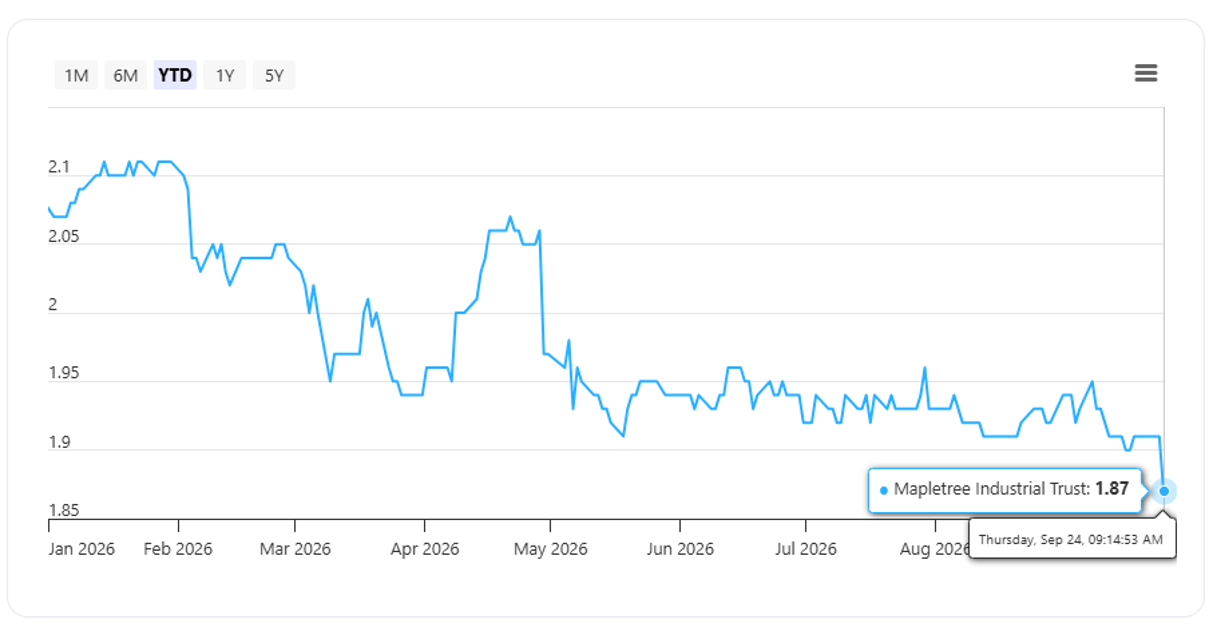
Its latest results showed continued pressure on distributions, although quarterly DPU improved slightly from the preceding quarter.
For the first quarter of FY2026/27, net property income declined 8.5% year on year to S$122.3 million, while the amount available for distribution to unitholders fell 4.8% to S$88.8 million.
DPU declined 4.9% to 3.11 cents, although it improved 0.6% from the preceding quarter.
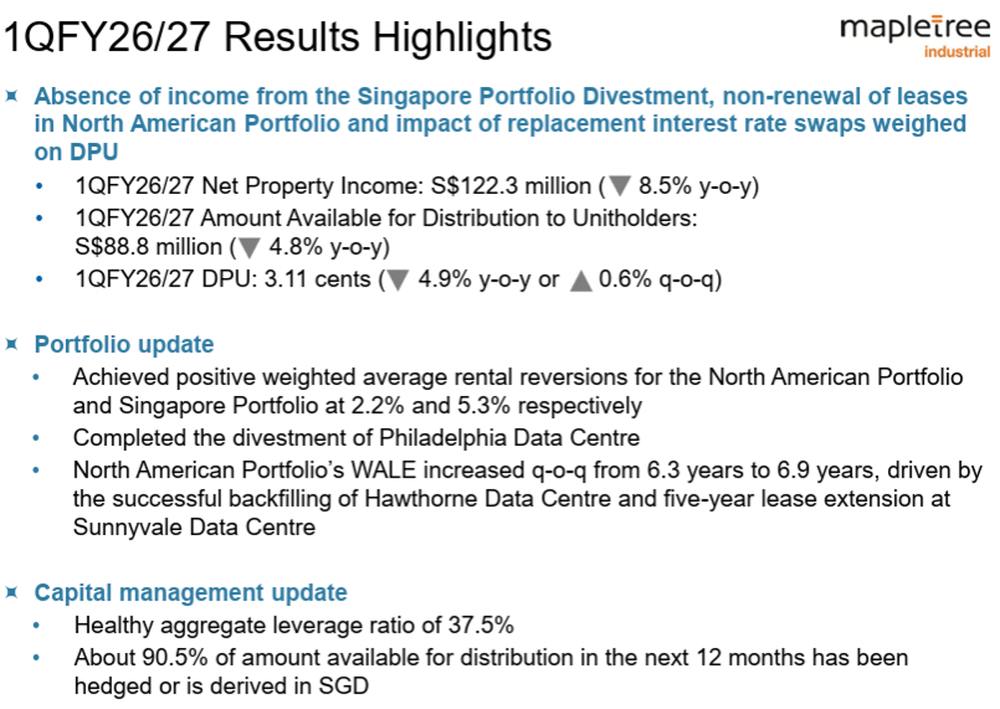
Management highlighted the absence of income from divested Singapore properties, lease non-renewals in North America and the impact of replacement interest-rate swaps.
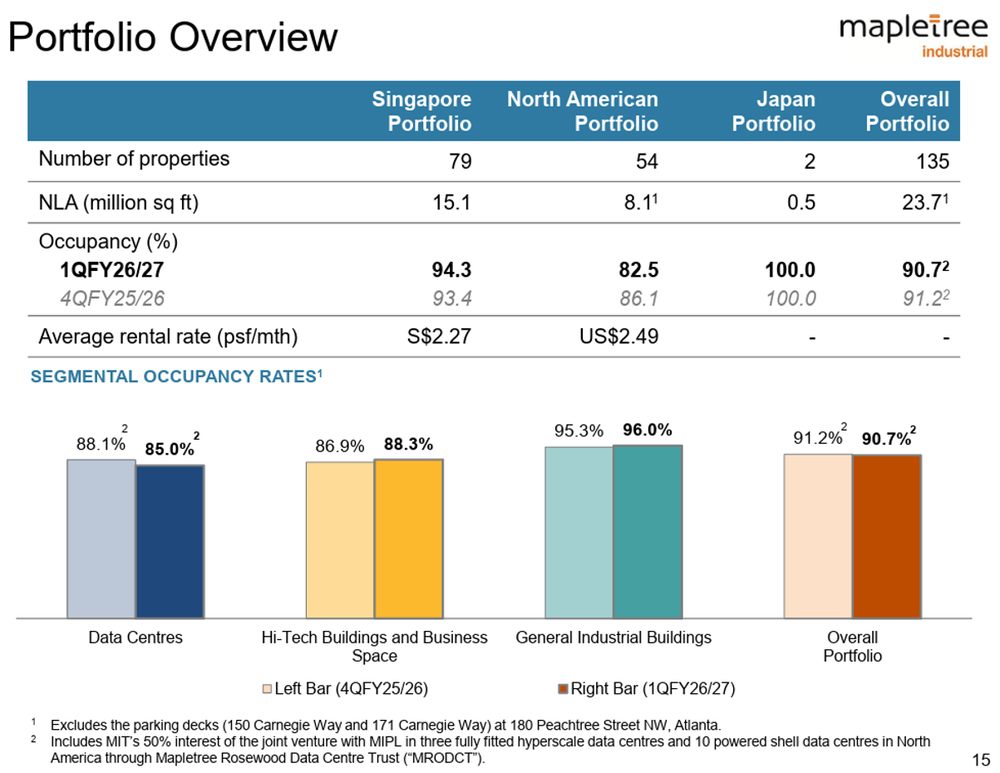
There were some encouraging leasing developments. Mapletree Industrial Trust achieved positive rental reversions of 5.3% in Singapore and 2.2% in North America.
However, North American occupancy fell to 82.5%, from 86.1% in the preceding quarter, while Singapore occupancy improved to 94.3%.
Mapletree Industrial Trust is also evaluating further divestments in North America.
On 31 August 2026, management clarified that there was no assurance that a transaction would materialise, following media reports about a potential sale of US data-centre assets.
These remain potential disposals rather than completed transactions.
Asset sales could free up capital for debt repayment or investment in other properties. However, they could also reduce rental income before the proceeds are reinvested.
I would therefore compare the income lost from any properties sold with the interest savings and income generated from the proceeds before assuming that divestments will improve DPU.
Despite the slight quarterly improvement in DPU, distributions remain lower year on year. I would apply the three checks in our Singapore REIT screening framework to assess whether its higher yield adequately compensates for the risks.
For the first check, Mapletree Industrial Trust’s latest available first-half results cover April to September 2025, or 1H FY2025/26. DPU fell 5.1% year on year to 6.45 cents, from 6.80 cents.
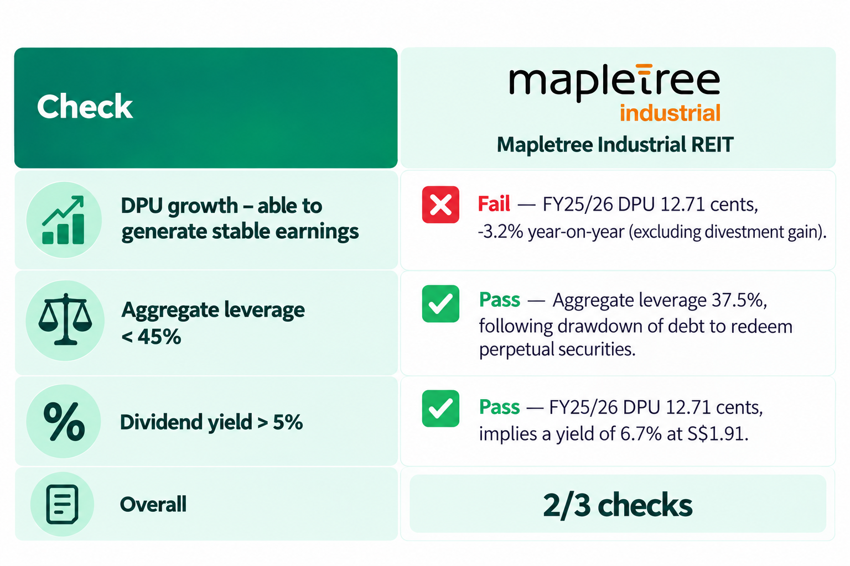
Mapletree Industrial Trust therefore does not pass the DPU growth check.
Its subsequent full-year results provide additional context. FY2025/26 reported DPU fell 6.3% to 12.71 cents, from 13.57 cents in the previous year.
Excluding divestment gains, the full-year DPU decline was smaller at 3.2%. This shows that the absence of those gains contributed to the headline decline, although underlying distributions also remained under pressure.
The latest 1Q FY2026/27 DPU was still lower year on year, despite improving slightly from the preceding quarter. I would therefore want clearer evidence of stabilisation.
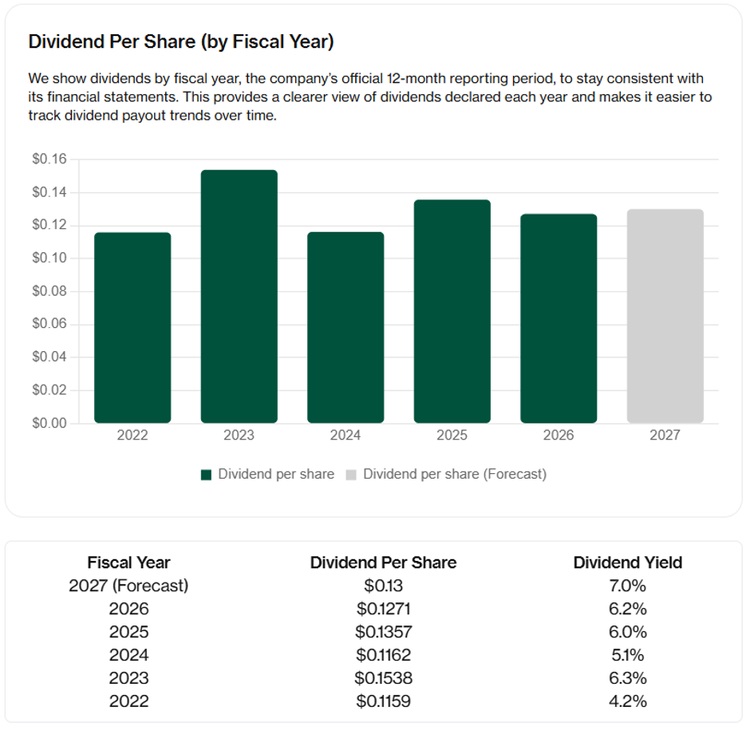
Annualising its latest quarterly DPU of 3.11 cents gives a payout of 12.44 cents per year. At its unit price of S$1.87 as at 24 September 2026, this translates to an annualised distribution yield of approximately 6.7%, the highest among the three REITs.
This assumes the latest quarterly payout is maintained and is not a forecast.
For the second check, Mapletree Industrial Trust’s aggregate leverage stood at 37.5%, the lowest reported figure among these three REITs.
Mapletree Industrial Trust therefore passes the gearing check, although I would still examine how refinancing and replacement interest-rate hedges affect distributions.
The third check is whether its dividend yield offers sufficient compensation for the risks.
Its annualised distribution yield offers a spread of approximately 4.3 percentage points over the latest SSB’s 2.32% 10-year average return.
Mapletree Industrial Trust therefore passes the yield check, but the higher yield needs to be weighed against its declining DPU.
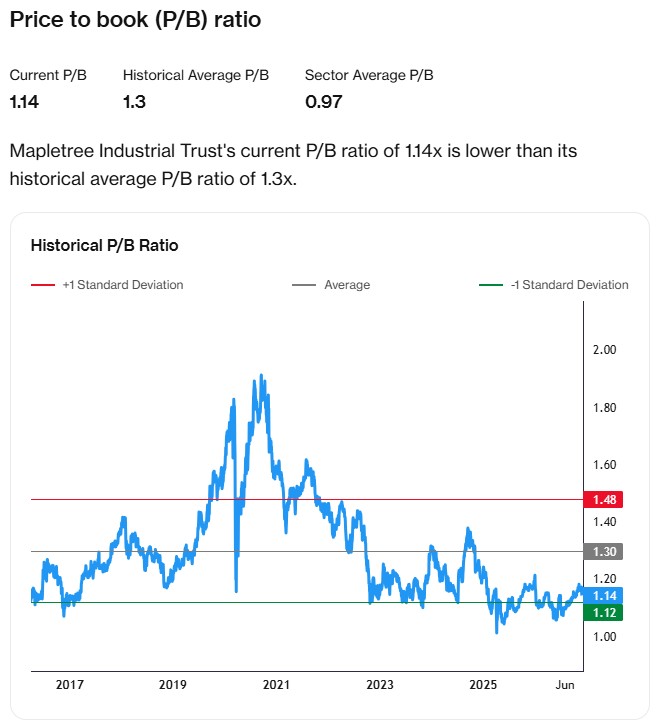
On valuation, Mapletree Industrial Trust is trading at 1.14 times book value, so its units still commanded a premium to reported net asset value despite the decline in price.
Overall, Mapletree Industrial Trust passes two of the three initial checks.
For my Income Pot, I would want clearer evidence that leasing progress and any portfolio changes are improving income per unit before adding to a position simply because the unit price has fallen.
Find out how much distribution income you would have received as a Mapletree Industrial Trust unitholder over the past 12 months using the dividend calculator.
Related links:
- Mapletree Industrial Trust latest valuation, share price and analysis
- Mapletree Industrial Trust dividend history and forecast
#3 – Keppel REIT (SGX: K71U)
Keppel REIT owns commercial properties in Singapore and overseas, including interests in Ocean Financial Centre and Marina Bay Financial Centre.
Keppel REIT was trading at S$0.845 as at 24 September 2026, down approximately 13.3% year to date from S$0.975 at the end of 2025.
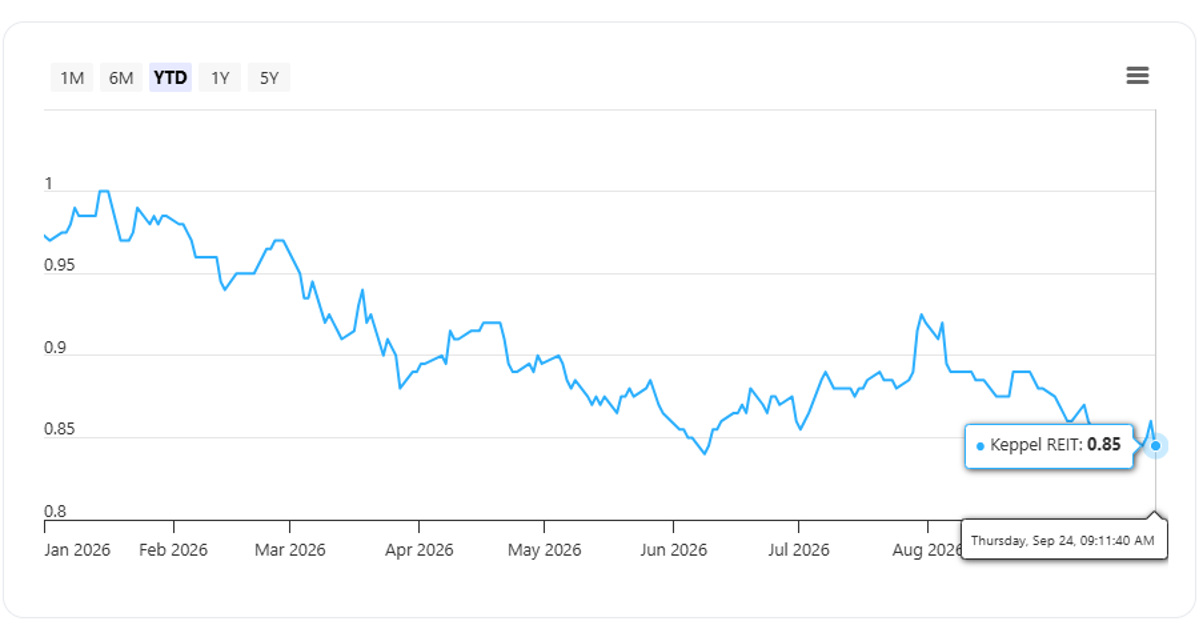
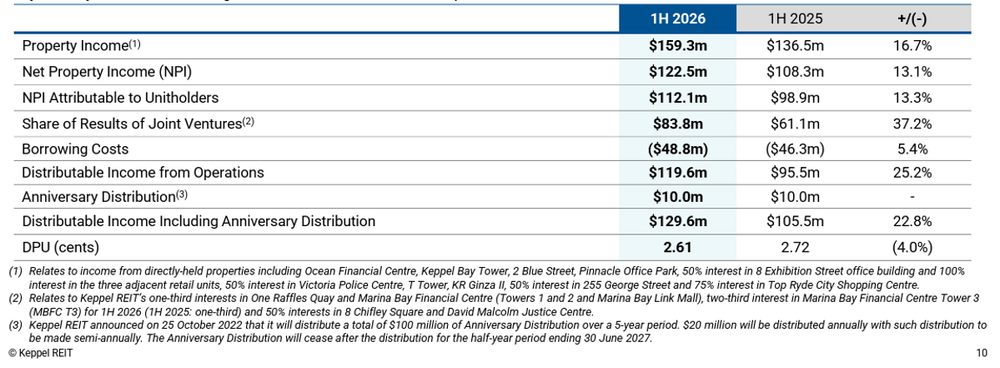
Its latest results showed higher property income, but a lower distribution per unit.
For the first half of 2026, net property income increased 13.1% year on year to S$122.5 million. Distributable income including the anniversary distribution rose 22.8% to S$129.6 million.
However, DPU declined 4.0% to 2.61 cents, as the income was spread across an enlarged unit base. As of 1H26, the number of units issued increased by 28% from 1H25.
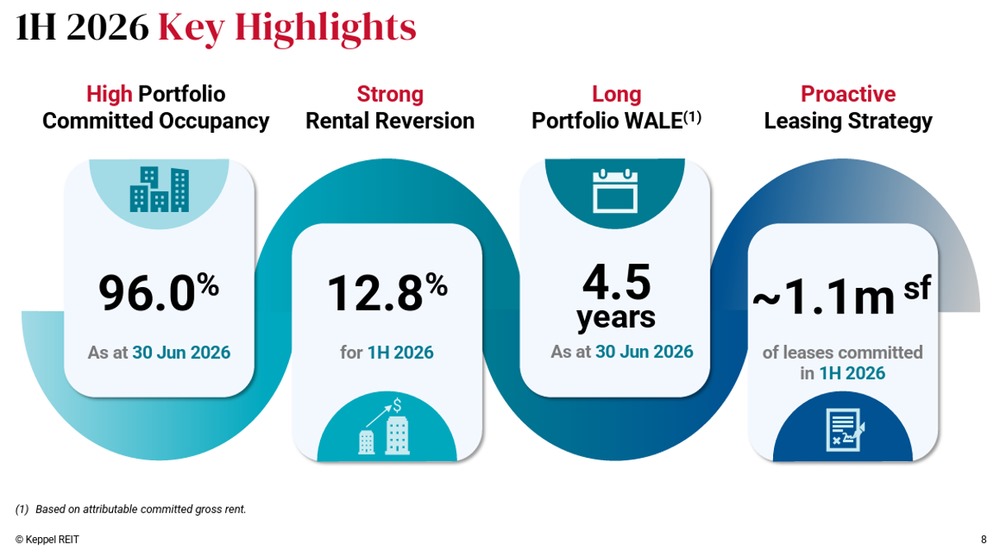
Committed occupancy stood at 96.0%, while rental reversion was positive at 12.8%.
Keppel REIT has since announced further steps to recycle capital.
Following the completion of its KR Ginza II disposal on 17 August, it agreed on 23 September 2026 to divest T Tower in Seoul.
The agreed property value of KRW348.8 billion represents a 7.4% premium to its latest valuation in local currency terms. Completion is expected in the fourth quarter of 2026.
Assuming both disposals and the use of net proceeds for debt repayment, aggregate leverage would decline from 40.0% to 38.0% on a pro forma basis. This calculation excludes unit buybacks.
Separately, management intends to use up to S$25 million of net sale proceeds for unit buybacks after its third-quarter business update, subject to market conditions and applicable requirements.
These actions could strengthen the balance sheet and reduce the number of units outstanding. However, I would also assess the rental income forgone from the disposals before concluding that they will lift DPU.
With divestments potentially reducing debt and anniversary distributions due to end after 1H 2027, I would apply the three checks in our Singapore REIT screening framework to assess how sustainable its income could be.
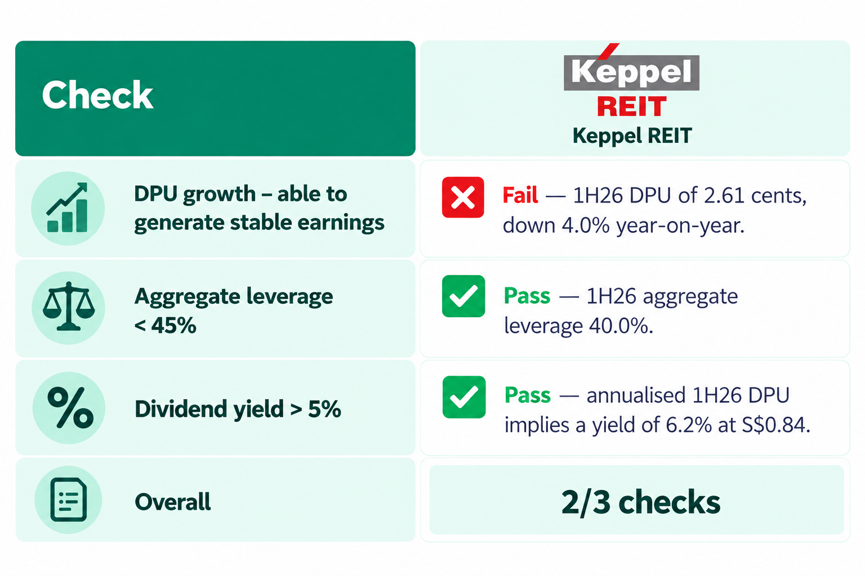
For the first check, Keppel REIT’s 1H2026 DPU fell 4.0% year on year to 2.61 cents. It therefore does not pass the DPU growth check.
This follows a decline in FY2025 DPU to 5.23 cents, from 5.60 cents in FY2024, indicating that distributions have remained under pressure.
Annualising its latest half-year DPU of 2.61 cents gives a payout of 5.22 cents per year. At its unit price of S$0.845 as at 24 September 2026, this translates to an annualised distribution yield of approximately 6.2%.
However, the payout includes a S$10 million half-year anniversary distribution, which will cease after the distribution for the half-year ending 30 June 2027.
Excluding the temporary anniversary distribution, the illustrative annualised yield would be approximately 5.7%.
This estimate applies the proportion of first-half distributable income excluding the anniversary payment to reported DPU, then annualises it at S$0.845. It assumes an unchanged unit base and excludes subsequent disposals, potential buybacks and future operating changes, so it is not a forecast of the payout after June 2027.
The comparison shows why recurring income matters when assessing how much distribution income can be sustained.
For the second check, Keppel REIT passes the gearing check based on its reported 40.0% aggregate leverage, although I would carry out additional checks on its debt profile and refinancing needs.
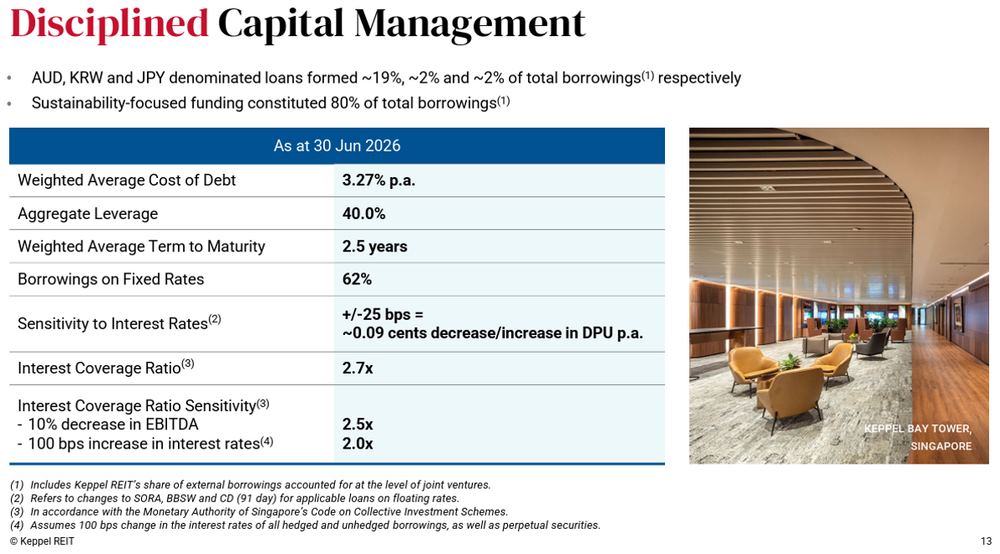
The potential reduction to 38.0% under the disposal assumptions would provide additional financial flexibility, although it remains subject to completion of the disposal and how the proceeds are used.
The third check is whether its dividend yield offers sufficient compensation for the risks. Its annualised distribution yield of approximately 6.2% offers a spread of about 3.9 percentage points over the latest SSB’s 2.32% 10-year average return.
Keppel REIT therefore passes the initial yield check based on its annualised distribution yield, although this includes temporary anniversary distributions. Excluding those payments, the illustrative annualised yield of approximately 5.7% would offer a narrower spread of about 3.4 percentage points.
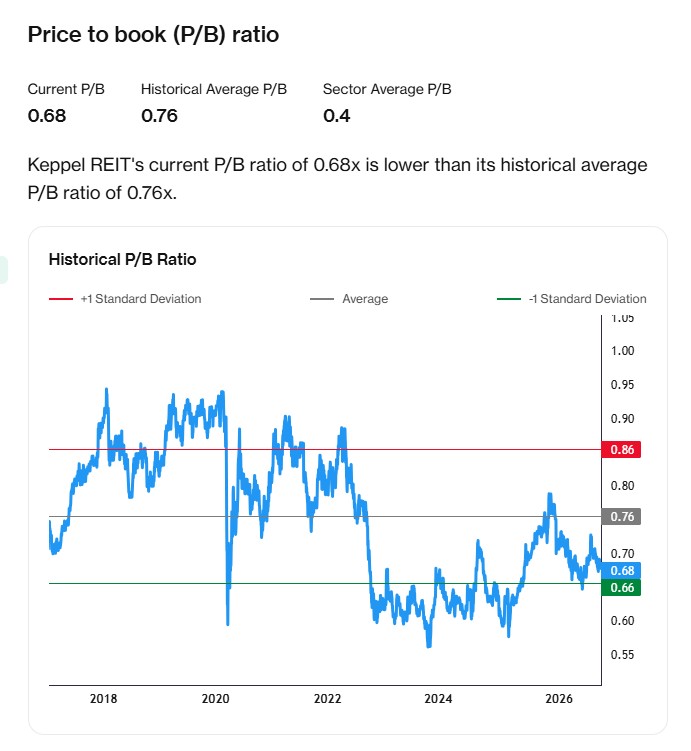
As additional valuation context, Keppel REIT was trading at 0.68 times book value, representing a discount of approximately 32%, the largest among the three REITs.
Overall, Keppel REIT passes two of the three initial checks.
Its asset sales and potential buybacks add to the investment case. For income, I would want to see whether debt savings, a smaller unit base and rental growth can offset the income lost from disposals and the eventual end of anniversary payments.
Find out how much distribution income you would have received as a Keppel REIT unitholder over the past 12 months using the dividend calculator.
Related links:
What would Beansprout do?
The recent Fed rate hike has brought the share prices of these Singapore blue chip REITs to their 52-week low, and lifted their dividend yields to above 6%.
However, I would look beyond headline dividend yield to decide whether to consider these REITs for my Income Pot within Beansprout’s Four Pots of Wealth.
Before adding one to my portfolio, I would want to have confidence that their distributions can remain resilient and that have a strong balance sheet to weather different market conditions. We share more these screening checks in our framework to select the best Singapore REITs here.
This is especially important as interest rates may stay higher for longer.
Against these metrics, CapitaLand Ascendas REIT passes all three initial screening checks. Mapletree Industrial Trust and Keppel REIT meet the yield and gearing checks, but fall short on DPU growth.
| REIT | DPU check | Financial health check | Dividend yield check* |
| CapitaLand Ascendas REIT | Pass: 1H 2026 DPU was up 0.1% year-on-year | Pass: Reported gearing of 39.7% | Pass: Annualised yield of approximately 6.6% |
| Mapletree Industrial Trust | Does not pass: FY2025/26 DPU fell 3.2% year-on-year (excluding divestment gain); latest quarterly DPU remained lower year-on-year | Pass: Reported gearing of 37.5% | Pass: Annualised yield of approximately 6.7% |
| Keppel REIT | Does not pass: 1H2026 DPU fell 4.0% year on year to 2.61 cents | Pass: Reported gearing of 40.0%; potentially 38.0% under the stated disposal assumptions | Pass, with a caveat: Annualised yield of approximately 6.2%, including temporary anniversary distributions |
| *Annualised yields use the latest reported DPU and unit prices as at 24 September 2026. They assume the latest payout is maintained and are not forecasts. | |||
CapitaLand Ascendas REIT’s annualised distribution yield is about 6.6%. Its first-half DPU rose only marginally, so I’d watch whether acquisitions and higher occupancy translate into more DPU after financing costs and the enlarged unit base.
Mapletree Industrial Trust yields about 6.7% and has the lowest gearing of the three, but its underlying DPU fell. I’d look for signs that North American occupancy and DPU are stabilising.
Keppel REIT yields about 6.2% and has the largest discount to book value. I’d assess whether debt savings, rental growth and potential buybacks can offset income lost from disposals and expiring anniversary distributions.
You can find which other REITs that meet these checks in our screener for the Best Singapore REITs.
With a higher interest rate environment, I’d also diversify my income sources with quality Singapore dividend stocks to avoid relying too heavily on one sector.
To find out which stocks and REITs we would hold in our model portfolio, check out how we would invest $100,000 in Singapore today.
For more of our investment views and portfolio thinking, explore Beansprout Pro.
Are there any other Singapore REITs you are watching for income? Share your thoughts in the comments below or join the discussion in our Telegram group.
Follow Beansprout on Youtube, Facebook and Instagram, and add Beansprout as your preferred source on Google so you never miss an update.
Read also
Gain financial insights in minutes
Subscribe to our free weekly newsletter for more insights to grow your wealth
Most Popular

Comments
0 comments