
Worth buying for income? 3 Singapore blue-chip REITs with dividend yield around 6% and near 52-week lows
REITs
By Goh Lay Peng • 28 Jul 2026
Why trust Beansprout? We’ve been awarded Best Investment Website at the SIAS Investors’ Choice Awards 2025
'%3e%3cpath%20fill-rule='evenodd'%20clip-rule='evenodd'%20d='M17.64%209.20455C17.64%208.56637%2017.5827%207.95273%2017.4764%207.36364H9V10.845H13.8436C13.635%2011.97%2013.0009%2012.9232%2012.0477%2013.5614V15.8195H14.9564C16.6582%2014.2527%2017.64%2011.9455%2017.64%209.20455V9.20455Z'%20fill='%234285F4'/%3e%3cpath%20fill-rule='evenodd'%20clip-rule='evenodd'%20d='M9%2018C11.43%2018%2013.4673%2017.1941%2014.9564%2015.8195L12.0477%2013.5614C11.2418%2014.1014%2010.2109%2014.4205%209%2014.4205C6.65591%2014.4205%204.67182%2012.8373%203.96409%2010.71H0.957275V13.0418C2.43818%2015.9832%205.48182%2018%209%2018V18Z'%20fill='%2334A853'/%3e%3cpath%20fill-rule='evenodd'%20clip-rule='evenodd'%20d='M3.96409%2010.71C3.78409%2010.17%203.68182%209.59318%203.68182%209C3.68182%208.40682%203.78409%207.83%203.96409%207.29V4.95818H0.957273C0.347727%206.17318%200%207.54773%200%209C0%2010.4523%200.347727%2011.8268%200.957273%2013.0418L3.96409%2010.71V10.71Z'%20fill='%23FBBC05'/%3e%3cpath%20fill-rule='evenodd'%20clip-rule='evenodd'%20d='M9%203.57955C10.3214%203.57955%2011.5077%204.03364%2012.4405%204.92545L15.0218%202.34409C13.4632%200.891818%2011.4259%200%209%200C5.48182%200%202.43818%202.01682%200.957275%204.95818L3.96409%207.29C4.67182%205.16273%206.65591%203.57955%209%203.57955V3.57955Z'%20fill='%23EA4335'/%3e%3c/g%3e%3cdefs%3e%3cclipPath%20id='clip0_0_2849'%3e%3crect%20width='18'%20height='18'%20fill='white'/%3e%3c/clipPath%3e%3c/defs%3e%3c/svg%3e)
Make Beansprout your preferred source on Google
Add us on Google to see more of our insights in your search results
We look at three Singapore blue-chip REITs near their 52-week lows and assess whether their dividend yields of around 6% are sustainable.

What happened?
Singapore stocks have rallied strongly.
While the STI has climbed above 5,500, led by the banks, several blue chip REITs remain near their 52-week lows as higher bond yields and expectations of elevated interest rates continue to weigh on the sector.
I recently looked at 3 blue chip REITs yielding above 5% and how asset sales may impact 4 Singapore REIT dividends.
With several blue-chip REITs still trading near their 52-week lows, many in the Beansprout community are wondering whether their higher dividend yields are sustainable for building passive income.
In this article, I look at 3 Singapore blue chip REITs and assess their distribution per unit (DPU) trends, financial health and whether their dividend yields of around 6% can be sustained.
3 Singapore blue-chip REITs with dividend yield around 6% and near 52-week lows
#1 – CapitaLand Ascendas REIT (SGX: A17U)
CapitaLand Ascendas REIT, or CLAR, owns a diversified portfolio of business spaces, industrial properties, logistics facilities and data centres.
Its portfolio is anchored in Singapore, with additional properties in Australia, the United States, the United Kingdom and Europe.
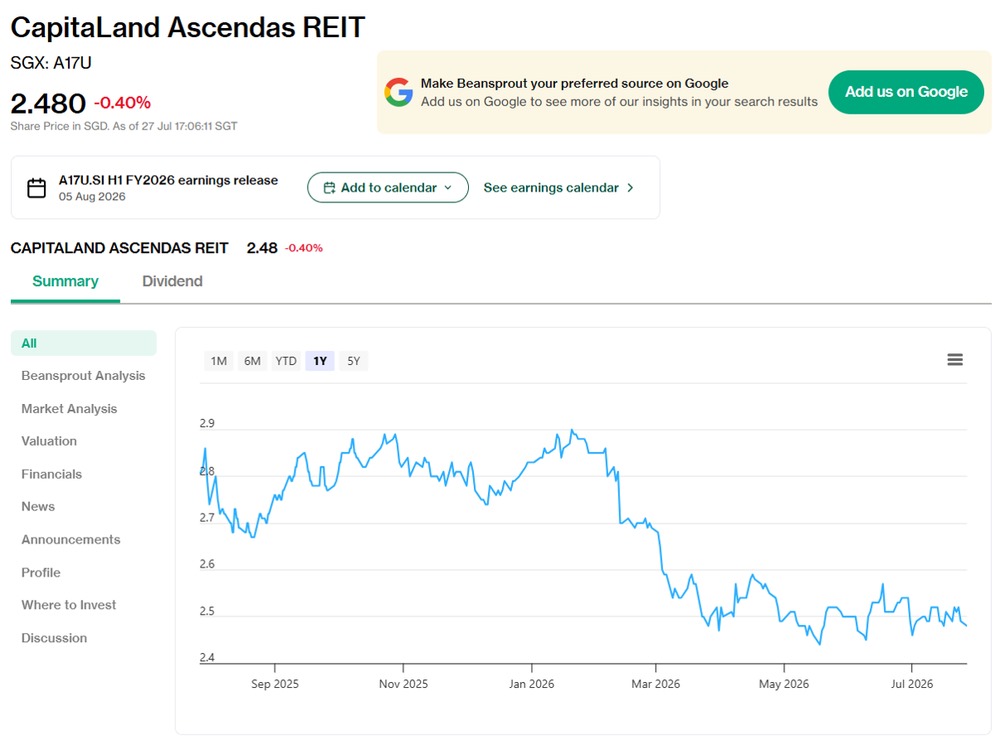
CapitaLand Ascendas REIT was trading at about S$2.48 on 27 July 2026, around 2.5% above its 52-week low of S$2.42.
CapitaLand Ascendas REIT continued to expand its portfolio despite weaker sentiment towards the REIT sector.
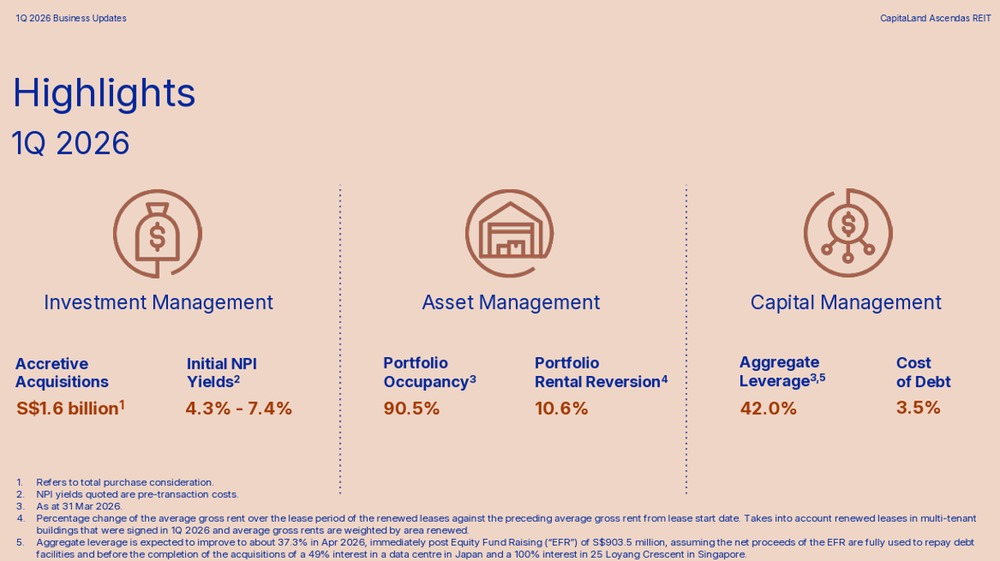
During 1Q 2026, CapitaLand Ascendas REIT completed or announced five acquisitions with a total purchase consideration of about S$1.6 billion.
These included logistics properties in the US and Spain, a 50% interest in Ascent at Singapore Science Park, a 49% interest in a data centre in Japan and 25 Loyang Crescent in Singapore.
The acquisitions had expected initial net property income yields ranging from 4.3% to 7.4% before transaction costs.
CapitaLand Ascendas REIT’s operating indicators were more mixed.
Portfolio occupancy declined slightly to 90.5% as at 31 March 2026, from 90.9% at the end of December 2025.
However, rental reversion remained healthy at 10.6% for leases renewed in multi-tenant buildings during the quarter. The manager expects rental reversion to moderate to the mid-single-digit range for FY2026.
Under the first check in our Singapore REIT screening framework, I would look at whether the latest full-year DPU was stable or growing.
CapitaLand Ascendas REIT reported DPU of 15.005 cents for FY2025, down by 1.3% from 15.205 cents in FY2024.
This was despite distributable income increasing by 1.4%, as the higher income was spread across an enlarged unit base following its equity fundraising.
I would therefore consider CapitaLand Ascendas REIT borderline on the DPU check rather than a clear pass.
Its DPU was broadly stable, but I would watch whether its acquisitions and ongoing development projects can generate enough additional income to offset the larger number of units.
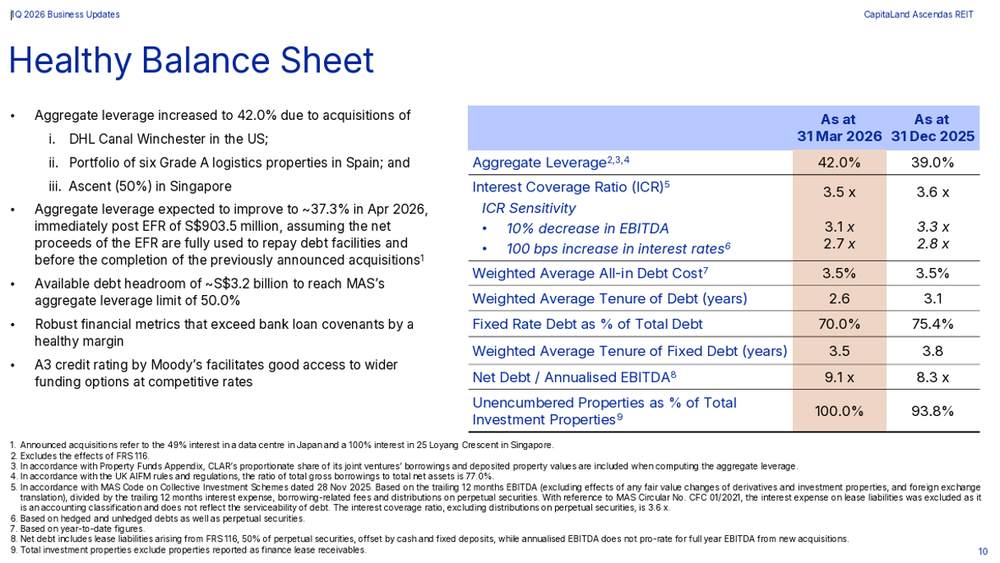
For the second check, CapitaLand Ascendas REIT’s aggregate leverage stood at 42.0% as at 31 March 2026, up from 39.0% at the end of 2025.
This was mainly due to the acquisitions completed during the quarter.
However, the manager expected aggregate leverage to improve to about 37.3% immediately after its S$903.5 million equity fundraising, assuming that the net proceeds were used to repay debt and before completing the two previously announced acquisitions.
CapitaLand Ascendas REIT’s weighted average all-in cost of debt stood at 3.5%, while 70% of its debt was on fixed rates. Its interest coverage ratio stood at 3.5 times.
CLAR therefore passes the gearing check, although a reported leverage ratio above 40% means I would continue monitoring its debt after the acquisitions are completed.
The final check is whether the dividend yield offers a sufficient premium over lower-risk alternatives.
As a guide, I would look for a quality REIT to offer a yield spread of about three percentage points or more above alternatives such as Singapore Savings Bonds, T-bills and fixed deposits.
CapitaLand Ascendas REIT’s forward dividend yield of 6.2% represents a spread of about 4.1 percentage points over a Singapore Savings Bond yield of around 2.1%.
CapitaLand Ascendas REIT therefore passes the yield check.
Overall, CapitaLand Ascendas REIT comes closest among the three REITs to passing all the initial checks.
Its portfolio is diversified and its rental reversions remain positive. However, I would continue monitoring occupancy and whether its recent investments support DPU after accounting for the enlarged unit base.
Find out how much dividends you would have received as a CapitaLand Ascendas REIT unitholder in the past 12 months with the dividend calculator below.
Related links:
- CapitaLand Ascendas REIT latest valuation, share price and analysis
- CapitaLand Ascendas REIT dividend history and forecast
#2 – Mapletree Industrial Trust (SGX: ME8U)
Mapletree Industrial Trust, or MIT, owns industrial properties and data centres across Singapore, North America and Japan.
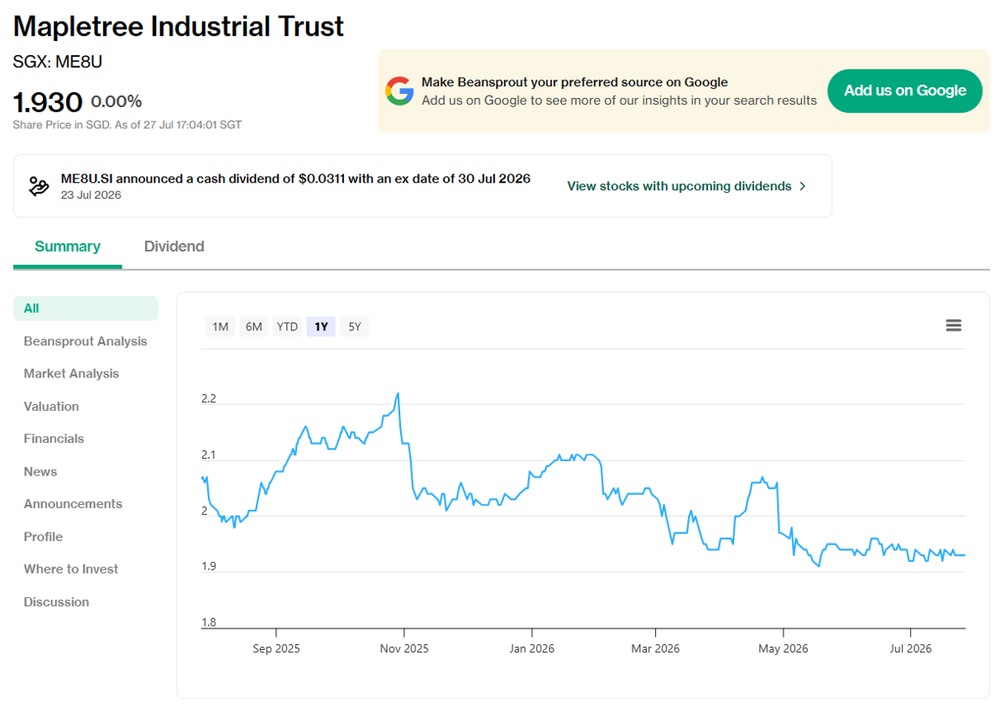
Mapletree Industrial Trust was trading at S$1.93 on 27 July 2026, about 1.6% above its 52-week low of S$1.90.
Its forward dividend yield stood at 6.7%, the highest among the three REITs.
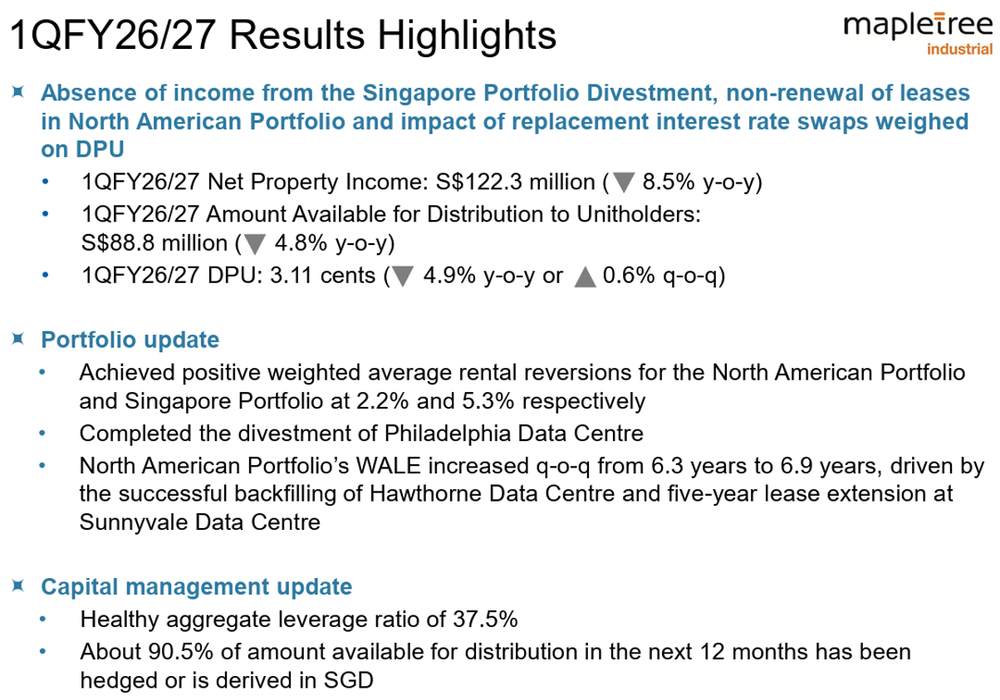
For 1Q FY26/27, Mapletree Industrial Trust’s gross revenue declined by 7.7% year-on-year to S$162.3 million, while net property income fell by 8.5% year-on-year to S$122.3 million.
DPU declined by 4.9% year-on-year to 3.11 cents. However, DPU increased by 0.6% compared with the preceding quarter, while net property income rose by 2.0% quarter-on-quarter.
The year-on-year decline was mainly due to the absence of contributions from three Singapore properties divested in August 2025, lease non-renewals in North America and the weaker US dollar.
These were partly offset by contributions from new and renewed Singapore leases and Mapletree Industrial Trust’s Japan portfolio.
Borrowing costs also declined by 24.6% year-on-year, helped by debt repayments and lower interest on unhedged floating-rate loans.
Mapletree Industrial Trust’s overall portfolio occupancy declined to 90.7% as at 30 June 2026, from 91.2% in the preceding quarter.
Singapore portfolio occupancy improved from 93.4% in 4Q FY25/26 to 94.3% in 1Q FY 26/27, while its two properties in Japan remained fully occupied.
However, North American occupancy fell from 86.1% in 4Q FY25/26 to 82.5% in 1Q FY 26/27, reflecting the continuing impact of lease non-renewals.
Mapletree Industrial Trust achieved positive rental reversions of 5.3% in Singapore and 2.2% in North America. Its overall weighted average lease expiry also increased slightly from 4.4 years as at 31 March 2026 to 4.5 years as at 30 June 2026.
For the first check, MIT’s full-year DPU declined by 6.3% to 12.71 cents in FY25/26, from 13.57 cents in FY24/25.
Its latest quarterly DPU was also 4.9% lower year-on-year.
Mapletree Industrial Trust therefore does not pass the DPU growth check.
The quarter-on-quarter improvement is encouraging, but I would want to see this sustained before concluding that its distributions have stabilised.
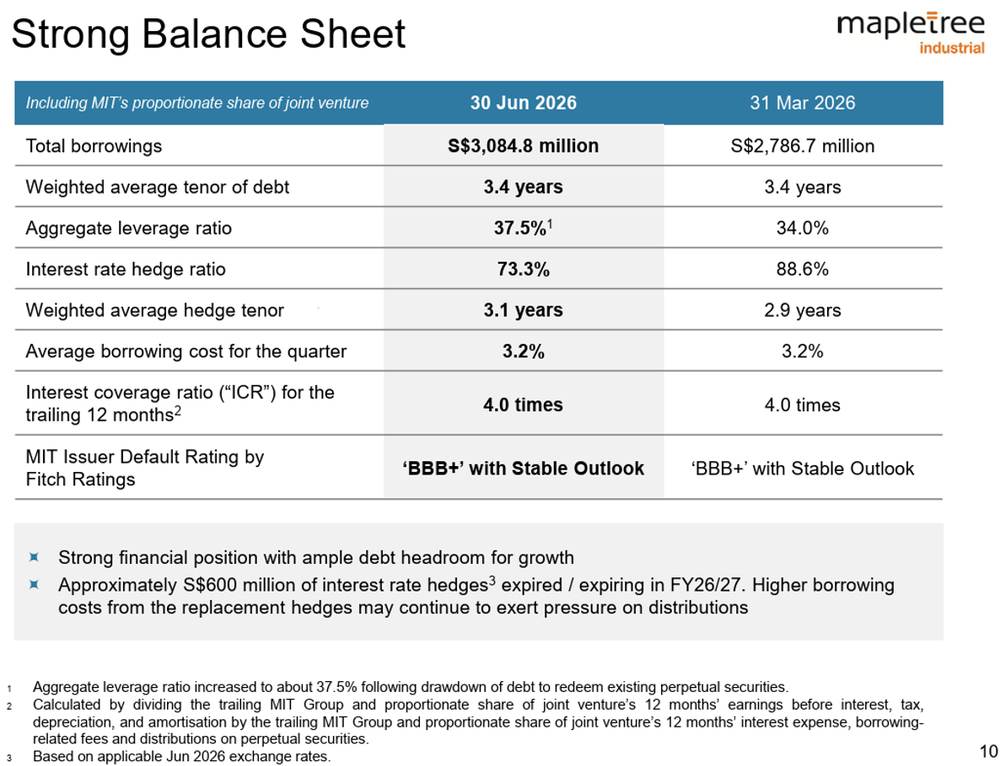
Mapletree Industrial Trust’s aggregate leverage stood at 37.5% as at 30 June 2026, up from 34.0% at the end of March.
The increase followed the drawdown of debt to redeem its existing perpetual securities.
Its average borrowing cost remained at 3.2%, while 73.3% of its debt was hedged or on fixed rates. Its interest coverage ratio stood at 4.0 times.
Mapletree Industrial Trust therefore passes the gearing check, with leverage remaining below 40%.
However, approximately S$600 million of interest-rate hedges expired or will expire in FY26/27. Replacing hedges that were previously secured at lower rates may continue to weigh on distributions.
Mapletree Industrial Trust’s forward dividend yield of 6.7% represents a spread of about 4.6 percentage points over a Singapore Savings Bond yield of around 2.1%.
Mapletree Industrial Trust therefore passes the yield check.
However, the higher yield also reflects the pressure on its North American portfolio and the decline in DPU.
Mapletree Industrial Trust offers exposure to industrial properties and data centres, supported by a gearing ratio below 40%. I would nevertheless watch for clearer signs that North American occupancy and DPU are stabilising.
Find out how much dividends you would have received as an Mapletree Industrial Trust unitholder in the past 12 months with the dividend calculator below.
Related links:
- Mapletree Industrial Trust latest valuation, share price and analysis
- Mapletree Industrial Trust dividend history and forecast
#3 – Mapletree Logistics Trust (SGX: M44U)
Mapletree Logistics Trust, or MLT, owns logistics properties across nine markets in Asia Pacific, including Singapore, China, Hong Kong, Japan and Australia.
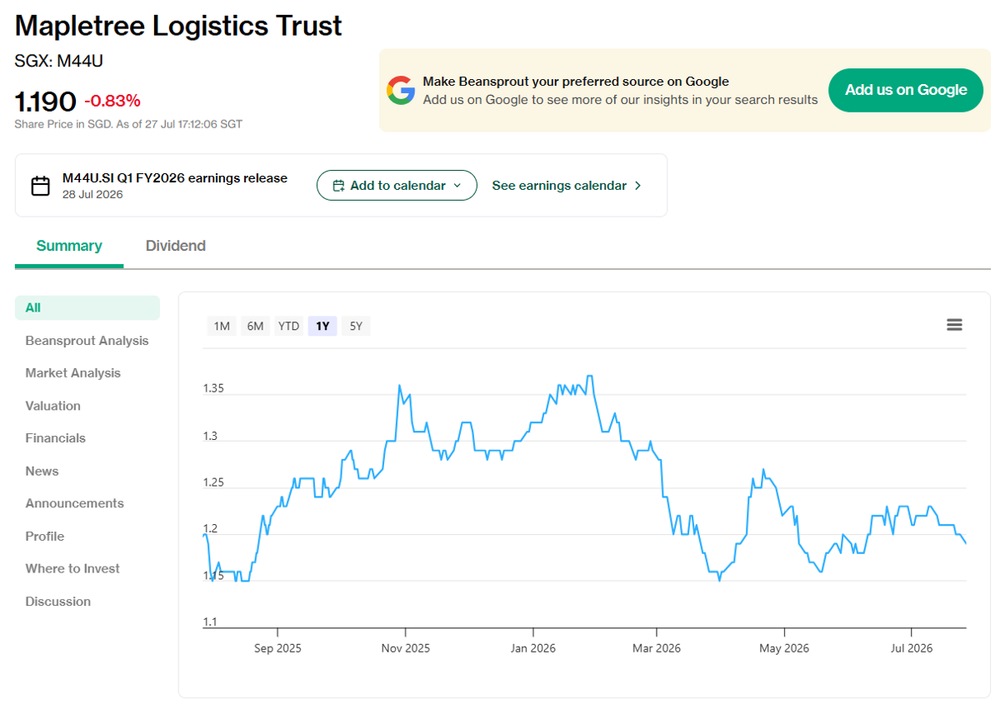
Mapletree Logistics Trust was trading at about S$1.19 on 27 July 2026, around 4.4% above its 52-week low of S$1.14.
Its forward dividend yield stood at approximately 5.9%, while its trailing 12-month dividend yield was about 6.1%.
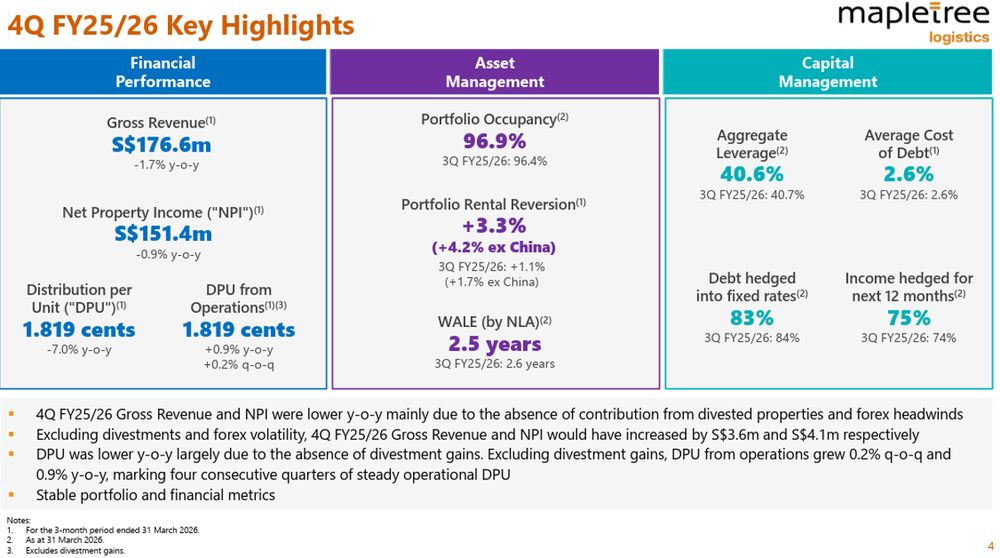
In 4Q FY25/26, gross revenue declined by 1.7% year-on-year to S$176.6 million, while net property income fell by 0.9% to S$151.4 million.
Quarterly DPU declined by 7.0% to 1.819 cents, largely because Mapletree Logistics Trust did not distribute the divestment gains included in the previous year.
Excluding divestment gains, DPU from operations increased by 0.9% year-on-year and 0.2% quarter-on-quarter. According to the manager, this marked four consecutive quarters of steady operational DPU.
Mapletree Logistics Trust’s portfolio occupancy improved to 96.9% as at 31 March 2026, from 96.4% in the preceding quarter.
Portfolio rental reversion also improved to 3.3%, or 4.2% excluding China, compared with 1.1% in the previous quarter.
For the full FY25/26 financial year, gross revenue declined by 2.6% to S$708.3 million, while net property income fell by 2.4% to S$610.2 million.
Full-year DPU declined by 9.8% to 7.262 cents, from 8.053 cents in FY24/25.
Excluding the divestment gains paid in the previous year, adjusted DPU would have declined by a smaller 3.4%.
Mapletree Logistics Trust therefore does not pass the DPU growth check.
Its improving occupancy, rental reversions and operational DPU are positive indicators. However, I would want to see these improvements translate into stable full-year distributions.
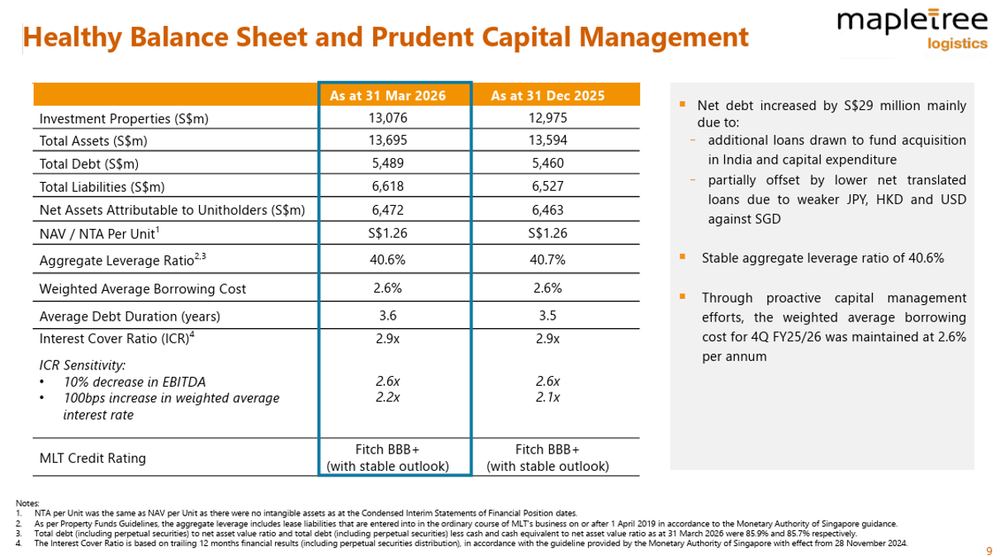
Mapletree Logistics Trust’s aggregate leverage stood at 40.6% as at 31 March 2026, broadly unchanged from 40.7% at the end of December 2025.
Its average borrowing cost remained at 2.6%, while 83% of its debt was hedged into fixed rates. Its interest coverage ratio stood at 2.9 times.
Mapletree Logistics Trust therefore passes the gearing check, although its leverage falls within the 40% to 45% range where I would carry out additional checks.
I would continue monitoring its interest coverage, refinancing needs and how proceeds from property disposals are used.
Since the results were released, MLT has continued to recycle capital.
In July 2026, it proposed selling two logistics properties in China for agreed property values totalling RMB724 million and a Singapore property at 39 Changi South Avenue 2 for about S$16.6 million.
The Changi South sale price was about 20% above its latest valuation. The manager said the proceeds would provide greater financial flexibility to pursue investment opportunities and improve portfolio quality.
These transactions may help Mapletree Logistics Trust strengthen its balance sheet or reinvest in newer assets. However, I would also assess whether the divestments reduce recurring rental income before the proceeds are redeployed.
Mapletree Logistics Trust’s forward dividend yield of 5.9% represents a spread of about 3.8 percentage points over a Singapore Savings Bond yield of around 2.1%.
Mapletree Logistics Trust therefore passes the yield check, although its spread is the narrowest among the three REITs.
Mapletree Logistics Trust’s high occupancy and improving rental reversions provide some support to its income. However, I would watch whether its operating performance and capital recycling programme can help stabilise DPU.
Find out how much dividends you would have received as an Mapletree Logistics Trust unitholder in the past 12 months with the dividend calculator below.
Related links:
- Mapletree Logistics Trust latest valuation, share price and analysis
- Mapletree Logistics Trust dividend history and forecast
What would Beansprout do?
These blue-chip REITs may deserve further research for an income portfolio, but I would not invest in them simply because they are close to their 52-week lows.
All three offer dividend yields with a meaningful spread over lower-risk alternatives and have aggregate leverage below 45%.
However, none recorded DPU growth in its latest full financial year, which means the higher yields should not automatically be assumed to be sustainable.
| REIT | DPU check | Financial health check | Dividend yield check |
| CapitaLand Ascendas REIT | Borderline: FY2025 DPU fell by 1.3% | Pass with more checks: Leverage was 42.0% before the latest equity fundraising proceeds were applied | Pass: Forward yield of about 6.2% |
| Mapletree Industrial Trust | Does not pass: FY25/26 DPU fell by 6.3% | Pass: Leverage stood at 37.5% | Pass: Forward yield of about 6.7% |
| Mapletree Logistics Trust | Does not pass: FY25/26 DPU fell by 9.8%, or 3.4% excluding previous divestment gains | Pass with more checks: Leverage stood at 40.6% | Pass: Forward yield of about 5.9% |
Among the three, CapitaLand Ascendas REIT’s yield appears relatively more sustainable based on the current indicators.
CapitaLand Ascendas REIT's DPU was broadly stable, while its diversified portfolio, positive rental reversions and recent acquisitions may provide potential income drivers. Its pro forma leverage is also expected to improve following its equity fundraising. However, I would continue monitoring whether occupancy improves and whether its new properties generate enough additional income to offset the enlarged unit base.
Mapletree Industrial Trust offers the highest forward dividend yield and has the lowest gearing among the three.
Mapletree Industrial Trust's latest quarterly DPU also improved slightly from the preceding quarter. However, DPU was still lower year on year, while weaker occupancy in its North American portfolio and the repricing of interest-rate hedges may continue to weigh on distributions. I would therefore want to see clearer signs that North American occupancy and DPU have stabilised before concluding that its current yield can be sustained.
Mapletree Logistics Trust has the strongest portfolio occupancy, while its rental reversions and operational DPU improved in its latest reported quarter.
However, Mapletree Logistics Trust also has the highest gearing among the three and recorded the largest decline in full-year DPU. Mapletree Logistics Trust forward yield is also lower than its trailing 12-month yield, suggesting that past distributions may not be maintained at the same level. I would watch whether improving rental reversions, capital recycling and a stabilisation in China can support its distributions. Its upcoming 1Q FY26/27 results should provide a more current indication of whether the improvement in underlying operations has continued.
Overall, CLAR’s yield currently appears to have the strongest support among the three, while MIT and MLT need clearer evidence that their DPUs are stabilising.
This does not mean that CLAR’s distribution is guaranteed, or that MIT and MLT will necessarily reduce their distributions. Rather, the latest figures suggest that the sustainability of their yields differs despite all three offering yields of around 6%.
I would not select a blue-chip REIT based on yield alone. For a REIT to form part of my Income Pot within the Beansprout's four pots of wealth, I would want to see resilient occupancy, positive rental reversions, manageable leverage and a DPU trend that can be sustained through different parts of the economic cycle.
To find out which REIT we would hold, in our model portfolio, check out how we would invest $100,000 in Singapore today.
You can learn more about how I check the three simple checks I use to screen Singapore REITs for passive income here.
To screen for Singapore REITs with lowest price-to-book valuation or highest dividend yield, check out our best Singapore REIT screener.
We still see Singapore stocks as a core part of a globally diversified portfolio, especially for investors looking for dividend income.
However, rather than relying too heavily on REITs alone, I would build a broader mix of income sources, including quality Singapore blue-chip stocks with sustainable dividends, resilient earnings and strong balance sheets. Learn more about how to build passive income streams with our income pot here.
Which Singapore blue chip REIT are you looking out for? Share with us in the comments below or in our Telegram group!
If you are new to investing in Singapore REITs, you can start to learn more about Singapore REITs here.
If you prefer diversification without picking individual REITs, you can also gain exposure through Singapore REIT ETFs.
Planning to invest in Singapore blue chip REITs? Compare the best Singapore brokers to find the right trading platform, and see the latest promotions and sign-up rewards available.
Follow Beansprout on YouTube, Facebook and Instagram, and add Beansprout as your preferred source on Google so you never miss an update.
Read also
Gain financial insights in minutes
Subscribe to our free weekly newsletter for more insights to grow your wealth
Most Popular

Comments
1 comments
- Susila Devi • 03 Aug 2026 01:44 PM