
3 Singapore blue chip REITs yielding above 5% compared for dividend income
REITs
By Goh Lay Peng • 24 Jul 2026
Why trust Beansprout? We’ve been awarded Best Investment Website at the SIAS Investors’ Choice Awards 2025
'%3e%3cpath%20fill-rule='evenodd'%20clip-rule='evenodd'%20d='M17.64%209.20455C17.64%208.56637%2017.5827%207.95273%2017.4764%207.36364H9V10.845H13.8436C13.635%2011.97%2013.0009%2012.9232%2012.0477%2013.5614V15.8195H14.9564C16.6582%2014.2527%2017.64%2011.9455%2017.64%209.20455V9.20455Z'%20fill='%234285F4'/%3e%3cpath%20fill-rule='evenodd'%20clip-rule='evenodd'%20d='M9%2018C11.43%2018%2013.4673%2017.1941%2014.9564%2015.8195L12.0477%2013.5614C11.2418%2014.1014%2010.2109%2014.4205%209%2014.4205C6.65591%2014.4205%204.67182%2012.8373%203.96409%2010.71H0.957275V13.0418C2.43818%2015.9832%205.48182%2018%209%2018V18Z'%20fill='%2334A853'/%3e%3cpath%20fill-rule='evenodd'%20clip-rule='evenodd'%20d='M3.96409%2010.71C3.78409%2010.17%203.68182%209.59318%203.68182%209C3.68182%208.40682%203.78409%207.83%203.96409%207.29V4.95818H0.957273C0.347727%206.17318%200%207.54773%200%209C0%2010.4523%200.347727%2011.8268%200.957273%2013.0418L3.96409%2010.71V10.71Z'%20fill='%23FBBC05'/%3e%3cpath%20fill-rule='evenodd'%20clip-rule='evenodd'%20d='M9%203.57955C10.3214%203.57955%2011.5077%204.03364%2012.4405%204.92545L15.0218%202.34409C13.4632%200.891818%2011.4259%200%209%200C5.48182%200%202.43818%202.01682%200.957275%204.95818L3.96409%207.29C4.67182%205.16273%206.65591%203.57955%209%203.57955V3.57955Z'%20fill='%23EA4335'/%3e%3c/g%3e%3cdefs%3e%3cclipPath%20id='clip0_0_2849'%3e%3crect%20width='18'%20height='18'%20fill='white'/%3e%3c/clipPath%3e%3c/defs%3e%3c/svg%3e)
Make Beansprout your preferred source on Google
Add us on Google to see more of our insights in your search results
We compare three Singapore blue chip REITs with dividend yields above 5%, assessing DPU trends, financial health and payout sustainability.
What happened?
I have been getting a few questions on Singapore blue chip REITs recently.
After we shared about the top-performing Singapore blue-chip REITs in the first half of 2026, some members of the Beansprout community asked if there are REITs that still offer a decent dividend yield.
After all, many investors rely on these Singapore blue chip REITs to generate passive income in Singapore.
This comes as we have seen a jump in the Singapore T-bill yield as inflation expectations stay elevated.
In this article, I compare three Singapore blue-chip REITs and assess whether their dividend yields are sustainable.
3 Singapore blue chip REITs with dividend yields above 5%
#1 - CapitaLand Integrated Commercial Trust (SGX: C38U)
CapitaLand Integrated Commercial Trust, or CICT, is the largest and most diversified REIT listed in Singapore.
As at 31 December 2025, CICT's portfolio comprised 26 properties across Singapore, Germany and Australia, with a total value of about S$27.4 billion.
Its portfolio is also strongly tilted towards Singapore, which made up 95% of gross revenue. Australia accounted for 3% and Germany accounted for 2%.
For FY2025, CICT's DPU rose 6.4% year-on-year to 11.58 Singapore cents.
Distributable income grew 14.4% year-on-year to S$860.9 million, helped by the step-up acquisition to full ownership of CapitaSpring and the handover of Gallileo Phase 1 (office tower) to major tenant.
In 2025, CICT completed the acquisition of the remaining 55% interest in CapitaSpring for S$1.045 billion.
Portfolio committed occupancy was a robust 96.9%, led by retail at 98.7%. Portfolio WALE was 3.0 years, in-line with industry level.
The latest 1Q 2026 update showed the retail portfolio reported positive rent reversion of 4.4%, following 6.6% positive rent reversion in FY2025.
Aggregate leverage improved marginally to 38.5%. More importantly, the cost of debt declined 0.3 ppt to 2.9% in 1Q26. Interest coverage ratio remains healthy at 3.8x. CICT remains rated A3/A- by Moody’s/S&P.
This growth trend has continued into FY2026. For 1Q FY2026, gross revenue rose 8.0% year-on-year to S$426.7 million, with net property income up 7.9% year-on-year to S$314.4 million, driven by the full contribution from CapitaSpring.
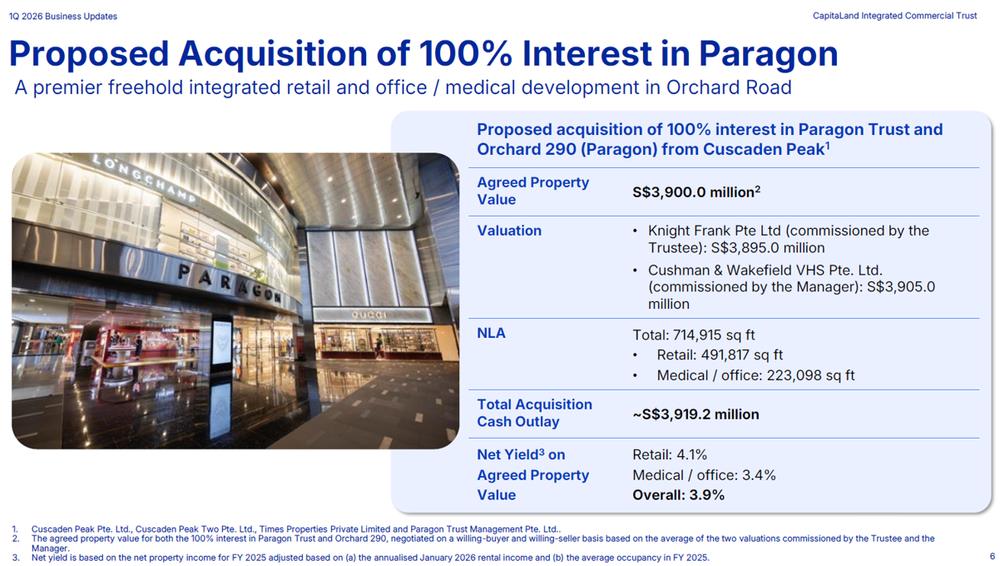
In April 2026, CICT further strengthened its foothold in Singapore’s retail landscape with the acquisition of Paragon. CICT announced the acquisition of freehold interest in Paragon for S$3.9 billion while simultaneously divesting Asia Square Tower 2 for S$2.476 billion.
As an initial assessment, I evaluated CICT using our three simple checks for screening Singapore REITs for passive income.
CICT passes all three checks, which suggests that it may warrant further consideration for the Income Pot.
| Check | CapitaLand Integrated Commercial Trust |
| DPU growth | ✅ Pass — able to generate stable earnings |
| Aggregate leverage | ✅ Pass — 38.5% as of 31 March 2026 |
| Dividend yield | ✅ Pass — FY2026E distribution yield 5.1% |
| Overall | 3/3 checks |
| Source : Beansprout | |
In FY2025, CICT reported DPU at 11.58 Singapore cents, an increase of 6.4% year-on-year. We expect the trend to continue in 2026, underpinned by mid-single-digit rental reversions and stable occupancy trends.
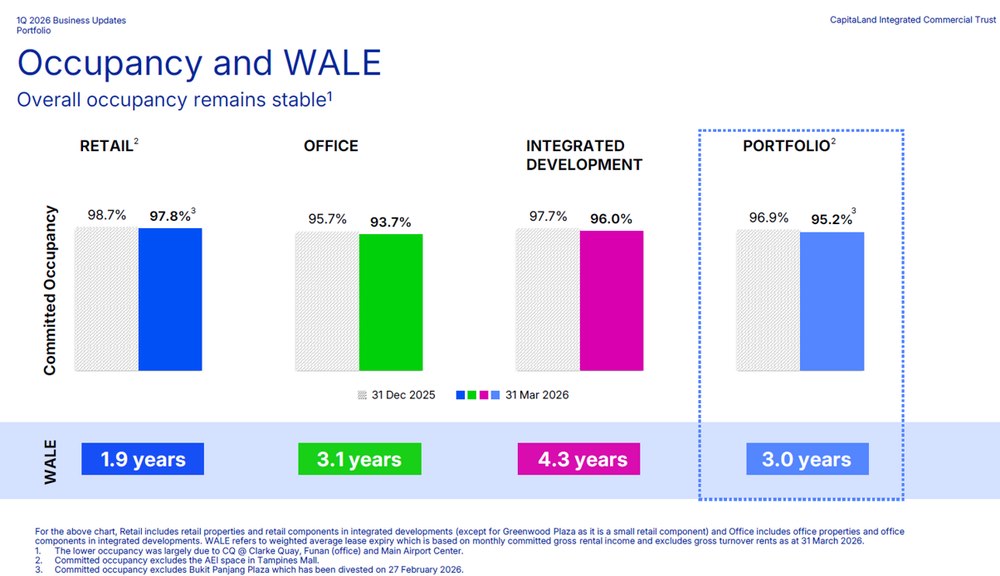
Furthermore, CICT has locked in the electricity costs for the rest of FY26 and FY27. CICT is fundamentally capable of providing a stable passive income to investors.
CICT reported aggregate leverage of 38.5% as of 31 March 2026 which passes one of our financial health check metric. CICT has a healthy buffer and financial flexibility in an environment of rising interest rates.
Based on Factset estimates, CICT’s FY2026E distribution per unit is estimated at S$0.125. At the closing price of S$2.45 on 16 July 2026, CICT is offering a forward distribution yield of FY2026E 5.1%.
Although this is near the lower end of the range, CICT's DPU growth and occupancy trends are the most consistent among the three. The market is pricing CICT at a premium for its scale, diversification and track record of steady distribution growth.
For CICT, I would watch whether it can continue to deliver positive rental reversions and make accretive acquisitions without stretching its balance sheet.
Find out how much dividends you would have received as a shareholder of CICT in the past 12 months with the calculator below.
Related links:
- Capitaland Integrated Commercial Trust latest valuation, share price and analysis
- Capitaland Integrated Commercial Trust dividend history and forecast
#2 - Mapletree Pan Asia Commercial Trust (SGX: N2IU)
Mapletree Pan Asia Commercial Trust, or MPACT, owns a diversified portfolio of retail, office and business park properties across five gateway markets in Asia - Singapore, China, Hong Kong, Japan and South Korea.
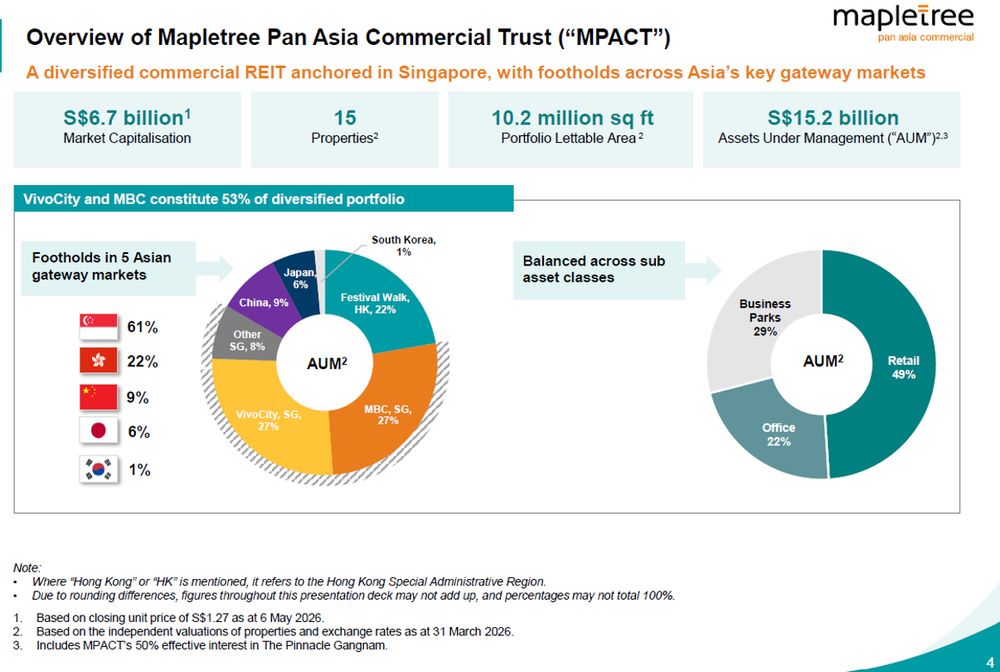
As at 31 March 2026, MPACT had 15 properties, with assets under management of S$15.2 billion.
Retail properties made up 49% of its AUM which is now its largest portfolio segment.
Singapore remains its anchor market, contributing about 61% of assets under management and around 65% of net property income, led by its flagship mall VivoCity.
MPACT has been reshaping its portfolio through asset disposals.
In FY25/26, MPACT divested three non-core properties totalling S$406.8 million. Post-divestments, MPACT has sharpened its focus on Singapore to reinforce its long-term portfolio stability.
VivoCity continued to be the standout performer, achieving portfolio rental reversion of about 14.1% for the year, with occupancy at or near full.
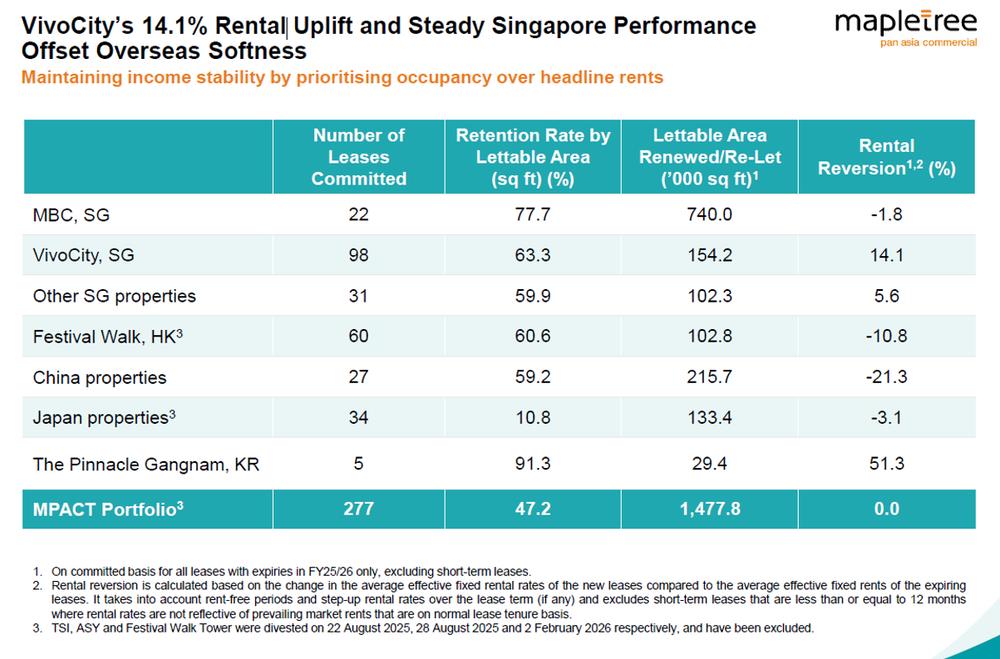
However, the strong performance in Singapore was partly offset by weaker contributions from some of MPACT’s overseas properties, particularly in China and Hong Kong.
MPACT executed about 1.48 million sq ft of leases in FY25/26, or 14.5% of its portfolio lettable area. Renewals and re-let achieved a flattish rental reversion.
For FY2025/26 (ended 31 March 2026), MPACT's gross revenue fell 4.6% year-on-year to S$867.3 million, while net property income declined 4.3% year-on-year to S$654.4 million.
The decline was due to the absence of income from divested properties in Japan, rather than weakness in its core Singapore assets.
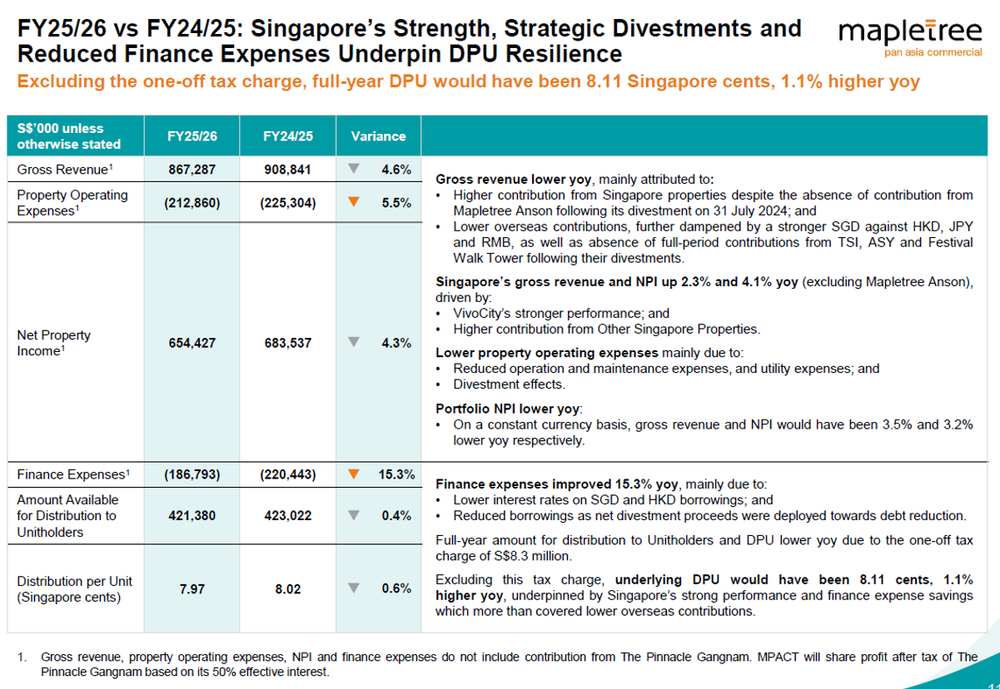
This shows that MPACT's flagship Singapore asset can still command strong pricing power even as some of its overseas properties, particularly in China and Hong Kong, continue to face negative rental reversions and softer occupancy.
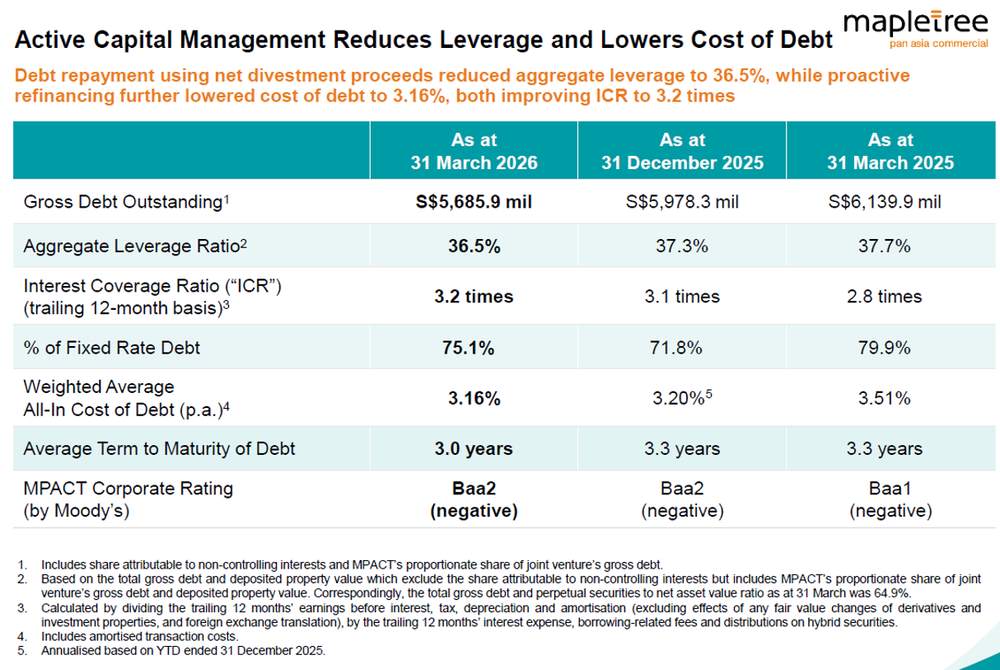
On the balance sheet, MPACT's finance costs fell 15.3% year-on-year on the back of debt repayment and refinancing. Aggregate leverage improved to 36.5%, with interest coverage at 3.2 times.
Following these strategic divestments, the key question is whether MPACT can continue to generate stable income and distributions.
As a first step, I assessed MPACT against our three basic checks for income-generating REITs.
MPACT passes on all the 3 initial checks as well, suggesting that it may warrant further research and consideration.
| Check | Mapletree Pan Asia Commercial Trust |
| DPU growth | ✅ Pass — FY2025 underlying DPU +1.1% year-on-year |
| Aggregate leverage | ✅ Pass — 36.5% as of 31 March 2026 |
| Dividend yield | ✅ Pass — FY2026E distribution yield 6.0% |
| Overall | 3/3 checks |
| Source : Beansprout | |
For FY2025/26, MPACT reported DPU of 7.97 Singapore cents. Excluding a one-off tax charge, underlying DPU rose 1.1% year-on-year to 8.11 Singapore cents.
We expect MPACT to maintain a stable DPU, driven by the Singapore portfolio. MPACT has also locked in the electricity rates through October 2027. MPACT will not be affected by the rising energy prices.
MPACT passes our fundamental strength check based on its stable underlying DPU and the continued resilience of its Singapore portfolio.
It also passes our financial health check following the reduction in leverage and financing costs.
MPACT’s aggregate leverage declined to 36.5% as at 31 March 2026, while its average cost of debt fell to 3.16% from 3.51% a year earlier.
This reflects the impact of debt repayment, refinancing and active capital management.
Based on Factset estimates, MPACT’s FY2026E distribution per unit is estimated at S$0.08. At the closing price of S$1.33 as of 16 July 2026, MPACT is offering a forward distribution yield of FY2026E 6.0%.
This has also passed our check on the attractive spread over the risk-free benchmark rates. Compared with the current 10-year Singapore Government benchmark rate of 2.22%, the spread at 3.78%.
For MPACT, I would watch whether the REIT can stabilise or turn around its China and Hong Kong properties, and whether continued capital recycling can support DPU growth even as overseas headwinds persist.
Find out how much dividends you would have received as a shareholder of Mapletree Industrial Trust in the past 12 months with the calculator below.
Related links:
- Mapletree Pan Asia Commercial Trust latest valuation, share price and analysis
- Mapletree Pan Asia Commercial Trust dividend history and forecast
#3- Frasers Centrepoint Trust (SGX: J69U)
Frasers Centrepoint Trust, or FCT, is Singapore's largest owner of suburban retail malls, with a portfolio of nine retail malls and one office property (Central Plaza) valued at about S$8.4 billion as at 31 March 2026.
Its retail portfolio spans roughly 3.0 million sq ft of net lettable area across more than 1,900 leases, with a market capitalisation of about S$4.4 billion.
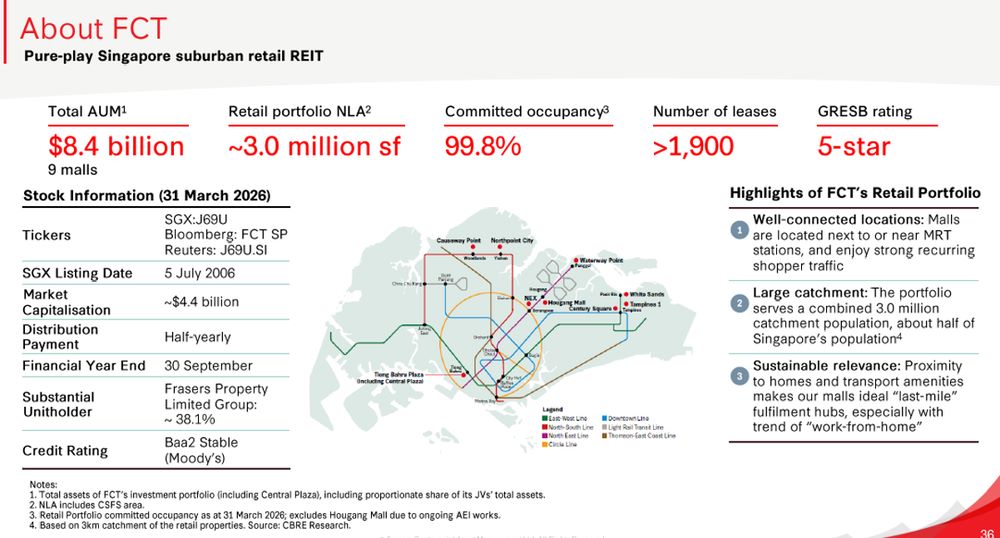
Its malls, including Causeway Point, Tampines 1, Tiong Bahru Plaza and Waterway Point, are anchored by supermarkets, F&B and essential services, which make up about 54% of gross rental income. This gives FCT a defensive, needs-based tenant mix that tends to hold up across economic cycles.
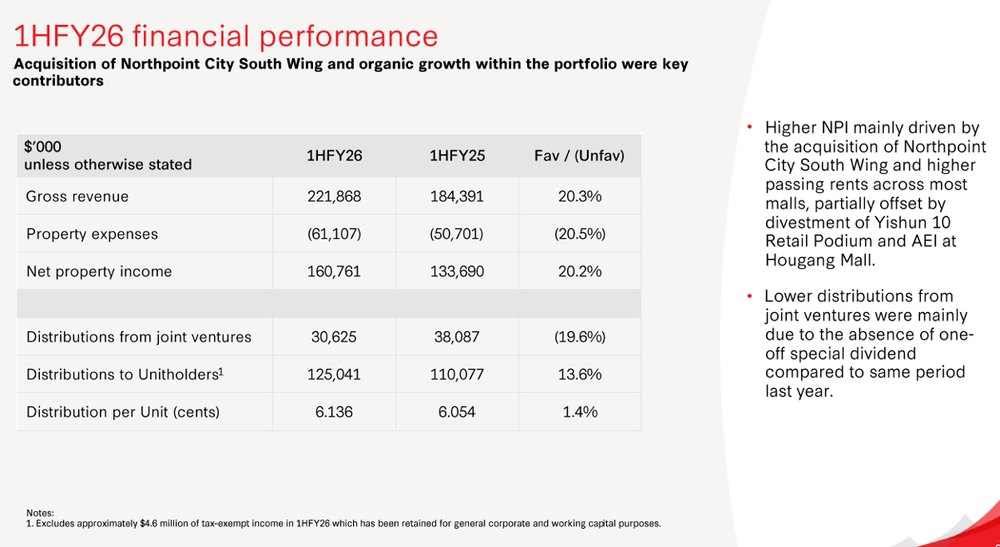
For the first half of FY2026 (ended 31 March 2026), FCT's gross revenue rose 20.3% year-on-year to S$221.9 million, while net property income rose 20.2% to S$160.8 million.
The increase was mainly driven by the acquisition of Northpoint City South Wing and higher passing rents across most malls.
This was partially offset by the earlier divestment of Yishun 10 Retail Podium and ongoing asset enhancement works at Hougang Mall.
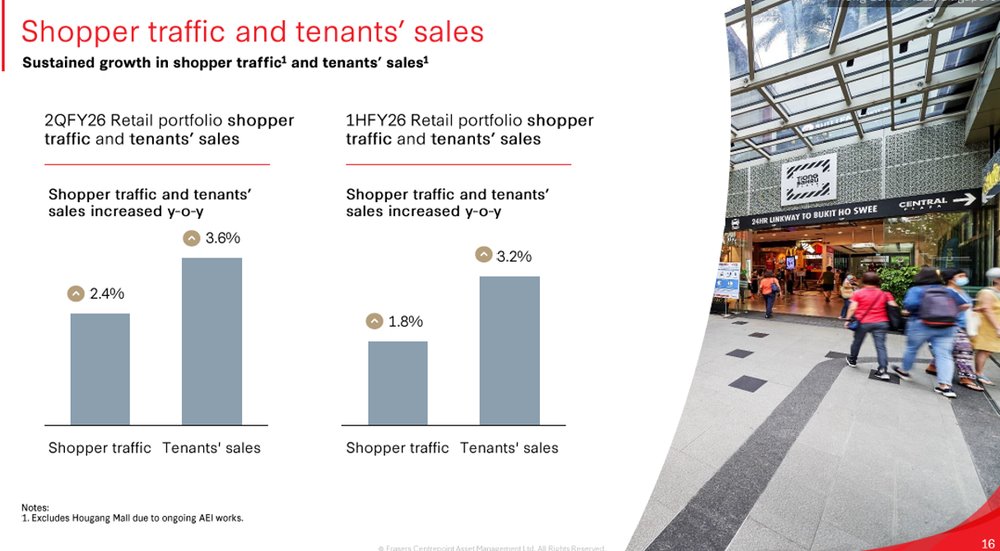
FCT’s retail portfolio achieved committed occupancy of 99.8%, excluding Hougang Mall, which is undergoing an asset enhancement initiative.
It also recorded positive rental reversion of 6.5% for the half-year, while shopper traffic and tenant sales rose 1.8% and 3.2% year-on-year respectively.
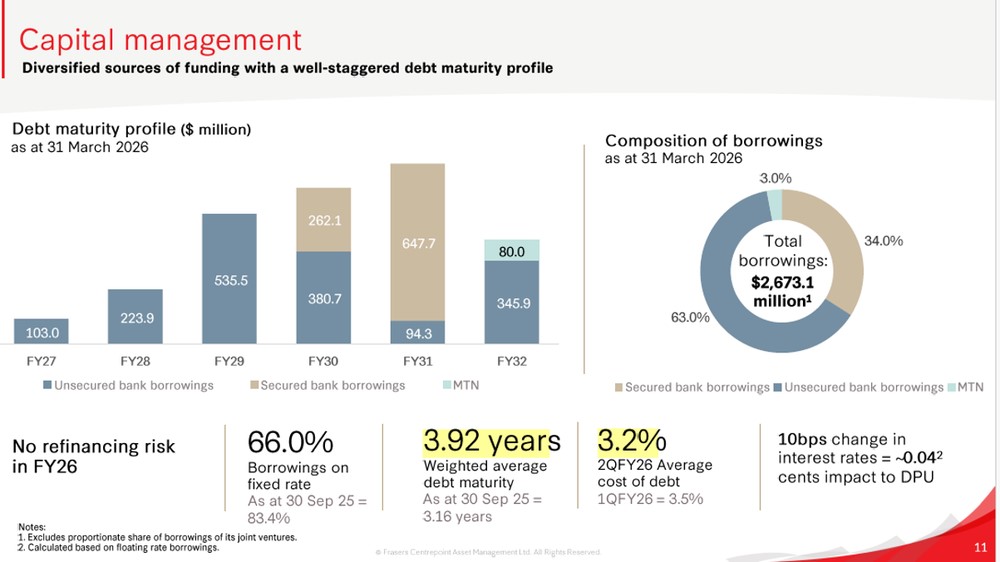
FCT has also strengthened its capital position. Aggregate leverage eased slightly to 40.0% as at 31 March 2026, while interest coverage improved to 3.59 times.
The average cost of debt fell to 3.2% for the quarter, down from 3.5% in the prior quarter, and weighted average debt maturity was extended to 3.92 years from 2.92 years as at 31 December 2025 - leaving the REIT with no refinancing risk for the remainder of FY2026.
On the growth front, FCT has two enhancement projects underway.
Phase 2 of the Hougang Mall AEI is on track for completion in September 2026, with over 88% of the AEI space already committed.
FCT is also carrying out an asset enhancement initiative at NEX, which aims to create about 44,000 square feet of additional net lettable area.
The project has a targeted return on investment of about 7%, although the eventual returns will depend on construction costs and leasing demand.
To strengthen the financial position for future growth opportunities, the management announced in June 2026 to sell White Sands mall for S$467 million. The net proceeds will be for debt repayment.
The proforma gearing is estimated to improve to 37%, from 40%.
In the latest announcement on 15 July 2026, FCT joined a Frasers Property-led consortium to put in the top bid on a 99-year leasehold Bayshore Drive mixed-used government land sales (GLS) site.
If successful, the S$2.13 billion project is FCT’s first development project. FCT will potentially develop and own 50% of the commercial component.
To fund the project, FCT will likely have to draw down new debt. With the incremental debt needed to fund this development project, the gearing could rise to 39%.
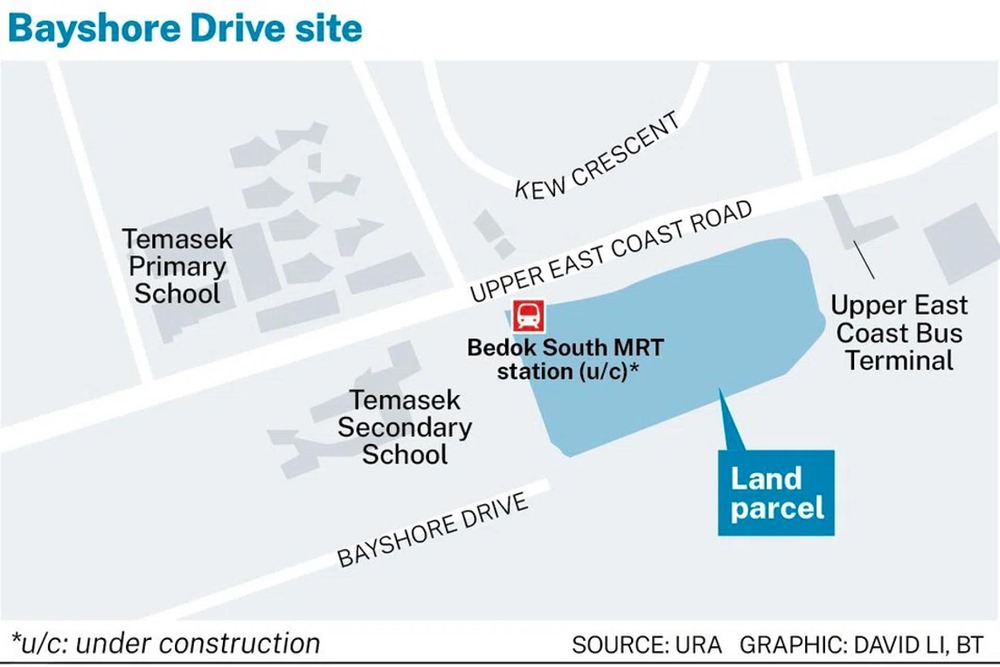
Source : Business Times, 16 July 2026
FCT’s latest results were also assessed using our three preliminary checks for screening Singapore REITs for passive income.
FCT meets all three criteria and may be worth considering for a deeper Income Pot review.
| Check | Fraser Centrepoint Trust |
| DPU growth | ✅ Pass — 1H FY2026 DPU grew 1.4% year-on-year |
| Aggregate leverage | ✅ Pass — *37% as of 31 March 2026 |
| Dividend yield | ✅ Pass — FY2026E distribution yield 5.5% |
| Overall | 3/3 checks |
| Source : Beansprout *Proforma | |
For 1H FY2026, FCT's DPU rose 1.4% year-on-year to 6.136 Singapore cents. The DPU growth is consistent with the checks for a stable or growing DPU.
We are positive on FCT’s participation in the development project. The location is attractive, being linked to key transport nodes. The development project will provide a higher yield compared with buying a completed project.
As FCT is likely to draw on debt to fund the project, aggregate leverage is estimated to increase to 39%, which is still lower than our checks on aggregate leverage.
Based on Factset estimates, FCT’s FY2026E/Sep distribution per unit is estimated at S$0.123. At the closing price of S$2.25 on 16 July 2026, FCT is offering a forward distribution yield of FY2026E 5.5%.
For FCT, I would watch how the Hougang Mall and NEX enhancement works progress toward their targeted returns, and whether rental reversions across its suburban malls can stay positive as more retail supply comes online in the years ahead.
Find out how much dividends you would have received as an unitholder of Fraser Centrepoint REIT in the past 12 months with the calculator below.
Related links:
- Fraser Centrepoint Trust latest valuation, share price and analysis
- Fraser Centrepoint Trust dividend history and forecast
What would Beansprout do?
Blue-chip REITs may offer established portfolios and relatively resilient income, but I would focus on whether their distributions can be sustained rather than simply choosing the highest yield.
Mapletree Pan Asia Commercial Trust (SGX: N2IU) offers a FY2026E distribution yield of approximately 6.0%. VivoCity continues to deliver strong rental reversions, but weakness in its China and Hong Kong properties has weighed on overall DPU growth. I would therefore watch for signs that its overseas portfolio is stabilising.
Frasers Centrepoint Trust (SGX: J69U) offers a more modest yield of approximately 5.5%, , but has the highest occupancy among the three at 99.8% and a defensive tenant mix. Its earnings growth has also been supported by the acquisition of Northpoint City South Wing, while its extended debt maturity profile reduces near-term refinancing risk.
CapitaLand Integrated Commercial Trust (SGX: C38U), while offering FY2026E distribution yield of marginally above 5%, has arguably the most consistent DPU growth trajectory of the four, supported by its scale and the full consolidation of CapitaSpring. For investors who prioritise portfolio quality and distribution consistency over the highest headline yield, CICT remains worth watching.
Overall, I would not select a blue-chip REIT based on yield alone. For a REIT to form part of my Income Pot within the Beansprout's four pots of wealth, I would want to see a combination of resilient occupancy, positive rental reversions, manageable leverage, and a DPU trend that can be sustained through different parts of the economic cycle.
To find out which REIT we would hold, in our model portfolio, check out how we would invest $100,000 in Singapore today.
You can learn more about how I check the three simple checks I use to screen Singapore REITs for passive income here.
To screen for Singapore REITs with lowest price-to-book valuation or highest dividend yield, check out our best Singapore REIT screener.
| REIT | The good | Key risks |
| CapitaLand Integrated Commercial Trust |
|
|
| Mapletree Pan Asia Commercial Trust |
|
|
| Frasers Centrepoint Trust |
|
|
We still see Singapore stocks as a core part of a globally diversified portfolio, especially for investors looking for dividend income.
However, rather than relying too heavily on REITs alone, I would build a broader mix of income sources, including quality Singapore blue-chip stocks with sustainable dividends, resilient earnings and strong balance sheets. Learn more about how to build passive income streams with our income pot here.
Which Singapore blue chip REIT are you looking out for? Share with us in the comments below or in our Telegram group!
If you are new to investing in Singapore REITs, you can start to learn more about Singapore REITs here.
If you prefer diversification without picking individual REITs, you can also gain exposure through Singapore REIT ETFs.
Planning to invest in Singapore blue chip REITs? Compare the best Singapore brokers to find the right trading platform, and see the latest promotions and sign-up rewards available.
Follow Beansprout on YouTube, Facebook and Instagram, and add Beansprout as your preferred source on Google so you never miss an update.
Read also
Gain financial insights in minutes
Subscribe to our free weekly newsletter for more insights to grow your wealth
Most Popular

Comments
0 comments