
Guide to Singapore Blue Chip Stocks: Largest SGX Blue Chips in 2026
Stocks 101
By Beansprout • 12 May 2026
Why trust Beansprout? We’ve been awarded Best Investment Website at the SIAS Investors’ Choice Awards 2025
'%3e%3cpath%20fill-rule='evenodd'%20clip-rule='evenodd'%20d='M17.64%209.20455C17.64%208.56637%2017.5827%207.95273%2017.4764%207.36364H9V10.845H13.8436C13.635%2011.97%2013.0009%2012.9232%2012.0477%2013.5614V15.8195H14.9564C16.6582%2014.2527%2017.64%2011.9455%2017.64%209.20455V9.20455Z'%20fill='%234285F4'/%3e%3cpath%20fill-rule='evenodd'%20clip-rule='evenodd'%20d='M9%2018C11.43%2018%2013.4673%2017.1941%2014.9564%2015.8195L12.0477%2013.5614C11.2418%2014.1014%2010.2109%2014.4205%209%2014.4205C6.65591%2014.4205%204.67182%2012.8373%203.96409%2010.71H0.957275V13.0418C2.43818%2015.9832%205.48182%2018%209%2018V18Z'%20fill='%2334A853'/%3e%3cpath%20fill-rule='evenodd'%20clip-rule='evenodd'%20d='M3.96409%2010.71C3.78409%2010.17%203.68182%209.59318%203.68182%209C3.68182%208.40682%203.78409%207.83%203.96409%207.29V4.95818H0.957273C0.347727%206.17318%200%207.54773%200%209C0%2010.4523%200.347727%2011.8268%200.957273%2013.0418L3.96409%2010.71V10.71Z'%20fill='%23FBBC05'/%3e%3cpath%20fill-rule='evenodd'%20clip-rule='evenodd'%20d='M9%203.57955C10.3214%203.57955%2011.5077%204.03364%2012.4405%204.92545L15.0218%202.34409C13.4632%200.891818%2011.4259%200%209%200C5.48182%200%202.43818%202.01682%200.957275%204.95818L3.96409%207.29C4.67182%205.16273%206.65591%203.57955%209%203.57955V3.57955Z'%20fill='%23EA4335'/%3e%3c/g%3e%3cdefs%3e%3cclipPath%20id='clip0_0_2849'%3e%3crect%20width='18'%20height='18'%20fill='white'/%3e%3c/clipPath%3e%3c/defs%3e%3c/svg%3e)
Make Beansprout your preferred source on Google
Add us on Google to see more of our insights in your search results
Learn what Singapore blue chip stocks are, see the largest SGX blue chips by market cap, key risks and how to buy them.
What happened?
You may have heard of blue chip stocks.
They are often mentioned when people talk about investing in large, established companies, or when they discuss Singapore stocks such as DBS, OCBC, UOB, Singtel and Singapore Airlines (SIA).
But what exactly are Singapore blue chip stocks, and why do investors pay attention to them?
For many investors, Singapore blue chip stocks are seen as a way to gain exposure to familiar businesses, potential dividend income and Singapore’s economy.
This may be useful if you are looking to build a long-term portfolio, or if you are exploring dividend-paying stocks as part of your Income Pot.
However, blue chip stocks are not risk-free. Their share prices can still fall, dividends can be reduced, and even large companies may face business challenges.
In this guide, I will explain what Singapore blue chip stocks are, why investors look at them, how to compare them, and how to buy them in Singapore.

What are Singapore blue chip stocks?
Singapore blue chip stocks generally refer to shares of large and established companies listed on the Singapore Exchange (SGX).
These companies usually have recognised brands, strong market positions and a long operating track record.
The term “blue chip” comes from poker, where the blue chip is traditionally seen as the highest-value chip.
In the stock market, blue chip stocks are often used to describe companies that are more established and financially resilient than smaller companies.
In Singapore, blue chip stocks are commonly associated with the Straits Times Index (STI), which is widely used as the main benchmark for Singapore’s stock market.
The STI is an index that tracks the performance of the top 30 companies listed on the Singapore exchange (SGX).
These companies span sectors such as banking, telecommunications, aviation, industrials, consumer goods, real estate and real estate investment trusts (REITs).
For example, investors often associate Singapore blue chip stocks with the three local banks, DBS, OCBC, and UOB , as well as well-known names such as Singtel, Singapore Airlines, Singapore Exchange, ST Engineering and Keppel.
To give a clearer sense of the types of companies that are often considered Singapore blue chip stocks, here are some examples by sector.
| Sector | Examples of Singapore blue chip stocks |
| Banks | DBS (D05), OCBC (O39), UOB (U11) |
| Telecommunications | Singtel (Z74) |
| Aviation and transport | Singapore Airlines (C6L), SATS (S58), ComfortDelGro (C52) |
| Industrials and infrastructure | ST Engineering (S63), Sembcorp Industries (U96), Keppel (BN4) |
| Market infrastructure | Singapore Exchange (S68) |
| Real estate and REITs | CapitaLand Investment (9CI), CapitaLand Integrated Commercial Trust (C38U), CapitaLand Ascendas REIT (A17U), Mapletree Industrial Trust (ME8U) |
| Consumer | Sheng Siong (OV8), Thai Beverage (Y92), Wilmar (F34) |
Another way to identify large Singapore blue chip stocks is by looking at market capitalisation.
Market capitalisation refers to the total market value of a listed company, calculated by multiplying its share price by the number of outstanding shares.
To keep the shortlist more objective, I have listed down the top 10 largest SGX-listed companies based on market capitalisation.
| Singapore blue chip stock | Ticker | Sector | Market capitalisation | Why investors watch it |
| DBS | D05 | Bank | S$167 billion | Singapore’s largest listed bank, watched for dividends, wealth management and capital strength |
| OCBC | O39 | Bank | S$99 billion | Major local bank with banking, wealth management and insurance exposure |
| Singtel | Z74 | Telecommunications | S$76 billion | Large telco with regional associates and digital infrastructure exposure |
| UOB | U11 | Bank | S$60 billion | Major local bank with ASEAN exposure and dividend income potential |
| ST Engineering | S63 | Industrials | S$34 billion | Aerospace, defence, engineering and smart city exposure |
| Wilmar International | F34 | Consumer / agribusiness | S$23 billion | Food, agriculture and commodities supply chain exposure |
| Singapore Exchange | S68 | Market infrastructure | S$23 billion | Exposure to securities trading, derivatives, data and market activity |
| Singapore Airlines | C6L | Aviation | S$20 billion | Exposure to air travel demand and Singapore’s aviation hub |
| Keppel | BN4 | Infrastructure / asset management | S$20 billion | Infrastructure, asset management and real estate-related exposure |
| CapitaLand Integrated Commercial Trust | C38U | REIT | S$18 billion | Singapore retail and office property exposure |
| Source: Beansprout stock quote pages, as of 8 May 2026. | ||||
Which are the best-performing Singapore blue chip stocks?
Apart from looking at market capitalisation, investors may also look at which Singapore blue chip stocks have performed well recently.
We publish regular updates on the best-performing Singapore blue chip stocks over the months, which may help you understand what has been driving market moves across different sectors.
Related reads:
- Top 3 Singapore blue chip stocks in 2025. Is there more upside in 2026?
- 3 best-performing Singapore blue chip stocks in January 2026
- 3 best-performing Singapore blue chip stocks in February 2026
- 3 best-performing Singapore blue chip stocks in March 2026
- 3 best-performing Singapore blue chip stocks in April 2026
The top-performing blue chip stocks can change from month to month.
This is why I would not buy a stock just because it appeared on a best-performing list.
Instead, I would look at what drove the rally, whether the company’s earnings can remain resilient, and whether the current valuation still makes sense.
Why invest in Singapore blue chip stocks?
Investors often look at Singapore blue chip stocks because they can play different roles in a portfolio.
Some may provide dividend income, while others may offer exposure to Singapore’s economy, regional growth, or established companies with long operating track records.
That does not mean they are risk-free.
However, for investors who want exposure to Singapore-listed companies, blue chip stocks can be a useful starting point for research.
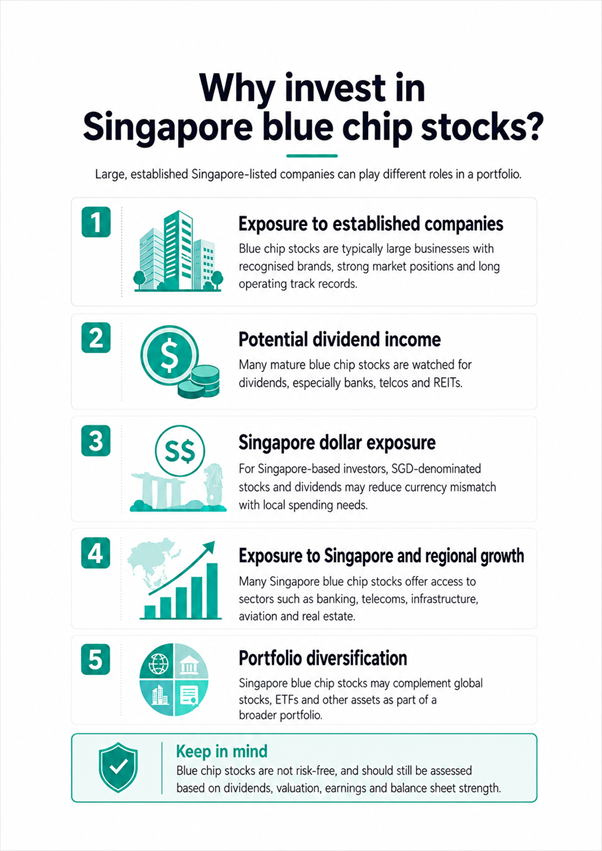
#1 - Exposure to established Singapore companies
Singapore blue chip stocks are typically large companies with long operating histories and strong market positions.
These include the three local banks, DBS, OCBC and UOB, as well as well-known names such as Singtel, Singapore Airlines, Singapore Exchange and ST Engineering.
Because of their size and track record, these companies are often more widely followed by analysts and institutional investors.
They also tend to have more available financial information, which can make it easier for retail investors to assess their business performance, dividends and valuation.
However, familiarity alone is not a reason to invest.
A well-known company can still face weaker earnings, rising costs, or a share price that already reflects high expectations.
#2 - Potential dividend income
Many Singapore blue chip stocks are watched for their dividends.
This is especially true for mature companies such as banks, telcos, REITs and infrastructure-related businesses, which may generate regular cash flow and return part of it to shareholders.
For investors building an Income Pot, Singapore blue chip stocks may help provide a diversified source of dividend income.
This can complement other income assets such as Singapore REITs, Singapore Savings Bonds, Treasury bills, fixed deposits, and bond funds.
However, dividends are not guaranteed.
A company may reduce or suspend its dividend if earnings fall, cash flow weakens, or management decides to retain more capital for the business.
That is why I would not look at dividend yield alone. I would also check the company’s dividend history, earnings strength, payout ratio and balance sheet.
If you’d like to identify other Singapore stocks with attractive dividend yields above 4%, you can explore our Singapore dividend stocks screener.
#3 - Singapore dollar exposure for local investors
For investors who earn, spend and plan for retirement in Singapore dollars, Singapore blue chip stocks may help reduce currency mismatch.
Many SGX-listed blue chip stocks trade in Singapore dollars and pay dividends in Singapore dollars.
This can be useful if your future spending needs are also in Singapore dollars.
For example, dividend income from Singapore blue chip stocks may be easier to match against local expenses compared to income from foreign-listed stocks that pay dividends in US dollars or other currencies.
However, this does not remove currency risk entirely.
Many Singapore-listed companies still earn revenue overseas, so their earnings may still be affected by foreign exchange movements.
#4 - Exposure to Singapore and regional growth
Singapore blue chip stocks do not only provide exposure to the domestic economy.
Many of them have regional or global businesses.
The local banks have exposure to regional lending, wealth management and trade flows.
Singtel has stakes in regional telecommunications associates.
Sembcorp Industries has exposure to energy and renewables, while Keppel has businesses across infrastructure, real estate and asset management.
This means Singapore blue chip stocks may give investors access to business trends across Singapore and Asia.
However, this also means investors need to understand where each company earns its revenue.
A Singapore-listed stock may still be affected by overseas economic conditions, foreign exchange movements and regulatory changes in other markets.
#5 - Portfolio diversification
Singapore blue chip stocks may help diversify a portfolio that is heavily focused on US stocks, global technology stocks or foreign-listed exchange traded funds (ETFs).
This can be useful for investors who want part of their portfolio to be linked to Singapore-dollar assets and local dividend income.
However, diversification should not stop at owning several Singapore blue chip stocks.
The Singapore stock market has significant exposure to banks, REITs and other income-oriented sectors.
As a result, investors may still be concentrated in a few sectors even if they own several well-known Singapore stocks.
In my view, Singapore blue chip stocks can play a useful role in a portfolio, but I would assess them alongside global equities, ETFs, bonds, cash and other assets.
What are the risks of Singapore blue chip stocks?
Blue chip stocks may be more established than smaller companies, but they still carry risks. That is why I would not look at blue chip status alone.
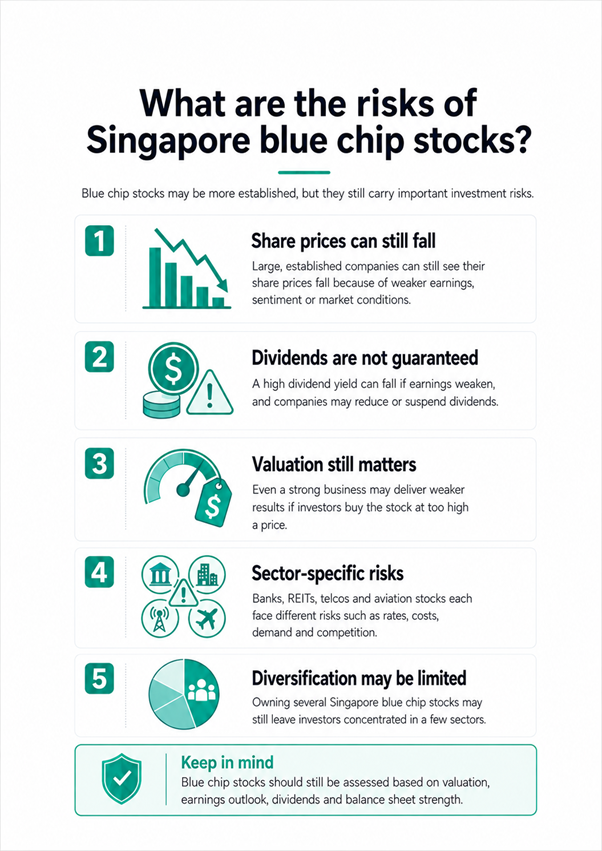
#1 - Share prices can still fall
A stock can fall because of weaker earnings, a change in interest rates, poor investor sentiment or company-specific issues.
This can happen even if the company is large, profitable and widely followed by investors.
#2 - Dividends are not guaranteed
A high dividend yield may look attractive, but it can also reflect a falling share price or market concerns about whether the dividend can be sustained.
A company may also reduce or suspend dividends if earnings fall, cash flow weakens, or management decides to retain more capital for the business.
#3 - Valuation still matters
A strong company may still lead to a disappointing investment outcome if investors buy it at too high a price.
This is why I would compare valuation metrics such as price-to-earnings ratio, price-to-book ratio and dividend yield against the company’s earnings outlook and historical range.
#4 - Sector risks can affect performance
Different blue chip stocks face different risks.
Banks may be affected by interest rates, credit costs and loan growth. REITs may be affected by refinancing costs, property valuations and rental demand.
Telcos may face competition and heavy capital spending needs. Aviation stocks may be affected by fuel prices, travel demand and operating costs.
#5 - Owning several blue chip stocks may not mean full diversification
The Singapore stock market has significant exposure to banks, REITs and other income-oriented sectors.
As a result, investors may still be concentrated in a few sectors even if they own several well-known Singapore blue chip stocks.
This is why I would still assess whether the company’s earnings, balance sheet, dividends and valuation support the investment case.
How to compare Singapore blue chip stocks
When comparing Singapore blue chip stocks, I would look beyond the company name.
A familiar brand may make a stock easier to understand, but it does not automatically make it a better investment.
Here are some factors I would look at before making an investment decision:
| Factor | What to check | Why it matters |
| Market capitalisation | Size of the listed company | Larger companies tend to be more widely followed and more liquid |
| Dividend yield | Current and forward dividend yield | Shows potential income |
| Dividend history | Whether dividends have grown, stayed stable or been cut | Helps assess income resilience |
| Earnings growth | Revenue, profit and margins | Supports future dividends and share price performance |
| Balance sheet | Debt, gearing and capital strength | Shows whether the company can withstand tougher conditions |
| Valuation | Price-to-earnings (P/E), price-to-book (P/B), dividend yield | Helps investors avoid overpaying |
For income investors, dividend yield is usually the first number that catches attention. However, I would also look at whether the dividend is supported by earnings and cash flow.
For growth-focused investors, I would look more closely at whether the company can increase profits over time.
For all investors, valuation matters.
Even a high-quality blue chip stock may be less attractive if too much optimism is already reflected in its share price.

Can I buy all the Singapore blue chip stocks individually?
You can buy Singapore blue chip stocks individually through a brokerage account.
However, buying all the major blue chip stocks one by one may require more capital, more time and more monitoring.
For example, if you want exposure to the banks, telcos, industrials, transport stocks and REITs, you would need to decide how much to allocate to each stock. You would also need to track each company’s earnings, dividends, valuation and business outlook over time.
This may work if you prefer selecting individual companies and want more control over your portfolio.
However, it may be less practical if you are just starting out or investing smaller amounts regularly.
Another way to gain exposure to Singapore blue chip stocks is through an STI exchange traded fund (ETF).
An STI ETF gives investors exposure to a basket of STI stocks through a single listed product. This may be simpler for investors who do not want to track each company individually.
Option | May work for investors who want | Key trade-off |
| Individual blue chip stocks | More control over stock selection | Requires more research and monitoring |
| STI ETF | Broad exposure to STI stocks | Still concentrated in Singapore and STI-heavy sectors |
If I do not want to track individual companies closely, an STI ETF may be a simpler starting point.
If I want to select individual stocks, I would compare each company’s valuation, dividend record, earnings outlook and risks.
How to buy Singapore blue chip stocks
To buy Singapore blue chip stocks and the STI ETF, you will need a brokerage account.
Retail investors can buy these shares through a Central Depository (CDP)-linked brokerage account or a custodian brokerage account.
Account type | How it works |
| CDP-linked brokerage | Shares are held in your own CDP account |
| Custodian brokerage | Shares are held by the broker on your behalf |
After opening an account, you can search for the stock or ETF ticker, decide how much to invest, and place a market order or limit order.
You may also want to compare brokerage fees, platform features and current sign-up rewards before opening an account.
You can refer to our best online brokerage in Singapore guide and the latest Beansprout promotions for more details.
What would Beansprout do?
If I were looking at Singapore blue chip stocks, I would not buy a stock just because it is familiar.
Instead, I would first ask what role the blue chip stock plays in my portfolio.
If I want dividend income, I would look at the company’s dividend yield, dividend history, earnings, balance sheet and ability to sustain its payout. This can help me decide whether the blue chip stock strengthens my Income Pot, rather than simply chasing the highest yield.
If I want long-term growth, I would look at whether the company can grow earnings over time and whether the valuation is reasonable. In that case, selected Singapore blue chip stocks may also fall into my Growth Pot, especially if they have durable business models, growing earnings and the potential to compound over time.
For investors who have higher conviction in a specific company or sector, some blue chip stocks may also sit within the Opportunity Pot. This may apply when I believe the market is underestimating a company’s long-term prospects, but I would size such positions carefully because share prices can still fall.
To compare dividend-paying Singapore stocks beyond blue chips, you can also use Beansprout’s Singapore dividend stock screener to view dividend yields, payout history and other key metrics.
If I do not want to pick individual blue chip stocks, I could also gain broader exposure to Singapore blue chip stocks through an STI ETF.
For a more structured way to organise your investments and wealth, you can read our guide to the Four Pots of Wealth, as well as our beginner’s guide to start investing in Singapore.
If you are planning to buy Singapore blue chip stocks, you can also compare the best online brokerage accounts in Singapore and check the latest Beansprout brokerage promotions.
Which Singapore blue chip stock are you watching closely now? Share with us in the comments below or in our Telegram group!
Follow Beansprout on Telegram, Youtube, Facebook and Instagram, and add Beansprout as your preferred source on Google so you never miss an update.
Read also
Gain financial insights in minutes
Subscribe to our free weekly newsletter for more insights to grow your wealth
Most Popular

Comments
0 comments