
3 Singapore REITs near 52-week lows despite higher dividends to watch for income
Stocks
By Gerald Wong, CFA • 28 Nov 2026
Why trust Beansprout? We’ve been awarded Best Investment Website at the SIAS Investors’ Choice Awards
3 Singapore REITs are trading near their 52-week lows despite reporting higher dividends. We examine their latest earnings, debt levels and valuations.

What happened?
Several Singapore REITs have reported higher distributions in 2026.
Following the recent market pullback, I have been looking more closely at Singapore stocks, including Singapore banks and REITs, for potential additions to my Income Pot.
We recently examined Singapore blue chip stocks near their 52-week lows, three blue chip stocks offering dividend yields of around 5%, and Singapore blue chip REITs trading near historical valuation lows.
While lower share prices may present opportunities for income investors, the sustainability of dividends remains an important consideration.
Against this backdrop, I noticed that a number of REITs have reported higher distributions in their latest results, even as their unit prices remain close to their 52-week lows.
I decided to examine their latest earnings, balance sheets and valuations using Beansprout's Fundamental Checklist to assess whether they warrant a closer look.
3 Singapore REITs that reported higher dividends in latest earnings
The three REITs operate across different property sectors, including commercial, hospitality, logistics, suburban retail and healthcare properties.
| Singapore REIT | Latest reported DPU | Year-on-year change |
| Mapletree Logistics Trust (M44U) | 1.816 cents (2Q FY26/27) | 0.10% |
| Parkway Life REIT (C2PU) | 13.10 cents (9M 2026) | 13.40% |
| OUE REIT (TS0U) | 1.26 cents (1H 2026) | 28.60% |
| Source: REIT managers' financial results. The reporting periods differ, and the DPU figures are not directly comparable. | ||
While all three REITs reported higher distributions, their latest results show different drivers of growth.
Let's examine whether their distributions are supported by improving earnings, manageable debt levels and sustainable rental income.
#1 – Mapletree Logistics Trust (SGX: M44U)
Mapletree Logistics Trust (MLT) owns a diversified portfolio of logistics properties across Asia-Pacific.
Its properties include warehouses and distribution facilities in Singapore, China, Japan, South Korea, Australia and other regional markets.
The REIT has been actively divesting older properties and redeveloping existing assets to improve its portfolio over time.
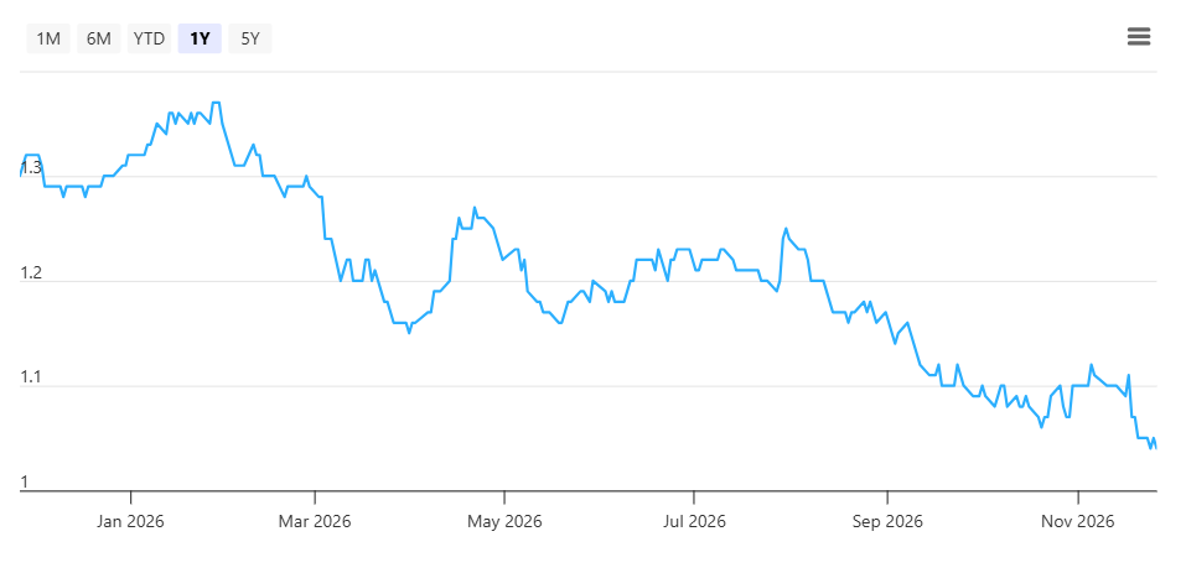
Mapletree Logistics Trust was trading close to its 52-week low, with its unit price of S$1.03 on 27 November 2026 just 1.0% higher than its low of S$1.02.
How has Mapletree Logistics Trust performed in its latest results?
Mapletree Logistics Trust reported a marginal 0.1% year-on-year increase in DPU to 1.816 cents for the second quarter of FY2026/27, ended 30 September 2026.
Revenue rose 1.4% year on year to S$180.0 million, while NPI increased 1.0% to S$154.8 million.
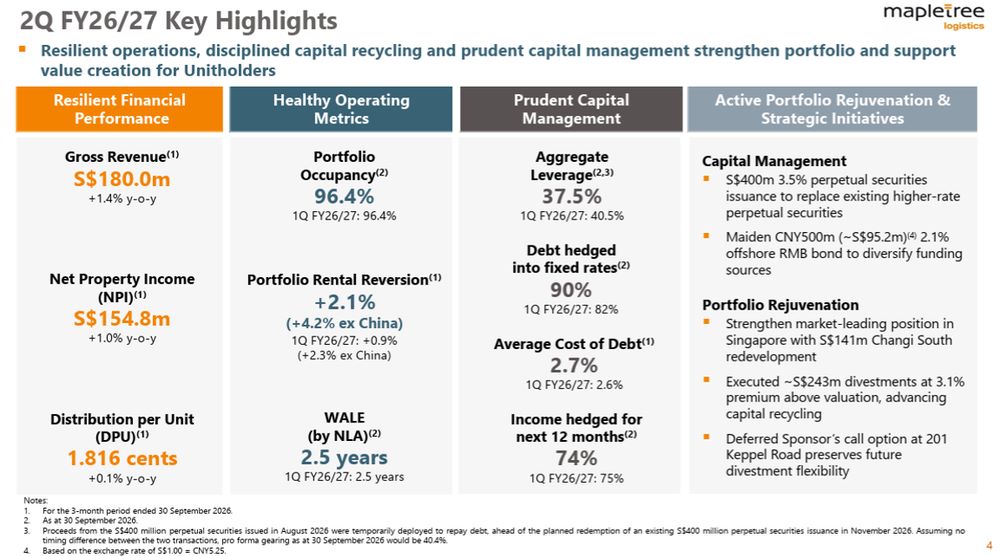
The improvement was supported by contributions from the completed redevelopment of Mapletree Joo Koon Logistics Hub, an acquisition in India, and organic growth from its existing portfolio.
However, these gains were partly offset by the loss of income from divested properties and foreign exchange movements.
For the first half of FY2026/27, DPU increased slightly to 3.632 cents, compared with 3.627 cents in the previous year.
While the increase was small, it marked a period of stabilisation after earlier distribution declines.
MLT's portfolio occupancy remained stable at 96.4% as at 30 September 2026.
Its rental reversion also improved to positive 2.1% in the second quarter, compared with positive 0.9% in the preceding quarter. Excluding China, rental reversion was stronger at 4.2%.
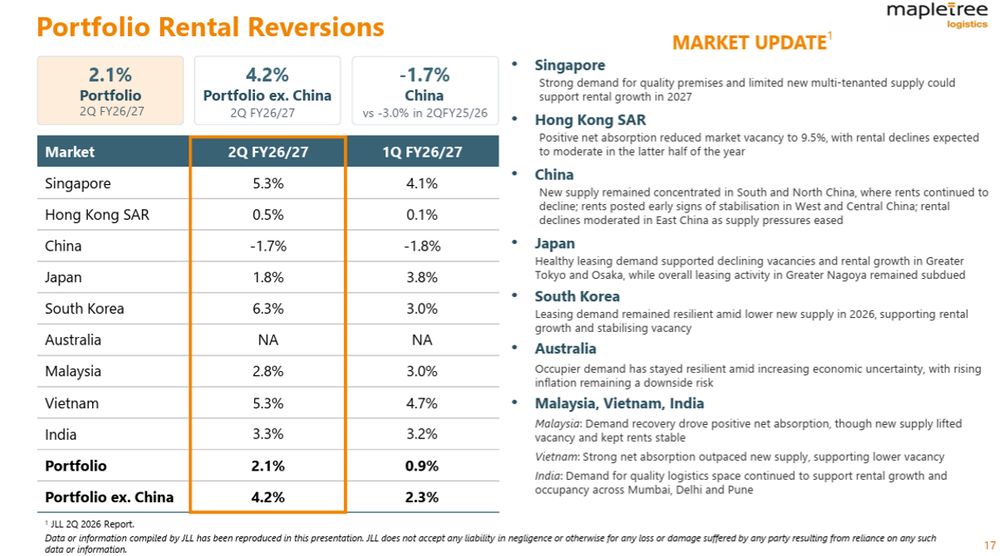
This suggests that rental growth remains uneven across its markets, with China continuing to weigh on overall performance.
What does Beansprout's Fundamental Checklist reveal about Mapletree Logistics Trust?
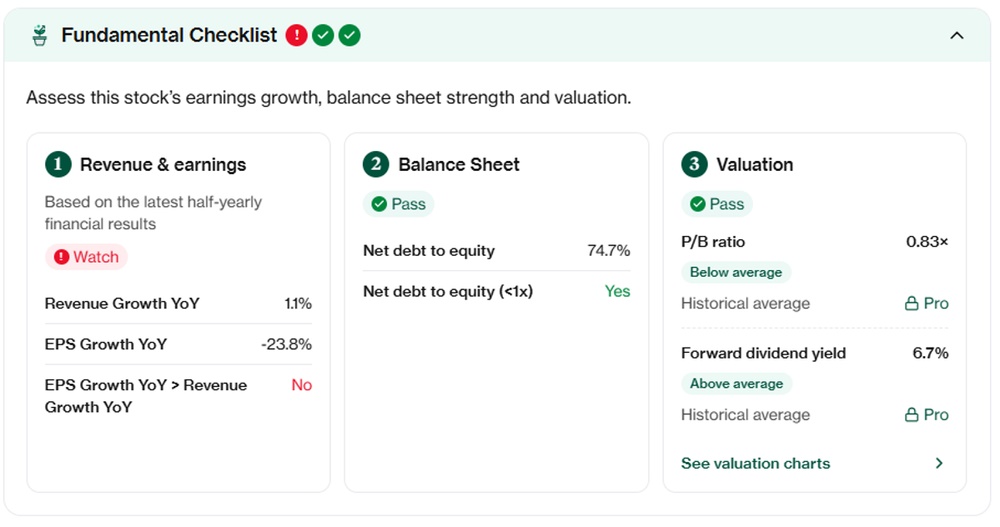
Based on Beansprout's Fundamental Checklist, Mapletree Logistics Trust passes 2 out of 3 checks, covering balance sheet strength and valuation, while revenue and earnings remain on Watch.
Revenue and earnings
MLT was placed on Watch for revenue and earnings, as revenue grew 1.1% year on year while EPS declined 23.8% in its latest half-yearly results.
This suggests that while revenue has stabilised, earnings remain under pressure. DPU growth remained marginal at just 0.1%.
I would watch whether rental growth and contributions from redeveloped properties can support a recovery in earnings, particularly as weaker leasing conditions in China continue to weigh on performance.
Balance sheet
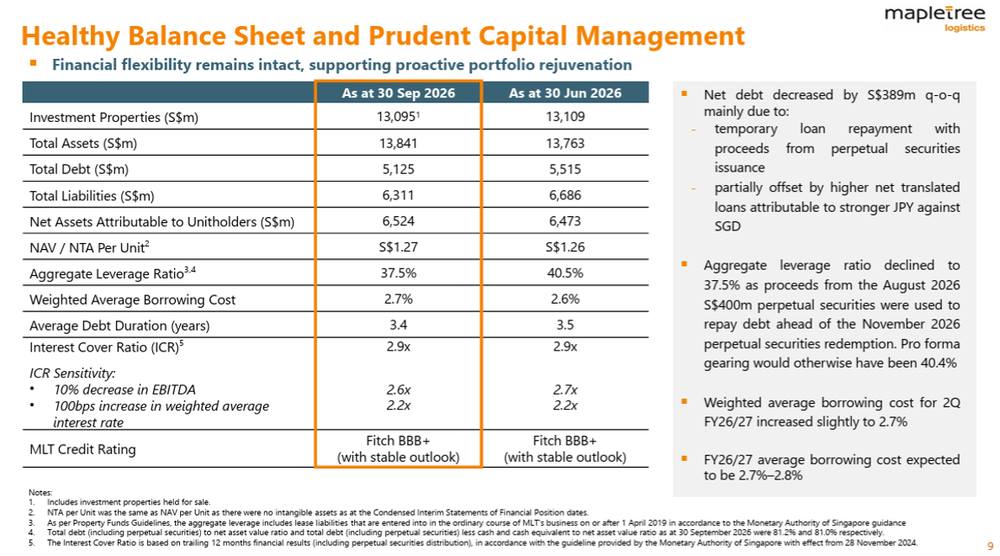
MLT passed the balance sheet check, with net debt to equity of 74.7%.
However, its reported aggregate leverage of 37.5% as at 30 September 2026 was temporarily lowered by the proceeds from a perpetual securities issuance.
Adjusting for this timing difference, its pro forma gearing would have been approximately 40.4%.
I would therefore continue to monitor its borrowing levels and financing costs.
Valuation
At approximately S$1.06, Mapletree Logistics Trust traded at a P/B ratio of 0.83 times below its historical average and its forward dividend yield of 6.7% above its historical average.
While MLT traded below its book value, I would also consider whether its earnings and distributions can recover more meaningfully amid continued challenges in China's logistics market.
Find out how much dividend income you would have received as a Mapletree Logistics Trust unitholder over the past 12 months using the dividend calculator below.
Related links:
- Mapletree Logistics Trust latest share price and analysis
- Mapletree Logistics Trust dividend history and forecast
- Mapletree Logistics Trust latest valuation
#2 – Parkway Life REIT (SGX: C2PU)
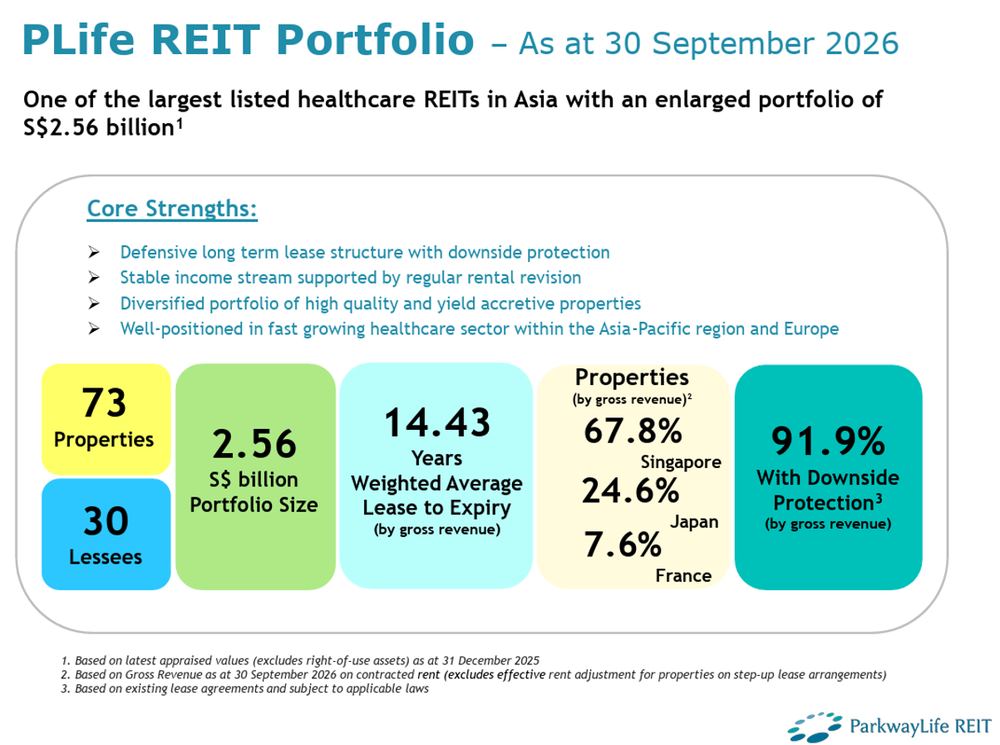
Parkway Life REIT is a healthcare-focused REIT with properties in Singapore, Japan and France.
Its portfolio includes Mount Elizabeth Hospital, Gleneagles Hospital and Parkway East Hospital in Singapore, as well as nursing homes and other healthcare facilities overseas.
The REIT benefits from long-term healthcare property leases, which can provide relatively stable rental income.
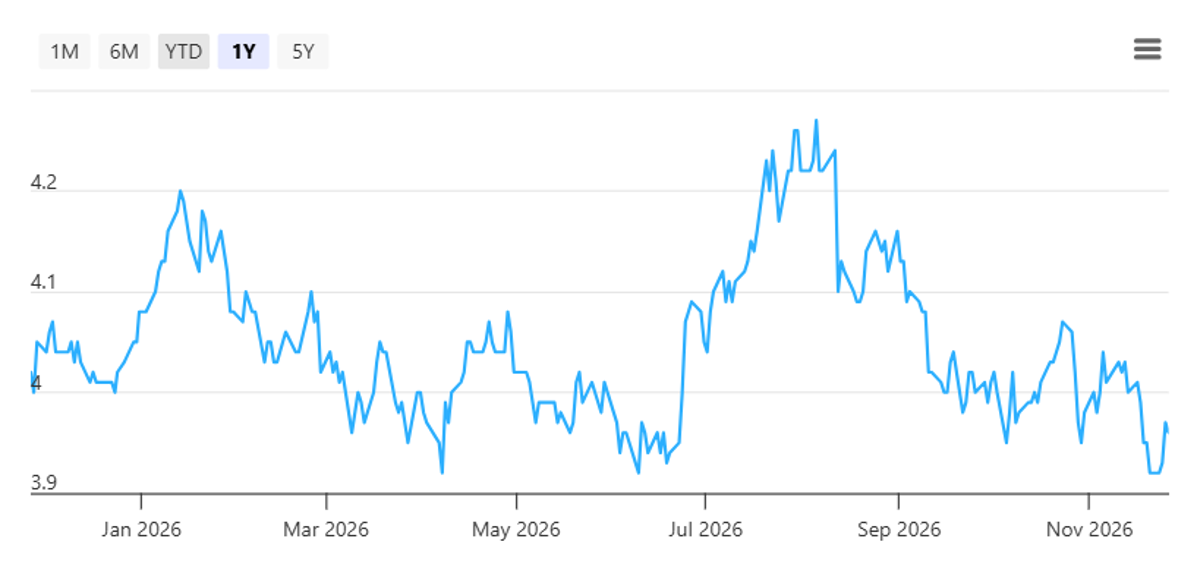
Parkway Life REIT's unit price also remained near its 52-week low, closing at S$3.96 on 27 November 2026, approximately 2.1% above its low of S$3.88.
How has Parkway Life REIT performed in its latest results?
Parkway Life REIT reported a 13.4% year-on-year increase in DPU to 13.10 cents for the nine months ended 30 September 2026.
The amount available for distribution also rose 13.4% year on year to S$85.5 million, based on the minimum rent under its Singapore hospital lease arrangements.
The increase was mainly supported by higher rental receipts from its Singapore hospitals and rental step-ups from its properties in France.
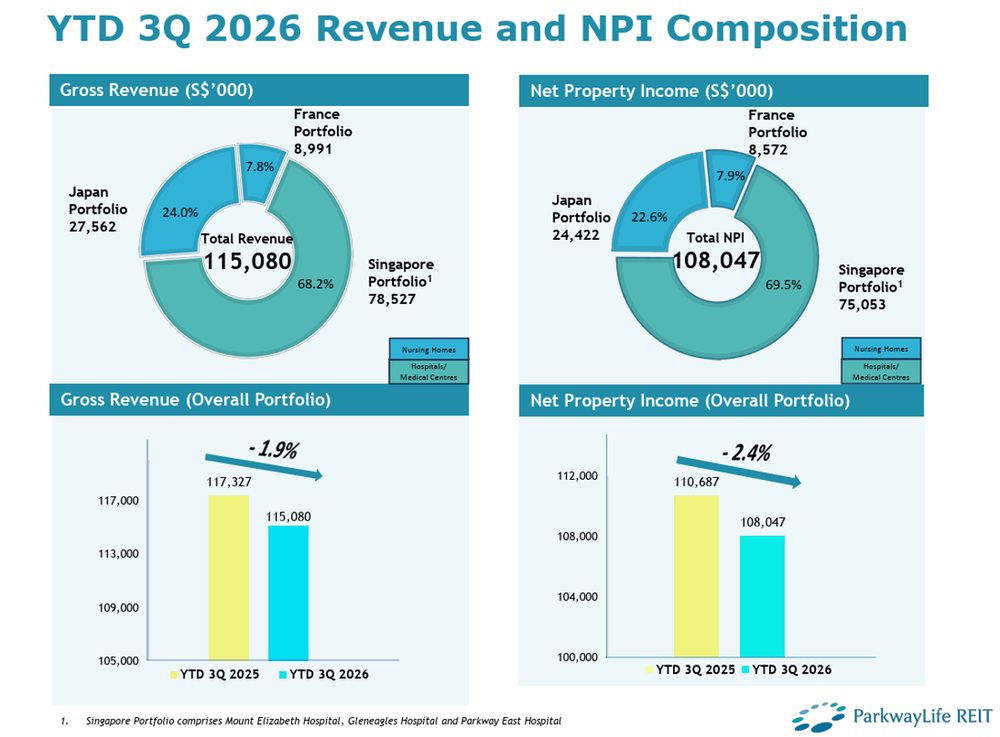
However, its overall property income declined during the period.
Gross revenue fell 1.9% year on year to S$115.1 million, while NPI declined 2.4% to S$108.0 million.
This was mainly due to the depreciation of the Japanese yen and the loss of rental income following tenant exits at five nursing homes in Japan.
The contrasting performance highlights that growth in distributions does not always reflect improving earnings across a REIT's entire portfolio.
The Singapore hospital portfolio remains an important contributor to Parkway Life REIT's income.
Under its lease arrangements, rental income includes a minimum rent component and potential additional rental income linked to hospital performance.
Parkway Life REIT has also continued expanding its overseas healthcare portfolio.
In October 2026, it announced an agreement to acquire three nursing homes in France for approximately €38.8 million.
The properties are intended to be leased back to healthcare operator DomusVi under new 12-year leases.
While the acquisitions could contribute additional rental income, investors should also consider the associated financing costs and overseas operating risks.
What does Beansprout's Fundamental Checklist reveal about Parkway Life REIT?
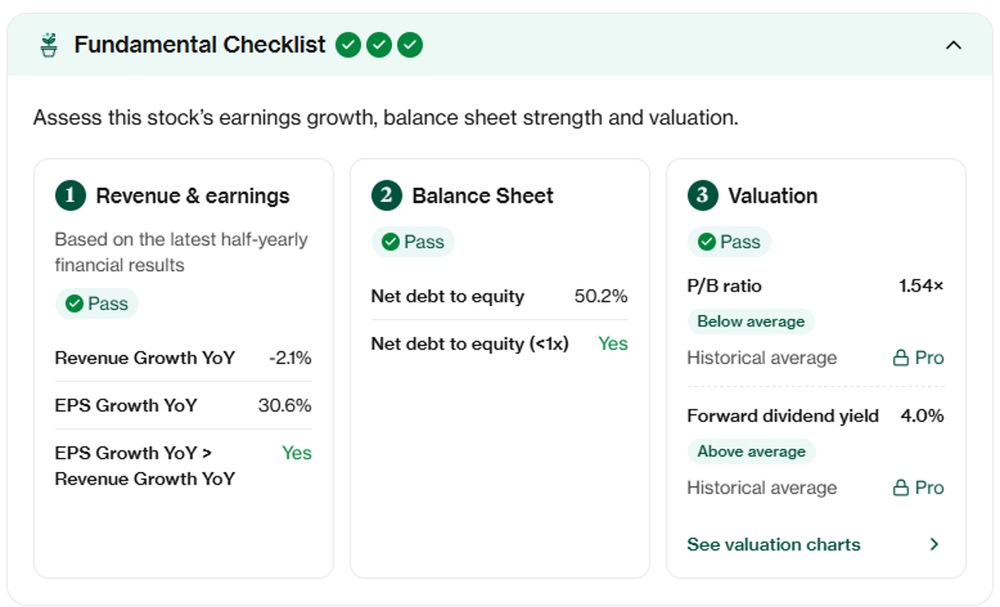
Based on Beansprout's Fundamental Checklist, Parkway Life REIT also passes all 3 checks, covering revenue and earnings, balance sheet strength and valuation.
Revenue and earnings
Parkway Life REIT passed the revenue and earnings check, as EPS grew 30.6% year on year despite a 2.1% decline in revenue in its latest half-yearly results.
However, the decline in revenue reflects continued pressure from its overseas portfolio, including the depreciation of the Japanese yen and tenant exits at nursing homes in Japan.
The REIT has also been actively recycling its Japanese portfolio. We previously examined how Parkway Life REIT's divestment of an older Japanese nursing home could help unlock value.
I would watch whether higher rental income from its Singapore hospitals and overseas acquisitions can continue to offset weaker contributions from Japan.
Balance sheet
Parkway Life REIT passed the balance sheet check, with net debt to equity of 50.2%, below the checklist's threshold of 100%.
Its aggregate gearing stood at 34.8% as at 30 September 2026, while its interest coverage ratio was 7.9 times.
This provides some financial flexibility for future acquisitions, although I would continue monitoring its borrowing requirements as it expands overseas.
Valuation
At approximately S$3.97 on 27 November 2026, Parkway Life REIT traded at a P/B ratio of 1.54 times, below its historical average and its forward dividend yield of 4.0% above its historical average.
Unlike the other three REITs, Parkway Life REIT continued to trade at a premium to its book value.
I would therefore consider whether its relatively stable Singapore hospital rental income justifies this premium, alongside the risks facing its overseas portfolio.
Find out how much dividend income you would have received as a Parkway Life REIT unitholder over the past 12 months using the dividend calculator below.
Related links:
- kopi-C with CIO of Manager of Parkway Life REIT: The art of waiting for the right moment
- Parkway Life REIT latest share price and analysis
- Parkway Life REIT dividend history and forecast
- Parkway Life REIT latest valuation
#3 – OUE REIT (SGX: TS0U)
OUE REIT owns a diversified portfolio of commercial and hospitality properties, primarily in Singapore.
Its portfolio includes One Raffles Place, OUE Bayfront, OUE Downtown Office, Hilton Singapore Orchard and Mandarin Gallery, as well as an interest in Salesforce Tower in Sydney.
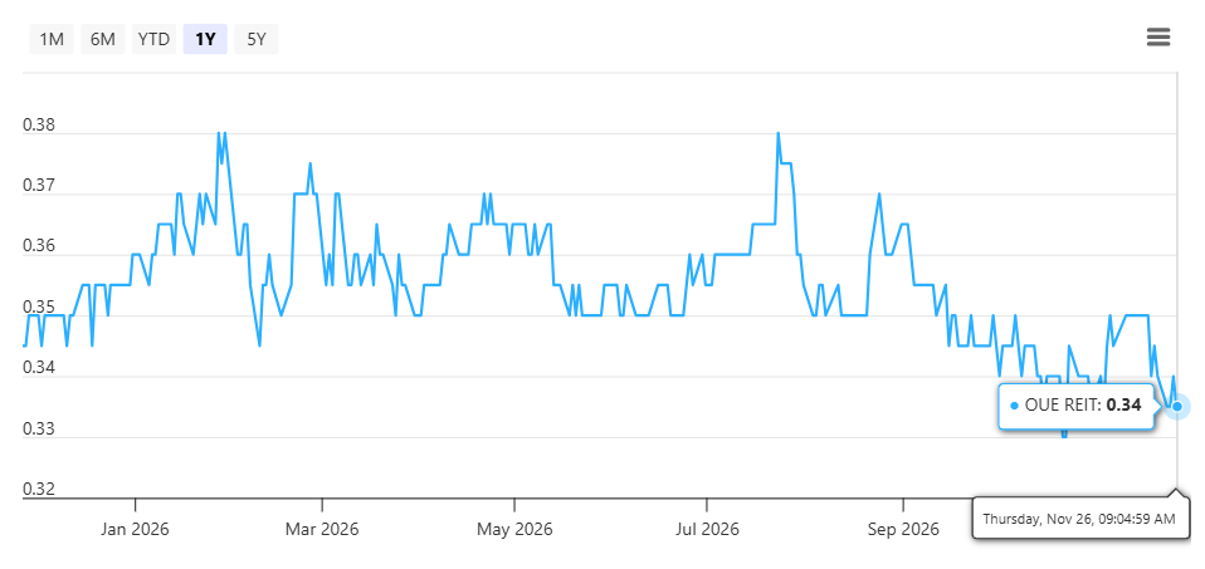
As at 27 November 2026, OUE REIT's unit price stood at S$0.340, just 3.0% above its 52-week low of S$0.330.
How has OUE REIT performed in its latest results?
OUE REIT reported a 28.6% year-on-year increase in DPU to 1.26 cents for the first half of 2026.
The improvement was supported by stronger operating performance and lower financing costs.
In its latest third-quarter business update released on 21 October 2026, revenue increased 3.1% year on year to S$72.6 million, while net property income (NPI) rose 4.6% to S$59.6 million.
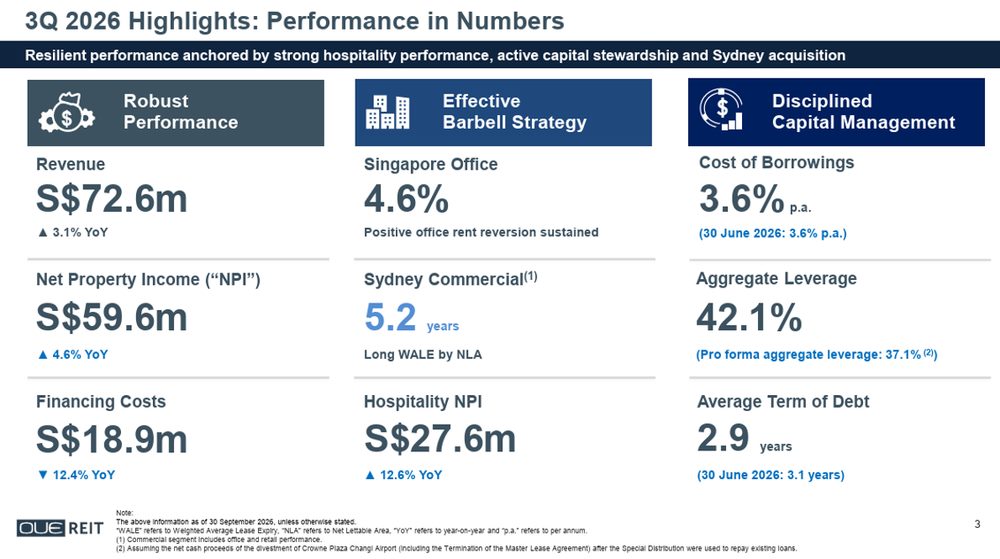
The hospitality segment was a key contributor, with NPI increasing 12.6% year on year to S$27.6 million.
Meanwhile, finance costs declined 12.4% year on year, providing further support to its earnings.
However, performance across its portfolio was mixed.
Commercial NPI declined 1.5% year on year to S$32.0 million, mainly due to tenant transition activities at OUE Downtown Office.
Despite this, OUE REIT reported positive rental reversions of 4.6% for its Singapore office portfolio during the quarter.
What does Beansprout's Fundamental Checklist reveal about OUE REIT?
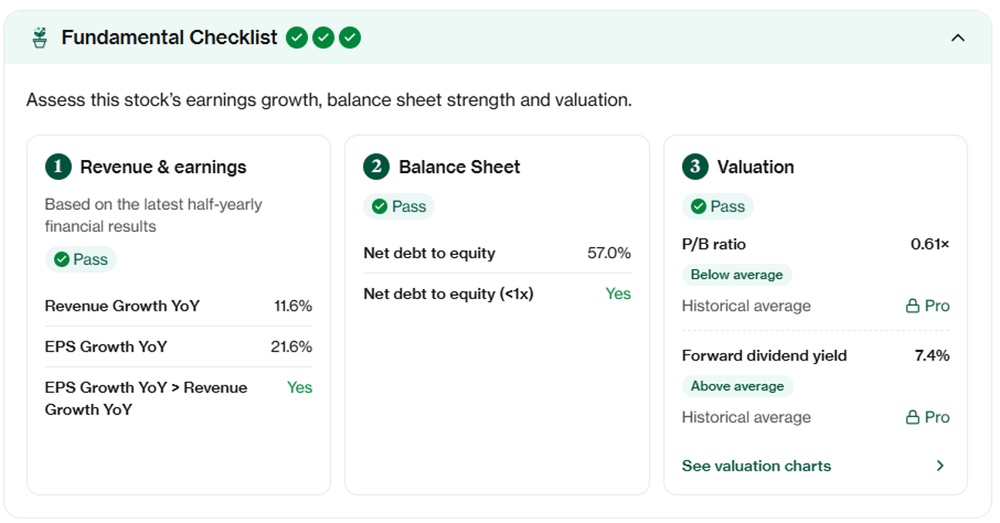
Based on Beansprout's Fundamental Checklist, OUE REIT passes all 3 checks, covering revenue and earnings, balance sheet strength and valuation.
Revenue and earnings
OUE REIT passed the revenue and earnings check, with revenue growing 11.6% year on year and EPS increasing by a stronger 21.6% in its latest half-yearly results.
However, I would monitor whether earnings from its remaining properties and future investments can offset the loss of rental income following the Crowne Plaza Changi Airport divestment.
OUE REIT has also been actively reshaping its portfolio. We previously examined whether OUE REIT's Sydney acquisition could unlock more value for unitholders, including its potential impact on future distributions.
Balance sheet
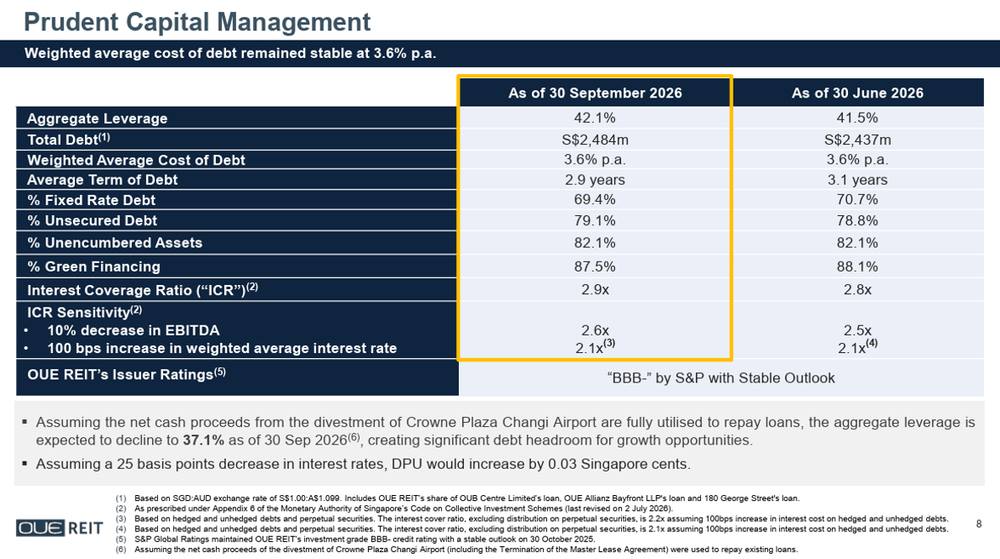
OUE REIT also passed the balance sheet check, with net debt to equity of 57.0%, below the checklist's threshold of 100%.
However, its aggregate leverage remained relatively elevated at 42.1% as at 30 September 2026.
Management indicated that leverage could decline to approximately 37.1% if the net proceeds from the Crowne Plaza Changi Airport divestment were fully used to repay borrowings.
Valuation
At S$0.34 on 27 November 2026, OUE REIT traded at a P/B ratio of approximately 0.61 times below its historical average and its forward dividend yield of 7.4% above its historical average.
While its valuation may appeal to income investors, I would also consider whether the REIT can sustain its distributions following its recent portfolio changes.
Find out how much dividend income you would have received as an OUE REIT unitholder over the past 12 months using the dividend calculator below.
Related links:
- OUE REIT – Can its Sydney acquisition unlock more value for unitholders?
- OUE REIT latest share price and analysis
- OUE REIT dividend history and forecast
- OUE REIT latest valuation
What would Beansprout do?
The latest results show that several Singapore REITs have managed to grow their distributions despite challenges from elevated financing costs and uneven property market conditions.
However, I would not look at DPU growth alone when deciding whether to invest in a REIT for my Income Pot within Beansprout's Four Pots of Wealth.
Here is a summary of what stands out and what I would watch for each REIT.
| REIT | Forward dividend yield | What stands out | What I would watch |
| Mapletree Logistics Trust | 6.70% | DPU stabilised with a marginal 0.1% increase, supported by new properties and redevelopment contributions | Whether rental growth can improve amid continued weakness in China's logistics market |
| Parkway Life REIT | 4.00% | Strong 13.4% DPU growth in 9M 2026, supported by higher Singapore hospital rents | Whether higher Singapore rental income can offset weaker contributions from Japan |
| OUE REIT | 7.40% | Strong 28.6% DPU growth in 1H 2026, supported by hospitality earnings and lower financing costs | Whether distributions can be sustained after asset divestments, given its relatively elevated leverage |
| Source: Beansprout and respective REIT financial announcements. Forward dividend yields are based on Beansprout data as at 27 November 2026. | |||
The Fundamental Checklist also shows that the three REITs have different financial strengths.
OUE REIT and Parkway Life REIT passed all three checks, while Mapletree Logistics Trust passed two.
However, I would not rely on the checklist results alone when deciding which REITs to add to my Income Pot.
For example, while OUE REIT offers a higher forward dividend yield, its relatively elevated leverage remains a consideration.
Beyond their latest earnings, I would compare their valuations and assess whether their unit prices offer sufficient potential returns for the risks involved.
A REIT trading below its historical valuation may not necessarily be undervalued, particularly if its future earnings or distributions are under pressure.
For my Income Pot, I would look for REITs with sustainable rental income, manageable debt levels and valuations supported by their fundamentals.
For investors looking to narrow down REITs worth researching, you can refer to Beansprout's REIT screening framework and explore REITs that meet our criteria through the Income REITs Screener.
You can also compare Singapore REITs on Beansprout to assess their dividend yields, valuations and financial performance.
You can use Beansprout's Stocks Near Historical P/B Lows screener to identify other Singapore stocks and REITs trading close to their historical valuation lows.
Ultimately, higher distributions are encouraging, but I would want to understand whether the REITs can sustain and grow their payouts over time.
With interest rates remaining elevated, I would also consider diversifying my income sources with quality Singapore dividend stocks, rather than relying too heavily on the REIT sector.
To see how we would balance REITs with other investments, check out how we would invest S$100,000 in Singapore stocks today.
You can also explore Beansprout Pro for our latest market views, portfolio thinking and the reasoning behind our investment decisions.
Which Singapore blue chip REITs are you watching at current levels? Share your views in the Beansprout Telegram community.
Follow Beansprout on YouTube, Facebook and Instagram, and add Beansprout as your preferred source on Google so you never miss an update.
Read also
Gain financial insights in minutes
Subscribe to our free weekly newsletter for more insights to grow your wealth
Most Popular

Comments
0 comments